You had a plan. Monday was leg day, or yoga, or a 30-minute strength session. And then — life happened. You slept through your alarm. The kid got sick. Work ran late. You were just exhausted.
Now it's Tuesday, and a familiar voice is running in the back of your head: "I already blew it. What's the point? I'll start over next week. Next month. Maybe next year."
Stop. Take a breath. Because here's what the research actually says: missing one workout doesn't ruin your progress. But how you respond to the missed workout might.
This guide is about the psychology and physiology of missed workouts — what actually happens to your body when you skip a session, why your brain overreacts, and practical strategies to get back on track without spiraling.
What Actually Happens to Your Body When You Miss a Workout
Let's start with the physiology, because the fear of lost progress is usually wildly disproportionate to reality.
Muscle strength and size: A 2013 study in the Journal of Strength and Conditioning Research found that trained individuals retained most of their strength gains after 3 weeks of complete detraining. Not 3 days. Three weeks. Meaningful muscle atrophy — actual measurable loss of muscle tissue — doesn't begin until approximately 2 to 3 weeks of total inactivity. One missed workout, or even one missed week, registers as statistical noise in your fitness trajectory.
Cardiovascular fitness: VO2 max — the gold standard measure of cardiovascular fitness — begins to decline after roughly 10 to 14 days of inactivity, according to research published in the Journal of Applied Physiology. But the decline is gradual, not a cliff. After 2 weeks of detraining, most people lose only about 4 to 7% of their aerobic capacity. After a single missed session? Effectively zero.
Neural adaptations: The motor patterns and neural recruitment you've built through training are remarkably durable. This is why people who took years off from a sport can often get back to their previous level faster than they originally built it — the neural pathways are still there, waiting to be reactivated.
Here's the bottom line: your body is not a house of cards. It doesn't collapse because you removed one brick. Fitness is built over hundreds and thousands of sessions. One session — or even several — barely registers in the grand total.
The Real Danger: The Abstinence Violation Effect
If the physiological impact of a missed workout is negligible, why does it feel so devastating?
Psychologists have a name for this: the abstinence violation effect. Originally described in addiction research by Marlatt and Gordon (1985) and validated experimentally soon after (Curry, Marlatt and Gordon, 1987), it describes a cognitive pattern where someone who has been maintaining a streak of "perfect" behavior interprets a single slip as evidence of complete failure. The slip itself isn't the problem. The catastrophic interpretation of the slip is.
Here's how it plays out with exercise:
- You set a goal: "I'm going to work out 4 times a week."
- You maintain it for 2 weeks. You feel great. You're building an identity as "someone who works out."
- You miss a session. Life gets in the way.
- Instead of thinking "I'll get back to it tomorrow," your brain says: "I failed. I'm not actually the kind of person who works out. This always happens. Why bother?"
- That thought leads to missing the next session. And the one after that. Within two weeks, you've hit the motivation dip and quit entirely.
The missed workout didn't cause the problem. The all-or-nothing thinking did.
A 2016 review in Health Psychology Review found that all-or-nothing thinking is one of the strongest predictors of exercise dropout. People who viewed their fitness journey as a binary — either perfect compliance or total failure — were significantly more likely to quit after a setback than those who viewed occasional missed sessions as a normal, expected part of the process.
The Mindset Shift: From Perfection to "Never Miss Twice"
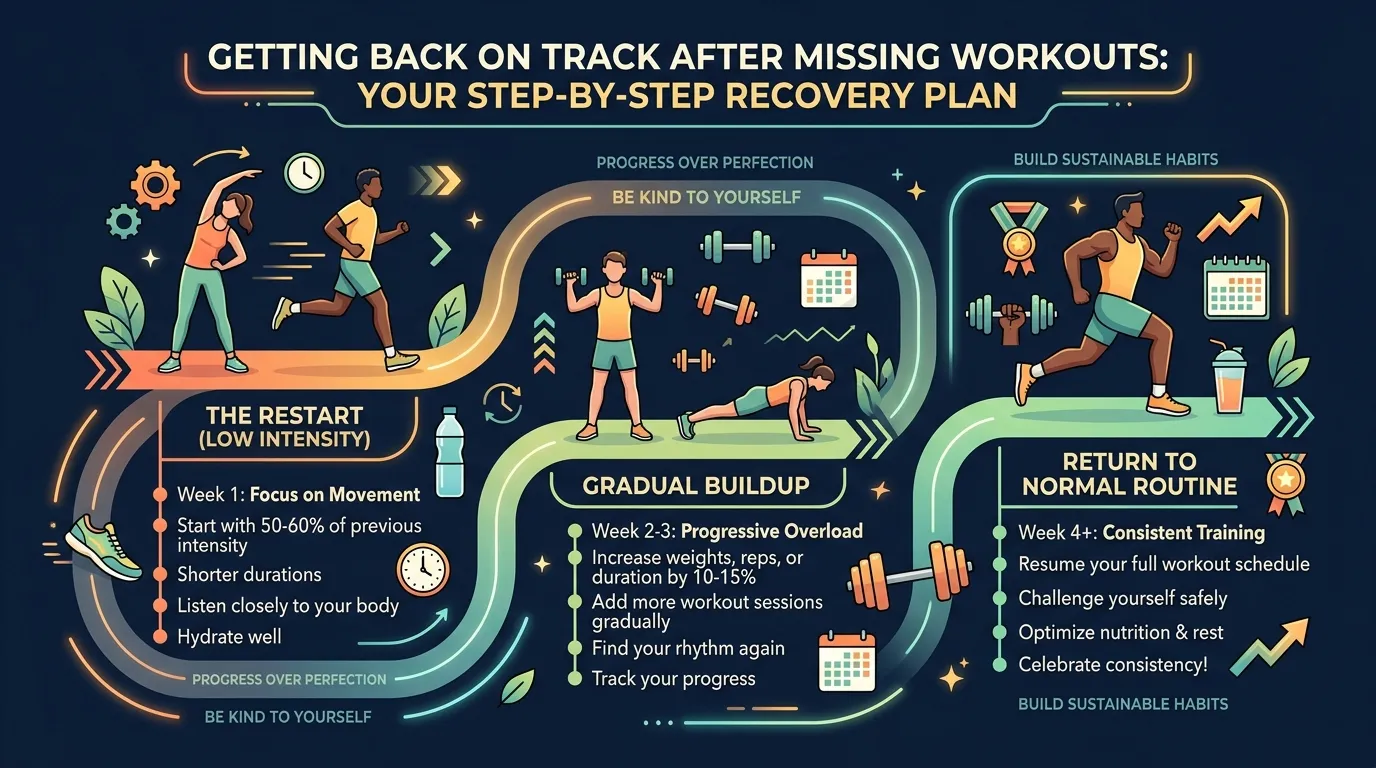
The single most effective cognitive reframe for exercise consistency is what some researchers and coaches call the "never miss twice" rule. The concept is simple:
Missing one workout is normal. Missing two in a row is the start of a new habit.
This reframe works because it does three things simultaneously:
- It normalizes imperfection. By explicitly building "missed sessions" into your mental model, you remove the shame spiral that the abstinence violation effect depends on. Missing isn't failing. Missing twice is where the risk begins.
- It creates a clear action threshold. Instead of the vague guilt of "I should get back on track," you have a specific, non-negotiable rule: whatever happens, you show up for the next one.
- It shifts your identity from "perfect exerciser" to "resilient exerciser." The person who never misses a workout is a fantasy. The person who always comes back after missing one? That's someone who can sustain a fitness practice for decades.
This isn't just motivational advice. A 2019 study published in the British Journal of Health Psychology found that participants who were taught to plan for setbacks — rather than simply told to be consistent — showed significantly higher exercise adherence over 12 weeks. Planning for failure made people more successful than planning for perfection.
Practical Strategies to Get Back on Track
The mindset shift is essential, but it's not sufficient. You also need concrete tactics for what to do in the hours and days after a missed session. Here's what works:
1. Do Something Small — Immediately
The longer the gap between your missed workout and your next movement, the harder it is to restart. Don't wait for the next "perfect" session. Instead, do something small within 24 hours of the missed workout — even if it's just 10 minutes of stretching, a short walk, or a single set of bodyweight squats.
This isn't about the physical benefit of that mini-session. It's about breaking the psychological inertia. You're sending your brain a signal: "I'm still a person who moves. The streak is alive."
2. Don't Compensate — Just Continue
One of the most common mistakes after a missed workout is trying to "make up for it" by doubling the next session or cramming two workouts into one day. This is counterproductive for two reasons:
- It increases injury risk by overloading a body that may have been stressed or fatigued (which is often why you missed the workout in the first place).
- It reinforces the belief that each individual workout carries enormous weight — which feeds the all-or-nothing thinking you're trying to escape.
Your body doesn't keep a ledger. Simply resume your normal schedule. If you missed Monday, do your next scheduled workout on Wednesday. Don't try to cram Monday's session in on Tuesday. The goal is to return to your rhythm, not to punish yourself for losing it briefly.
3. Examine Why You Missed — Without Judgment
There's a difference between a random miss and a pattern. After the emotional charge fades, look at why you missed with genuine curiosity:
- Was it logistical? (Schedule conflict, unexpected obligation, travel.) These are normal and require no changes. They're just life.
- Was it motivational? (You could have gone but didn't want to.) This might signal that your current program is too demanding, too boring, or not well-matched to your actual preferences. It's worth asking whether something about your routine needs adjustment.
- Was it physical? (Exhaustion, soreness, feeling unwell.) Your body might have been telling you something useful. Sometimes a missed workout is your body's way of requesting recovery — and honoring that request is the smart move.
The point isn't to find someone to blame. It's to gather data that helps you build a more resilient routine over time.
4. Lower the Bar for Your Next Session
After a miss, the biggest obstacle is often the mental image of what a "real" workout looks like. If you're picturing an hour-long high-intensity session, even starting feels overwhelming.
Instead, give yourself explicit permission to do a reduced workout. Twenty minutes instead of forty-five. Lighter weights. Fewer sets. A gentle mobility flow instead of a strength circuit.
Research on exercise adherence consistently shows that reduced-intensity sessions maintain the habit loop far better than skipped sessions. A "bad" workout you actually do is infinitely more valuable than a perfect workout you skip because it felt too intimidating to start.
Get a plan that adapts when life happens
Take the free 2-minute diagnostic. FitCraft's AI trainer builds a program that works with your real schedule — not against it.
Take the Free Assessment Free · 2 minutes · No credit cardWhy Streaks and Gamification Actually Help (When Done Right)
If you've ever used a habit-tracking app, you know the power of a streak. There's something viscerally motivating about seeing "14 days in a row" and not wanting to break it. But streaks have a dark side: when they break, people often quit entirely. The streak was the motivation, and without it, there's nothing left.
This is the abstinence violation effect applied to gamification. And it's why naive streak mechanics can actually harm long-term adherence.
Well-designed gamification handles this differently. Instead of a single fragile streak that shatters on contact with reality, effective systems use multiple interlocking engagement mechanics that provide re-engagement hooks even after a miss:
- XP and leveling systems that accumulate over time. Missing a day means you didn't earn XP for that day — but you didn't lose any either. Your level, your progress, your accumulated investment in the system is still there, waiting for you to come back.
- Collectible rewards that create "I want to earn the next one" motivation. When you're three sessions away from unlocking a new collectible card, a missed day feels like a pause, not a reset.
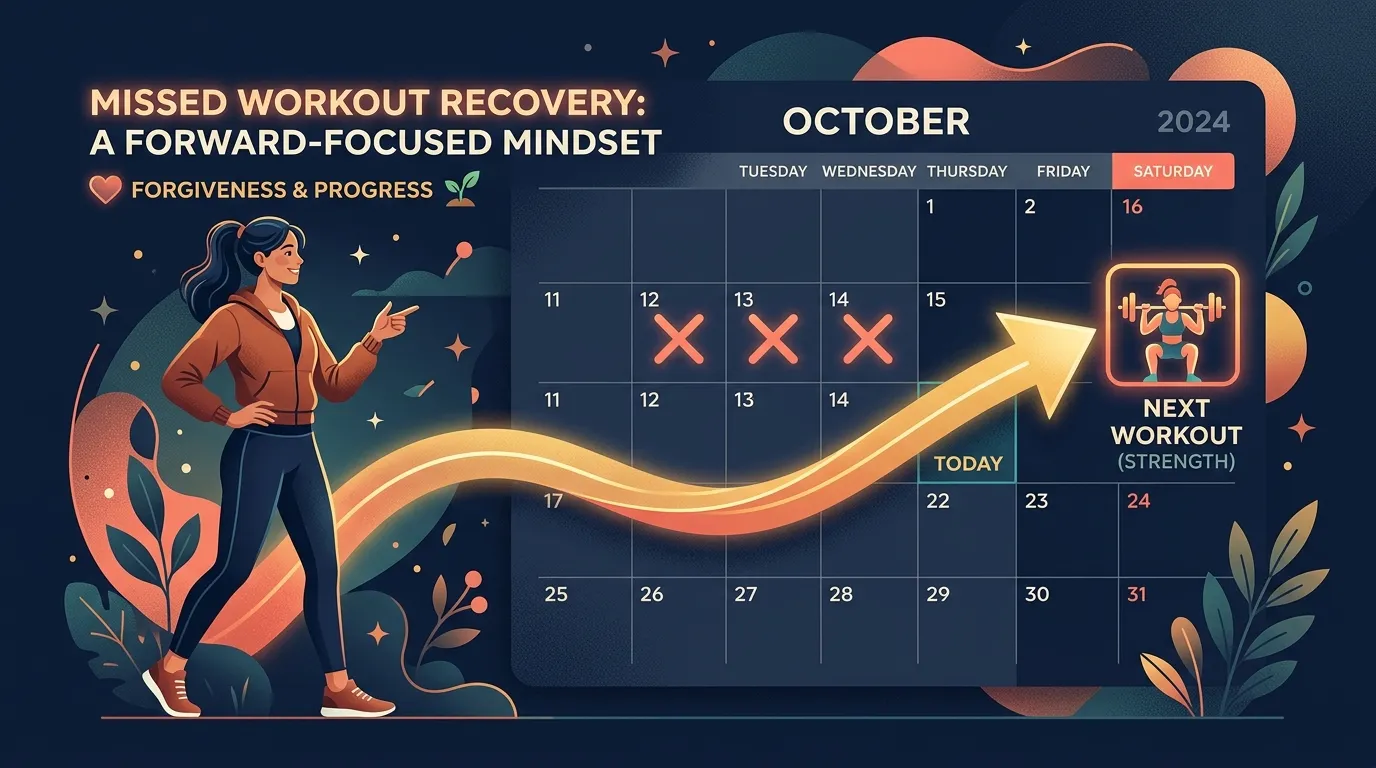
- Calendar tracking with rewards that visualize your consistency pattern over weeks and months. When you can see that you completed 22 out of 26 planned sessions this month, one miss looks like what it is: a minor blip in an otherwise strong record.
A 2022 systematic review in the Journal of Medical Internet Research found that gamified fitness interventions produced a small-to-medium improvement in physical activity (Hedges g=0.42) against non-gamified controls. But the review noted that the effect was strongest when gamification included multiple reward types and progress visualization — not just a simple streak counter.
How FitCraft Handles Missed Workouts
FitCraft was designed with the understanding that missed workouts are inevitable — and that the system's job is to make getting back on track as frictionless as possible.
Here's what that looks like in practice:
- Ty, the AI trainer, adapts without judgment. FitCraft's AI trainer doesn't guilt you for missing a session. Instead, Ty provides adaptive encouragement that meets you where you are and recalibrates your plan going forward. Missed a strength day? Ty adjusts the upcoming schedule based on your actual progress, not the theoretical plan you were "supposed" to follow.
- The gamification system creates multiple reasons to come back. XP, leveling up, and collectible cards mean that even after a missed day, you still have accumulated progress to protect and new rewards to chase. A missed workout is a pause in earning — not a loss of what you've already built.
- Adaptive workouts based on progress keep you from overdoing it. When you return after a break, FitCraft doesn't throw you into the deep end. The app adapts your workouts based on your actual progress patterns, ensuring your comeback session is appropriately challenging without being punishing.
- Interactive 3D exercise demos lower the restart barrier. If you're feeling uncertain about form after time away, FitCraft's interactive 3D demos let you review any exercise with pinch-and-zoom camera control. No searching for YouTube videos or guessing at technique. The information is right there, reducing one more friction point between "I should work out" and actually doing it.
- Flexible workout types match your energy. Not every comeback session needs to be a heavy strength workout. FitCraft offers yoga, mobility work, dynamic movement, cardio, and strength training with dumbbells, resistance bands, or bodyweight. On a low-energy day, a gentle mobility session keeps the habit alive without demanding more than you can give.
The underlying philosophy: the app should make it easier to come back than it is to stay away.
The Long View: What Actually Matters
Zoom out far enough and the math becomes obvious.
Assume you plan to work out 4 times a week. Over a year, that's 208 planned sessions. If you hit 80% of them — which means missing roughly one session per week — you'll have completed 166 workouts. That's 166 doses of progressive overload. 166 sessions of cardiovascular stimulus. 166 deposits in the compound interest account of your fitness.
Now ask yourself: does it matter which specific 42 sessions you missed? Does it matter whether miss number 17 happened on a Tuesday in April or a Thursday in June?
Of course not. What matters is the 166 sessions you showed up for.
Fitness is a decades-long project. The person who maintains an 80% adherence rate for 5 years will be in a completely different physical condition than the person who achieves 100% adherence for 6 weeks and then quits. The imperfect, inconsistent, occasionally-miss-a-workout exerciser who keeps showing up will always outperform the perfectionist who eventually stops.
So you missed a workout. That's fine. It's data, not destiny. The only question that matters now is: what are you going to do next?
The Takeaway
Missing a workout doesn't ruin your progress — but believing it does might. The physiology is clear: meaningful fitness loss requires weeks of inactivity, not one missed session. The real danger is the psychological spiral — the all-or-nothing thinking that turns a single miss into a complete quit.
The fix is a mindset shift (from perfection to "never miss twice"), combined with practical tactics (do something small immediately, don't compensate, lower the bar for your next session) and systems that make re-engagement automatic (gamification, adaptive planning, multiple reward types).
You didn't fail. You paused. Now go back.
Studies Referenced
- Ogasawara, R., et al. (2013). "Comparison of muscle hypertrophy following 6-month of continuous and periodic strength training." European Journal of Applied Physiology, 113(4), 975-985.
- Mujika, I. & Padilla, S. (2000). "Detraining: Loss of Training-Induced Physiological and Performance Adaptations." Sports Medicine, 30(3), 145-167.
- Marlatt, G. A. & Gordon, J. R. (1985). Relapse Prevention: Maintenance Strategies in the Treatment of Addictive Behaviors. Guilford Press.
- Sniehotta, F. F., et al. (2016). "All-or-nothing thinking and exercise dropout: A cognitive distortion perspective." Health Psychology Review, 10(2), 215-221.
- Kwasnicka, D., et al. (2019). "Planning for setbacks in health behavior change: a systematic review." British Journal of Health Psychology, 24(2), 345-370.
- Cheng, V. W., et al. (2022). "Gamification in Apps and Technologies for Improving Mental Health and Well-Being: Systematic Review." JMIR mHealth and uHealth, 10(8), e36975.
Frequently Asked Questions
Does missing one workout ruin my progress?
No. Research shows that meaningful muscle atrophy doesn't begin until approximately 2 to 3 weeks of complete inactivity, and cardiovascular detraining takes roughly 10 to 14 days to become measurable. A single missed workout — or even a missed week — has virtually zero impact on your long-term fitness trajectory. What matters is the pattern over months and years, not any individual session.
Should I do a harder workout to make up for one I missed?
No. Compensatory overtraining — doubling up or dramatically increasing intensity to "make up" for a missed session — increases injury risk and reinforces the unhealthy belief that each workout carries equal weight. Instead, simply resume your normal routine at the next scheduled session. Your body doesn't keep a ledger. Consistency over weeks matters far more than any single session.
How many workouts can I miss before I lose fitness?
The timeline depends on your training history. Beginners may retain strength gains for up to 3 weeks of inactivity. Experienced exercisers retain muscle and strength even longer — a 2013 study in the Journal of Strength and Conditioning Research found that trained individuals maintained most strength gains after 3 weeks of detraining. Cardiovascular fitness declines faster, with VO2 max dropping measurably after about 10 to 14 days. But in all cases, the losses are much smaller and slower than most people fear.
Why do I feel so guilty after missing a workout?
Workout guilt stems from all-or-nothing thinking — a cognitive distortion where any deviation from a plan feels like total failure. Psychologists call this the abstinence violation effect, originally studied in addiction research. When someone who has been "perfect" slips once, they interpret the slip as evidence they've failed entirely, which often triggers a complete abandonment of the behavior. Recognizing this pattern is the first step to breaking it.
How does FitCraft help after missing a workout?
FitCraft's AI trainer Ty provides adaptive encouragement that acknowledges the missed session without judgment and recalibrates your plan going forward. The gamification system — including XP, leveling up, collectible cards, and calendar tracking with rewards — creates multiple re-engagement hooks so that a missed day feels like a temporary pause rather than a broken streak. The app adapts your workouts based on your progress, so you're never punished for taking a day off.