Muscles Worked
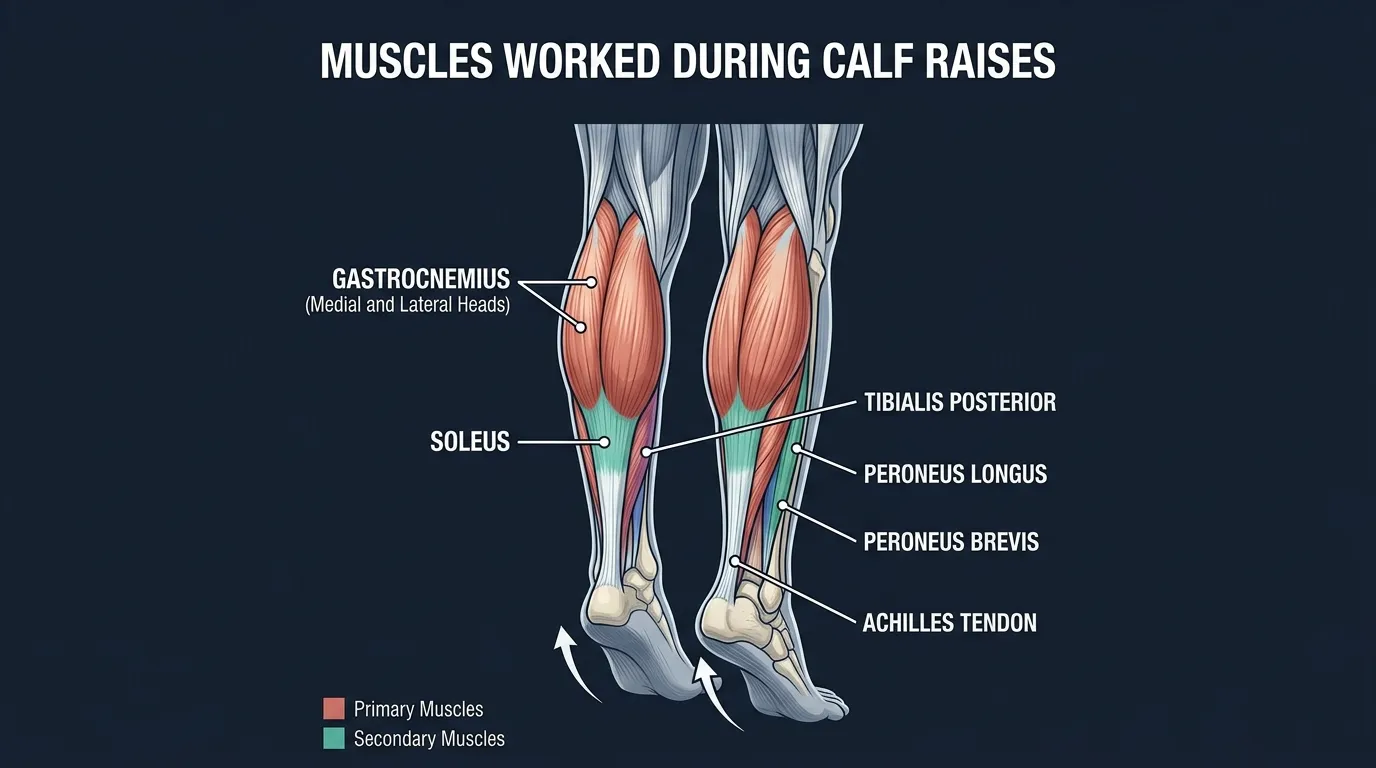
Primary movers. The gastrocnemius and soleus together form the triceps surae, the muscle group responsible for plantarflexion (pointing the foot down). The gastrocnemius is the larger two-headed muscle visible at the back of the lower leg; it crosses both the knee and the ankle joints, so it works hardest when the knee is straight. The soleus sits underneath the gastrocnemius and crosses only the ankle, so it does the bulk of the work when the knee is bent (as in seated calf raises). In a standing calf raise, both fire concentrically as you rise onto the toes and eccentrically as you lower under control.
Secondary movers. The plantaris and the deep posterior compartment muscles (tibialis posterior, flexor hallucis longus, flexor digitorum longus) contribute small amounts of plantarflexion force. The peroneus longus and peroneus brevis on the outside of the lower leg help control eversion and keep your weight tracking through the big toe rather than rolling outward to the pinky-toe side of the foot.
Stabilizers. The intrinsic muscles of the foot stabilize the arch as you balance on the balls of the feet at the top. The tibialis anterior on the front of the shin works isometrically to keep the ankle from rolling. The hip abductors (gluteus medius, gluteus minimus) and the quadriceps fire to keep the knees and pelvis stacked over the feet. On single-leg variations, the gluteus medius of the standing leg works much harder to keep the pelvis level.
Mechanism. The triceps surae attaches to the calcaneus (heel bone) through the Achilles tendon, the largest tendon in the body. The Achilles tolerates loads of several times bodyweight during running and jumping; calf raises build both contractile strength in the muscle and tendon stiffness in the Achilles itself. Heavy slow eccentric calf raises (3-second descents) are the foundation of the Alfredson protocol used clinically to rehabilitate Achilles tendinopathy, which is why tempo and full range matter more than raw load on this lift.
Quick Facts
Quick Facts: Dumbbell Calf Raises
- Equipment needed: Pair of dumbbells (5-50 lb per hand depending on level); optional step or platform for elevated variation
- Difficulty: Beginner. Easy to learn; load and range determine intensity
- Modality: Strength / single-joint isolation
- Body region: Lower leg (calves, Achilles tendon)
- FitCraft quest category: Strength accessories
Step-by-Step Instructions
- Stand with dumbbells at your sides. Stand upright with your feet hip-width apart, holding a dumbbell in each hand with your arms hanging naturally at your sides. Keep your chest up, shoulders pulled back, and core lightly braced.
Coach Ty's cue: "Don't lean forward as you raise your body, try to go straight up."
- Press through the balls of your feet. Slowly raise your heels off the ground by pressing through the balls of your feet. Focus on driving straight upward, not forward or backward. Weight tracks through the big toe and the second toe, not the outside of the foot.
- Rise as high as possible. Continue rising until you're standing on your toes at full calf contraction. You should feel a strong squeeze in both calves at the top of the movement.
Coach Ty's cue: "Try to raise yourself up as high as you can."
- Hold for one second at the peak. Pause at the top to maximize the contraction. The brief hold eliminates momentum and makes sure your muscles are doing the work.
- Lower yourself slowly. Take 2-3 seconds to lower your heels back to the ground. The eccentric (lowering) phase drives most of the calf and Achilles adaptation. Don't just drop back down.
Coach Ty's cue: "It's important to control your movement, don't just drop back down, lower yourself slowly."
- Repeat without bouncing. Each rep should start from a full stop on the ground. Bouncing at the bottom uses elastic rebound instead of muscle contraction and cheats the exercise.
Common Mistakes
- Dropping down too fast. Gravity is not your friend on the lowering phase. A quick drop eliminates the eccentric contraction that's responsible for most of the calf and tendon adaptation. Lower slowly over 2-3 seconds.
- Bouncing at the bottom. Using elastic rebound to start the next rep cheats your calves out of the work. Come to a full stop at the bottom before each rep.
- Leaning forward. Tipping your torso forward shifts stress to the ankle joint and reduces calf activation. Stay upright throughout the movement.
- Partial range of motion. Rising only halfway up activates only part of the muscle fibers. Push to full extension at the top and come all the way down at the bottom for complete range.
- Using too little weight. Your calves carry your entire bodyweight all day. They're strong. Don't be afraid to use meaningful resistance. If you can easily hit 20 reps, the dumbbells are too light.
- Weight rolling to the outside of the foot. If the load tracks through the pinky toe rather than the big toe, you're loading the ankle in inversion (the sprain-prone direction). Cue weight through the first and second toe; the peroneals on the outside of the lower leg help keep this tracking honest.
Get this exercise in a personalized workout
FitCraft, our mobile fitness app, uses its AI coach Ty to program isolation exercises like this into your plan at the right volume and intensity, based on your level, goals, and equipment. Ty was designed and trained by Domenic Angelino, MPH (Brown University) and NSCA-CSCS, with research published in the Journal of Strength and Conditioning Research and Medicine & Science in Sports & Exercise.
Take the Free Assessment Free · 2 minutes · No credit card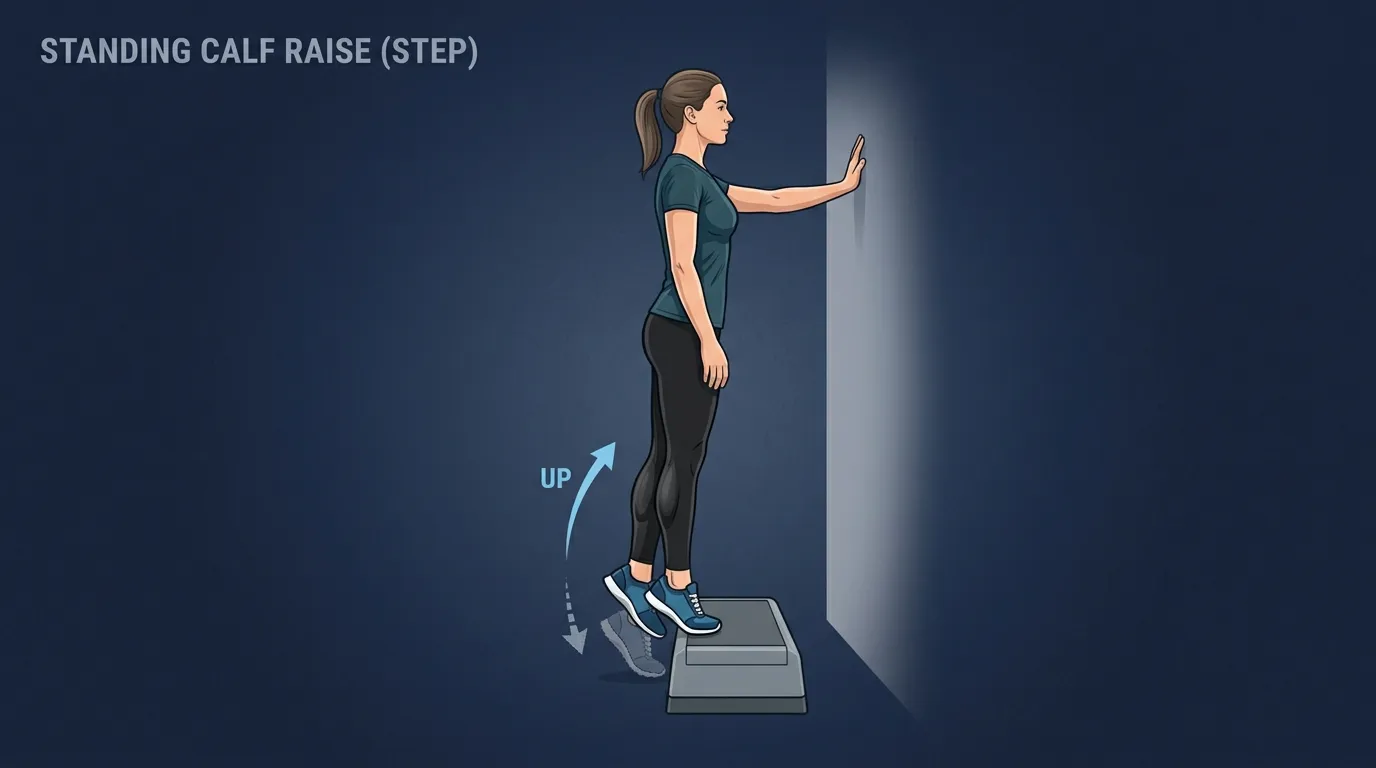
Variations
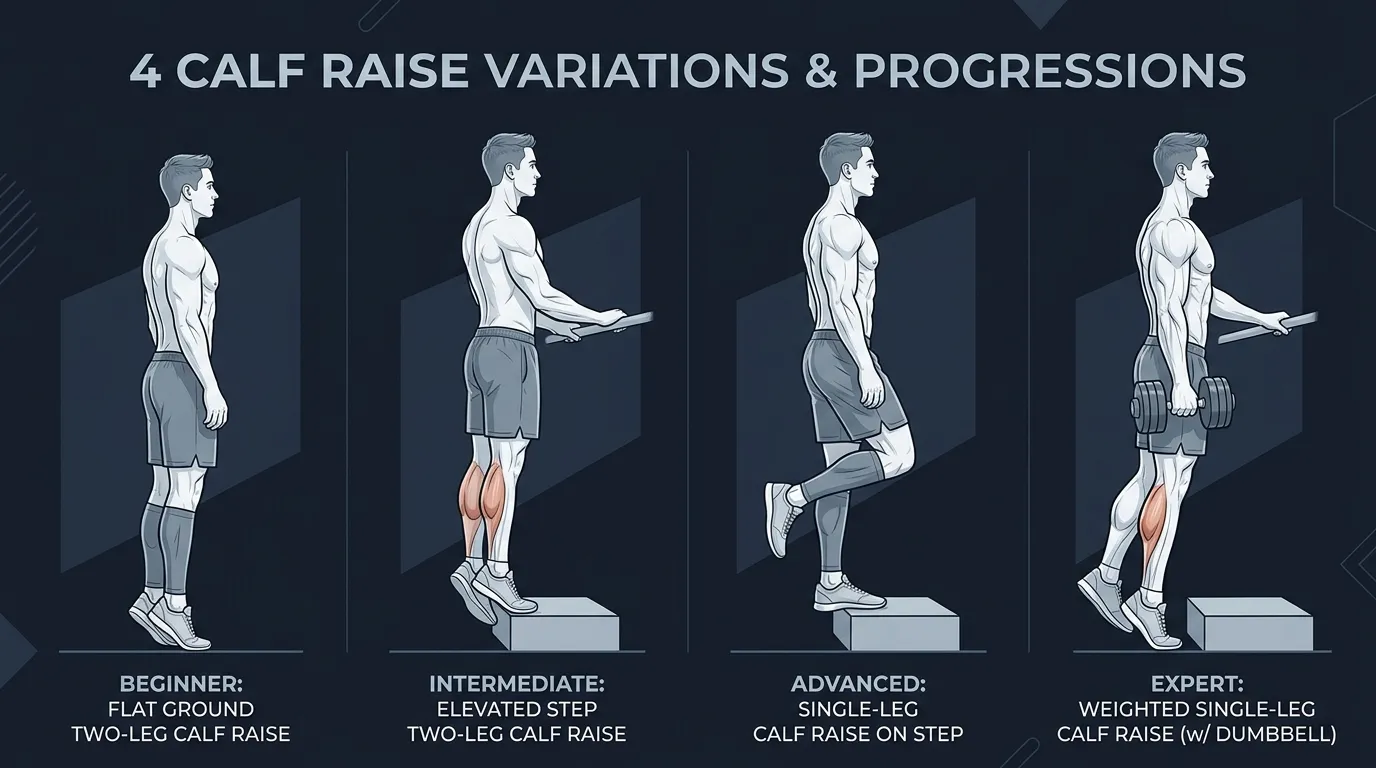
- Bodyweight calf raise (easier). Perform the same movement without dumbbells. Ideal for learning the movement pattern or for high-rep endurance sets (20-40 reps).
- Elevated calf raise. Stand with the balls of your feet on a step or platform with heels hanging off the edge. The bottom of each rep drops below floor level, adding 20-30 degrees of dorsiflexion at the stretch and roughly doubling the effective range of motion. This is the highest-yield progression for hypertrophy if your Achilles tolerates the deep stretch.
- Single-leg dumbbell calf raise. Hold one dumbbell on the working side and perform all reps on one foot before switching. Doubles the load on each calf and adds a balance challenge that recruits the hip stabilizers. This is the standard progression once two-leg raises become easy.
- Seated calf raise. Sit on a bench with dumbbells resting on your thighs near the knees. The bent-knee position puts the gastrocnemius on slack and shifts work to the soleus underneath. Pair with standing raises for complete calf development.
- Single-leg elevated calf raise (advanced). Combine single-leg load with elevated range. Hold a dumbbell on the working side, stand on a step with the heel hanging off, balance with the free hand on a wall or rack. The hardest progression most home lifters will ever need.
When to Avoid or Modify Calf Raises
Calf raises are safe for most healthy adults and are commonly used in rehabilitation. A few conditions warrant modification. Always consult a qualified healthcare provider or physical therapist before starting or returning to any exercise program, especially in the scenarios below.
- Acute Achilles tendinopathy or recent Achilles rupture/repair. Heavy slow eccentrics are first-line treatment, but the protocol needs to be staged by a physical therapist. During an acute pain flare, skip the elevated variation (the bottom-stretch position loads the tendon hardest), drop to bodyweight, and keep the bottom of the rep at floor level rather than dropping below it. Sharp tendon pain is a stop signal.
- Active plantar fasciitis or heel pain. The pressure under the ball of the foot at the top of each rep can aggravate symptoms. Try seated calf raises (less bodyweight pressure on the foot) and avoid the elevated variation until heel pain resolves.
- Recent ankle sprain or unstable ankle. Two-leg raises in a controlled, slow tempo are often part of ankle rehab and help rebuild proprioception. Hold a wall or rack lightly for balance until single-leg stability returns. Avoid single-leg variations until you can balance on the affected leg for 30 seconds without wobbling.
- Recent foot, ankle, or lower-leg surgery. Get surgeon clearance. Isolation rehab typically progresses from isometric heel raises to bodyweight raises to loaded raises over weeks to months depending on the procedure.
- Severe varicose veins or peripheral vascular disease. The calf is the body's "second heart" venous pump and calf raises generally help circulation, but high-volume daily protocols should be cleared with a vascular physician if you have a known condition.
- Pregnancy with significant lower-leg edema or balance changes. Hold a wall or counter for balance, drop the load, and keep both heels at or above floor level rather than using the elevated variation.
Related Exercises
- Same target muscle (plantarflexion / lower leg): calf hops for explosive plantarflexion and elastic Achilles work; jump squats for triple-extension power that finishes through the calves.
- Compounds that load the calves: squats, front squats, Bulgarian split squats, and deadlifts all recruit the calves isometrically as ankle stabilizers but do not train them through full range. Calf raises are the accessory that closes this gap.
- Hip-and-hinge pairing for posterior chain: Romanian deadlifts for hamstrings and glutes; glute bridges for hip extension. Calves sit at the bottom of the same posterior-chain kinetic chain.
- Ankle mobility and tibialis health: cross-legged ankle stretch for dorsiflexion range; tibialis-raise work (front-of-shin) pairs with calf raises as the antagonist to balance the lower leg and reduce shin splint risk.
- Conditioning that hammers the calves: high knees and butt kicks load the calves at high cadence; alternating with strength work develops both reactive and contractile capacity.
How to Program Calf Raises
Programming should follow Ratamess et al., 2009 (the ACSM Position Stand on resistance training), with the practical adjustment that calves tolerate higher rep ranges and slightly higher frequency than most muscle groups because of their daily endurance role and high slow-twitch fiber composition.
| Level | Sets × Reps | Rest between sets | Frequency |
|---|---|---|---|
| Beginner | 2-3 × 12-15 (bodyweight or light dumbbells) | 45-60s | 2-3 sessions/week |
| Intermediate | 3-4 × 10-15 (moderate dumbbells, introduce elevated) | 60-90s | 2-4 sessions/week |
| Advanced | 3-4 × 8-15 (heavy single-leg, mix standing + seated for full muscle coverage) | 60-120s | 2-4 sessions/week |
Where in your workout. Calf raises are an isolation accessory. Place them late in the session, after compound work for the same kinetic chain (squats, lunges, deadlifts). Doing them first fatigues the ankle stabilizers and undermines your heavier lifts. A typical leg-day order: squat or hinge variation → unilateral lower-body work → posterior chain accessory → calf raises (standing + seated) → conditioning. For runners and jumpers, calf raises can also live as a stand-alone 2-3 times per week (separate from lower-body strength days) to build Achilles capacity without competing for recovery with the heavier lifts.
Form floor over rep targets. If you can't hit a full peak contraction and a controlled 2-3 second eccentric, the rep doesn't count. Stop the set when the tempo breaks, even if the rep number is short. Quality reps build the calf; sloppy bounces train the elastic tendon at the expense of muscle adaptation.
How FitCraft Programs This Exercise
Calf raises might look like a beginner exercise, but how they fit into a program makes the difference. FitCraft's AI coach Ty uses a personalized diagnostic to determine the right load, rep range, tempo, and placement for your situation.
For beginners with limited equipment, Ty often starts with bodyweight calf raises as part of a lower-body circuit, building the movement pattern and the eccentric control habit. Once dumbbells are available, Ty prescribes loaded raises with specific tempo instructions: a controlled rise, a one-second pause at the top, and a slow 2-3 second descent.
For users who report access to a step or platform, Ty introduces elevated calf raises to expand the range of motion. For users training for running, jumping, or court sports, calf-raise volume goes up because Achilles capacity is a performance ceiling. Ty also pairs standing with seated raises so both the gastrocnemius and soleus get developed across the program.
Calves only grow if you train them consistently. FitCraft's streaks, quests, and collectible cards keep the small accessory lifts from getting skipped, which is where most "I have small calves" stories actually come from.
Frequently Asked Questions
Can I do calf raises with Achilles tendinopathy or Achilles pain?
Heavy slow eccentric calf raises are a first-line rehabilitation exercise for Achilles tendinopathy (the Alfredson protocol), but they should be programmed by a physical therapist, not self-prescribed during an acute flare. If you have current Achilles pain, stop the elevated variation (the bottom-stretch position loads the tendon hardest), keep both heels at floor level or above, drop the load to bodyweight, and see a physical therapist before progressing. Do not push through sharp tendon pain.
How heavy should dumbbells be for calf raises?
Start with a weight that allows 12-15 reps with a slow rise, a one-second pause at the top, and a controlled 2-3 second descent. For most beginners, 10-20 lb dumbbells per hand is a good starting point. Calves carry your bodyweight all day and tolerate substantial load, so progress steadily as the exercise becomes easy. If you can hit 20 reps without effort, the dumbbells are too light.
How many calf raises should I do per week?
For calf hypertrophy, 3-4 sets of 12-20 reps performed 2-3 times per week is a sound starting range, with at least 48 hours between intense sessions. Calves respond well to higher rep ranges and slightly higher frequency than other muscle groups because they are endurance-biased and used heavily in daily life. Daily bodyweight calf raises (20-40 reps) are also reasonable as low-load capacity work.
What is the difference between standing and seated calf raises?
Standing calf raises (with knees straight) bias the gastrocnemius, the larger two-headed muscle that crosses both the knee and ankle joints. Seated calf raises (with knees bent at 90 degrees) put the gastrocnemius on slack and shift work to the soleus, the deeper single-joint muscle underneath. A complete calf program includes both: standing for the gastrocnemius, seated for the soleus.
Are calf raises worth doing if I run or train legs already?
Yes. Running and squats load the calves, but neither takes them through the full range of motion under direct progressive overload the way calf raises do. Strong calves improve ankle stability, running economy, jump performance, and balance. They also reduce risk of Achilles tendon injuries, shin splints, and ankle sprains. Calves are often the most undertrained muscle group, even in regular lifters.