The Floor Wiper looks simple. You lie on your back, lift your legs straight up, and sweep them side to side in a controlled arc. Then you actually try it and realize your obliques have been coasting through every other core exercise you've ever done. That sweeping motion demands serious rotational strength, anti-rotation stability from your deep core, and enough hip flexor endurance to keep your legs elevated through the entire set.
Here's what makes the floor wiper exercise so valuable: most core exercises work in one plane. Crunches flex you forward. Planks resist extension. Floor Wipers force your core to control rotation under a long lever arm, which is closer to how your core actually functions during sports, lifting, and daily life. So if your core training has been limited to planks and sit-ups, this exercise will expose gaps you didn't know existed.
Quick Facts
Quick Facts: Floor Wipers
- Equipment needed: Bodyweight only (mat optional for comfort)
- Difficulty: Advanced
- Modality: Strength (dynamic, alternating, controlled tempo)
- Body region: Core (obliques, rectus abdominis, transverse abdominis)
- FitCraft quest category: Core stability
Muscles Worked
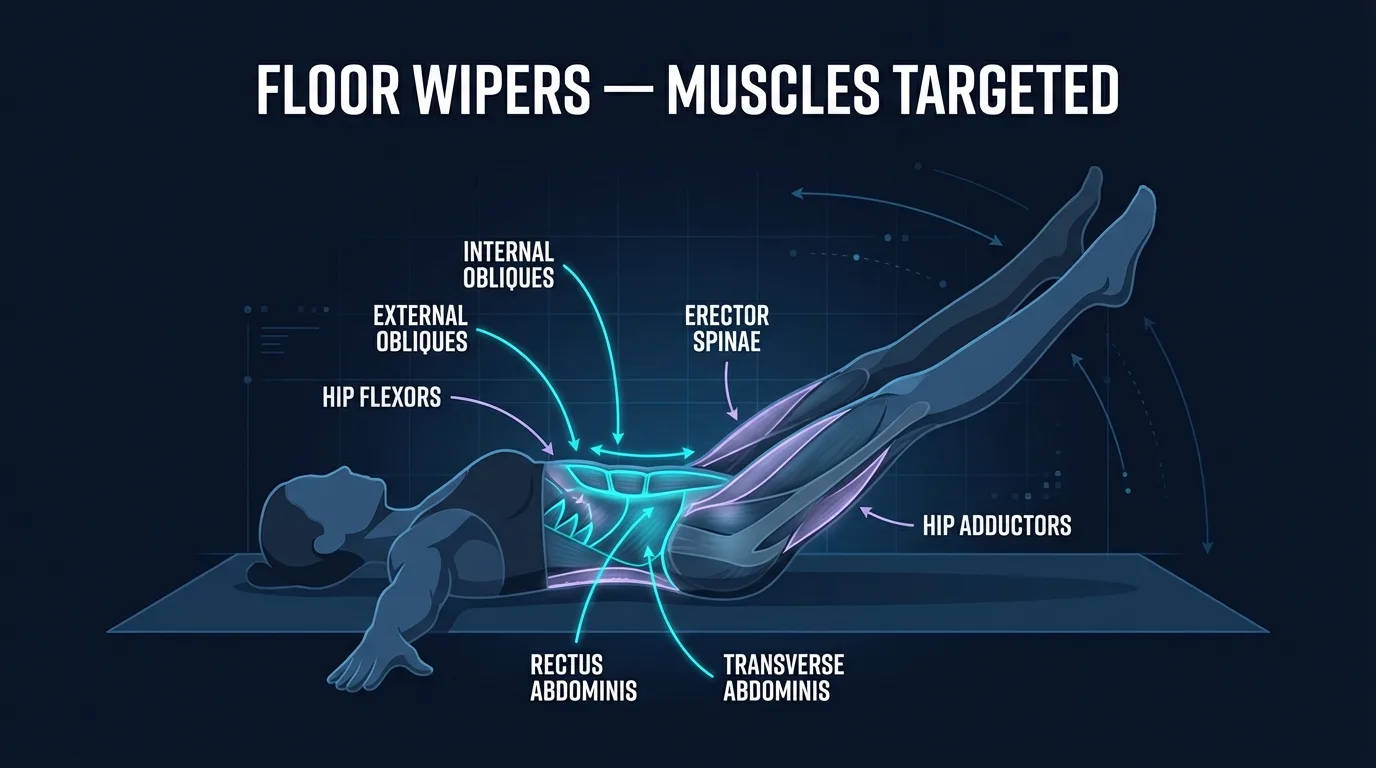
Primary movers: the internal and external obliques. As your legs lower to one side, the contralateral obliques lengthen eccentrically to control the descent, and the ipsilateral obliques shorten concentrically. Pulling the legs back to vertical reverses this, so each rep trains both halves of the rotational pattern.
Secondary movers: the rectus abdominis braces against spinal extension as the legs pull on the pelvis, the transverse abdominis maintains intra-abdominal pressure throughout the set, and the hip flexors (psoas, iliacus, rectus femoris) work isometrically to keep the long lever elevated. The hip adductors squeeze the legs together to maintain the unified lever, which is a quietly demanding part of the exercise.
Stabilizers: the shoulder girdle and lats anchor the torso to the floor as your palms press hard into the ground. The diaphragm and pelvic floor form the deep core canister that resists rotation. Exhaling as you pull the legs back to center reinforces transverse abdominis activation and protects the lower back from arching.
Mechanism: Floor Wipers train both anti-rotation (the upper body resists being pulled into rotation by the moving legs) and controlled rotation (the obliques actively pull the legs back to center). The straight-leg position creates a long lever arm — the longer the lever, the higher the torque your core has to resist. That's why Bent-Knee Floor Wipers are dramatically easier: shortening the lever by even 50% can cut the rotational demand by more than half. The exercise is more closely related to anti-rotation classics like Bird-Dogs than to flexion exercises like crunches, even though the position looks like a leg-raise variant.
Step-by-Step Instructions
- Lie on your back with arms extended. Lie face up on the floor with your arms straight out to your sides, palms pressing firmly into the ground. Lift both legs straight up toward the ceiling so they are perpendicular to the floor. Your body should form an L shape.
Coach Ty's cue: "Press your palms into the ground. Your arms are your anchors." Your hands aren't resting on the floor; they're actively pushing down to create the stability your core needs.
- Brace your core. Engage your core by bracing as if someone were about to press on your stomach. Press your shoulders and upper back firmly into the floor. Your arms act as stabilizers, so push your palms hard into the ground throughout the entire movement.
- Lower your legs to one side. Keeping both legs straight and together, slowly lower them to one side in a controlled arc. Go only as far as you can while keeping both shoulder blades on the floor. Your obliques should be controlling the descent, not gravity.
Coach Ty's cue: "Keep both shoulder blades glued to the floor." The moment a shoulder lifts, the obliques have stopped doing the work and momentum has taken over.
- Return to center and alternate. Use your obliques to pull your legs back to the vertical starting position. Without pausing, lower them to the opposite side with the same controlled tempo. One full rep equals a sweep from center to one side, back to center, and over to the other side.
Coach Ty's cue: "Slower is harder. That's the point." Each side-to-side sweep should take 3 to 4 seconds. Fast reps mean swinging legs, and swinging legs do almost nothing for core development.
- Breathe deliberately. Exhale as you pull your legs back to center. Inhale as you lower to the side. If you feel your lower back arching or a shoulder lifting off the floor, reduce your range of motion immediately.
Coach Ty's cue: "Straight legs amplify the difficulty. Bend them if you need to." Bending the knees to 90 degrees isn't cheating; it's a legitimate regression that keeps the exercise effective while you build strength.
Get this exercise in a personalized workout
FitCraft, our mobile fitness app, uses its AI coach Ty to program core stability work like this into your plan at the right volume and intensity, based on your level, goals, and equipment. Ty was designed and trained by Domenic Angelino, MPH (Brown University) and NSCA-CSCS, with research published in the Journal of Strength and Conditioning Research and Medicine & Science in Sports & Exercise.
Take the Free Assessment Free · 2 minutes · No credit card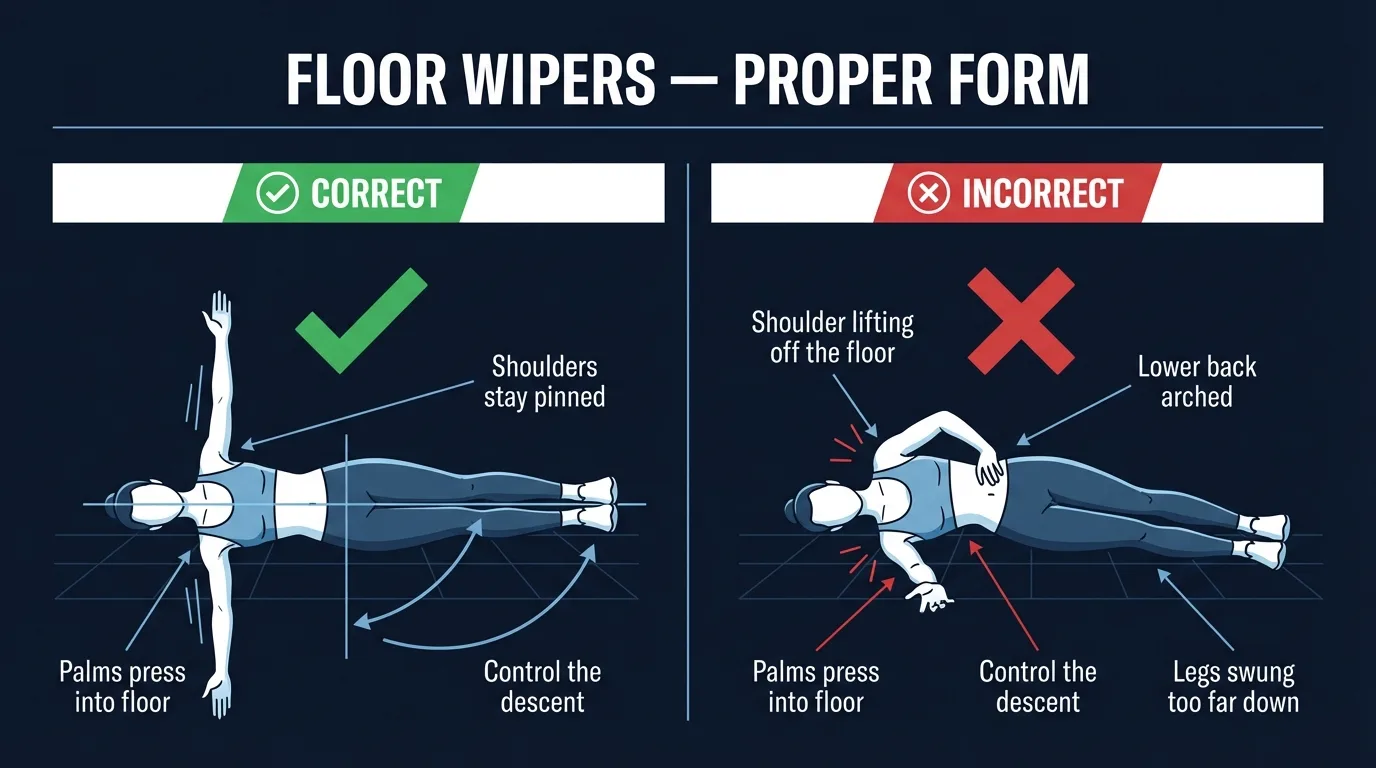
Common Mistakes
- Letting momentum take over. This is the big one. People swing their legs side to side like a pendulum and wonder why their obliques never get sore. When momentum controls the movement, your core does almost no work. Slow down. If you can't control the descent for at least 2 seconds per side, the exercise is too advanced for you right now.
- Shoulder lifting off the floor. When your legs drop to one side, the opposite shoulder naturally wants to follow. Fight that. Press both palms hard into the ground and keep your upper back anchored. If your shoulder lifts, the rotational load has exceeded what your core can stabilize. Reduce the range of motion.
- Arching the lower back. Your lower back should stay neutral to flat throughout the exercise. If you feel your lumbar spine hyperextending as your legs lower, your hip flexors are fatiguing and your core can't compensate. Shorten the range or take a rest.
- Going too low, too soon. Your legs don't need to touch the floor on each side. For most people the effective range means stopping 30 to 45 degrees from vertical. The right depth is wherever you can maintain full control with both shoulders down and no lower back arching. That range increases as strength improves.
- Holding the breath. Bracing isn't the same as breath-holding. Exhale as you pull the legs back to center to reinforce transverse abdominis activation. Holding the breath through every rep spikes intra-abdominal pressure and can leave you dizzy on a long set.
Variations
Easier (Regression)
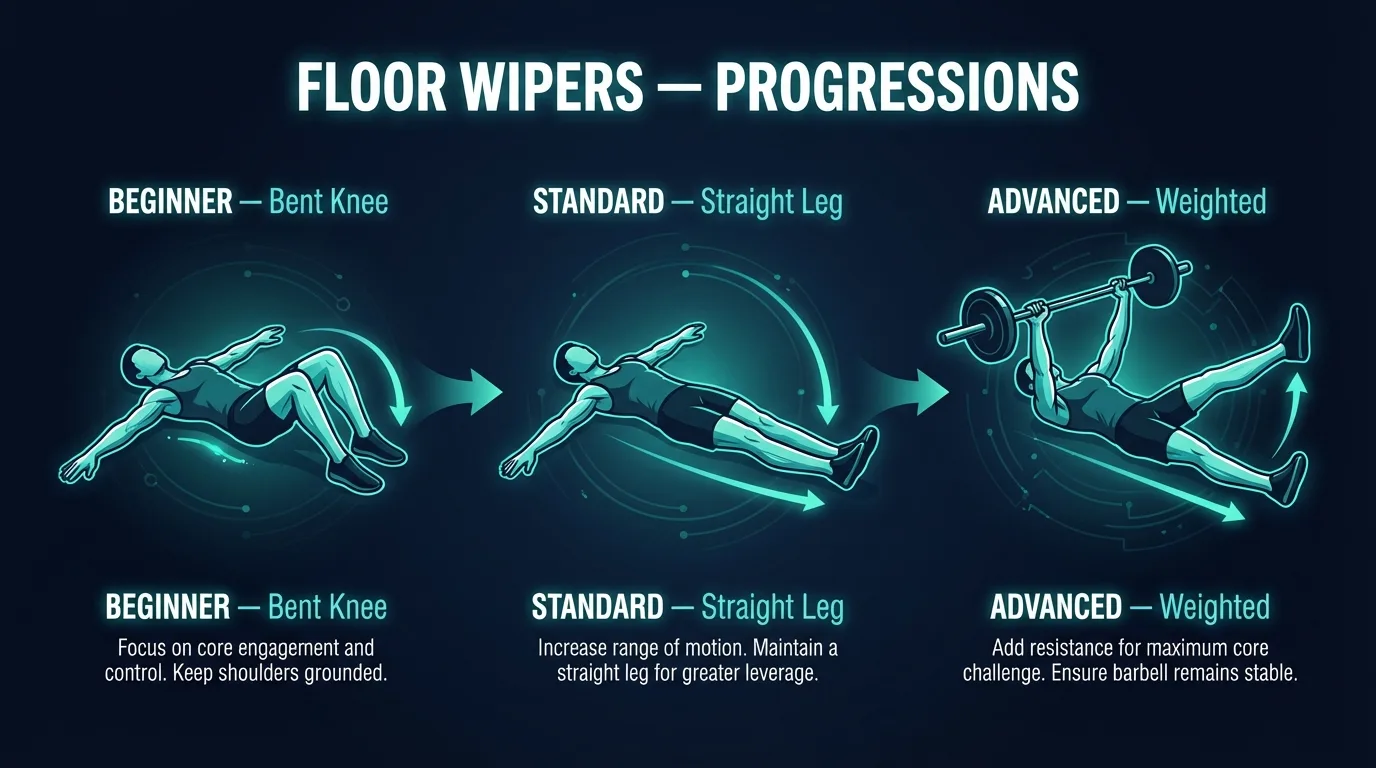
- Bent-Knee Floor Wipers: Bend your knees to 90 degrees instead of keeping your legs straight. This shortens the lever arm significantly and cuts the rotational force your obliques need to control. Start here if straight-leg Floor Wipers cause your shoulders to lift or your back to arch.
- Reduced Range of Motion: Keep your legs straight but only lower them 20 to 30 degrees from vertical. Smaller arc, still highly effective. Think of it as a stepping stone to full-range Floor Wipers.
- Dead Bugs: The universal anti-extension foundation for the core. Build a clean Dead Bug pattern first if Floor Wipers feel chaotic.
Harder (Progression)
- Weighted Floor Wipers: Hold a barbell or pair of dumbbells locked out above your chest while performing the leg sweep. This adds an isometric chest and tricep challenge on top of the core demand. Only attempt this once you can do 10 clean bodyweight reps per side.
- Floor Wipers with Pause: Add a 3-second hold at the bottom of each side before returning to center. That isometric pause eliminates any residual momentum and intensifies oblique activation substantially. Three seconds doesn't sound like much until you're doing it.
- Windshield Wipers (Bar): Perform the same movement while hanging from a pull-up bar. The grip and shoulder demand turn this into a full-body advanced core exercise.
Alternative Exercises
- Russian Twists: Rotational core exercise that targets similar muscles from a seated position. Less demanding on hip flexor endurance but still solid for oblique development.
- Bicycle Crunches: Combines trunk rotation with hip flexion in an alternating pattern. Good intermediate-level rotational work that builds toward Floor Wipers.
- Side Planks: Isometric anti-lateral-flexion work for the obliques and quadratus lumborum. Pairs well with Floor Wipers to cover both static and dynamic oblique training.
When to Avoid or Modify Floor Wipers
Floor Wipers are safe for healthy adults with established core strength, but a few conditions warrant modification or substitution. Always consult a qualified healthcare provider or physical therapist before starting or returning to advanced core training, especially in the situations below.
- Acute lower-back pain or known disc pathology. The rotational load with a long lever can aggravate lumbar discs and facet joints. Substitute with anti-rotation patterns like Bird-Dogs and Dead Bugs and clear progression with a physical therapist before reintroducing Floor Wipers.
- First 6 to 8 weeks postpartum or active diastasis recti. Rotational and high-intra-abdominal-pressure movements can widen abdominal separation. Restore deep-core function first with diaphragmatic breathing, transverse abdominis activation, and Bird-Dogs / Dead Bugs.
- Recent abdominal surgery (C-section, hernia repair, appendectomy). Get clearance from your surgeon. Most post-surgical protocols start with diaphragmatic breathing, then gentle bracing, then progressive loading. Floor Wipers belong late in that progression.
- Hernia (umbilical, inguinal, ventral). The combination of intra-abdominal pressure and rotational load can worsen symptoms. Consult your physician about safe core options.
- Pregnancy (second and third trimesters). Avoid supine positions for long durations (vena cava compression) and skip rotational core work. Use upright or side-lying alternatives such as standing anti-rotation drills or Side Plank variations cleared by your provider.
- Pelvic-organ prolapse or pelvic-floor dysfunction. Avoid high-intra-abdominal-pressure rotational movements; work with a pelvic-floor PT before attempting Floor Wipers.
- Shoulder pain or recent rotator-cuff injury. Pressing the palms hard into the floor to anchor the torso loads the shoulder girdle. If that pressure provokes shoulder pain, modify by anchoring the arms in a T position with reduced palm pressure, or substitute with a Bent-Knee variation that needs less anchoring force.
Related Exercises
- Same plane (rotational / anti-rotation core): Russian Twists, Bicycle Crunches, Bird-Dogs, Plank Twists
- Easier regressions for the same pattern: Dead Bugs, Bird-Dogs, Heel Taps
- Foundational anti-extension core: Dead Bugs, Forearm Planks, Hollow Holds
- Lateral core companions: Side Planks, Side Plank Raise
- Hip flexor strength (long-lever companion): Leg Raises, Hanging Leg Raises
- Glute foundation (often paired in core circuits): Glute Bridges
How to Program Floor Wipers
The Ratamess et al., 2009 ACSM Position Stand on Resistance Training establishes the general framework for rep, set, rest, and frequency targets. For Floor Wipers, the rep ranges sit on the lower end of the core-dynamic spectrum because the movement is advanced and form degrades quickly under fatigue.
| Level | Sets × Reps (per side) | Rest between sets | Frequency |
|---|---|---|---|
| Beginner (Bent-Knee or reduced ROM) | 2 × 6 to 8 | 60 seconds | 2 sessions/week |
| Intermediate (straight-leg, reduced ROM) | 2 to 3 × 6 to 8 | 60 seconds | 2 to 3 sessions/week |
| Advanced (full-range straight-leg, paused or weighted) | 3 to 4 × 8 to 10 (slow tempo) | 60 to 90 seconds | 3 sessions/week |
Where in your workout: place Floor Wipers in the middle or end of your session, not at the start. Pre-fatiguing the core compromises spinal stability on compound lifts like squats and deadlifts. On a dedicated core day, they can serve as a primary movement near the start of the session when freshness allows the cleanest reps. Pair with a static core exercise (like a Forearm Plank) in a superset to cover both dynamic-rotational and isometric-anti-extension demands.
Form floor over rep targets. If your shoulders lift, your back arches, or your legs start swinging instead of being controlled, the set is over even if you haven't hit the rep target. Quality of movement is the ceiling, not the rep count. Cut the set, rest longer, or regress the variation. Bad reps don't bank toward the next session; they just teach your nervous system a sloppy pattern.
FitCraft's AI coach Ty adjusts the variation and volume of core work like Floor Wipers based on your assessment results, so you don't have to guess which regression or progression is right for you today. Ty also pairs core exercises into supersets that cover both rotational and anti-rotation patterns in the same session, which is more time-efficient than training each pattern in isolation.
Frequently Asked Questions
Can I do Floor Wipers if I have lower-back pain?
If you have acute lower-back pain, known disc pathology, or a history of back injury, skip Floor Wipers and get clearance from a physical therapist or physician first. The long-lever rotational load can aggravate symptoms. Build foundational anti-rotation strength with Bird-Dogs and Dead Bugs first, then reintroduce Floor Wipers as a Bent-Knee Floor Wiper (knees bent to 90 degrees) with a tiny range of motion. Always consult a qualified healthcare provider before starting or returning to advanced core training, especially if you have current or recent back pain.
What muscles do Floor Wipers work?
Floor Wipers primarily target the internal and external obliques (controlling the rotational descent and pulling the legs back to center), with the rectus abdominis and transverse abdominis providing anti-extension bracing. Secondary movers include the hip flexors (keeping the legs elevated), hip adductors (keeping the legs together), and erector spinae (resisting spinal flexion). Stabilizers include the shoulder girdle (your arms anchor your torso to the floor) and the deep core canister of diaphragm and pelvic floor.
Are Floor Wipers a good core exercise?
Floor Wipers are one of the most effective advanced bodyweight core exercises because they train rotational control, anti-rotation strength, and oblique endurance in a single movement. Most standard core exercises (crunches, planks) work in one plane. Floor Wipers force your core to control rotation under a long lever arm, which mirrors how the core functions during sports, lifting, and daily life. They earn their advanced classification: the rotational load is substantial, and form breaks down quickly when fatigue sets in.
How many Floor Wipers should I do?
Most lifters benefit from 6 to 10 reps per side for 2 to 3 sets, performed 2 to 3 times per week. Because Floor Wipers are advanced, quality of movement matters more than volume. If your lower back arches off the floor, a shoulder lifts, or your legs start swinging instead of being controlled, the set is over. Quality reps build the core strength. Sloppy reps build bad habits.
Can beginners do Floor Wipers?
Floor Wipers are classified as advanced. Beginners should build foundational core strength with Dead Bugs, Bird-Dogs, Bicycle Crunches, and Leg Raises before attempting them. A good entry point is the Bent-Knee Floor Wiper, where you bend your knees to 90 degrees to shorten the lever arm and dramatically reduce the rotational load. Master that for 3 sets of 10 per side with clean form before progressing to straight-leg Floor Wipers.
What's the difference between Floor Wipers and Russian Twists?
Both are rotational core exercises, but the mechanics differ. Russian Twists involve seated rotation of the torso while the legs stay relatively stable; the obliques shorten and lengthen concentrically. Floor Wipers reverse this: the torso stays anchored to the floor while the legs rotate around it, and the obliques work mostly to resist rotation and pull the legs back to center. Floor Wipers also demand more hip flexor endurance and core anti-extension strength because the legs are elevated throughout the set.