The glute bridge looks simple. Lie down, push your hips up, come back down. That simplicity is exactly what makes it one of the most underrated exercises in any program. Done correctly, it builds serious glute strength, improves hip extension mechanics, and helps protect your lower back, all with zero equipment.
Done incorrectly, it turns into a lower-back exercise that misses the glutes entirely. Most people rush through it, never squeeze at the top, and wonder why they aren't seeing results.
This guide breaks down the standard glute bridge and its single-leg progression with form cues straight from Coach Ty, FitCraft's AI coach. Whether you're using it as a warm-up activation drill or programming it as a strength builder, proper form is what separates going through the motions from actual progress.
Quick Facts: Glute Bridge
- Equipment needed: None
- Difficulty: Beginner (standard) to Advanced (single-leg)
- Modality: Strength · activation
- Body region: Lower body · posterior chain
- FitCraft quest category: Strength
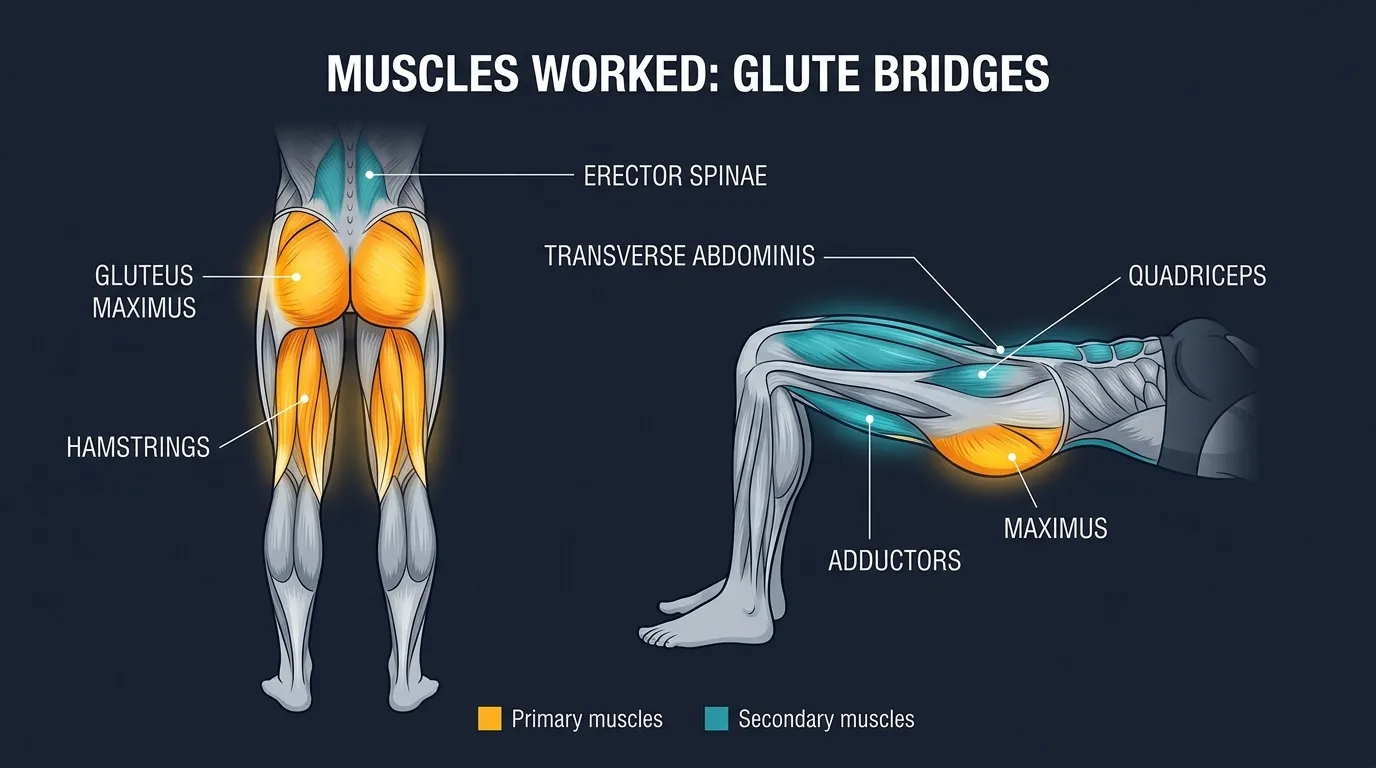
Muscles Worked
Primary movers: the gluteus maximus is the dominant working muscle. It shortens concentrically as you drive your hips toward the ceiling (hip extension) and lengthens under load on the way down (eccentric phase). The eccentric is where most strength is built, which is why dropping your hips at the bottom wastes half of every rep.
Secondary movers: the hamstrings (biceps femoris, semitendinosus, semimembranosus) assist with hip extension and contribute more when your feet are placed further from your hips. The adductor magnus also fires as a hip extender, especially when your feet are wider than hip-width.
Stabilizers: the entire deep core (transverse abdominis, rectus abdominis, internal and external obliques) braces isometrically to keep the pelvis neutral and prevent lumbar hyperextension at the top. The erector spinae works to keep the trunk rigid, and the hip abductors (gluteus medius and minimus) keep the knees tracking over the toes. The breath is a stabilizer: exhaling during the lift reinforces transverse abdominis activation.
Mechanism: the glute bridge is a closed-chain hip-extension exercise. With the feet planted, the femurs rotate at the hip joint while the trunk and pelvis move as one rigid segment. Gluteus maximus EMG activation is highest at end-range hip extension, which is why the squeeze-and-hold at the top is non-negotiable. Skipping the hold cuts the most productive part of the movement. Foot position is a real programming lever: feet close to the hips bias the glutes, feet further away bias the hamstrings, and a narrow vs wide stance shifts demand between the gluteus maximus and the adductors.
Step-by-Step: How to Perform a Glute Bridge
Whether you're using glute bridges as a warm-up or as the main lift, the movement pattern is the same. The cues below apply to both.
Step 1: Set Your Starting Position
Lie flat on your back with your knees bent and feet flat on the floor, roughly hip-width apart. Position your heels close enough to your hips that when you lift, your shins will be roughly vertical. Place your arms at your sides with palms pressing into the floor.
Coach Ty's cue: "Feet flat, knees bent, palms pressing the floor. Your shins should be roughly vertical at the top of the rep."
Step 2: Brace Your Core and Pre-Tension the Glutes
Before you move, lock everything in. Pull your belly button gently toward your spine and squeeze your glutes. The glutes should be firing before you start the lift, not after.
Ty's cue: "Squeeze your glutes to prepare for the lift. If they aren't on before you move, the lower back will jump in."
Step 3: Drive Through Your Heels
Press your heels into the floor and lift your hips toward the ceiling. The lift should come from the glutes pushing the hips up, not from the lower back arching. If you feel it in your lumbar instead of your glutes, reset your bracing and try again.
Ty's key cue: "Drive through your heels, not your toes. Pushing through the balls of your feet hands the work to your quads."
Step 4: Hold and Squeeze at the Top
At the top, your body forms a straight line from your knees to your shoulders. Hold for one to two seconds and squeeze your glutes hard. Do not push higher than the straight line. Hyperextending into the lower back undoes the entire exercise.
Ty's reminder: "Knees to shoulders, straight line. If your back is arching, you've gone too high."
Step 5: Lower with Control
Slowly lower your hips back to the floor, resisting gravity on the way down. The descent should take about two seconds. Don't drop.
Ty's cue: "Control the descent. The eccentric is where the strength is built."
Step 6: Repeat
Every rep should look the same: same tempo, same depth, same squeeze at the top. If your hips start sagging or your back takes over, stop the set.
Get this exercise in a personalized workout
FitCraft, our mobile fitness app, uses its AI coach Ty to program core stability work like this into your plan at the right volume and intensity, based on your level, goals, and equipment. Ty was designed and trained by Domenic Angelino, MPH (Brown University) and NSCA-CSCS, with research published in the Journal of Strength and Conditioning Research and Medicine & Science in Sports & Exercise.
Take the Free Assessment Free · 2 minutes · No credit card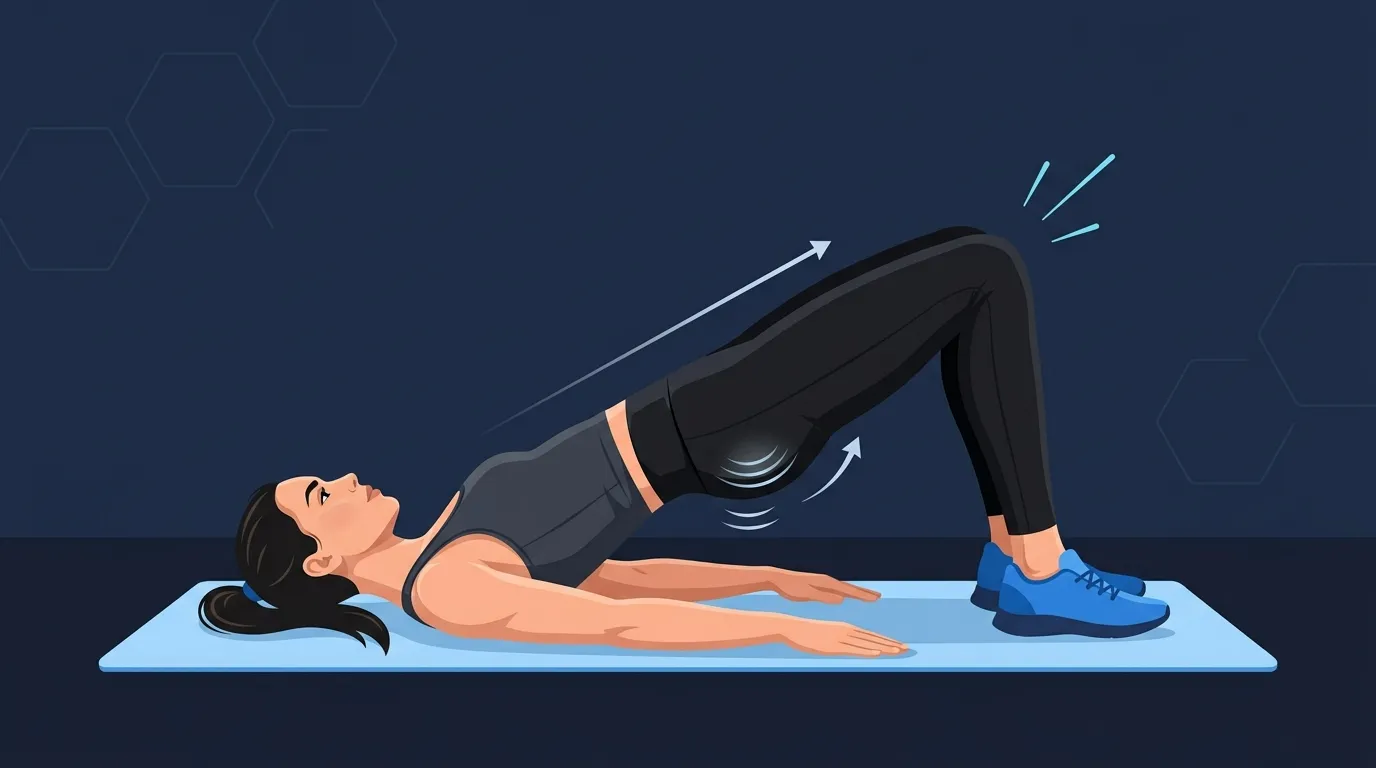
Common Mistakes (and How to Fix Them)
These are the errors that turn the glute bridge from a glute exercise into a lower-back exercise, or waste your time entirely. Here's what Ty corrects most often.
- Hyperextending at the top. Pushing your hips higher than the straight knees-to-shoulders line dumps load onto your lumbar spine. Fix: stop when your body is straight. No higher.
- Pushing through the toes. When you drive through the balls of your feet, the quads and calves take over and your glutes barely work. Fix: keep your weight in your heels. You should be able to lift your toes slightly at the top.
- Letting the knees cave inward. Sign of weak hip abductors. It robs your glutes of proper activation. Fix: actively push your knees out so they stay in line with your toes throughout the rep.
- Dropping too fast on the way down. The eccentric phase is where a lot of the strength comes from. Fix: take two seconds to lower. Resist gravity instead of giving in to it.
- Flaring the ribs. When your ribs flare up at the top, the core disengages and the lower back compensates. Fix: keep the ribcage pulled down toward your pelvis throughout the movement.
- Placing feet too far from your body. If your feet are too far away, you'll feel it in your hamstrings more than your glutes. Fix: at the top, your shins should be roughly vertical. If they're slanted forward, scoot your heels closer.
- Skipping the top squeeze. Rushing through reps without holding the peak contraction misses the most productive part of the movement. Fix: pause one to two seconds at the top of every rep and squeeze hard.
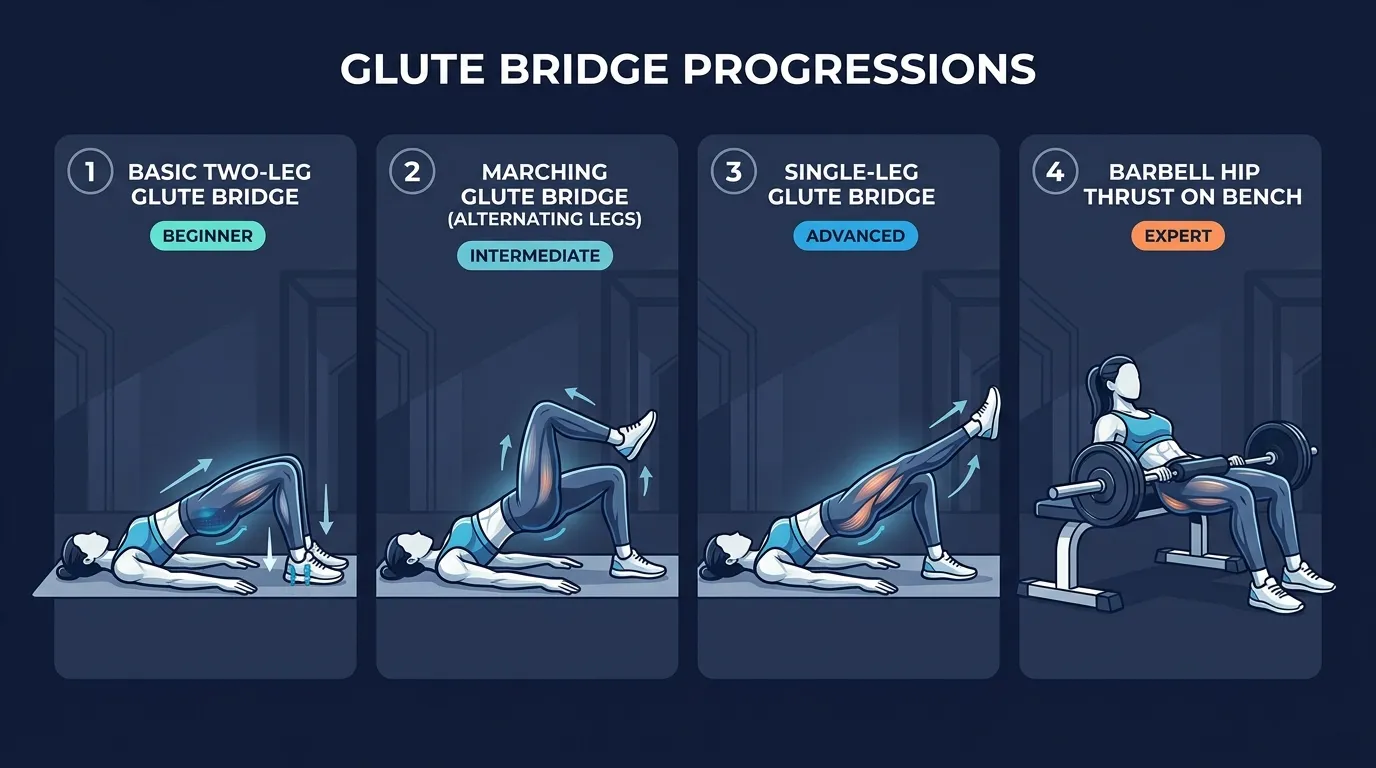
Glute Bridge Variations: Regressions and Progressions
Start where you are and progress when your form is solid at the current level.
Glute Bridge Partial (Beginner Regression)
If a full glute bridge causes back pain or you can't feel your glutes working at all, start with the partial range. Lift your hips only halfway, hold the squeeze, and lower with control. The reduced range lets you build the mind-muscle connection without exposing the lumbar spine to a full lever.
Standard Glute Bridge (Beginner)
The standard version described above is where most people should start. Bodyweight, beginner-friendly, and a clean teaching tool for hip extension mechanics and glute activation. Use it as a warm-up before lower-body sessions, or program it for higher reps (15 to 20) as part of your workout. Once you can do 3 sets of 20 reps with a full squeeze at the top, you're ready to progress.
Paused Glute Bridge (Intermediate)
Same movement, longer hold. Pause at the top for 3 to 5 seconds on every rep. This dramatically increases time under tension for the gluteus maximus without needing extra equipment. A great intermediate step before single-leg.
Single-Leg Glute Bridge (Advanced)
The single-leg glute bridge takes the same movement pattern and doubles the demand on each glute. By removing one leg from the equation, you also expose and correct side-to-side strength imbalances, which almost everyone has.
How to set up: Start in the same position as a standard glute bridge. Extend one leg straight out so it's roughly in line with your opposite thigh. Drive through the heel of the grounded foot to lift your hips, keeping the raised leg straight throughout.
Coach Ty's tips for single-leg glute bridges:
- Press the floor away. Engage your glutes as you lift your hips upward. Imagine pressing the floor away with your grounded foot.
- Keep the raised leg straight. Think of it as trying to kick the ceiling. A bent raised leg changes the leverage and makes the exercise easier than it should be.
- Control the descent. Stay in control as you lower your hips back to the ground, resisting gravity. The lowering phase is where the real strength is built.
- Drive through the heel. Feel the power in your glutes by pushing through the heel of the grounded foot. Not the toes, not the midfoot.
- Squeeze and hold. Hold the top position for a moment and squeeze your glutes. Make every single rep count.
FitCraft programs the left and right single-leg variations as separate movements to track balanced development. If one side is weaker, Ty may prescribe extra volume on that side to close the gap.
When to Avoid or Modify Glute Bridges
Glute bridges are safe for most healthy adults, but a few conditions call for modification or a smaller range. None of these are permanent restrictions. They're starting points. Always consult your physician or physical therapist for personalized guidance.
- Acute lower-back pain that worsens with hip extension. Most low-back pain improves with glute bridges because they strengthen the posterior chain without compressive spinal load. But if the lift itself spikes back pain (not glute fatigue), you are likely hyperextending or driving through your lumbar instead of your hips. Drop to the partial range, cue posterior pelvic tilt, and rebuild bracing with deadbugs and bird-dogs first.
- First 6 to 8 weeks postpartum or active diastasis recti. The bracing pattern under hip extension can increase intra-abdominal pressure. Start with diaphragmatic breathing, transverse abdominis activation, and deadbugs and bird-dogs. Progress to short-range glute bridges only once you can brace without doming or coning at the linea alba.
- Pregnancy past the first trimester. Avoid prolonged supine positions because of vena cava compression. Substitute with quadruped hip extension (donkey kicks, fire hydrants) or standing hip-extension drills under guidance from your prenatal provider.
- Hamstring cramping during reps. Cramping usually means the hamstrings are doing the work the glutes should be doing. Scoot your heels closer to your hips so shins are vertical at the top, and pre-squeeze the glutes before every lift to recruit them first.
- Recent hip, lower-back, or sacroiliac surgery. Get clearance from your surgeon or physical therapist. Most post-surgical protocols start with isometric glute squeezes lying down, then partial-range bridges, before progressing to full range.
- Knee discomfort from foot placement. Feet placed too close to your hips can compress the patellofemoral joint at the top. Move your heels slightly further away (still keeping shins close to vertical) until knee discomfort resolves.
Related Exercises
If glute bridges are part of your routine, these movements complement or extend the same training pattern:
- Easier regression: Glute Bridge Partial trains the same hip-extension pattern through a shorter range, useful for rebuilding bracing or working around back pain.
- Same muscle group (loaded hinge): Romanian Deadlifts and Good Mornings load the same posterior chain through a standing hip-hinge pattern, useful once you've outgrown bodyweight.
- Same muscle group (unilateral): Single-Leg Deadlifts hit the glutes and hamstrings unilaterally and pair well with single-leg glute bridges for balanced posterior-chain development.
- Glute-focused accessories: Donkey Kicks, Fire Hydrants, and Kickbacks isolate the gluteus maximus and medius without spinal load, great for high-rep activation work.
- Core foundation for spinal bracing: Deadbugs, Bird-Dogs, and Forearm Planks train the anti-extension bracing pattern glute bridges rely on, useful if your lower back takes over during sets.
- Compound that demands strong glutes: Squats use glute bridges as foundational activation and benefit directly from the hip-extension strength built here.
How to Program Glute Bridges
Glute bridge programming follows the same evidence-based ranges as any bodyweight strength or core exercise. The American College of Sports Medicine (ACSM) Position Stand on resistance training recommends roughly 8 to 12 reps per set for strength and 12 to 20 for muscular endurance, with at least 48 hours between sessions training the same muscle group (Ratamess et al., 2009).
| Level | Sets × Reps | Rest between sets | Frequency |
|---|---|---|---|
| Beginner (standard, activation) | 2–3 × 10–15 | 45–60 seconds | 2–4 sessions/week |
| Intermediate (paused or banded) | 3 × 12–20 | 45–60 seconds | 3–5 sessions/week |
| Advanced (single-leg or loaded hip thrust) | 3–4 × 8–15 per side | 60–90 seconds | 2–4 sessions/week |
Where in your workout: glute bridges work best in two slots. As an activation drill, place them at the start of a lower-body session for 1 to 2 sets of 10 to 15 reps to wake up the glutes before squats, deadlifts, or lunges. As a strength accessory, place them after the main compound lifts when the glutes are pre-fatigued and the bridge becomes a finishing burnout. In a core or rehab context, glute bridges fit anywhere because the load is low and the spinal demand is minimal.
Form floor over rep targets: if your last 2 reps of a set break form (hips sagging, back arching, no squeeze at the top), stop the set there. Hitting a target rep count with broken form is worse than hitting fewer reps cleanly.
How FitCraft Programs This Exercise
Knowing how to do a glute bridge is step one. Knowing when to do it, how many reps, and when to progress is where most people get stuck.
FitCraft's AI coach Ty handles that. During your personalized diagnostic assessment, Ty maps your fitness level, goals, and available equipment. Then Ty builds a personalized program that slots glute bridges into a balanced training plan at the right variation for your level.
For beginners, glute bridges show up as a warm-up activation exercise or as part of lower-body strength sessions, programmed at higher rep ranges (12 to 20) to build the mind-muscle connection. For intermediate and advanced users, single-leg variations replace the standard version, often paired with other lower-body movements for time-efficient sessions. For anyone working around low-back issues, glute bridges are often one of the first movements Ty prescribes because they strengthen the posterior chain without placing compressive load on the spine. As you get stronger, Ty adjusts the variation and volume to match your level. Every program is designed by an Ivy League-trained exercise scientist and NSCA-certified strength coach using evidence-based periodization, then adapted to you by the AI.
Frequently Asked Questions
Can I do glute bridges with lower-back pain?
Glute bridges are often one of the first exercises a physical therapist prescribes for low-back pain, because strong glutes take pressure off the lumbar spine. The catch is that they only help if you bridge with the glutes, not the lower back. If pushing up causes back pain instead of glute fatigue, you are likely hyperextending at the top or driving through your lumbar instead of your hips. Reduce the range, hold the top for two seconds, and cue posterior pelvic tilt. If pain persists, see a physical therapist for an assessment.
What muscles do glute bridges work?
Glute bridges primarily target the gluteus maximus through hip extension. They also engage the hamstrings as secondary movers, and the core, lower-back erectors, and hip stabilizers work isometrically to hold a neutral pelvis. The single-leg variation increases demand on the hip stabilizers and obliques to resist rotation.
How many glute bridges should I do per day?
For beginners, 2 to 3 sets of 10 to 15 reps is a solid starting point. More advanced lifters can progress to single-leg variations, paused holds, or loaded hip thrusts. FitCraft's AI coach Ty programs the right volume based on your level, goals, and weekly recovery.
What is the difference between a glute bridge and a hip thrust?
Both target the glutes through hip extension, but the setup differs. A glute bridge is performed with your back flat on the floor, which limits range of motion to about 90 degrees of hip extension. A hip thrust is performed with your upper back elevated on a bench, which adds 30 to 45 degrees of hip flexion at the bottom and allows for greater range and heavier loading. Glute bridges are the foundation. Hip thrusts are the loaded progression.
Are single-leg glute bridges harder than standard glute bridges?
Yes. Single-leg glute bridges are significantly more challenging because you are lifting your entire body weight with one leg instead of two. They also demand more balance and hip rotational stability, which exposes side-to-side strength imbalances. Once you can complete 3 sets of 20 standard glute bridges with a full squeeze at the top, you are ready to progress to single-leg.
Can I do glute bridges every day?
Bodyweight glute bridges are low-impact enough that most people can do them daily, especially as a warm-up or activation drill before lower-body sessions. If you are doing high-volume, paused, or loaded glute bridges as part of a strength session, allow 48 hours of recovery between sessions training the same muscle group.