The plank is the most popular core exercise in the world, and most people only know the forearm version. The hand plank takes things further by adding upper-body demand. You support your full bodyweight through extended arms, which loads the shoulders, wrists, chest, and triceps alongside the entire anterior core.
It's the same position as the top of a push-up, held for time. Simple. Not easy. The hand plank exposes every weak link: sagging hips reveal a soft core, shaking arms reveal weak shoulder stabilizers, and held breath reveals poor body-tension management.
Get this fundamental right and you've built the foundation for push-ups, burpees, and most compound lifts that demand a rigid trunk under load.
Quick Facts: Hand Plank
- Equipment needed: None (bodyweight)
- Difficulty: Beginner (incline) to Intermediate (floor)
- Modality: Strength (isometric)
- Body region: Core and upper body
- FitCraft quest category: Strength
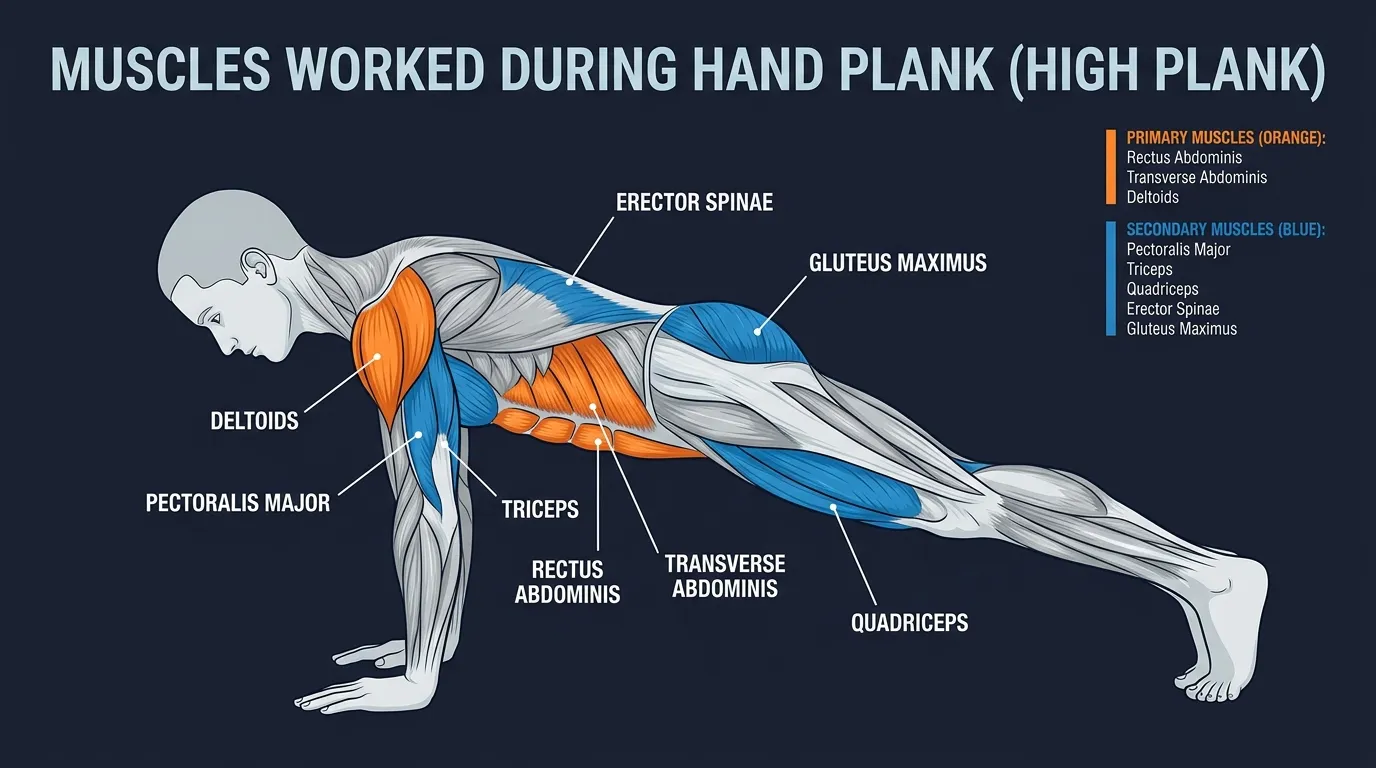
Muscles Worked
Primary movers: the rectus abdominis, transverse abdominis, and obliques. These work isometrically (no change in length) to resist spinal extension and keep the lumbar spine in a neutral position. The transverse abdominis is the central player. Its job is to maintain intra-abdominal pressure and prevent the lower back from arching toward the floor, which would shift load off the core and onto the spine.
Secondary movers: the anterior and middle deltoids, triceps brachii, pectoralis major, and serratus anterior. All four support your bodyweight through extended arms throughout the hold. The serratus anterior deserves a special note: it fires throughout the hold to keep the shoulder blades protracted (wrapped around the ribcage) rather than sagging together. Poor serratus engagement is what makes the upper back look "winged" during planks and push-ups.
Stabilizers: the glutes, quadriceps, hip stabilizers, and rotator cuff. The glutes squeeze to lock the pelvis in a posterior tilt and prevent the hips from sagging or piking. The quadriceps fire to keep the knees straight and the legs rigid. The rotator cuff stabilizes the shoulder joint under load. The breath is itself a stabilizer: exhaling under tension reinforces transverse abdominis activation, which is why holding your breath collapses the brace.
Mechanism: the hand plank is an anti-extension isometric. Gravity pulls the pelvis toward the floor, which would cause the lumbar spine to arch (extend) if the core didn't actively resist. The core trains this resistance the same way it does in a deadlift, a squat, or an overhead press. Walking the body through this skill in an unloaded plank position lets you train bracing without the stakes of a barbell on your back. That's why physical therapists prescribe planks (hand and forearm) as foundational rehab work for lower-back pain after the acute phase resolves.
Step-by-Step: How to Hold a Hand Plank
The hand plank looks like the simplest exercise in the gym. There's a real difference between holding the position and holding it correctly. Here's the right way.
Step 1: Get Into Position
Place your hands flat on the floor directly under your shoulders with your arms fully extended. Step your feet back until your body forms a straight line from the crown of your head to your heels. Feet should be hip-width apart for balance.
Coach Ty's cue: "Your wrists should be directly under your shoulders." And: "Your feet should be hip-width apart for balance."
Step 2: Engage Your Entire Body
This isn't a passive hold. You need active tension from head to toe. Tighten your core like you're bracing for a punch. Squeeze your glutes. Press your hands into the floor as if you're trying to push it away from you. That full-body engagement is what turns a casual plank into a real strength exercise.
Ty's cues: "Keep your core tight throughout the exercise, like a plank of wood." And: "Push your hands into the floor as if you're trying to push it away from you."
Step 3: Align Your Head and Spine
Your head should sit in a neutral position, directly in line with your spine. Gaze at the floor just in front of your fingertips. Not forward, not at your feet. A neutral head position keeps the entire spine aligned and prevents neck strain.
Ty reminds: "Your head should be in line with your back."
Step 4: Hold and Breathe
Hold the position for the prescribed time while breathing steadily. This is where most people fail. They either hold their breath or let their form fall apart as fatigue sets in. Steady breathing keeps the muscles oxygenated and the blood pressure stable. Don't sacrifice form for duration.
Ty's cue: "Focus on your breathing. Don't accidentally hold your breath." And: "Try not to let your hips sag. Keep them at the same level as the rest of your body." Squeeze your glutes for extra anti-sag insurance: "Squeeze your glutes for an extra challenge."
Step 5: Lower with Control
When the hold is complete, or when your form starts to break, lower your knees to the floor slowly. Don't collapse. Rest briefly, then repeat for the prescribed number of sets.
Ty's encouragement: "If you're struggling, just hold for as long as you can. You're building strength every time."
Get this exercise in a personalized workout
FitCraft, our mobile fitness app, uses its AI coach Ty to program core stability work like this into your plan at the right volume and intensity, based on your level, goals, and equipment. Ty was designed and trained by Domenic Angelino, MPH (Brown University) and NSCA-CSCS, with research published in the Journal of Strength and Conditioning Research and Medicine & Science in Sports & Exercise.
Take the Free Assessment Free · 2 minutes · No credit card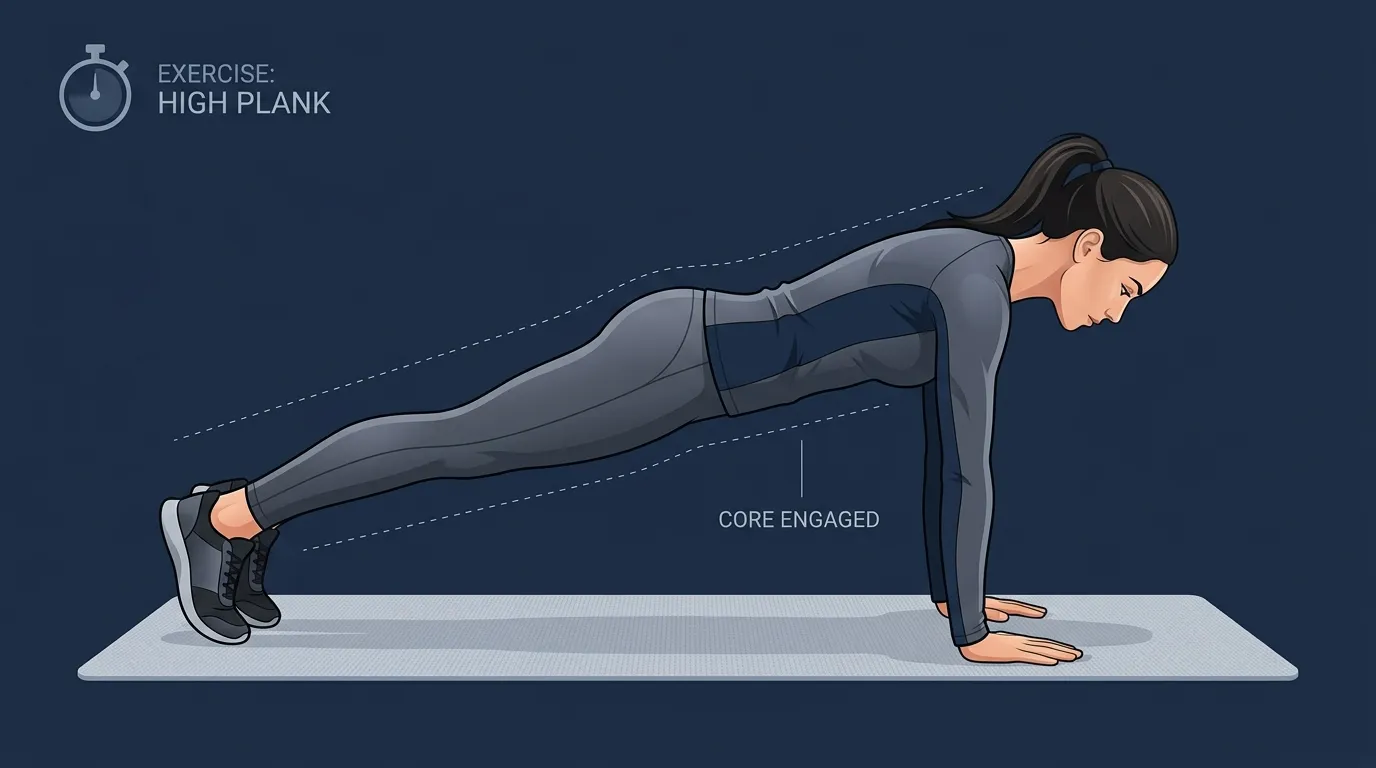
Common Mistakes (and How to Fix Them)
The hand plank reveals every weakness in the kinetic chain. Here are the errors Ty corrects most often, and the fix for each.
- Sagging hips. The most common plank mistake. When the core fatigues, the hips drop and the lower back takes the load. Fix: actively squeeze the abs and glutes throughout the entire hold. If your hips start to sag, end the set. You've reached your form limit for that round.
- Piking hips upward. The opposite problem. Hiking your hips toward the ceiling turns the plank into a downward dog stretch and removes the anti-extension demand. Fix: check your alignment in a mirror or ask someone to look. Your body should form a straight line, not a tent shape.
- Hands too far forward. When the hands are ahead of the shoulders, the shoulder joint is under unnecessary stress and the wrists get pinched. Fix: stack your wrists directly under your shoulders. Straight line from shoulder to wrist.
- Holding your breath. Almost everyone does this during planks. It spikes blood pressure and cuts your hold time short. Fix: breathe in through your nose for 3 counts, out through your mouth for 3 counts. Steady rhythm throughout the hold.
- Head dropping or craning up. Both positions pull the cervical spine out of alignment and can produce neck strain that lingers for days. Fix: keep your head neutral and gaze at the floor just ahead of your fingertips. Your ears should sit in line with your shoulders.
- Feet too close together. This creates a balance challenge that makes the plank harder for the wrong reasons (lateral stability becomes the limiter instead of core strength). Fix: keep feet hip-width apart until you've mastered the hold, then narrow them for added difficulty if desired.
- Soft shoulder blades (winging). If the upper back caves between the shoulder blades, the serratus anterior is off duty. Fix: actively press the floor away from you and feel the upper back round slightly. The shoulder blades should wrap around the ribcage, not pinch toward each other.
Hand Plank Variations: Regressions and Progressions
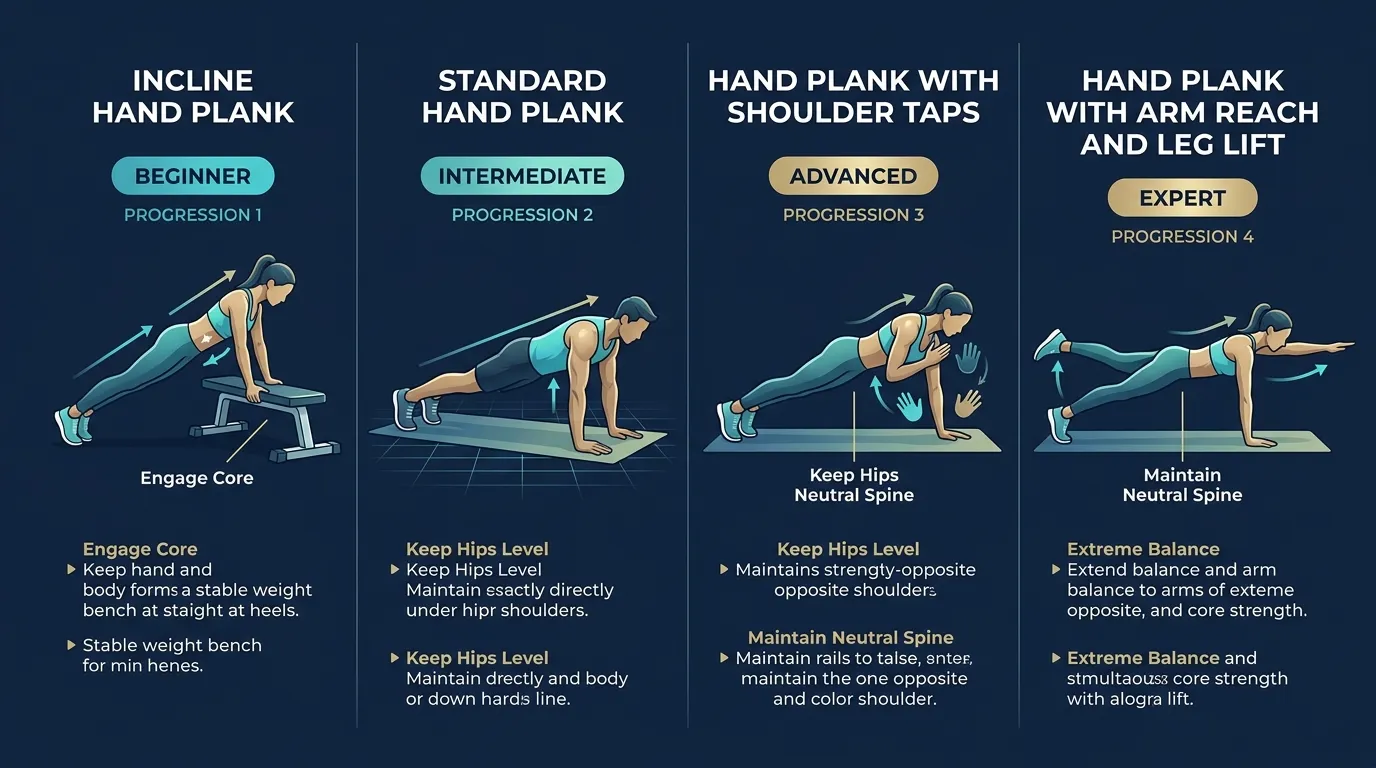
The hand plank is the foundation for a family of plank exercises. Start where you are and progress when your form is solid at the current level.
Incline Hand Plank (Beginner Regression)
Place your hands on an elevated surface (a bench, step, sturdy table, or kitchen countertop) instead of the floor. This reduces the percentage of bodyweight your core and shoulders must support. The higher the surface, the less load. Same exercise pattern, lighter dose, and an excellent starting point if the floor variation feels too demanding or aggravates the wrists.
Standard Hand Plank (Intermediate)
The version described above. Hands on the floor, body in a straight line, held for time. Once you can hold for 45 to 60 seconds with perfect form and steady breathing, you're ready for harder progressions.
Forearm Plank (Sibling Variation)
Same anti-extension hold, performed on the forearms instead of the hands. Trades wrist load for elbow load. Often easier on the shoulders. Useful when wrist pain or shoulder fatigue is the limiter, or when you want to isolate the anterior core without the upper-body bracing component.
Shoulder Tap Plank (Advanced Progression)
From the standard hand plank, lift one hand off the floor and tap the opposite shoulder, then switch. This adds an anti-rotation challenge: your core must work overtime to prevent your body from twisting toward the unloaded side. Keep your hips perfectly level throughout. If the hips rotate, slow down or widen the feet.
Plank to Push-Up (Advanced Progression)
Alternate between the hand plank and a forearm plank by lowering one arm at a time to the forearm, then pressing back up. This combines isometric core work with dynamic upper-body work and substantially raises the difficulty. Alternate the lead arm each set to avoid asymmetric load.
Spider Plank (Advanced Progression)
From the standard hand plank, drive one knee out to the side toward the same-side elbow, then return and switch. Adds hip mobility and oblique flexion under load while the rest of the body maintains plank position. A solid bridge from static planks to dynamic core work.
When to Avoid or Modify Hand Planks
The hand plank is safe for most healthy adults, but several conditions warrant modification or temporary substitution. None of these are permanent restrictions. They're starting points. Always consult your physician or physical therapist for personalized guidance.
- Wrist pain, carpal tunnel, or arthritic wrists. The hand plank loads the wrists at roughly 90 degrees of extension under bodyweight. Modify with push-up handles or dumbbell grips (keeps the wrist neutral), switch to a forearm plank, or use a high-incline hand plank against a bench or counter to reduce wrist load.
- Acute shoulder impingement or rotator cuff irritation. Full-load extended-arm planks can compress the supraspinatus tendon, especially if the shoulder blades aren't well-controlled. Switch to a forearm plank or a high-incline hand plank, focus on actively pressing the floor away to engage the serratus anterior, and stay only within a pain-free range. If symptoms persist for more than a week or two, see a physical therapist before progressing.
- Acute lower-back pain or known disc pathology. Hand planks are usually well-tolerated and often prescribed in rehab once the acute phase resolves (anti-extension isometrics are protective for the lumbar spine), but get PT clearance first. Start with shorter incline holds and build from there.
- Recent shoulder, wrist, or elbow surgery. Get clearance from your surgeon before any plank or pressing exercise. Most post-surgical protocols start with isometric scapular work, then wall planks, before introducing inclined or floor variations on a controlled timeline.
- First 6 to 8 weeks postpartum or active diastasis recti. Full plank positions demand real deep-core engagement. If the core can't hold a neutral spine, the lumbar will sag and intra-abdominal pressure can worsen abdominal separation. Restore deep-core function first with diaphragmatic breathing, deadbugs, and bird-dogs. Progress to wall and incline planks before the floor variation, and watch for doming or coning along the midline.
- Pregnancy (especially second and third trimester). The plank position is generally fine in early pregnancy, but as the belly grows, the load on the linea alba increases. Switch to incline or wall planks, watch for doming, and stop if you feel any pelvic-floor pressure or coning.
- Uncontrolled hypertension. Long isometric holds can spike blood pressure, especially if breathing isn't controlled. Keep holds short (15 to 30 seconds), breathe steadily, and avoid any breath-holding.
Related Exercises
If hand planks are part of your routine, these movements complement or extend the same training pattern:
- Same anti-extension pattern: Forearm Planks (same hold, forearms down, less wrist and shoulder demand) and Hollow Holds (supine version of the same anti-extension brace, no shoulder load).
- Anti-rotation companions ("Big 3" core stability): Side Planks (anti-lateral-flexion) and Bird-Dogs (anti-rotation on hands and knees) round out the McGill "Big 3" with plank holds.
- Foundation for spinal bracing: Deadbugs and Bird-Dogs teach the same bracing skill in unloaded positions. Useful regressions if hand planks aggravate the back or you need to rebuild deep-core function postpartum or post-injury.
- Dynamic plank progressions: Spider Planks, Plank Twists, and Plank Walks add movement on top of the static base. Build a clean 60-second hand plank first.
- Posterior chain balance: Superman Holds (anti-flexion isometric) and Glute Bridges (hip-extension pattern that locks the pelvis during planks) round out a complete core program.
- Compound that demands strong planking: Push-Ups start and end in the hand plank position. A clean 45 to 60-second hand plank is the bracing foundation push-ups rely on.
How to Program Hand Planks
Hand plank programming treats the exercise as an isometric hold, where time-under-tension is the primary load variable. The American College of Sports Medicine (ACSM) Position Stand on resistance training supports the general principles of progressive overload and at least 48 hours between sessions for the same muscle group (Ratamess et al., 2009). For planks specifically, hold time and frequency are the primary progression levers, not raw rep count.
| Level | Hold time × Sets | Rest between sets | Frequency |
|---|---|---|---|
| Beginner (incline or short floor holds) | 15–30 seconds × 2–3 | 45–60 seconds | 2–4 sessions/week |
| Intermediate (standard floor) | 30–60 seconds × 3 | 60 seconds | 3–5 sessions/week |
| Advanced (long holds, shoulder taps, plank-to-push-up) | 60–120 seconds × 3–5 | 60–90 seconds | 4–6 sessions/week |
Where in your workout: hand planks fit at the end of a resistance-training session as a core finisher (training core to fatigue before compound lifts compromises spinal stability under load), as a standalone "core day" or "core block," or as a brief activation drill (15 to 30 second holds) at the start of a session to wake up the deep core before squats, deadlifts, or overhead presses. They also pair naturally with push-ups in upper-body circuits because both use the same shoulder-and-core bracing pattern.
Form floor over duration targets: if your last 10 seconds of a hold break form (hips sag, back arches, breath stops), end the set at the last clean second. Holding for 90 seconds with a sagging back trains worse motor patterns than holding for 45 seconds with a clean plank. The goal is quality time under tension.
How FitCraft Programs This Exercise
Knowing how to hold a hand plank is step one. Knowing the right hold duration, when to progress, and how planks fit into a complete training program is where most people get stuck or plateau.
FitCraft's AI coach Ty handles that. During your personalized diagnostic assessment, Ty maps your current fitness level, available equipment, and goals. Then Ty builds a personalized program that integrates hand planks into a balanced training plan, pairing them with complementary core exercises, push-up progressions, and full-body movements.
As you get stronger, Ty adjusts the variation and volume to match your level. Hold durations increase. Incline regressions become floor planks. Standard planks get paired with dynamic variations like shoulder taps. Every program is designed by an Ivy League-trained exercise scientist and NSCA-certified strength coach using evidence-based periodization, then adapted to you by the AI.
Frequently Asked Questions
Can I do hand planks if I have wrist pain?
The hand plank loads the wrists at roughly 90 degrees of extension under bodyweight, which can aggravate carpal tunnel, wrist strain, or arthritic wrists. Two effective modifications: switch to a forearm plank (forearms flat, elbows under shoulders, wrists unloaded entirely), or use push-up handles or dumbbell grips to keep the wrist in a neutral, vertical position. A high-incline hand plank against a counter or bench also dramatically reduces wrist load. If pain persists for more than a week or two after these modifications, see a physical therapist for an assessment before progressing.
What is the difference between a hand plank and a forearm plank?
A hand plank (high plank) is performed with arms fully extended and hands under the shoulders. A forearm plank is performed with the forearms flat on the floor, elbows under the shoulders. The hand plank places more demand on the shoulders, wrists, and triceps. The forearm plank isolates the anterior core more directly because the upper body has less bracing work to do. Both train the same anti-extension pattern. The hand plank adds an upper-body stability component the forearm plank doesn't, and doubles as the top position of a push-up.
How long should I hold a hand plank?
For beginners, aim for 15 to 30 seconds with perfect form. Intermediate exercisers should target 30 to 60 seconds. Advanced practitioners can work up to 60 to 120 seconds. The number that matters most is the moment your form breaks. The instant your hips sag, your back arches, or your breathing stops, the set is over. Holding for 90 seconds with a sagging lower back is worse than holding for 45 seconds with a clean plank.
Do hand planks build upper body strength?
Yes, as a secondary effect. The primary stimulus is anterior-core anti-extension. The shoulders (deltoids), triceps, and chest work isometrically to support your bodyweight throughout the hold, which builds shoulder stability and upper-body endurance alongside core strength. The hand plank is the top position of a push-up, so it's a strong foundation for building toward bodyweight pressing.
Why do my shoulders shake during a hand plank?
Shaking usually means one of three things: the shoulder stabilizers (rotator cuff, serratus anterior, scapular muscles) are at their endurance limit; the wrists are taking too much load because the hands are too far forward of the shoulders; or general fatigue from a long hold. The fix for the first two is to actively press the hands into the floor (this engages the serratus anterior and locks the shoulder blades) and verify wrists stack directly under shoulders. If shaking starts within 10 to 15 seconds, regress to an incline hand plank to build endurance, then return to the floor variation.