High knees are a staple cardio drill that can spike heart rate, sharpen coordination, and build lower-body endurance with no equipment at all. They are essentially running in place with exaggerated knee lifts, and that simplicity is what makes them so versatile. Warm-up, finisher, HIIT interval, active recovery, high knees fit anywhere in your program.
The catch? Most people either go through the motions with knees barely reaching waist height, or they sacrifice posture for speed and end up leaning so far back they are practically falling. Proper high knees demand both height and control. Here is how to nail them.
Quick Facts: High Knees
- Equipment needed: None (optional light resistance band for the banded variation)
- Difficulty: Beginner (marching) to Intermediate (steady rhythm) to Advanced (sprint bursts, banded)
- Modality: Cardio / Conditioning
- Body region: Lower body
Muscles & Systems Worked
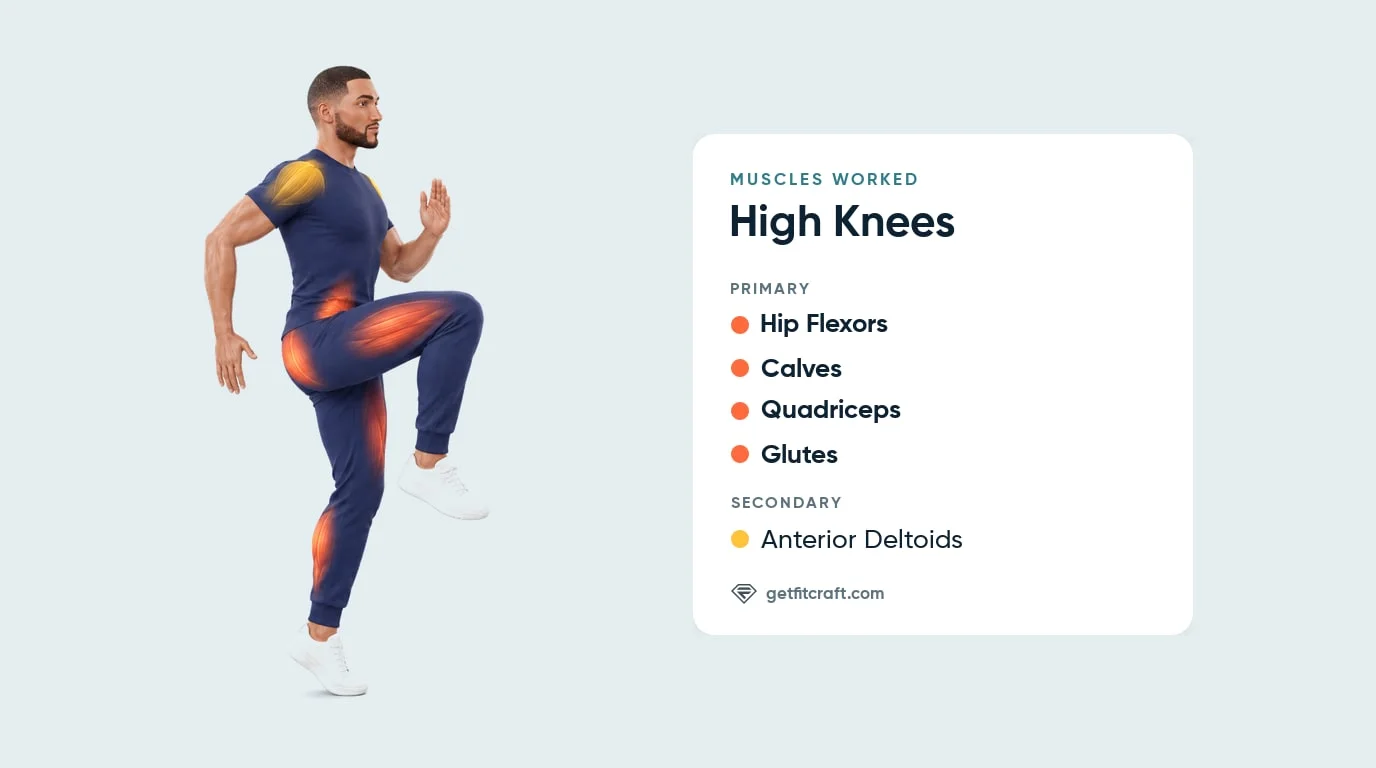
Primary movers: the hip flexors, calves, quadriceps and glutes. The hip flexors, mainly the iliopsoas (psoas major plus iliacus), lift each thigh to hip height on every step. The calves push you up through the balls of your feet on each small hop and soften each landing. The glutes drive each leg back down to the floor and help push you off it.
The quadriceps work on every step too. The rectus femoris, the only quadriceps head that crosses both the hip and the knee, helps lift the thigh, and the other heads (vastus lateralis, vastus medialis and vastus intermedius) straighten the knee as the leg comes back down to land and push off. In a study of 12 women running in place on dry land, with the hip and knee raised to 90 degrees on each step, the rectus femoris and vastus lateralis were more active at maximal speed than at a metronome pace of 80 beats per minute, and the vastus lateralis was most active as the hip and knee straightened (Alberton et al., 2015).
Secondary movers: the front deltoids (anterior deltoids) swing each arm forward as you pump your arms in opposition to your legs, which keeps you balanced and steadies the torso.
Energy systems and the cardiovascular stimulus: high knees are a fast, repeated movement: the standing leg pushes against the floor on every step while the other leg swings freely, and heart rate climbs fast. Short bursts (under 30 seconds) draw mostly on the phosphocreatine and glycolytic systems for ATP. Longer intervals (45 seconds and beyond) shift toward the oxidative system. This is why interval structure matters more than rep count: a 20-second sprint and a 60-second steady effort train fundamentally different qualities. The quick, springy landings on the balls of your feet also rehearse the elastic recoil pattern that running and most jumping sports depend on.
Step-by-Step: How to Perform High Knees
Whether you are doing a slow march or a full-speed sprint variation, the movement pattern is the same. The cues below apply across all intensities.
Step 1: Stand Tall with Feet Hip-Width Apart
Start with good posture. Chest up, shoulders back, core engaged, eyes looking straight ahead. Your arms should be relaxed at your sides with elbows bent at roughly 90 degrees, the same position they would be in if you were running.
Form tip: keep your knees and feet pointing straight ahead, and fix your eyes on a point in front of you to help keep your head and torso steady.
Step 2: Drive Your Right Knee Up to Hip Height
Using your hip flexors, drive your right knee up until your thigh is at least parallel to the floor. Stay on the ball of your left foot as your right knee rises.
Form tip: hip height is the target. Going higher is fine as long as your torso stays upright. Knee height and pace together set how hard the exercise is, so low knee drives make it much easier.
Step 3: Pump Your Opposite Arm Forward
As your right knee drives up, your left arm should swing forward. This counter-rotation is natural, like running, and it keeps you balanced and on rhythm.
Form tip: pump your arms like a sprinter, opposite arm with opposite knee, with your elbows bent at about 90 degrees.
Step 4: Switch Legs Immediately
As your right foot touches back down, drive your left knee up to the same height. Switch legs with a small hop, so the transition is quick and light. You are running in place, not marching.
Form tip: land softly on the balls of your feet with your knees slightly bent. Landing with bent knees softens the impact of each step, while stiff, flat-footed landings break your rhythm.
Step 5: Hold a Steady Rhythm and Breathe
Find a pace you can maintain with full knee height for the entire interval. If your knees start to drop, slow down a little rather than letting them sink. Breathe steadily the whole time and never hold your breath.
Get this exercise in a personalized workout
FitCraft, our mobile fitness app, uses its AI coach Ty to program conditioning work like this into your plan at the right volume and intensity, based on your level, goals, and equipment. Ty was designed and trained by Domenic Angelino, MPH (Brown University) and NSCA-CSCS, with research published in the Journal of Strength and Conditioning Research and Medicine & Science in Sports & Exercise.
Take the Free Assessment Free · 2 minutes · No credit card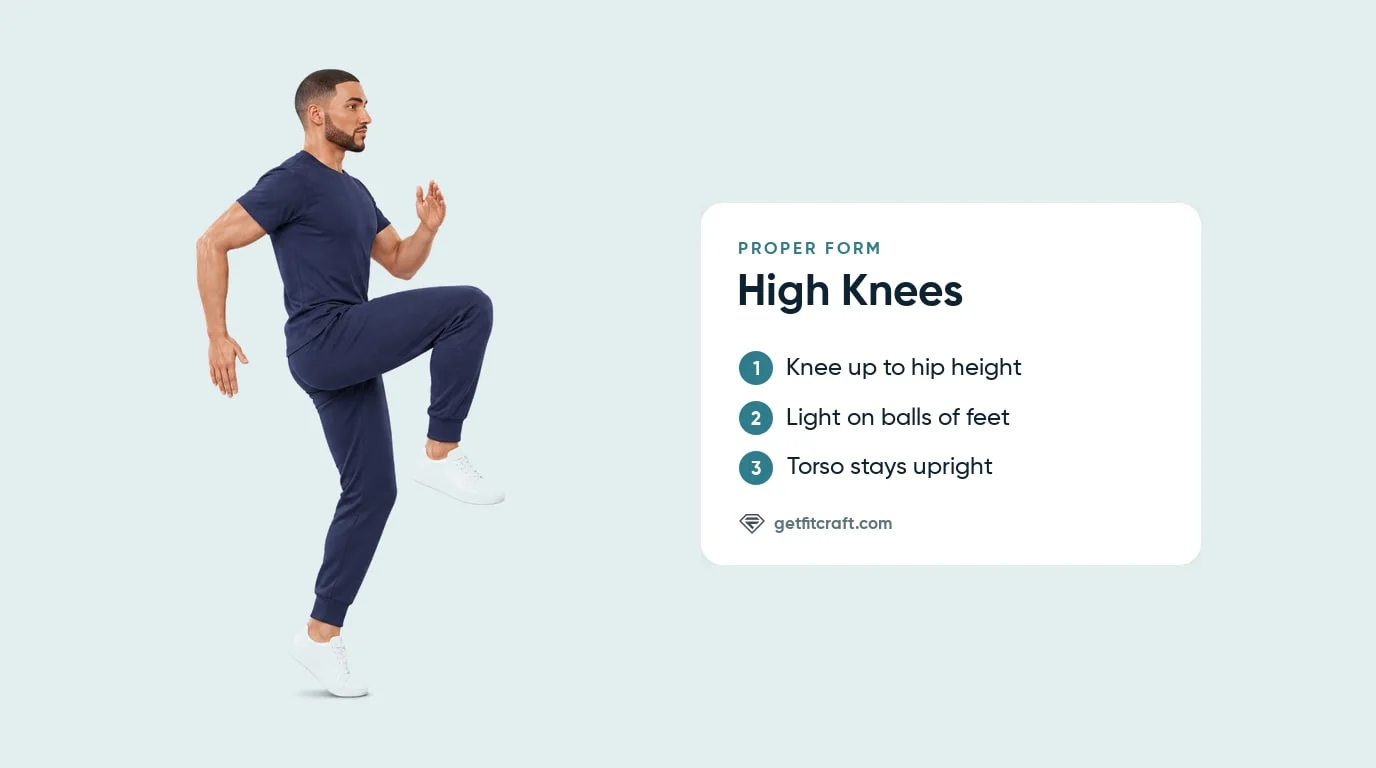
Common Mistakes (and How to Fix Them)
These are the most common mistakes and how to fix them.
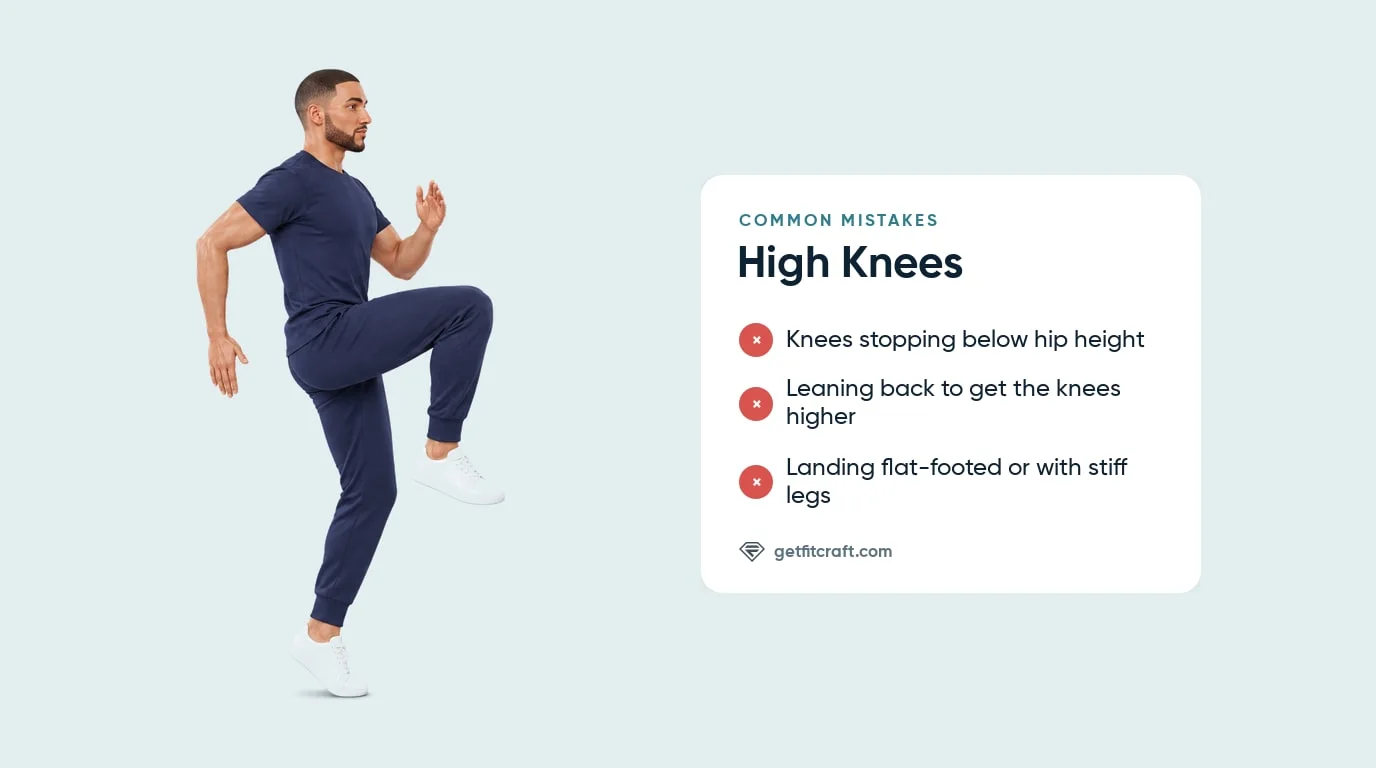
- Knees not reaching hip height. If your knees are not coming up to at least waist level, you are not getting the full benefit. Fix: slow the cadence down until you can reliably hit the height, then build pace back up. Height first, speed second.
- Leaning forward or backward. Leaning back to get the knees higher, or hunching forward over the knee drive, breaks the upright running posture. Fix: keep the torso vertical, with your shoulders over your hips, and slow down if you can only reach hip height by leaning.
- Flat-footed or stiff-legged landings. Landing on your heels or with locked knees makes each step hit harder and breaks your rhythm. Fix: stay light on the balls of your feet with your knees slightly bent, heels barely touching between reps.
- Arms hanging at your sides. Without the arm swing it is harder to stay balanced and keep a steady rhythm. Fix: pump your arms actively in opposition to your legs, the same way you would when running.
- Holding your breath. High knees are demanding on your cardiovascular system. Holding your breath leads to premature fatigue and sometimes dizziness. Fix: establish a breathing rhythm at the start of the set and stay with it.
- Cadence outpacing form. Going as fast as possible from rep one usually means knees drop in the second half of the interval. Fix: pick a sustainable cadence that holds full knee height all the way through.
- Knees or feet flaring out to the sides. Each knee should drive straight up in front of its hip. Fix: keep your knees and feet pointing straight ahead on every step.
High Knees Variations: Regressions and Progressions
Start where your conditioning and joints allow, then progress when you can hold full knee height for the whole interval.
Marching High Knees (Beginner Regression)
Perform the movement at walking speed: one knee up, foot down, then the other knee up. No bounce, no plyometric component. This builds the movement pattern and hip flexor endurance without the cardiovascular spike or impact of the running version. Use this if you are returning to exercise, in early postpartum, or working around mild knee, shin, or ankle issues.
Standard High Knees (Intermediate)
Running in place with a small hop between steps, knees driving to hip height and rhythmic arm pumping. This is the version the FitCraft app teaches, at its Intermediate level, and the default for warm-ups, conditioning intervals, and finishers. Once you can hold 30 to 45 seconds at full knee height, you are ready for the advanced variations.
High Knees with a Twist
Add a torso rotation as each knee rises, driving the opposite elbow toward the lifted knee. This adds an oblique and anti-rotation core challenge on top of the cardio stimulus. Useful in core circuits and dynamic warm-ups.
Banded High Knees (Advanced)
Place a light resistance band around your feet or just above the ankles. The added resistance ramps up hip flexor engagement and makes each knee drive significantly harder. Lower the cadence to maintain knee height. Excellent for sprint-specific conditioning.
Sprint High Knees (Advanced)
Perform at maximum cadence and maximum knee height for short bursts (10 to 15 seconds). This plyometric variation trains explosive hip flexor power and pushes the alactic and glycolytic systems hard. Pair with long rest intervals (45 to 90 seconds) so each burst is genuinely maximal.
When to Avoid or Modify High Knees
High knees are safe for most healthy adults, but a few conditions call for modification or for swapping the running version for a low-impact alternative. None of these are permanent restrictions. They are starting points. Always consult your physician or physical therapist for personalized guidance.
- Knee pain, patellofemoral pain, or recent knee injury. The plyometric landing on the ball of the foot transmits force up through the knee. Any knee pain or instability means you should stop, then drop to marching in place or seated knee drives and get a physical therapist to assess the pattern before returning to the running version.
- Shin splints or a history of stress reactions. Repeated impact loading is a textbook aggravator for medial tibial stress syndrome. Substitute marching high knees or squat walks until pain is gone for at least two weeks, then reintroduce gradually with shorter intervals.
- Stress incontinence or pelvic-floor weakness. Jumping and high-impact landings spike intra-abdominal pressure and often trigger leakage. Use marching in place instead, prioritize pelvic-floor coordination work, and consider a pelvic-floor physical therapist if symptoms persist.
- First 6 to 12 weeks postpartum. The pelvic floor and connective tissue need time to recover before they can absorb impact safely. Start with marching, then progress to low knees and finally to running-style high knees only after clearance from a pelvic-floor PT or your obstetric provider.
- Second or third trimester of pregnancy. Joint laxity from relaxin plus the shifted center of gravity increase fall risk during high-cadence running in place. Substitute marching or low knees and keep the cadence moderate.
- Known cardiovascular disease or uncontrolled hypertension. High knees rapidly elevate heart rate and blood pressure. Get cardiologist clearance and stay within prescribed heart-rate zones. Marching in place is a far gentler conditioning option for early reintroduction.
- Vertigo, balance disorders, or vestibular conditions. Fast cyclic limb movement plus visual flow can trigger episodes. Switch to marching with a fingertip on a wall or chair for balance support.
- Asthma or exercise-induced bronchoconstriction. Keep an inhaler accessible, use a longer warm-up before high-intensity intervals, and consult your physician about pre-exercise protocols.
Related Exercises
If high knees are part of your routine, these movements complement or extend the same training pattern:
- Lower-impact alternatives within the same pattern: Marching in Place and Walking in Place keep the cyclic hip-flexion drive without the plyometric landing, useful for warm-ups, deload weeks, or pelvic-floor-aware programming.
- Similar cardio drills in the same family: Butt Kicks train the opposite half of the running cycle (knee flexion and hamstring engagement) and High Knee Running takes the same pattern into forward locomotion.
- HIIT pairings for circuits: Mountain Climbers, Jumping Jacks, and Burpees pair well with high knees in metabolic conditioning blocks.
- Power and impact progression: Jump Squats and Jump Lunges build the same triple-extension landing tolerance and pair with high knees in lower-body plyometric work.
- Core stability foundation: Forearm Planks and Deadbugs train the anti-extension and anti-rotation patterns that keep the torso upright during high knees.
- Ankle and foot conditioning: Calf Raises and Calf Hops train the calves and Achilles tendons directly.
How to Program High Knees
HIIT-style cardio drills like high knees are programmed by time and work-to-rest ratio, not by sets and reps. The research we reviewed gives no work or rest times for high knees, so treat the table below as a practical starting point and adjust it to how well your knee height holds up.
| Level | Work × Rest | Rounds per session | Frequency |
|---|---|---|---|
| Beginner (marching or short intervals) | 20–30 sec on / 60–90 sec off | 4–6 rounds (10–15 min total) | 2–3 sessions/week |
| Intermediate (steady-rhythm running) | 30–45 sec on / 45–60 sec off | 6–10 rounds (15–25 min total) | 3–4 sessions/week |
| Advanced (sprint bursts or banded) | 15 sec sprint / 45 sec rest, or 45–60 sec / 30–45 sec | 8–12 rounds (20–30 min total) | 3–5 sessions/week |
Where in your workout: high knees work well in three slots. As a dynamic warm-up (2 sets of 20 to 30 seconds to raise core temperature and prime the hip flexors before strength work), as a HIIT interval inside a circuit (paired with mountain climbers, burpees, jumping jacks), or as a metabolic finisher at the end of a session (5 to 10 minutes max). Do not program a hard high-knees interval before heavy compound lifts. Cardio first dampens force production for the strength block.
Form floor over time targets: if your knees drop below hip height in the last 10 seconds of an interval, the interval was too long. Cut the work time, add rest, or drop to marching for the round. Quality of knee height beats clock time every set.
How FitCraft Programs This Exercise
Knowing how to do high knees is the easy part. Knowing when to slot them in, how long the interval should be, and how often to repeat them is where most home workouts get sloppy.
FitCraft handles that. The diagnostic maps your fitness level and goals, then the app builds a plan around them. High knees are one of the app's intermediate cardio exercises, and marching in place is a separate beginner exercise. The app's interactive 3D demonstration shows the form: knees driven to about hip height, light landings on the balls of the feet, and an upright torso.
As you get fitter, the app adjusts your workouts to match your progress. Every program is designed by an Ivy League-trained exercise scientist and NSCA-certified strength coach using evidence-based periodization, then adapted to you by the AI.
Frequently Asked Questions
Can I do high knees if I have knee pain?
It depends on the cause. Any knee pain, including patellofemoral pain, or a known meniscus or ligament issue means you should skip the plyometric version and substitute marching high knees, low knees, or seated knee drives, then get a physical therapist to assess the underlying pattern. Mild stiffness or end-of-range achiness often improves with a gradual warm-up and lower volume. The hip-flexion drive itself does not load the knee joint much. The repeated landing on the ball of the foot does. Stop if landing hurts, and use a slower tempo or marching instead of the hop.
Are high knees cardio or strength?
High knees are primarily a cardio exercise. They elevate heart rate quickly and train the glycolytic and oxidative energy systems for cardiovascular endurance. They also work the hip flexors, calves, quadriceps and glutes on every step, with the front deltoids helping as your arms pump, and the faster you go, the harder your thigh muscles work.
How long should I do high knees?
For a warm-up, 30 to 60 seconds of high knees is plenty to raise core temperature and prime the hip flexors. For a cardio conditioning effect, try 3 to 4 sets of 30 to 45 seconds with 15 to 30 seconds of rest between sets. Beginners should start with shorter intervals of 15 to 20 seconds and build duration as fitness improves. The interval matters less than knee height: if your knees drop below hip level in the last 10 seconds, the interval was too long.
Do high knees burn belly fat?
No exercise spot-reduces fat from a specific area. Fat loss is driven by energy balance across the week. High knees are an effective calorie-burning movement that contributes to overall fat loss when combined with a sensible diet.
Why do my shins hurt during high knees?
Shin pain during repeated knee drives is usually one of three things: weak tibialis anterior (the muscle along the front of your shin) struggling to control foot strike, too much volume too soon, or landing heavy on the heels instead of the ball of the foot. Drop to marching high knees for a few weeks, train calf raises and tibialis raises directly, and check that you are landing softly on the balls of your feet. Stop if your shins hurt, and see a physical therapist or sports medicine doctor if the pain keeps coming back, to rule out shin splints or a stress reaction.