Jumping jacks are the classic cardio exercise everyone learned as a kid, and there's a reason they've stuck around. They're simple, need zero equipment, and work the entire body in one movement. They land in warm-ups, between strength sets, in HIIT circuits, and as standalone home cardio. Done well they're a fantastic conditioning tool. Done with stiff, heavy landings, they put extra stress on your joints.
Muscles & Systems Worked
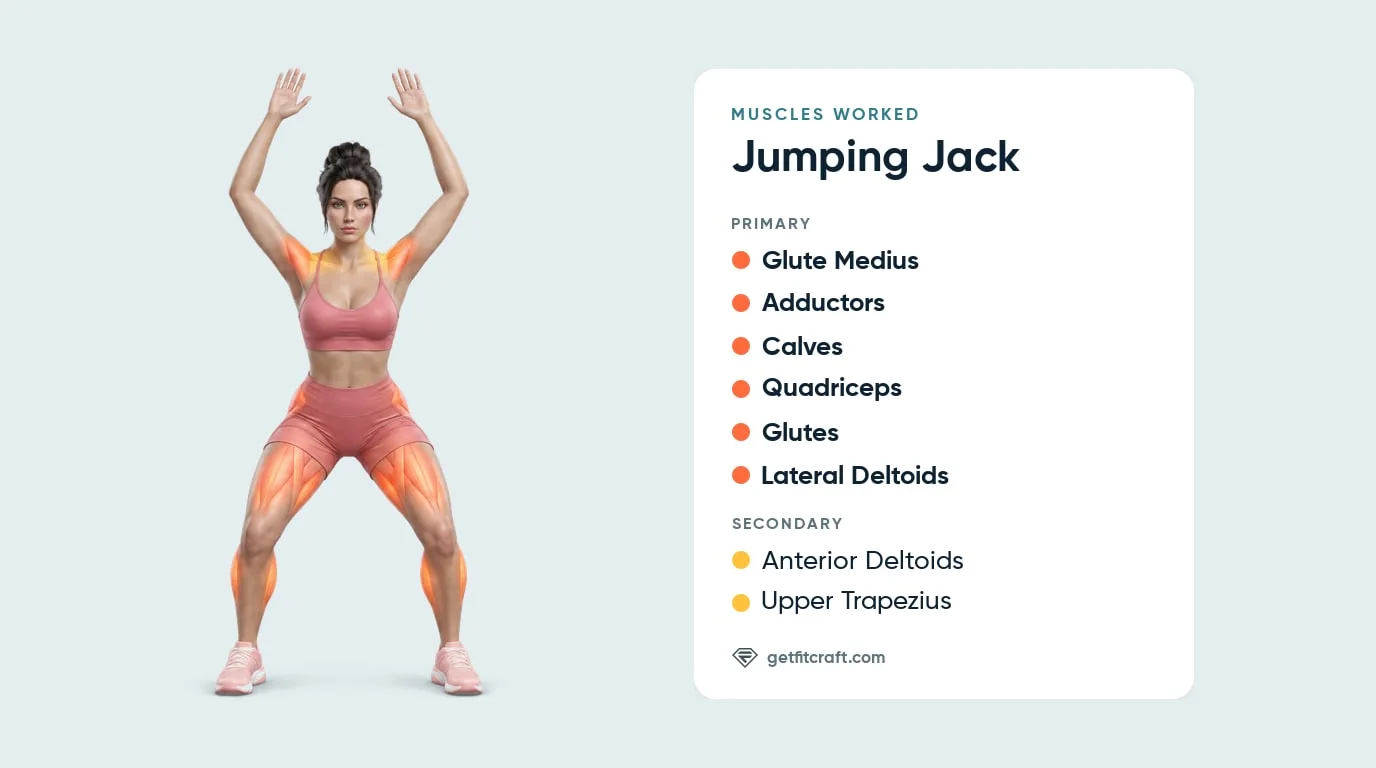
Primary muscles. The glute medius, on the outside of your hip, moves your legs out to the sides as you jump them apart, and the adductors, on your inner thighs, bring them back together. The calves push you off the floor and cushion each landing, while the quadriceps, at the fronts of your thighs, and the glutes absorb each landing and drive the small jumps. The lateral deltoids, at the sides of your shoulders, raise your arms out and up.
Secondary muscles. The anterior deltoids, at the fronts of your shoulders, and the upper trapezius, at the tops of your shoulders, help as your arms finish overhead.
Heart rate. Jumping jacks raise your heart rate quickly because your arms and legs move together in a steady rhythm. The 2024 Adult Compendium of Physical Activities lists calisthenics such as jumping jacks and burpees as vigorous effort, at 7.5 METs.
Quick Facts
Quick Facts: Jumping Jacks
- Equipment needed: None (bodyweight)
- Difficulty: Advanced (as rated in the FitCraft app); the step jack is a lower-impact version
- Modality: Cardio / plyometric / full-body warm-up
- Body region: Full body (outer hips, inner thighs, calves, thighs, glutes and shoulders)
Step-by-Step Instructions
- Stand tall with feet together. Start with your feet touching or nearly touching, arms relaxed at your sides. Chest up, shoulders back, knees soft, core lightly braced.
Tip: set your posture before the first rep, with your chest up, trunk tall and eyes forward. You return to it every time your feet come back together.
- Jump your feet out wide. In one quick movement, jump your feet out to about shoulder width or a little wider, as wide as you can land softly with your knees in line with your toes. As the feet leave the ground, start sweeping the arms out to the sides and up.
- Reach your arms overhead. As the feet land wide, the arms reach up overhead, with the elbows straight or bent as long as your hands finish above your head. Taking your hands right above your head and stopping in a high V above your head are both fine.
Tip: keep your chest up and your trunk tall as your arms go up, without leaning back or hunching.
- Jump back to the starting position. Spring your feet back together while sweeping the arms back down to the sides. Land softly on the front-to-middle of your feet with your heels coming down and your knees clearly bent, never on straight legs.
Tip: bend your knees as you land so your legs soak up the impact, and keep your knees in line with your toes.
- Find a steady rhythm. Continue at a steady pace, about one jumping jack a second. Each rep should feel smooth and controlled: feet out and arms up, feet in and arms down. Speed up only while every landing stays soft, and slow down when you get tired.
Tip: keep breathing in a steady, relaxed rhythm and never hold your breath.
Get this exercise in a personalized workout
FitCraft, our mobile fitness app, uses its AI coach Ty to program conditioning work like this into your plan at the right volume and intensity, based on your level, goals, and equipment. Ty was designed and trained by Domenic Angelino, MPH (Brown University) and NSCA-CSCS, with research published in the Journal of Strength and Conditioning Research and Medicine & Science in Sports & Exercise.
Take the Free Assessment Free · 2 minutes · No credit card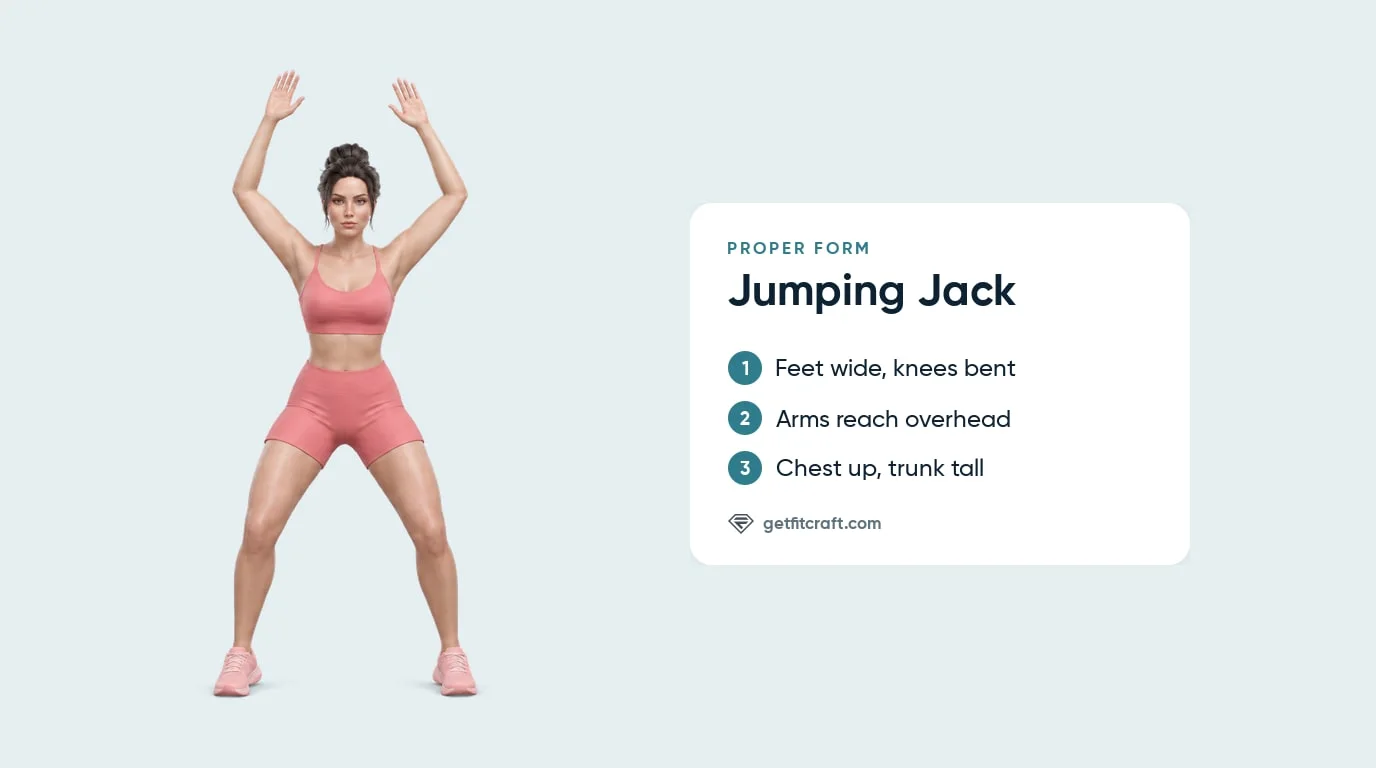
Common Mistakes
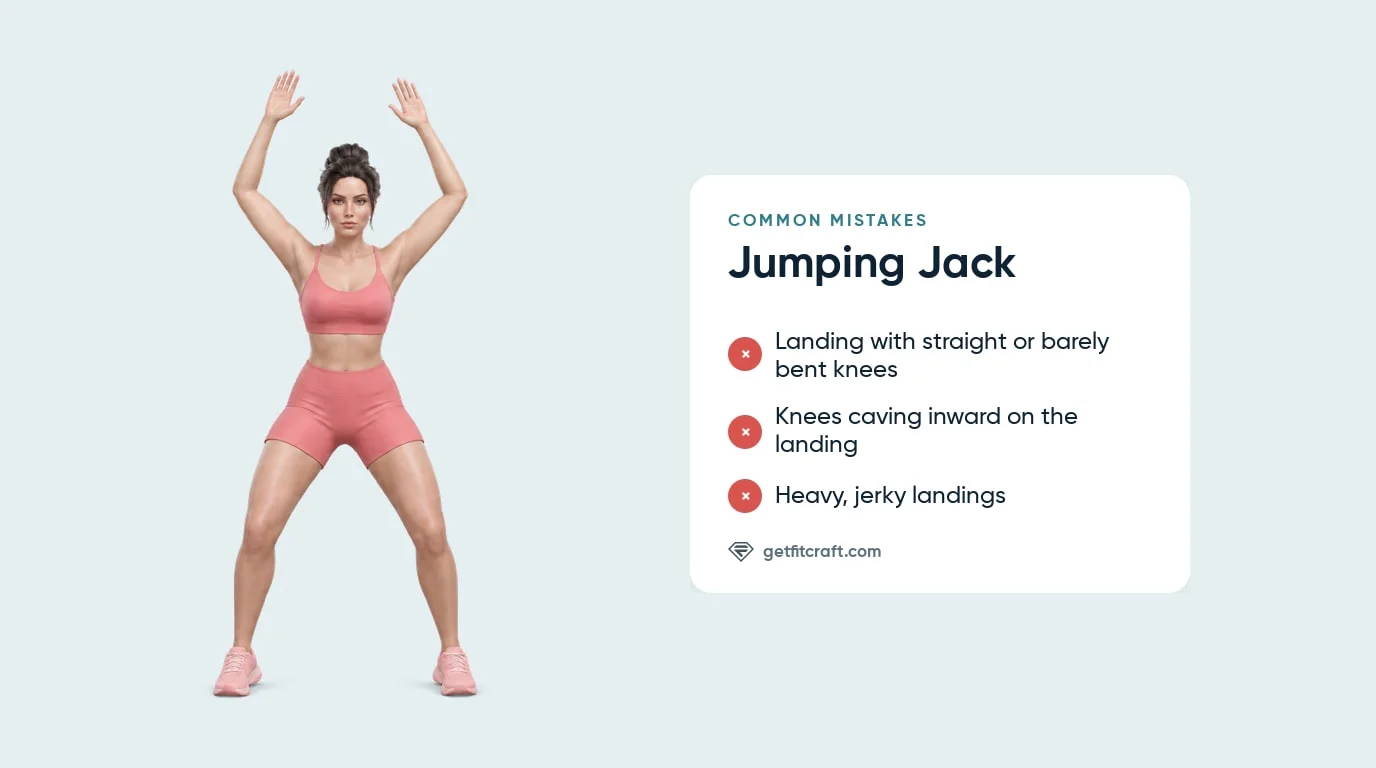
- Landing with stiff, locked knees. Landing with straight or barely bent knees increases the stress on your joints. Land with your knees clearly bent on every jump so your legs soak up the impact.
- Knees caving inward. Keep your knees in line with your toes as you land, whether your feet are landing wide or together.
- Heavy, jerky landings. Land softly and quietly on the front-to-middle of your feet and let your heels come down. If you can't keep the landings soft, slow down or step out instead of jumping.
- Rushing. Going so fast that your arms and legs fall out of rhythm makes the reps sloppy. Find a pace where they move together, about one jack a second, and stay with it.
- Swinging the arms too hard. If your trunk rocks or leans as your arms go up, you are throwing them too hard. Sweep them up with control, keep your chest up and your trunk tall, and keep your eyes forward.
- Keeping the pace up when tired. When your landings get heavy, slow down, step out instead of jumping, or end the interval.
Variations
- Step jacks (low-impact). Step one foot out to the side at a time instead of jumping, raising the arms overhead on the same timing, then bring it back and step out with the other foot. It is the lower-impact version for anyone, and it still gets your heart rate up.
- Faster jumping jacks (harder). Pick up the pace a little while every landing stays soft with your knees bent. Slow down again as soon as your landings get heavy.
- Arm height. Taking your hands right above your head and stopping in a high V above your head are both fine, and FitCraft's 3D demonstration shows both. Your elbows can stay straight or bend, as long as your hands finish above your head.
- Harder moves. When jumping jacks feel easy even at a faster pace, try burpees or jump squats for a tougher cardio challenge.
When to Avoid or Modify Jumping Jacks
Jumping jacks are safe for most healthy adults. A burn in your legs or shoulders is normal; any pain in a joint, your lower back or your neck means stop the exercise. If any of the following apply, talk to a doctor or physical therapist before you do jumping jacks.
- Known cardiovascular disease or uncontrolled hypertension. Jumping jacks elevate heart rate and blood pressure rapidly. Get cardiology clearance first and stay within the heart-rate zones your cardiologist prescribes.
- Acute knee, ankle, hip, or foot injury (or plantar fasciitis, shin splints, patellar tendinopathy). Repeated jumping loads all of these. Skip jumping jacks and see a doctor or physical therapist; start again only once they clear you.
- Pregnancy. Ask your doctor or midwife whether jumping jacks, or the lower-impact step jack, suit you at each stage of pregnancy.
- Postpartum recovery (or pelvic-floor symptoms). Get clearance from your doctor or a pelvic floor physical therapist before you do jumping jacks or other jumping movements again.
- Stress incontinence or pelvic-floor weakness. Jumping movements often trigger leakage. See a doctor or pelvic floor physical therapist before doing jumping jacks.
- Vertigo, balance disorders, or vestibular conditions. Fast direction changes and the rebound impact risk falls. Ask your doctor before doing jumping jacks.
- Asthma or exercise-induced bronchoconstriction. Have a rescue inhaler accessible, build into the intensity with a long warm-up, and consult your physician about heart-rate ceilings.
- New to jumping. If you haven't jumped in a while, start with step jacks or small, slow jumps, and build up while every landing stays soft. Walking in place is another easy way to start moving. Any knee or ankle pain means stop.
Related Exercises
- Lower-impact alternative within the same pattern: walking in place and running in place for the same upright cardio stimulus without the rebound impact.
- Other foundational cardio movements: high knees, butt kicks, and mountain climbers for circuit variety and additional plane-of-motion coverage.
- Plyometric progressions: jump squats, jump lunges, and plank jacks when jumping jacks no longer challenge the cardiovascular and neuromuscular systems.
- Highest-intensity full-body progression: burpees, a squat, plank and stand or jump in one move (FitCraft's burpees have no push-up), for a tougher full-body cardio challenge.
- Core stability foundation: forearm planks, hand planks, deadbugs, and bird-dogs to build the trunk control that keeps jumping mechanics clean.
- Ankle and calf conditioning: calf raises and calf hops to strengthen the calves that push you off the floor and cushion each landing.
How to Program Jumping Jacks
Because jumping jacks are continuous and cardiovascular rather than load-based, they're programmed in seconds of work and rest, not sets and reps. The research we reviewed gives no work or rest times for jumping jacks, so treat the table below as a practical starting point.
| Version | Work interval | Rest between intervals | Total session | Frequency |
|---|---|---|---|---|
| Easier (step jacks or shorter intervals) | 20-30 seconds | 60-90 seconds | 10-15 minutes | 2-3 sessions per week |
| Jumping jacks (Advanced in the app) | 30-45 seconds | 45-60 seconds | 15-25 minutes | 3-4 sessions per week |
| Harder (faster pace, same soft landings) | 45-60 seconds | 30-45 seconds | 20-30 minutes | 3-5 sessions per week |
Where in your workout. Jumping jacks fit naturally as the first movement in a general warm-up (1-2 minutes continuous gets heart rate up and shoulders mobile before the main work). They also work as an active-recovery filler between strength sets, as one station in a HIIT circuit, or as a 5-10 minute metabolic finisher at the end of a session. Save long, hard intervals of jumping jacks (or any HIIT) for after heavy compound lifts, so your legs are fresh for the lifts.
Form floor over rep targets. If your knees stop landing softly, your arms stop reaching overhead, or your rhythm breaks down, end the interval early even if the timer says you have time left. A shorter interval with soft landings is better than a longer one with stiff landings.
How FitCraft Programs This Exercise
Jumping jacks might seem like a basic exercise, but when and how they show up in a plan matters. FitCraft maps your level, goals, and equipment during the diagnostic and builds a plan around them. The app has one jumping jack exercise, rated Advanced, and can include it in your plan.
Its 3D demonstration plays about one jack every second and a quarter, a touch slower than the one-a-second rhythm the steps above suggest: the feet land out wide with the knees clearly bent, and the arms go up overhead, some reps all the way up and some to a high V.
The programming sits on top of an exercise-science foundation built by Domenic Angelino (Ivy League-trained MPH and NSCA-CSCS strength coach), then adapted to you by the AI.
Frequently Asked Questions
Can I do jumping jacks with bad knees?
Not while your knees hurt. Any knee pain during jumping jacks means stop the exercise. If you have a knee injury or a known knee condition, see a doctor or physical therapist first and start again only once they clear you. If your knees feel fine and you just want less impact, step jacks are the lower-impact version: step one foot out to the side at a time while raising the arms overhead, then step back together.
How many jumping jacks should I do per day?
For general conditioning, work in time blocks rather than rep counts. If you are new to them, try 20-30 seconds of jumping jacks followed by 60-90 seconds of rest, repeated 4-6 times, and build toward 30-45 second work intervals with 45-60 seconds of rest. As a warm-up, 1-2 minutes of continuous jumping jacks raises your heart rate to prepare your body for the main workout.
Are jumping jacks a good cardio workout?
Jumping jacks are an effective full-body cardiovascular exercise. They work the glute medius, adductors, calves, quadriceps, glutes and lateral deltoids, with the anterior deltoids and upper trapezius helping, while raising your heart rate quickly, and they require no equipment. They fit well in an interval circuit or as 5-10 minute conditioning blocks, rather than as a single long set.
Do jumping jacks burn belly fat?
Jumping jacks burn calories and contribute to the overall energy deficit needed for fat loss, but spot reduction is not how the body loses fat. No single exercise targets belly fat specifically. A consistent calorie deficit, together with full-body strength training and cardio (including jumping jacks), is what brings fat loss across the whole body, including the abdomen.
Are jumping jacks safe during pregnancy?
Ask your doctor or midwife before doing jumping jacks during pregnancy; they can tell you whether jumping, or the lower-impact step jack, suits you at each stage. After giving birth, get clearance from your doctor or a pelvic floor physical therapist before you jump again.