Quick Facts: Lateral Raises
- Equipment needed: Pair of dumbbells (3-25 lb depending on level)
- Difficulty: Beginner to Advanced (scalable by load and tempo)
- Modality: Strength · Isolation · Bilateral · Shoulder abduction
- Body region: Upper body (shoulders)
- FitCraft quest category: Strength
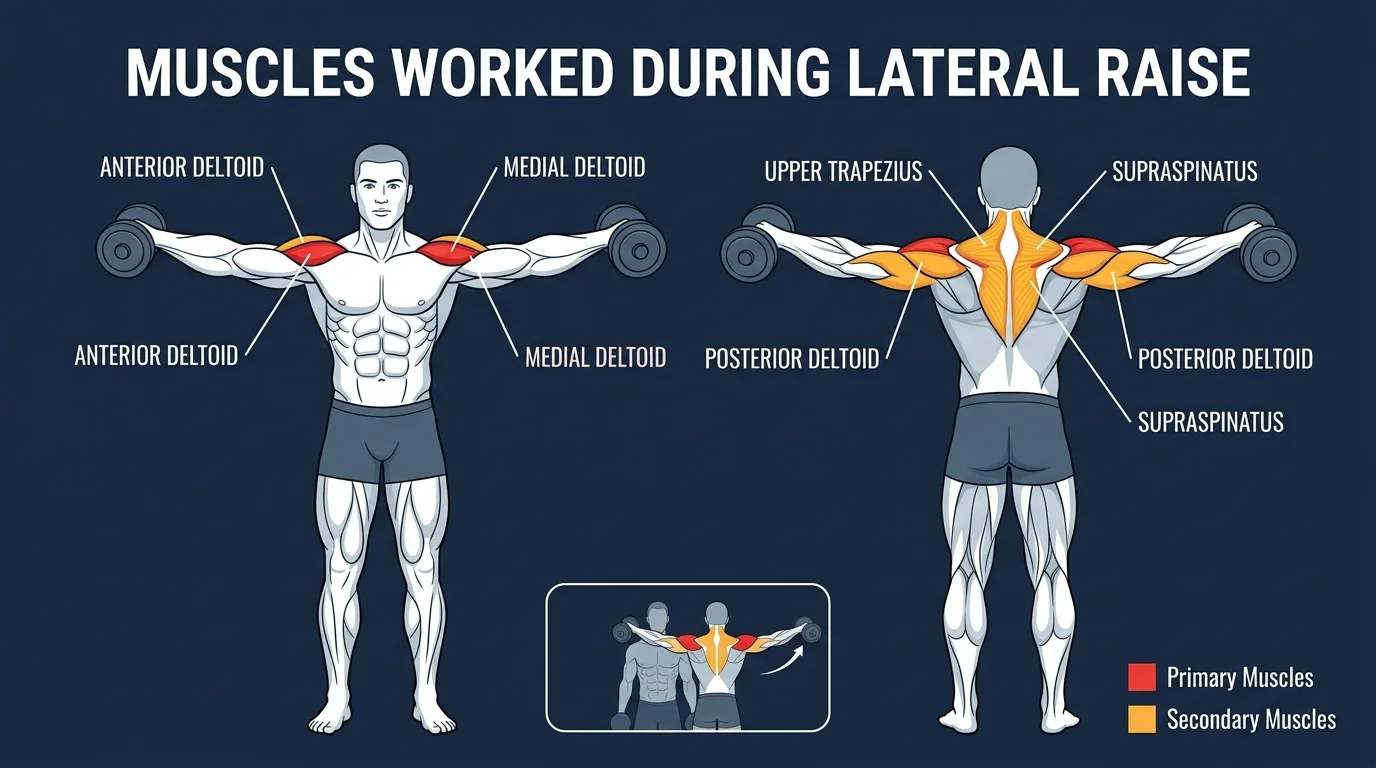
Muscles Worked
Primary mover. The medial (lateral) deltoid is the muscle that drives the dumbbell up through the abduction arc. It works concentrically on the way up and eccentrically on the way down. This is the deltoid head that creates the broad, capped shoulder look, and the lateral raise is the most direct way to load it.
Secondary movers. The supraspinatus (a rotator cuff muscle) initiates the first 15-30 degrees of abduction before the deltoid takes over. The anterior deltoid contributes when the arm drifts forward of the body, and the posterior deltoid contributes when the arm drifts behind. Keeping the dumbbell path in the frontal plane (straight out to the side) maximizes medial deltoid emphasis and minimizes the assist from the front and rear delts.
Stabilizers. The upper trapezius and serratus anterior stabilize the scapula throughout the lift. The rotator cuff (supraspinatus, infraspinatus, teres minor, subscapularis) keeps the humeral head centered in the glenoid socket, which is what protects the shoulder from impingement at the top of the range. The core remains lightly braced to prevent torso lean.
Evidence. Botton et al. (2020) compared muscle activation across four shoulder exercises in resistance-trained men at 60% 1RM. The lateral raise produced 30.3% MVIC in the medial deltoid, the shoulder press 27.9%, the bench press just 5%, and the dumbbell fly 3.4%. Coratella et al. (2020) compared lateral raise grip variations in competitive bodybuilders and found the neutral-grip version produced the highest medial deltoid activation versus internal-rotation, external-rotation, and bent-elbow variations. Translation: the standard dumbbell lateral raise with a neutral grip and a small elbow bend is already the optimal version. No exotic variation needed.
How to Do a Lateral Raise (Step-by-Step)
- Stand tall with dumbbells at your sides. Feet shoulder-width apart, dumbbell in each hand, palms facing inward. Pull your shoulders down and back. Put a slight bend in your elbows, about 10-15 degrees. This angle stays locked the entire set. Think of your arms as two slightly curved steel rods. Once you set that elbow bend, it doesn't change.
Coach Ty's cue: "Set the elbow bend before the first rep, then forget about it. The arm shape is fixed."
- Raise the dumbbells out to your sides. Lead with your elbows, not your hands. Raise both arms in a wide arc out to your sides. A cue that helps: imagine you're pouring water from two pitchers. Your pinkies should end up slightly higher than your thumbs at the top. Stop when your arms reach shoulder height. Not above. Shoulder height is where the medial deltoid peaks. Going higher just recruits your traps.
Coach Ty's cue: "Elbows above hands. Always. If your hands lead, it becomes a front raise."
- Pause at the top. Hold it for a full second. Your body should form a T shape. Elbows still slightly bent, wrists neutral, shoulders down (not shrugged up toward your ears). If you can't pause here without swinging or shaking, the weight is too heavy. Drop down. Seriously.
Coach Ty's cue: "Shoulders away from your ears. The second you shrug, your traps steal the rep."
- Lower with control. Take 2-3 seconds to bring the dumbbells back down. Fight gravity the whole way. This eccentric phase is where a large portion of the muscle-building stimulus actually happens. Letting the weight just drop throws away half the exercise.
- Reset and repeat. At the bottom, let the dumbbells briefly touch your sides, reset your shoulder blades down and back, and go again. Exhale on the way up, inhale on the way down. Beginners: 3 sets of 12-15 reps with light weight. If you're using 5-pound dumbbells and it's challenging, that's perfect. No shame in that.
Common Mistakes to Avoid
The lateral raise looks easy. That's why people butcher it. These are the five mistakes that turn a great deltoid builder into a trap exercise (or worse, a shoulder injury).
- Using too much weight. This is mistake number one, two, and three. When the dumbbells are too heavy, everything else breaks down. You swing, you shrug, you use momentum, and the medial deltoid barely works. A reality check: most experienced lifters use 15-25 pound dumbbells for lateral raises. If you're using 30+ and you've been training for less than 2 years, something's off.
- Shrugging the shoulders. When you shrug, your upper trapezius takes over the movement. The medial deltoid gets minimal stimulus. You end up building your traps instead of your shoulders. The fix: think about pushing the dumbbells away from your body, not lifting them up. That mental shift usually kills the shrug instantly.
- Swinging and using momentum. If you need a big hip thrust to get the dumbbells moving, the weight is too heavy. Period. Every rep should start from a dead stop. No bouncing at the bottom, no body English. If it's boring and slow, you're probably doing it right.
- Going above shoulder height. Raising the dumbbells above parallel shifts the load from the medial deltoid to the upper trapezius and increases the risk of subacromial impingement. Coratella et al. (2020) noted that the lateral raise's effectiveness for the medial deltoid peaks at about shoulder height. Beyond that, you're working different muscles entirely.
- Locking the elbows straight. Completely straight arms create a longer lever arm that puts unnecessary stress on the elbow joint. Plus, it makes the exercise harder in a way that doesn't benefit the deltoid. That slight 10-15 degree bend protects your elbows and keeps tension on the target muscle.
Get this exercise in a personalized workout
FitCraft, our mobile fitness app, uses its AI coach Ty to program isolation exercises like this into your plan at the right volume and intensity, based on your level, goals, and equipment. Ty was designed and trained by Domenic Angelino, MPH (Brown University) and NSCA-CSCS, with research published in the Journal of Strength and Conditioning Research and Medicine & Science in Sports & Exercise.
Take the Free Assessment Free · 2 minutes · No credit card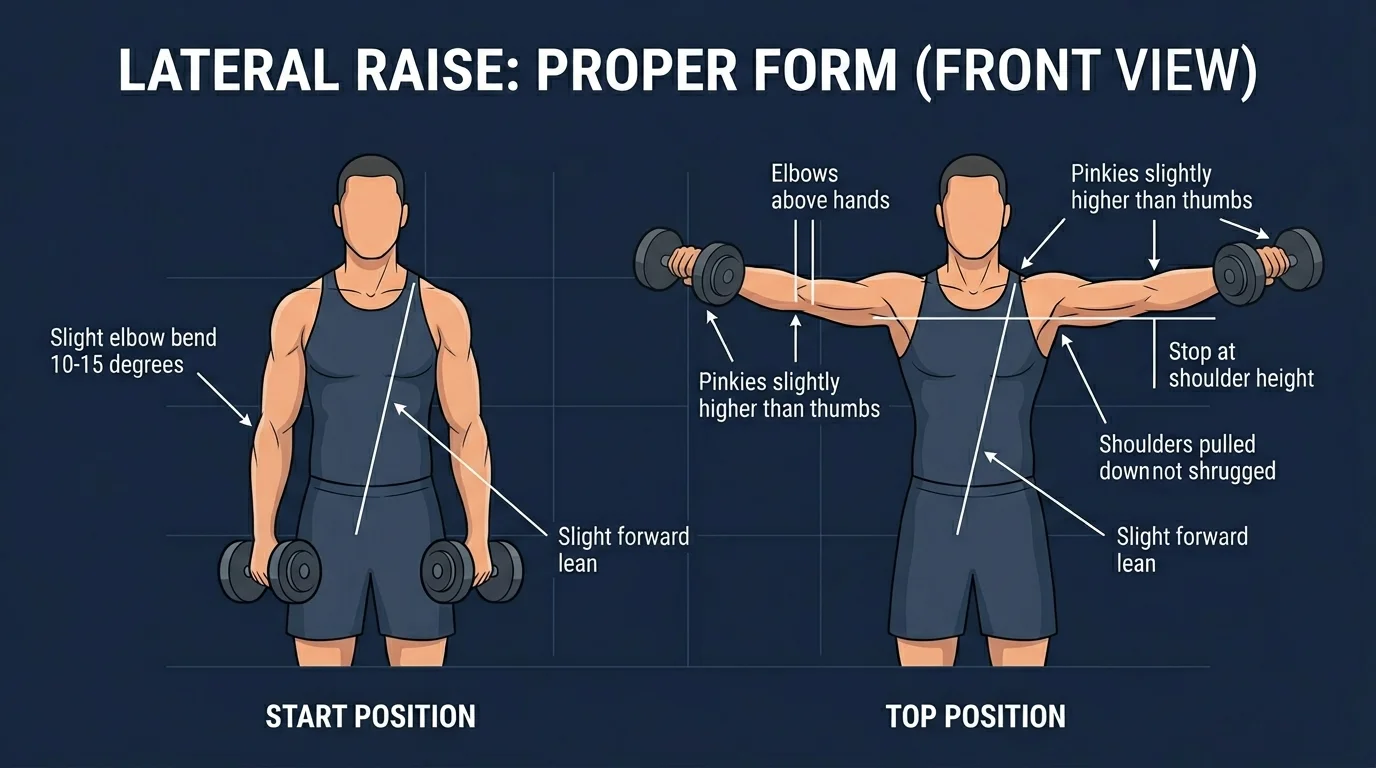
Variations: Beginner to Advanced
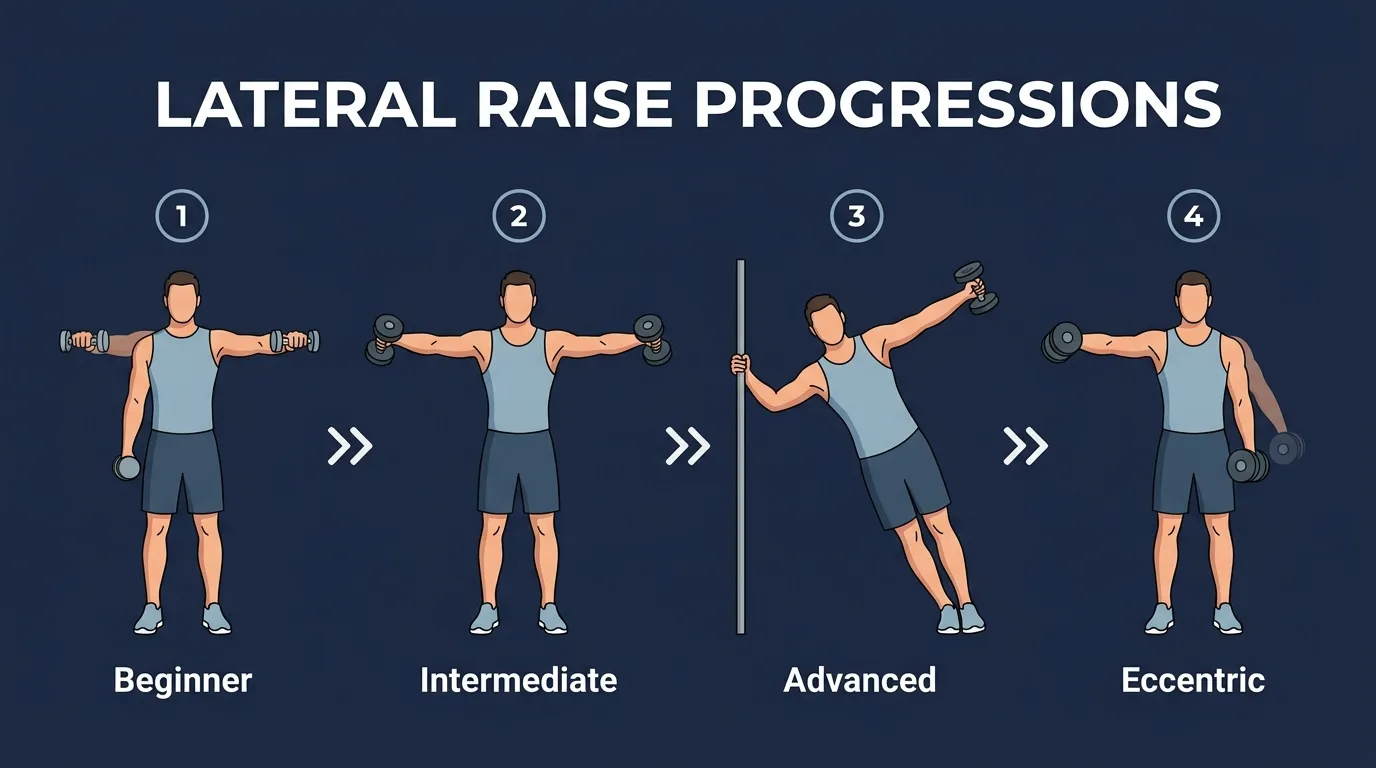
Light Dumbbell Lateral Raise (Beginner)
Start with the lightest dumbbells available. 3-5 pounds. That sounds ridiculous, but it isn't. The goal here is to build the mind-muscle connection with the medial deltoid and learn to keep the traps quiet. Focus on a full 3-second lift, 1-second pause, and 3-second lower. Once you can complete 3 sets of 15 reps with clean form and a clear burn in the side of your shoulder (not the top), you're ready to add weight.
Standard Dumbbell Lateral Raise (Intermediate)
This is the version described in the step-by-step above. It's what Coach Ty programs as the default in FitCraft. Moderate weight, 10-15 reps, strict form. The key at this level is consistency. You should feel a deep burn in the side delts by rep 10. If you don't, slow down the tempo or add a 2-second pause at the top.
Leaning Lateral Raise (Advanced)
Grab a sturdy pole or doorframe with one hand and lean your body away at about a 15-20 degree angle. Now perform single-arm lateral raises. This changes the resistance curve so the medial deltoid is loaded through a greater range of motion, particularly at the bottom of the movement where the standard version provides almost zero tension. It's harder than it looks. Drop the weight by about 30% from your standard lateral raise.
Eccentric-Focused Lateral Raise (Advanced)
Raise both dumbbells to shoulder height using a normal 2-second lift. Then take a full 5 seconds to lower them back down. That slow eccentric creates large mechanical tension in the medial deltoid and is one of the most effective hypertrophy techniques for any muscle group. Use about 60-70% of your normal lateral raise weight. 3 sets of 8-10 reps is plenty.
Related Shoulder Work
If lateral raises aggravate your shoulders (some lifters with existing impingement issues find them uncomfortable), here are two alternatives that load the shoulder without the same painful arc:
- Front raise: Targets the anterior deltoid through shoulder flexion. The arm path stays in front of the body and avoids the abduction arc that triggers impingement for many lifters.
- Y-raise: A low-load scapular and rotator cuff drill that strengthens the supraspinatus and lower trapezius. Useful as both a warm-up before pressing work and a substitute when classic lateral raises aren't tolerated.
When to Avoid or Modify Lateral Raises
Lateral raises are safe for most healthy adults, but a few conditions warrant modification or a substitute. Always consult your physician or physical therapist before starting or returning to shoulder loading, especially if any of the following apply:
- Shoulder impingement syndrome. The classic lateral raise moves the arm through the painful arc (60-120 degrees of abduction) where the supraspinatus tendon can pinch under the acromion. Stop raising to parallel; stay below 60 degrees. Substitute with the y-raise and t-raise for scapular work, or try the leaning lateral raise (forward torso tilt) which often reduces symptoms by changing the line of force on the joint.
- Rotator cuff strain or tendinopathy. Active rotator cuff inflammation will be aggravated by loaded abduction. Drop the weight to bodyweight or 1-2 lb, work in a pain-free range, and get cleared by a physical therapist before progressing. Isolation work like the w-raise and external rotation drills are typically prescribed first in rotator cuff rehab.
- AC joint sprain or osteoarthritis. Lateral raises load the acromioclavicular joint at the top of the range. If you have a history of AC separation or palpable pain at the AC joint, stop at 70-80 degrees instead of full shoulder height, or skip lateral raises entirely until cleared.
- Recent shoulder surgery (rotator cuff repair, labral repair, decompression). Get explicit surgeon clearance and a graded return-to-load protocol. Isolation work typically returns last in the rehab sequence, after isometric and pain-free active range have been re-established.
- Active cervical spine pain or radiating arm symptoms. The trap activation in heavy lateral raises can flare cervical issues. Reduce load, focus on keeping the shoulders down, and stop if symptoms worsen.
- Uncontrolled high blood pressure. Isometric trap engagement under load can spike blood pressure. Use lighter weight, breathe steadily through every rep, and never hold your breath at the top.
Related Exercises
- Same target muscle (medial deltoid): Bent-arm lateral raise (lower lever arm, lighter effective load, beginner-friendly).
- Other deltoid isolation: Front raise (anterior deltoid).
- Compound shoulder pressing: Shoulder press and Arnold press (multi-joint, multi-head deltoid work; program before lateral raises).
- Scapular and rotator cuff health: Y-raise, T-raise, W-raise (low-load drills that protect the shoulder under heavier work).
- Posterior shoulder counterbalance: Seated rear delt stretch to maintain shoulder mobility after heavy delt work.
How to Program Lateral Raises
Programming guidance follows the resistance-training principles laid out in Ratamess et al., 2009 (ACSM Position Stand on Progression Models in Resistance Training). The medial deltoid is a small muscle that recovers quickly, so it tolerates moderate-to-high frequency and benefits from higher rep ranges than larger muscles.
| Level | Sets × Reps | Rest between sets | Frequency |
|---|---|---|---|
| Beginner | 2-3 × 12-15 (light dumbbells, 3-8 lb) | 45-60 seconds | 2-3 sessions/week |
| Intermediate | 3-4 × 10-15 | 60-90 seconds | 2-4 sessions/week |
| Advanced | 3-4 × 8-15 (or leaning/eccentric variants) | 60-120 seconds | 2-4 sessions/week |
Where in your workout. Place lateral raises late in the session, after any compound pressing work like the shoulder press or Arnold press. Isolation work is accessory; doing it first will fatigue the medial deltoid and underload your main compound lifts. A typical shoulder day pattern: pressing compound → lateral raises → posterior delt work → rotator cuff finisher.
Form floor over rep targets. If you can't hit the rep target with controlled tempo and no shrugging or swinging, drop the weight. Form is the floor on this exercise. Total weekly volume for lateral deltoid work between 10-20 sets is the general hypertrophy recommendation, and lateral raises can share that volume with the shoulder press and any rear delt work you program.
FitCraft's AI coach Ty adjusts the variation and volume of lateral raises to match your level, available equipment, and recovery, with 3D demonstrations showing the exact arm path and elbow position from multiple angles.
Frequently Asked Questions
Can I do lateral raises if I have shoulder impingement?
Modify or hold off. Classic lateral raises move the arm through the painful arc (about 60-120 degrees of abduction) where the rotator cuff tendons can pinch under the acromion. If you have a current impingement diagnosis or feel a sharp pinch at shoulder height, stop raising to parallel and stay below 60 degrees, or substitute with scapular work like the y-raise and t-raise until cleared by a physical therapist. The leaning lateral raise (forward torso tilt) often reduces symptoms by changing the line of force.
What muscles do lateral raises work?
Lateral raises primarily target the medial (side) deltoid, which is the muscle responsible for shoulder width. Secondary muscles include the anterior deltoid, posterior deltoid, upper trapezius, and supraspinatus (a rotator cuff muscle). EMG research by Botton et al. (2020) measured 30.3% MVIC activation in the medial deltoid during the dumbbell lateral raise, significantly higher than the bench press (5%) or dumbbell fly (3.4%).
How heavy should lateral raises be?
Lighter than you think. The medial deltoid is a small muscle, and lateral raises use a long lever arm that multiplies the effective load. Most men start with 10-15 lb dumbbells, most women with 5-8 lb. If you need to swing or use momentum to get the weight up, drop down. Form and time under tension matter far more than weight on this exercise.
Should I go above shoulder height on lateral raises?
No. Raising the dumbbells above shoulder height shifts the work from the medial deltoid to the upper trapezius and increases impingement risk in the subacromial space. Stop when your arms are parallel to the floor. That's the peak contraction point for the side delts.
How often should I do lateral raises?
Two to three times per week works well for most people. The medial deltoid recovers relatively quickly compared to larger muscle groups. Spread sessions at least 48 hours apart. Total weekly volume of 10-20 sets for side delts is the general recommendation for hypertrophy, and lateral raises can share that volume with other shoulder exercises like the overhead press.
Are lateral raises better with cables or dumbbells?
Both work. Dumbbells are simpler and load the top of the movement most heavily. Cables provide more constant tension across the entire range of motion, particularly at the bottom where dumbbells almost feel weightless. If you have access to both, alternate. If you only have dumbbells, you're not missing out on much. The exercise still produces the highest medial deltoid activation of any common dumbbell movement.