You don't need a gym membership or fancy equipment to train your core and cardio at the same time. The mountain climber chains a high plank with a fast alternating knee drive and drives your heart rate up without any landing impact.
The problem? Most people sag the hips, place the hands wrong, or bounce the shoulders so hard that the core stops doing the work. This guide covers how to perform mountain climbers correctly, from the slow elevated-hands regression through the cross-body and sliding progressions.
Quick Facts: Mountain Climbers
- Equipment needed: None (optional: bench or sliders for variations)
- Difficulty: Beginner (slow, elevated hands) to Advanced (fast cross-body or sliding)
- Modality: Cardio / Conditioning
- Body region: Full body, core-dominant
- FitCraft quest category: Cardio
Muscles & Systems Worked
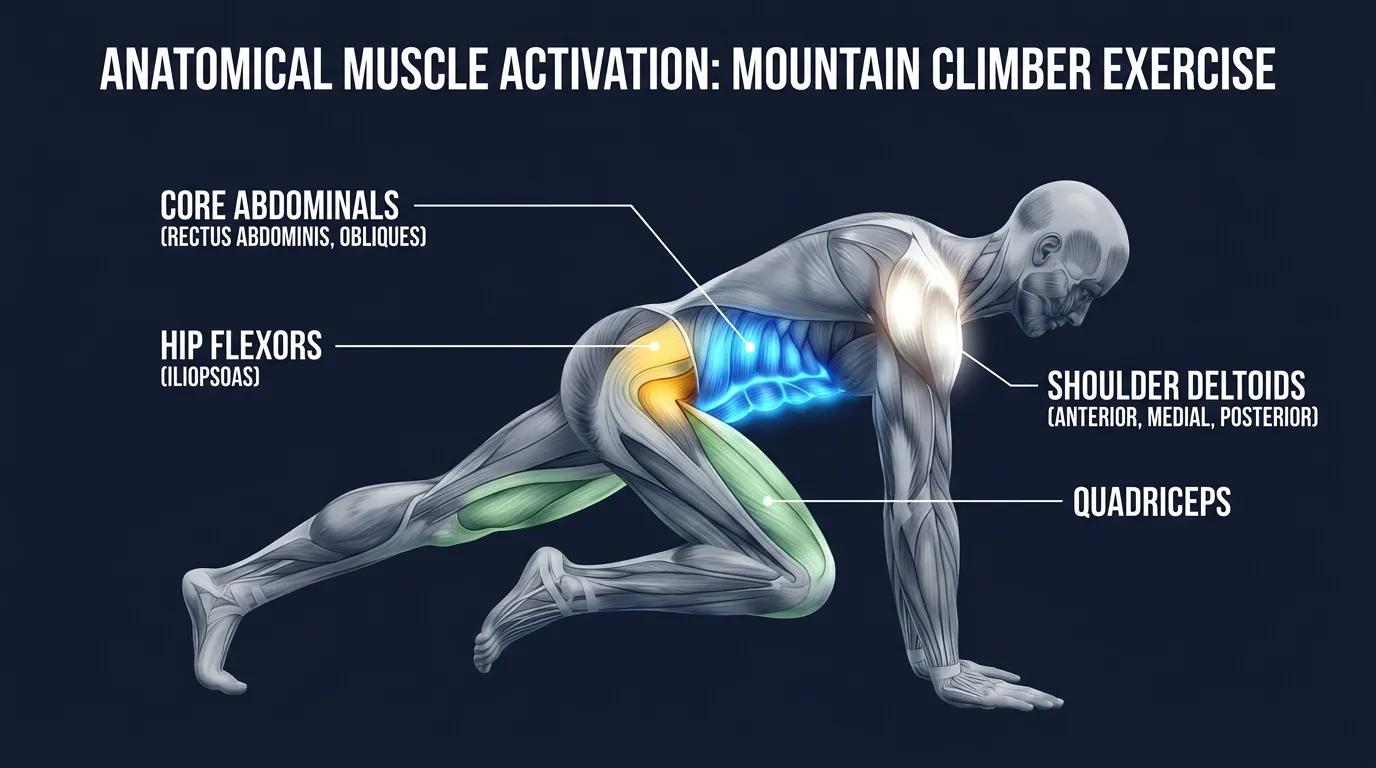
Primary movers: the hip flexors (psoas major, iliacus, and rectus femoris) drive each knee toward the chest through concentric hip flexion. The rectus abdominis, transverse abdominis, and obliques contract isometrically to brace the trunk against the rotational pull created when one leg drives forward while the other extends back. On every rep, both halves of the core are doing work, but the obliques carry the anti-rotation load.
Secondary movers: the quadriceps, glutes, and hamstrings of the extended leg hold the hip and knee in extension to keep the body in a straight line. The pectoralis major, anterior deltoids, and triceps brachii hold the high-plank position, with the shoulders supporting roughly 60 to 70 percent of bodyweight depending on hand placement. The serratus anterior protracts and stabilizes the scapula against the floor.
Stabilizers: the spinal erectors and multifidus keep the lumbar spine neutral. The diaphragm and pelvic floor (the deep-core canister) brace alongside the transverse abdominis. The ankle stabilizers (peroneals, tibialis anterior and posterior) control foot placement on the planted leg. The wrists and forearms (flexor and extensor groups) stabilize the hand contact, which is why wrist endurance often becomes the limiting factor before the cardiovascular system does.
Energy systems and cardiovascular load: mountain climbers elevate heart rate quickly because the movement combines whole-body coordination with a sustained isometric upper-body load. Short, all-out work intervals (10 to 20 seconds) draw primarily on the phosphocreatine system. Sustained work (30 to 60 seconds) shifts into the glycolytic system, which is where the burning sensation in the abs and shoulders comes from. Repeated rounds with short rest also tax the oxidative system. The work-to-rest ratio is the lever that decides which energy system gets trained.
Step-by-Step: How to Do a Mountain Climber
These steps cover the standard floor variation. Differences for elevated-hand and cross-body variations are noted in the Variations section below.
Step 1: Set Up in a High Plank
Place your hands flat on the floor, directly under your shoulders. Extend your legs behind you so your body forms a straight line from head to heels. Spread your fingers wide for a stable base.
Coach Ty's cue: "Hands directly under your shoulders. Too far forward and you'll strain your wrists; too far back and you lose stability."
Step 2: Brace Your Core
Before you start moving, tighten your abs as if someone is about to tap your stomach. This protects your lower back and keeps your hips from sagging throughout the movement.
Ty's cue: "Lock the rib cage down toward the pelvis. If your hips drop, the lower back takes the load instead of the core."
Step 3: Drive Your Right Knee Toward Your Chest
Using your core rather than momentum, pull your right knee forward toward your chest. Your foot should come off the ground as your knee tucks in.
Ty's cue: "Imagine you're using your abs to pull your knees up. The hip flexors finish the movement, but the core starts it."
Step 4: Switch Legs in a Running Motion
As you extend your right leg back, simultaneously drive your left knee toward your chest. The transition should be smooth and controlled, like you're running in place horizontally.
Ty's cue: "Drive your knees in toward your chest, then quickly switch legs, as though you're running up an imaginary hill."
Step 5: Maintain a Steady Rhythm and Finish with Control
Continue alternating legs. Keep your hips level with your shoulders, your hands firmly planted, and your breathing steady. Don't hold your breath. Exhale as each knee drives forward.
Ty's cue: "Don't let your hips sag. Keep them at the same level as your shoulders." When your set is complete, return to the high plank position before resting rather than collapsing to the floor.
Get this exercise in a personalized workout
FitCraft, our mobile fitness app, uses its AI coach Ty to program conditioning work like this into your plan at the right volume and intensity, based on your level, goals, and equipment. Ty was designed and trained by Domenic Angelino, MPH (Brown University) and NSCA-CSCS, with research published in the Journal of Strength and Conditioning Research and Medicine & Science in Sports & Exercise.
Take the Free Assessment Free · 2 minutes · No credit card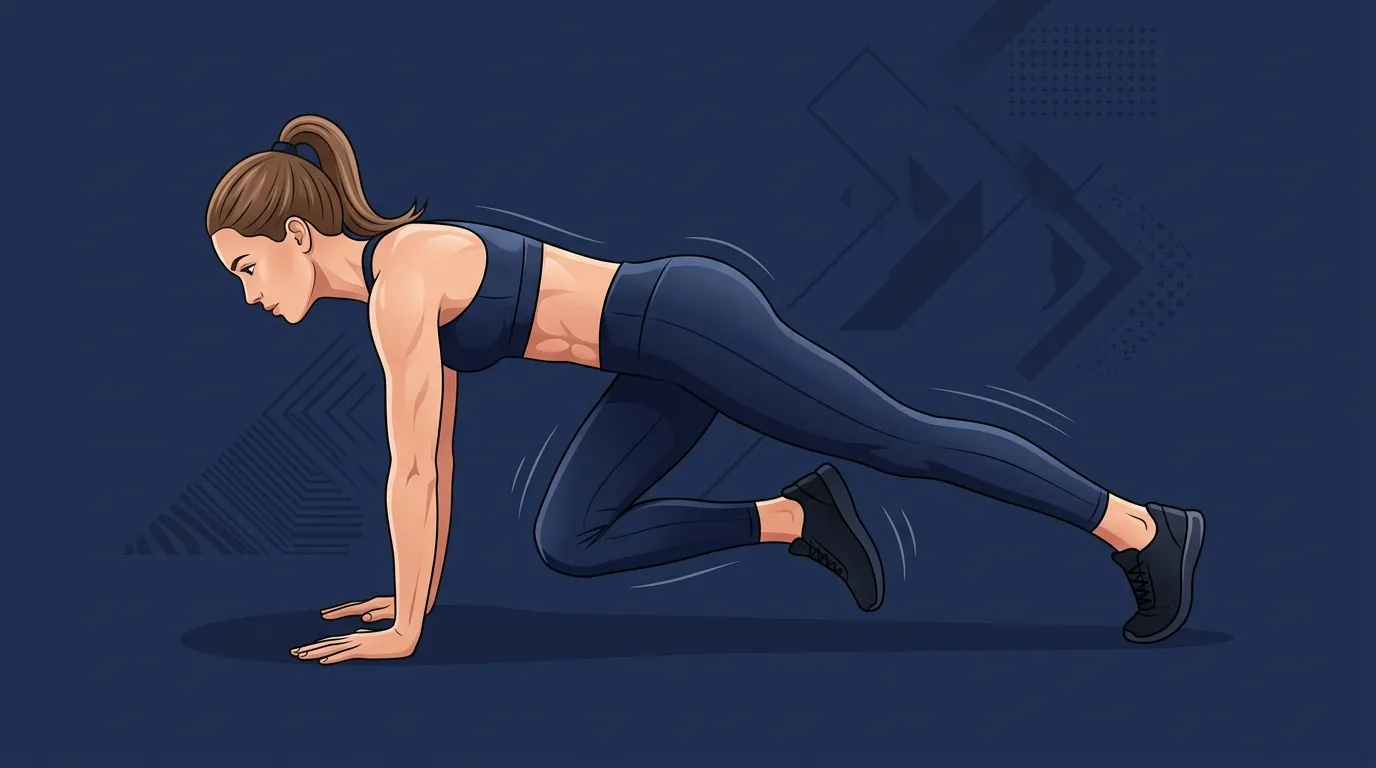
Common Mistakes (and How to Fix Them)
Mountain climbers look simple and feel easy to get wrong. Here are the mistakes Ty corrects most often.
- Hips piking up or sagging down. The most common error. Your body should hold a straight plank line. If your hips rise into a tent shape, you're shifting the work away from the core. If they drop, the lower back takes the load. Fix: squeeze your glutes, brace your abs, and check your hip line in a mirror or with a video. If you can't hold a clean plank for 20 seconds, build the foundation with forearm planks and deadbugs before chasing speed.
- Shallow knee drives. Half-hearted knee drives cut the exercise's effectiveness in half. Aim to bring your knee as close to your chest as the hip-flexor mobility allows on every rep. If you can't get the knee past mid-thigh, slow the pace down until you can.
- Hands too far forward. Placing the hands ahead of the shoulders puts unnecessary strain on the wrists and shoulders. Stack your wrists directly under your shoulders. Press the floor away with the heels of the palms so the load distributes evenly.
- Bouncing shoulders. Your upper body should stay relatively still while the legs do the work. If the shoulders are bouncing up and down, the pace is too fast for your current core strength. Slow down and re-establish a quiet upper body before adding speed back.
- Holding your breath. Oxygen fuels performance. Establish a rhythmic breathing pattern, exhale as each knee drives in, and inhale as it returns. Breath-holding spikes blood pressure and kills your endurance, which is the opposite of what you want in a conditioning exercise.
- Letting the planted foot float. Both feet should be in clear contact with the floor between knee drives. If the planted foot is floating or skipping, the rhythm is broken and the planted leg loses its anti-rotation job. Drive through the ball of the foot of the extended leg.
Mountain Climber Variations: Regressions and Progressions
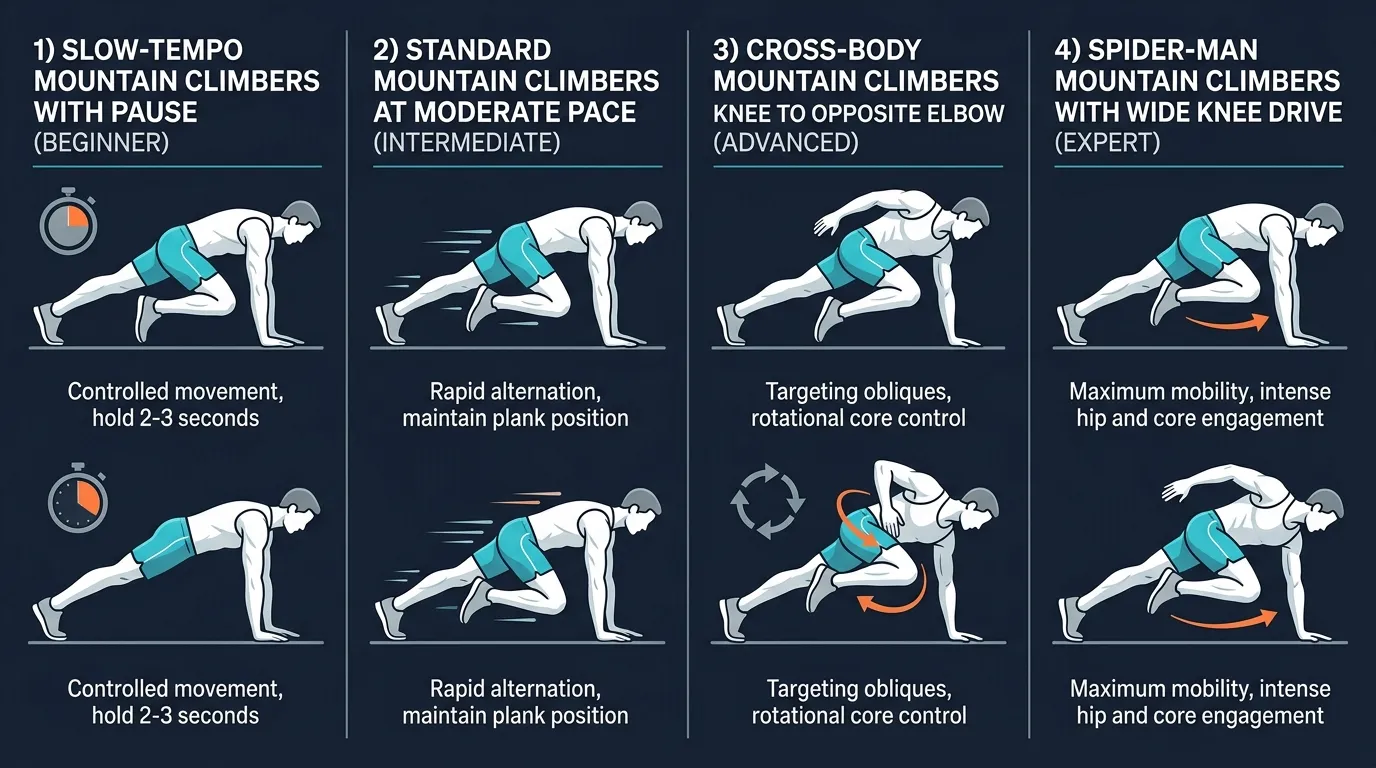
FitCraft programs mountain climbers across a clear progression path. A low-impact regression is available for anyone managing wrist sensitivity, pregnancy, or early postpartum recovery.
Elevated-Hands Mountain Climbers (Beginner Regression)
Place your hands on a bench, kitchen counter, or sturdy table instead of the floor. The higher your hands, the less load on the wrists, shoulders, and core. Start with the surface at chest height and lower over time. This is the right starting point if you can't hold a clean 20-second floor plank yet, if your wrists complain about the floor position, or if you're returning from injury.
Slow Mountain Climbers (Beginner Build)
Perform the movement at half speed with a deliberate pause at each knee drive. The slow tempo builds core strength and reinforces proper form before adding speed. Use this as the bridge between elevated-hand mountain climbers and the standard floor version.
Standard Floor Mountain Climbers (Intermediate)
Hands on the floor, moderate pace, controlled breathing. This is the version most workouts call for. Build up to 30 to 45 seconds of continuous work with clean form before progressing.
Cross-Body Mountain Climbers (Advanced)
Drive your right knee toward your left elbow, and your left knee toward your right elbow. This variation increases oblique engagement and adds a rotational challenge that the standard version doesn't have. Slow the pace by 20 to 30 percent compared to standard floor mountain climbers because the rotation makes form breakdown easier.
Spider-Man Mountain Climbers (Advanced)
Drive each knee toward the outside of the same-side elbow. This opens the hips and adds a lateral stability challenge. The hip-opening pattern makes spider-man mountain climbers useful as a mobility-and-conditioning combo at the end of a session.
Sliding Mountain Climbers (Advanced)
Place your feet on sliders or small towels on a smooth floor. Instead of lifting each foot to drive the knee forward, slide the foot in along the floor. The reduced friction changes the muscle activation pattern, removes the foot-contact phase, and increases the eccentric demand on the core during the slide back. Slow tempo is mandatory because momentum can't help you here.
When to Avoid or Modify Mountain Climbers
Mountain climbers are safe for most healthy adults, but several conditions warrant modification or temporarily swapping for easier alternatives. None of these are permanent restrictions. They're starting points. Always consult your physician or physical therapist for personalized guidance.
- Wrist pain or carpal tunnel. The floor plank loads the wrists at roughly 90 degrees of extension, which can aggravate carpal tunnel or wrist strain. Use the elevated-hands variation on a bench or counter, push-up handles, or dumbbells under the hands to keep the wrist neutral. If pain persists, substitute a non-plank conditioning movement like jumping jacks or high knees until the wrist tolerates loaded extension.
- Known cardiovascular disease or uncontrolled hypertension. Mountain climbers spike heart rate and blood pressure quickly. Get your cardiologist's approval first and stay within their prescribed heart-rate zones. Lower-intensity substitutions like step-n-clap let you build a base.
- Acute lower-extremity injury (knee, ankle, hip, shin splints, plantar fasciitis). Even though there are no jumps, the rapid knee drive and planted-foot rebound load the lower leg. Drop to the elevated-hands slow-tempo variation, or substitute deadbugs and bird-dogs for the same anti-rotation core work without the lower-extremity demand.
- Second or third trimester of pregnancy. The prone plank position becomes uncomfortable as the belly grows, and the rapid leg switch can strain the abdominal wall. Switch to standing alternatives (modified jumping jacks or step-n-clap) and avoid prolonged supine or prone positions.
- First 6 to 12 weeks postpartum or active diastasis recti. The combined plank load plus rapid hip flexion can widen abdominal separation. Get clearance from a pelvic-floor PT. Until cleared, rebuild deep-core control with deadbugs and bird-dogs, then phase in elevated-hands slow mountain climbers before any fast-pace work.
- Stress incontinence or pelvic-floor weakness. The combined intra-abdominal pressure of the plank plus the rapid leg switch can trigger leakage. Substitute step-n-clap or low-impact alternatives and strengthen the pelvic floor first under the guidance of a pelvic-floor PT.
- Acute lower-back pain or known disc pathology. A sagging plank position aggravates the lumbar spine. Drop the floor version entirely and use bird-dogs for anti-rotation work, or use the elevated-hands variation, which dramatically reduces the spinal load.
Related Exercises
If mountain climbers are part of your conditioning, these movements complement, extend, or scale back the same training pattern:
- Same conditioning family: Burpees, Jumping Jacks, and Jump Squats hit similar energy systems and are great rotation options inside a HIIT circuit.
- Lower-impact alternative in the same pattern: Step-n-Clap and High Knees drive heart rate up without the wrist load, useful when the upper body needs a break.
- Same plank position, different stimulus: Plank Jacks add a lateral foot pattern to the same high-plank base, and they pair well with mountain climbers in a back-to-back circuit.
- Core stability foundation: Forearm Planks, Hand Planks, and Deadbugs isolate the bracing pattern mountain climbers rely on, useful if your hips sag during the plank phase.
- Anti-rotation core complement: Bird-Dogs train the same anti-rotation pattern that mountain climbers demand, but at a slower tempo that lets you groove the bracing pattern.
- Lower-impact running-in-place family: Butt Kicks drive a similar cyclic hip pattern in a standing position, useful when you want the running motion without the plank load.
How to Program Mountain Climbers
Mountain climber programming is time-based or work-to-rest-interval-based rather than fixed sets and reps. The American College of Sports Medicine (ACSM) Position Stand on resistance training, which also informs interval-based conditioning, recommends matching work intensity, rest duration, and frequency to your current conditioning level (Ratamess et al., 2009).
| Level | Work interval | Rest between rounds | Total session | Frequency |
|---|---|---|---|---|
| Beginner (elevated hands, slow tempo) | 20 to 30 seconds | 60 to 90 seconds | 10 to 15 minutes | 2 to 3 sessions/week |
| Intermediate (standard floor) | 30 to 45 seconds | 45 to 60 seconds | 15 to 25 minutes | 3 to 4 sessions/week |
| Advanced (cross-body, spider-man, or sliding) | 45 to 60 seconds | 30 to 45 seconds | 20 to 30 minutes | 3 to 5 sessions/week |
Where in your workout: mountain climbers fit in a standalone HIIT session, after resistance training (never before, because they deplete the glycogen your strength work needs), or as a metabolic finisher in the last 5 to 10 minutes of a session. They also work well as a dynamic warm-up at low pace for 30 to 45 seconds before a core-focused workout. Don't program mountain climbers before heavy core or pressing work because the wrist and shoulder fatigue will compromise the next exercise.
Form floor over rep targets: if your plank starts sagging, your shoulders start bouncing, or your knee drives get shallow, stop the work interval there. Hitting a target work duration with broken form is worse than hitting a shorter clean interval. The core stops working the moment the hip line breaks.
How FitCraft Programs This Exercise
Knowing how to do a mountain climber is step one. Knowing when to do it, at what work-to-rest ratio, and when to progress from elevated hands to standard floor to cross-body is where most people get stuck.
FitCraft's AI coach Ty handles that. During your personalized diagnostic assessment, Ty maps your fitness level, goals, and any wrist, knee, or pelvic-floor considerations. Then Ty builds a personalized program that slots mountain climbers into a balanced training plan at the right variation for your level.
As your conditioning improves, Ty adjusts the variation and the work-to-rest interval to match your level. Elevated hands become standard floor. Standard floor becomes cross-body or sliding. Work duration extends and rest shortens as aerobic and lactate-tolerance capacities grow. Every program is designed by an Ivy League-trained exercise scientist and NSCA-certified strength coach using evidence-based periodization, then adapted to you by the AI.
Frequently Asked Questions
Can I do mountain climbers if I have wrist pain?
The standard floor version loads the wrists at roughly 90 degrees of extension, which can aggravate carpal tunnel or wrist strain. The first modification is to elevate your hands on a bench, kitchen counter, or sturdy table. A higher hand position reduces wrist extension and lowers total load on the joint. Push-up handles or dumbbells under the hands also keep the wrist neutral. If pain persists, substitute a non-plank conditioning movement like jumping jacks, high knees, or step-n-clap while you rehab the wrist, and see a physical therapist if symptoms continue for more than a week or two.
Are mountain climbers good for burning calories?
Yes. Mountain climbers are a high-intensity compound movement that elevates heart rate quickly while engaging multiple muscle groups, including the core, shoulders, hip flexors, and legs. That combination makes them one of the most time-efficient bodyweight exercises for calorie burn per minute. The exact calorie cost depends on bodyweight, pace, and interval length, but a 30-second all-out burst pushes most people well into the glycolytic energy system.
How many mountain climbers should a beginner do?
Start with 2 to 3 sets of 10 to 15 repetitions per side at a slow, controlled pace, with 60 to 90 seconds of rest between sets. Focus on maintaining a clean plank line rather than chasing speed. As core strength and conditioning improve over several weeks, gradually increase reps or shorten rest before adding speed. Most people benefit from training mountain climbers as a 20 to 30 second work interval with 60 seconds of rest, repeated 4 to 6 rounds, rather than chasing a fixed rep count.
What muscles do mountain climbers work?
Mountain climbers primarily target the hip flexors (psoas major, iliacus, and rectus femoris) on the leg drive and the entire core (rectus abdominis, transverse abdominis, and obliques) for trunk stability during the rapid leg switch. Secondary movers include the quadriceps, glutes, and hamstrings, plus the pectorals, anterior deltoids, and triceps holding the plank position. Stabilizers include the serratus anterior at the scapula, the spinal erectors, and the ankle stabilizers. Beyond the muscles, mountain climbers train the cardiovascular system and tap the phosphocreatine and glycolytic energy systems depending on work-interval length.
Mountain climbers vs burpees: which is better?
Neither is universally better. Mountain climbers keep you in a plank the whole time, which loads the core more isometrically and is gentler on the knees and lower back because there are no jumps or landings. Burpees demand more total work per rep (squat, plank transition, optional jump), spike heart rate faster, and recruit more lower-body muscle, but they punish form breakdown harder and are tougher on the wrists and knees. Mountain climbers are the better pick when you want a sustained core-and-cardio stimulus with lower joint impact. Burpees are the better pick for maximum metabolic demand in the shortest time. Most balanced programs use both.