The rear lunge builds single-leg strength without asking you to decelerate a forward step. That makes it a useful option when you want lunge benefits but need cleaner balance and less chaos at the knee.
The working leg is the front leg. Your back leg steps away, lowers you into the rep, then returns. Keep that distinction clear and the exercise gets much easier to feel: the front hip and thigh do the work, while the rear leg guides the pattern.
Quick Facts: Rear Lunges
- Equipment needed: None; dumbbells optional
- Difficulty: Beginner to Advanced
- Modality: Strength
- Body region: Lower body
- FitCraft quest category: Strength
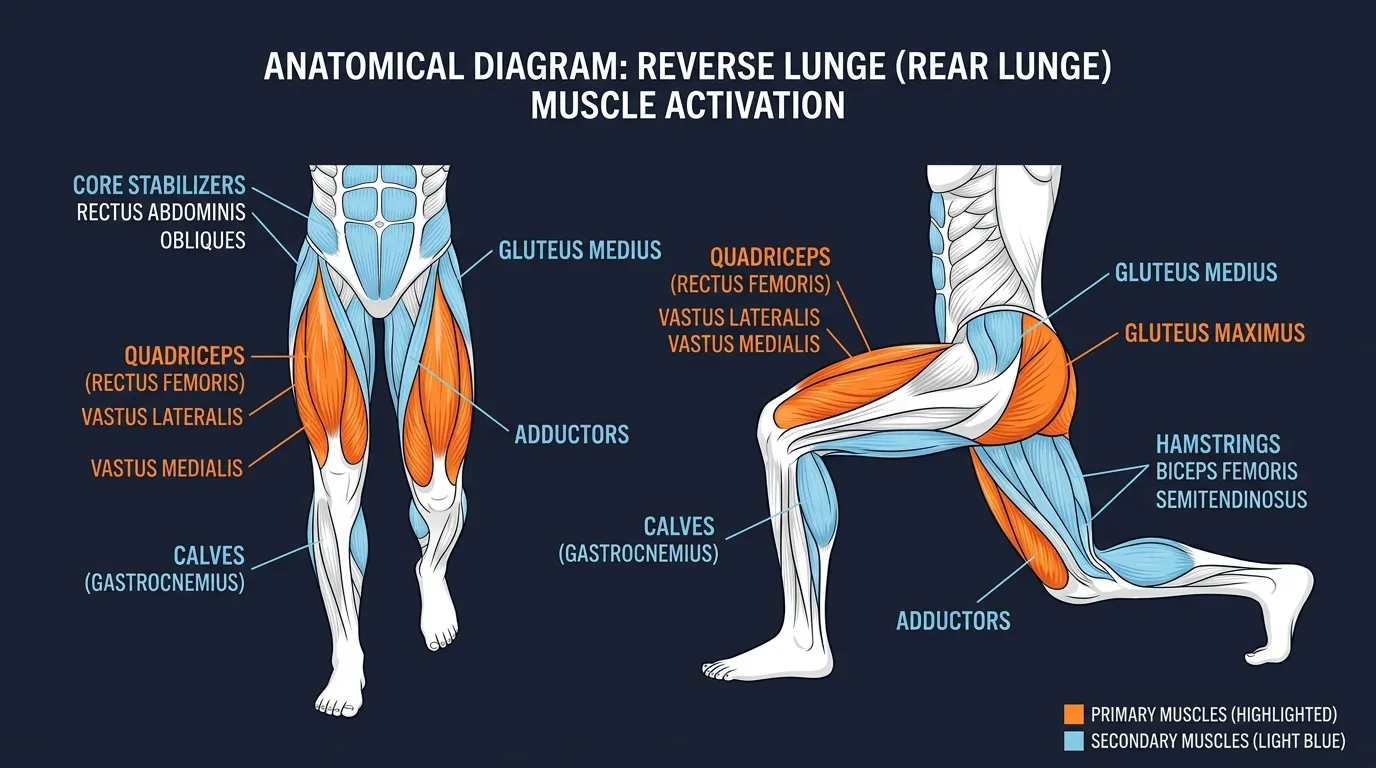
Muscles Worked
Primary movers: the quadriceps, gluteus maximus, and hamstrings drive most of the rear lunge. The quadriceps extend the front knee as you stand up. The gluteus maximus extends the front hip. The hamstrings assist hip extension and help control the descent.
Secondary movers: the adductors help control the front thigh and keep the pelvis from drifting. The calves stabilize the ankle on the planted leg, and the hip flexors of the rear leg lengthen as you lower into the bottom position.
Stabilizers: the gluteus medius, deep hip rotators, obliques, transverse abdominis, rectus abdominis, and spinal erectors work isometrically to keep the pelvis level and the torso stacked. This is why rear lunges feel like balance work even when your legs are strong enough.
Mechanism: stepping backward keeps the front foot planted, so the movement becomes a controlled split-squat pattern with a dynamic reset between reps. A longer stride shifts more demand toward the glutes and hamstrings. A shorter stride biases the quads but can crowd the front knee. Use the stride that lets the front heel stay down and the knee track over the toes.
Step-by-Step Instructions
- Set your starting position. Stand with your feet hip-width apart, ribs stacked over your pelvis, and eyes forward. Keep your weight balanced through the full foot of the leg that will stay in front.
Coach Ty's cue: "Stand tall before every rep so your front leg has a stable target to return to."
- Step back with control. Take one foot straight back and land softly on the ball of that foot. Use a stride long enough that both knees can bend while your front heel stays down.
Coach Ty's cue: "Imagine sliding your back foot along a straight rail behind you."
- Lower into the lunge. Bend both knees and lower until your front thigh approaches parallel to the floor. Keep your front knee tracking over your second and third toes while your back knee hovers above the ground.
Coach Ty's cue: "Hover the back knee. Don't crash into the bottom."
- Drive through the front foot. Press through the heel and midfoot of your front leg to stand back up. Keep the return smooth instead of pushing off hard from the rear foot.
Coach Ty's cue: "Push the floor away with the front leg."
- Reset and alternate. Bring the rear foot back under your hips, regain balance, then repeat on the other side. Stop the set when knee tracking, torso position, or balance breaks down.
Coach Ty's cue: "Own the reset. A clean next rep starts before you step back."
Get this exercise in a personalized workout
FitCraft, our mobile fitness app, uses its AI coach Ty to program compound strength exercises like this into your plan at the right volume and intensity, based on your level, goals, and equipment. Ty was designed and trained by Domenic Angelino, MPH (Brown University) and NSCA-CSCS, with research published in the Journal of Strength and Conditioning Research and Medicine & Science in Sports & Exercise.
Take the Free Assessment Free · 2 minutes · No credit card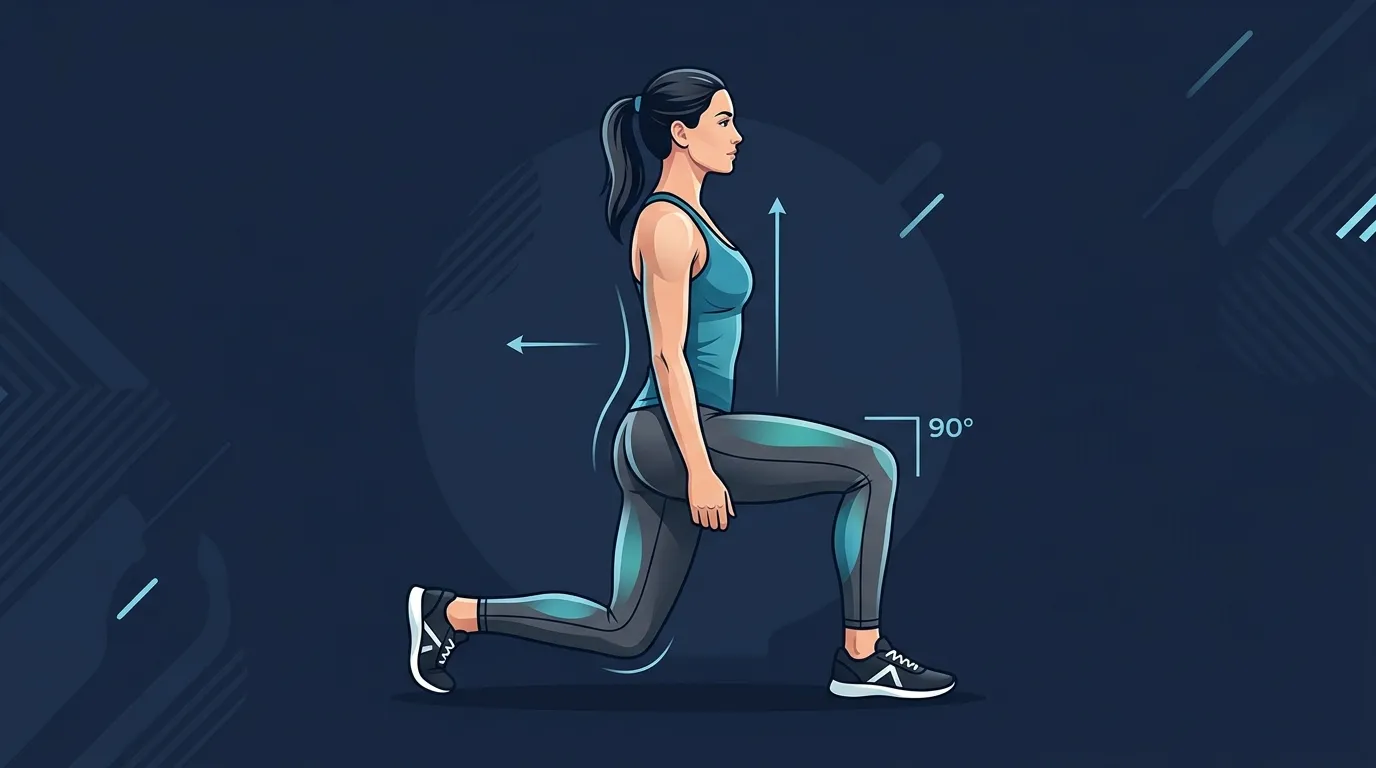
Common Mistakes
- Stepping too short. A short stride crowds the front knee and makes the heel want to lift. Step far enough back that both knees can bend without your front shin collapsing forward.
- Letting the front knee cave inward. Knee valgus usually means the hip is losing control. Push the knee gently toward the second and third toes and slow the rep down.
- Pushing off the back foot. The rear leg should help you balance, but the front leg should drive the return. If you feel the back calf doing most of the work, reset your weight into the front heel and midfoot.
- Leaning forward to finish the rep. A small torso angle is normal, but folding at the waist shifts stress to the lower back. Keep your ribs stacked over your pelvis and stand up through the front hip.
- Rushing the switch between legs. Alternating reps can turn sloppy fast. Pause briefly at the top, regain balance, then step back for the next rep.
- Dropping into the bottom. The lowering phase builds control. Hover the back knee instead of bouncing off the floor.
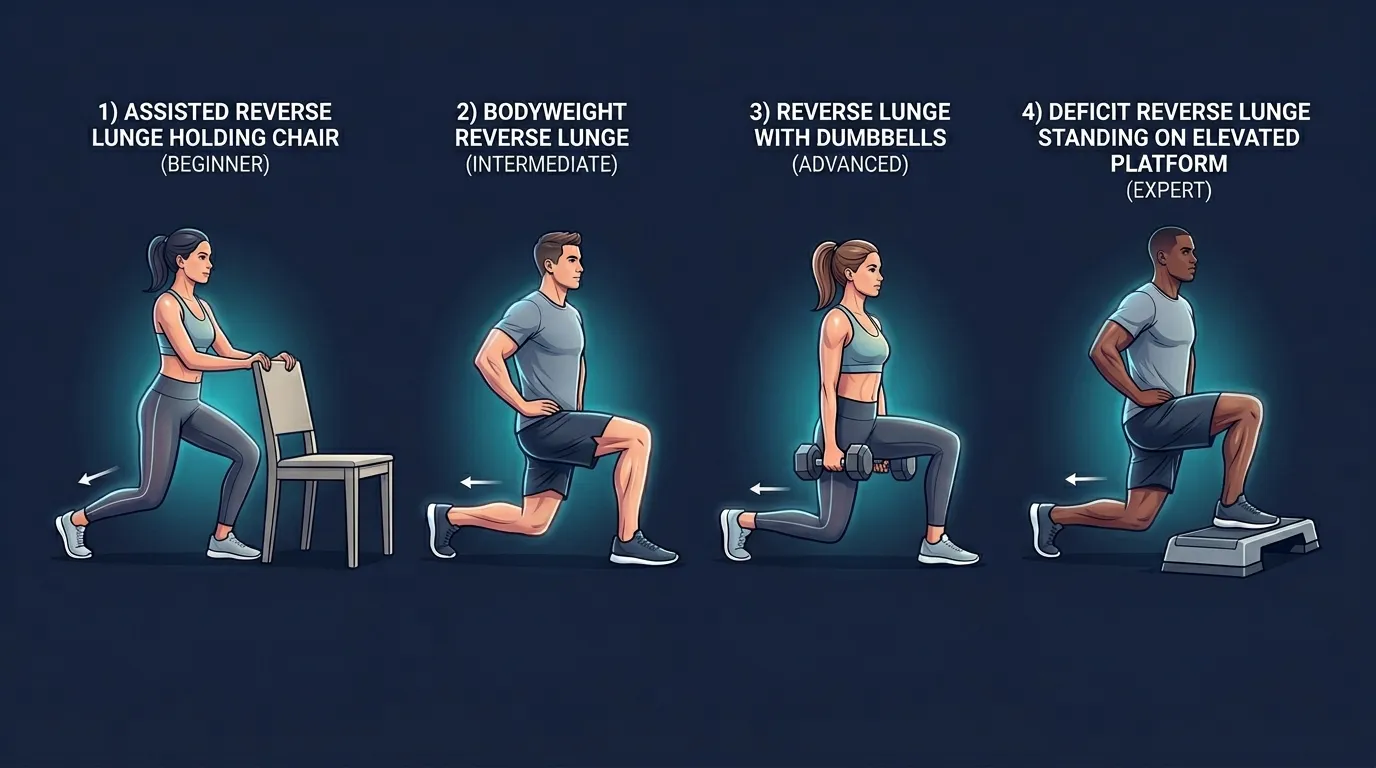
Rear Lunge Variations: Regressions and Progressions
- Supported rear lunge: hold a wall, rail, or sturdy chair while you learn the stepping pattern. This is the best starting point if balance, not leg strength, is the limiter.
- Bodyweight rear lunge: use the standard alternating version once you can keep the front heel down and return to standing without wobbling.
- Dumbbell rear lunge: hold a dumbbell in each hand at your sides. Add load only after bodyweight reps look the same on both legs.
- Deficit rear lunge: stand on a low step and reach the rear foot back to the floor. The extra range of motion increases glute and quad demand.
- Rear Lunge Knee Drive: drive the rear knee forward at the top of each rep to add hip-flexor control, rhythm, and a light conditioning effect.
- Jump Lunges: use this plyometric progression only after standard rear lunges, split squats, and landing mechanics are solid.
When to Avoid or Modify Rear Lunges
Rear lunges are safe for most healthy adults, but a few situations call for a smaller range, extra support, or a different lower-body exercise. Always consult your physician or physical therapist if you're returning from injury, surgery, pregnancy, or a long training layoff.
- Knee pain during the descent or return. Shorten the range, hold a support, or use Step-N-Lunge until the pattern is pain-free.
- Recent hip, knee, ankle, or spine injury. Rear lunges load the front hip and knee while challenging balance. Get clearance before adding depth or dumbbells.
- Balance limitations or dizziness. Use supported reps, Split Squats, or Squats so the feet stay predictable.
- Uncontrolled hypertension or known cardiovascular disease. Avoid heavy loaded versions and breath-holding. Use bodyweight reps, longer rest, and medical guidance.
- Pregnancy, early postpartum, or active diastasis recti. Use a supported split stance, shorter range, and steady breathing. Stop if you notice pelvic pressure, doming, or pain.
- Acute lower-back pain. Start with Deadbugs, Bird-Dogs, and supported squat patterns before returning to loaded unilateral work.
Related Exercises
- Same movement family: Split Squats, Bulgarian Split Squats, and Side Lunges train single-leg strength with different stability and hip demands.
- Squat-pattern foundation: Squats and Sumo Squats build the bilateral leg strength that makes lunges cleaner.
- Glute-focused accessory: Glute Bridges train hip extension without the balance demand of a standing lunge.
- Conditioning progression: Rear Lunge Knee Drive and Jump Lunges raise the intensity once your base pattern is stable.
- Core foundation: Deadbugs, Bird-Dogs, and Forearm Planks help you keep the pelvis and ribs steady during unilateral lower-body work.
How to Program Rear Lunges
Rear lunge programming follows the same broad progression model used for resistance training: start with a load and rep range you can control, then increase volume, range, tempo, or external load over time. Ratamess et al., 2009, the ACSM Position Stand on resistance training, supports matching sets, reps, rest, and frequency to training status.
| Level | Sets × Reps | Rest between sets | Frequency |
|---|---|---|---|
| Beginner | 2-3 × 6-10 per side | 90-120 seconds | 2-3 sessions/week |
| Intermediate | 3-4 × 8-12 per side | 120-180 seconds | 2-4 sessions/week |
| Advanced | 3-5 × 6-10 per side | 180-240 seconds | 2-4 sessions/week |
Where in your workout: place rear lunges early or mid-session, after your heaviest squat or hinge if you have one. In a bodyweight session, use them as the main lower-body strength move. In a dumbbell session, pair them with a hinge such as Romanian deadlifts or a glute accessory such as glute bridges.
Form floor over rep targets: end the set when the front knee caves inward, the heel lifts, the torso folds, or balance gets sloppy. Fewer clean reps beat more reps with a collapsing knee.
How FitCraft Programs This Exercise
Knowing how to do rear lunges is step one. Knowing when to use them, how many reps to do, and when to progress is where most lifters need a plan.
FitCraft's AI coach Ty uses your level, goals, and equipment to place compound strength exercises like rear lunges into a balanced workout. Bodyweight control comes first. Then volume, tempo, range of motion, and dumbbell loading can increase as your form holds up.
Ty also helps keep the progression practical. If balance is limiting you, the plan can stay with supported or bodyweight reps. If strength is the limiter, dumbbells, pauses, and deficit work give you room to grow.
Frequently Asked Questions
Are rear lunges better than forward lunges?
Rear lunges are often easier to control than forward lunges because the working leg stays planted while the other leg steps back. That makes it easier to keep pressure through the front heel and midfoot. Forward lunges are still useful, but they ask for more braking and balance.
What muscles do rear lunges work?
Rear lunges train the quadriceps, gluteus maximus, and hamstrings as the main lower-body muscles. The adductors, calves, gluteus medius, and deep core help keep the pelvis level and the front knee tracking cleanly.
How many rear lunges should I do?
Start with 2 to 3 sets of 6 to 10 reps per side if you're learning the pattern. Build toward 8 to 12 clean reps per side before adding dumbbells or harder tempo work.
Why do I lose balance during rear lunges?
Most balance problems come from stepping too narrow, rushing the return, or letting the front knee drift inward. Step straight back on a slightly wider track, slow the rep down, and reset between sides before you add load.
Can I do rear lunges with knee pain?
Modify rear lunges if knee pain shows up during the descent or return. Use a shorter range of motion, hold a wall or rail for support, or switch to split squats, step-n-lunges, or squats. If pain persists or feels sharp, stop and get assessed by a qualified clinician.