Medical disclaimer: This article is for informational purposes only and does not constitute medical advice. Always consult your physician or healthcare provider before starting any exercise program after a stroke. Your doctor can advise on appropriate activity levels, restrictions, and progression based on your specific medical history.
Exercise After Stroke Is Critical — But Intimidating
If you or someone you love has survived a stroke, you've probably heard that exercise is important for recovery. The American Heart Association and American Stroke Association explicitly recommend physical activity after stroke for reducing recurrence risk and improving long-term outcomes.
Research suggests that appropriate exercise after stroke may improve cardiovascular fitness, support mobility recovery, reduce fatigue, and benefit mental health during what is often one of the most challenging periods in a person's life. However, the type, intensity, and timing of exercise should always be guided by your medical team.
But knowing you should exercise and actually doing it are two very different things.
After a stroke, starting an exercise routine can feel overwhelming. Your body may not respond the way it used to. Movements that were once automatic now require conscious effort. The gap between where you are and where you want to be feels enormous. And the fear of another event — of pushing too hard, too fast — can be paralyzing.
This is where most post-stroke fitness advice fails. It tells you what to do but ignores the hardest part: how to actually keep doing it when everything about the experience feels difficult, slow, and discouraging.
The Research: Gamification Works for Stroke Survivors
A 2022 randomized controlled trial published in JAMA Neurology studied 34 stroke survivors to test whether gamification could improve physical activity outcomes. The results were striking.
Participants in the gamification group increased their daily steps by 981 compared to the control group (P=.01). They also showed a significant improvement in goal-achievement days, with a difference of +0.41 days (P<.001). These are meaningful, measurable improvements in a population that typically struggles to maintain any consistent exercise routine.
The program used several gamification elements that directly addressed the motivational challenges stroke survivors face:
- Loss-framed points: Participants started with points they could lose by not meeting their goals — tapping into the powerful psychological principle that people are more motivated to avoid losing something they have than to gain something new.
- Levels and progression: Clear, visible advancement that rewarded consistency rather than peak performance. Every step counted toward progression.
- Support partner: Each participant had an accountability partner who received updates on their progress, adding a social dimension that made showing up feel like it mattered to someone beyond themselves.
- Remote delivery: The entire program was delivered remotely, demonstrating that effective post-stroke exercise programs don't require traveling to a gym or rehabilitation center.
This wasn't a generic wellness app study. This was a controlled trial, published in one of the world's leading neurology journals, targeting a population with real physical limitations — and gamification produced significant, measurable improvements.
Why Movement Matters After Stroke
The benefits of exercise after stroke extend across nearly every dimension of recovery:
- Reduced recurrence risk. The AHA/ASA identifies physical inactivity as a modifiable risk factor for stroke. Regular exercise helps manage blood pressure, cholesterol, and blood sugar — all of which contribute to stroke risk.
- Improved cardiovascular fitness. Stroke survivors often experience significant deconditioning. Structured exercise helps rebuild cardiovascular capacity, which supports everything from walking endurance to daily energy levels.
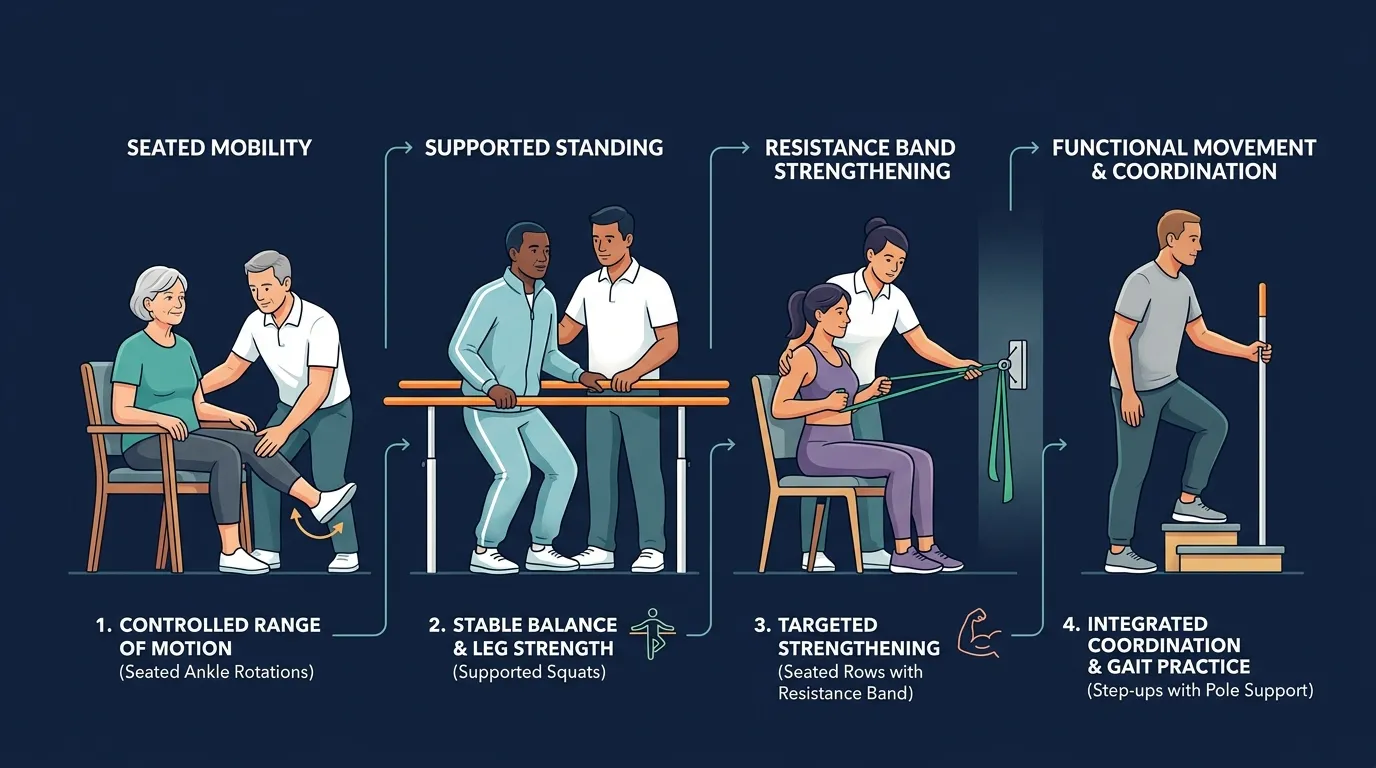
- Mobility and balance support. Targeted movement, when appropriate for the individual, may help retrain neural pathways, support coordination, and reduce the risk of falls — one of the most common concerns for stroke survivors. The specific approach should be guided by your rehabilitation team.
- Mental health benefits. Depression affects up to one-third of stroke survivors. Research suggests that exercise may help improve mood, reduce anxiety, and support a sense of agency during recovery, though individual experiences vary.
- Greater independence. The ability to perform daily activities — climbing stairs, carrying groceries, playing with grandchildren — depends on maintaining and rebuilding functional fitness.
The research supports that appropriate, medically supervised movement can play an important role in stroke recovery. The challenge isn't understanding that — it's building the consistent habit that makes it real, while respecting the individual safety needs that vary from person to person.
Barriers to Exercise After Stroke
Understanding why stroke survivors struggle with exercise is the first step toward solving the problem. The barriers are real and significant:
- Physical limitations. Hemiparesis (weakness on one side of the body), reduced coordination, and fatigue make traditional exercise programs inaccessible or discouraging.
- Fear of another event. Many survivors are afraid that exertion could trigger another stroke. This fear, while understandable, often leads to excessive caution and inactivity.
- Transportation challenges. Getting to a gym or rehabilitation center can be a significant barrier, especially for those with mobility limitations or who no longer drive.
- Loss of confidence. When your body doesn't work the way it used to, the psychological impact can be devastating. Many survivors feel embarrassed or defeated before they even start.
- Slow, invisible progress. Recovery after stroke is measured in weeks and months, not days. Without visible markers of progress, it's easy to feel like nothing is working — and to quit.
- Isolation. Stroke can be socially isolating. Without a support system or accountability structure, maintaining any new habit becomes exponentially harder.
Traditional fitness programs aren't designed to address these barriers. They assume a baseline level of physical ability, confidence, and motivation that many stroke survivors don't have. That's not a failure of the individual — it's a failure of the approach.
How Gamification Addresses These Barriers
What makes the JAMA Neurology trial so compelling isn't just that gamification worked — it's why it worked. Each gamification element directly targeted a specific barrier to post-stroke exercise:
Loss-framed accountability solves the motivation gap
Stroke survivors don't need to be told exercise is important — they know. What they need is a system that makes not exercising feel costly in the moment, not just in the abstract future. Loss-framed points create that immediate cost. You start with something, and every missed day means losing it. This gentle pressure is often the nudge that turns "I should" into "I will."
Support partners solve isolation
When someone else is watching — a partner, a family member, a friend — showing up stops being just about you. The social accountability in the JAMA Neurology study created a sense of connection and obligation that kept participants engaged even on difficult days. You're not just exercising for your health. You're exercising because someone is in your corner, rooting for you.
Visible progression solves the "nothing is working" problem
When physical recovery is slow, progress needs to be measured differently. Points, levels, and streaks create a parallel track of advancement that rewards consistency rather than performance. You may not notice a change in your mobility from one day to the next — but you can see your streak growing, your level increasing, and your points accumulating. That visible progress is the signal your brain needs to keep going.
Remote delivery solves access barriers
The fact that the JAMA Neurology trial was delivered entirely remotely is significant. It means effective post-stroke exercise doesn't require driving to a gym, navigating a rehabilitation center, or working around someone else's schedule. You can do it from your living room, at your own pace, on your own terms.
Getting Started Safely
If you're a stroke survivor interested in building an exercise habit, here's how to begin:
- Talk to your doctor first. This is non-negotiable. Your physician knows your specific situation — the type of stroke, your current medications, any physical limitations, and what intensity levels are appropriate for you. Get clearance before starting any program.
- Start with walking. For most stroke survivors, walking is the safest and most accessible starting point. Even five minutes of walking counts. The JAMA Neurology trial measured steps for a reason — they're achievable, measurable, and meaningful.
- Set goals based on where you are, not where you want to be. If you're currently walking 1,000 steps a day, don't set a goal of 10,000. Set a goal of 1,200. Small, achievable goals build momentum. Unrealistic goals build frustration.
- Use a system that rewards consistency. The research is clear: gamification elements like streaks, points, and accountability partners significantly improve exercise adherence in stroke survivors. Choose a program that makes showing up feel rewarding, even when the physical results are still developing.
- Involve someone you trust. Whether it's a spouse, a friend, or an adult child, having a support partner who checks in on your progress makes a measurable difference. The JAMA Neurology trial built this into the intervention for a reason — it works.
- Be patient with yourself. Recovery is not linear. You'll have good days and hard days. The goal isn't perfection — it's persistence. Every day you move is a day you're investing in your recovery.
How FitCraft Applies This Science
FitCraft was built on the same principles that made the JAMA Neurology gamification trial successful — applied to a broader fitness context that adapts to any starting point, including post-stroke recovery.
- AI that adapts to your level. FitCraft's AI coach, Ty, personalizes every workout through a 32-step diagnostic assessment. Whether you're recovering from a stroke or simply starting from zero, the program meets you where you are — not where a generic template assumes you should be. Programs are designed by an Ivy League-trained exercise scientist, NSCA-certified strength coach.
- Streak accountability. Just like the loss-framed points in the stroke trial, FitCraft's streak system creates gentle daily accountability. Missing a day means breaking your streak — a simple but powerful motivator that keeps you showing up.
- Home-based workouts. Every FitCraft workout can be done at home with minimal or no equipment. No gym required. No transportation barriers. No uncomfortable public environments. Just you, your space, and your next quest.
- Progression you can see. Quests, collectible cards, avatar leveling, and visible milestone tracking ensure you always have evidence of your progress — even before the physical changes become apparent.
- Built for people who've struggled before. FitCraft isn't designed for people who already love fitness. It's designed for people who've quit other programs, who feel intimidated by exercise, and who need the experience itself to be rewarding — not just the distant promise of future results.
Find out where to start
Take the free 2-minute assessment and get a personalized plan that adapts to your fitness level, available equipment, and goals — no matter where you're starting from.
Take the Free Assessment Free · 2 minutes · No credit cardThe Bottom Line
For many stroke survivors, appropriate exercise can be an important part of recovery, potentially reducing recurrence risk and improving quality of life. The AHA and ASA recommend it under proper medical guidance. The research supports it. And a 2022 randomized controlled trial in JAMA Neurology demonstrated that gamification makes it significantly more achievable.
The barriers to post-stroke exercise are real. But they're also solvable — with the right system. A system that rewards you for showing up, that adapts to your limitations, that gives you visible progress when physical changes are still weeks away, and that doesn't require leaving your home.
You've already survived the hardest part. Now it's about building the habits that protect what you've fought to keep.
Frequently Asked Questions
Is exercise safe after a stroke?
Yes — assuming it is done at a manageable low intensity and adheres to stroke rehabilitation protocols. Most often, it is recommended that rehabilitation exercise begins as soon as 24 to 48 hours following a stroke, but personal safety needs may vary on a case-by-case basis. The American Heart Association and American Stroke Association actively recommend exercise after stroke for reducing recurrence risk and improving recovery outcomes. Exercise improves cardiovascular fitness, mobility, and mental health in stroke survivors. However, you should always get clearance from your doctor before starting any exercise program after a stroke. Your physician can advise on appropriate intensity levels and any movements to avoid based on your specific situation.
How does gamification help stroke survivors exercise more?
A 2022 randomized controlled trial published in JAMA Neurology found that stroke survivors using a gamification-based program increased their daily steps by 981 compared to the control group (P=.01) and significantly improved goal-achievement days (P<.001). The program used points, levels, loss-framed accountability, and a support partner to keep participants engaged. Gamification works by creating immediate rewards for movement, which is especially important when recovery feels slow or frustrating.
What kind of exercise should I do after a stroke?
The AHA/ASA recommends a combination of aerobic exercise, strength training, and flexibility work for stroke survivors. Walking is often the best starting point — even short walks count. The key is starting at a level that matches your current ability and building gradually. An AI-adaptive program like FitCraft can adjust exercises to your specific fitness level, available equipment, and any physical limitations.
Can I exercise at home after a stroke?
Absolutely. The 2022 JAMA Neurology stroke gamification trial was delivered entirely remotely, demonstrating that home-based programs can be highly effective for post-stroke exercise. Home-based programs remove major barriers like transportation difficulties and gym anxiety that many stroke survivors face. FitCraft is designed for home workouts with minimal or no equipment, making it accessible regardless of mobility limitations.
How soon after a stroke can I start exercising?
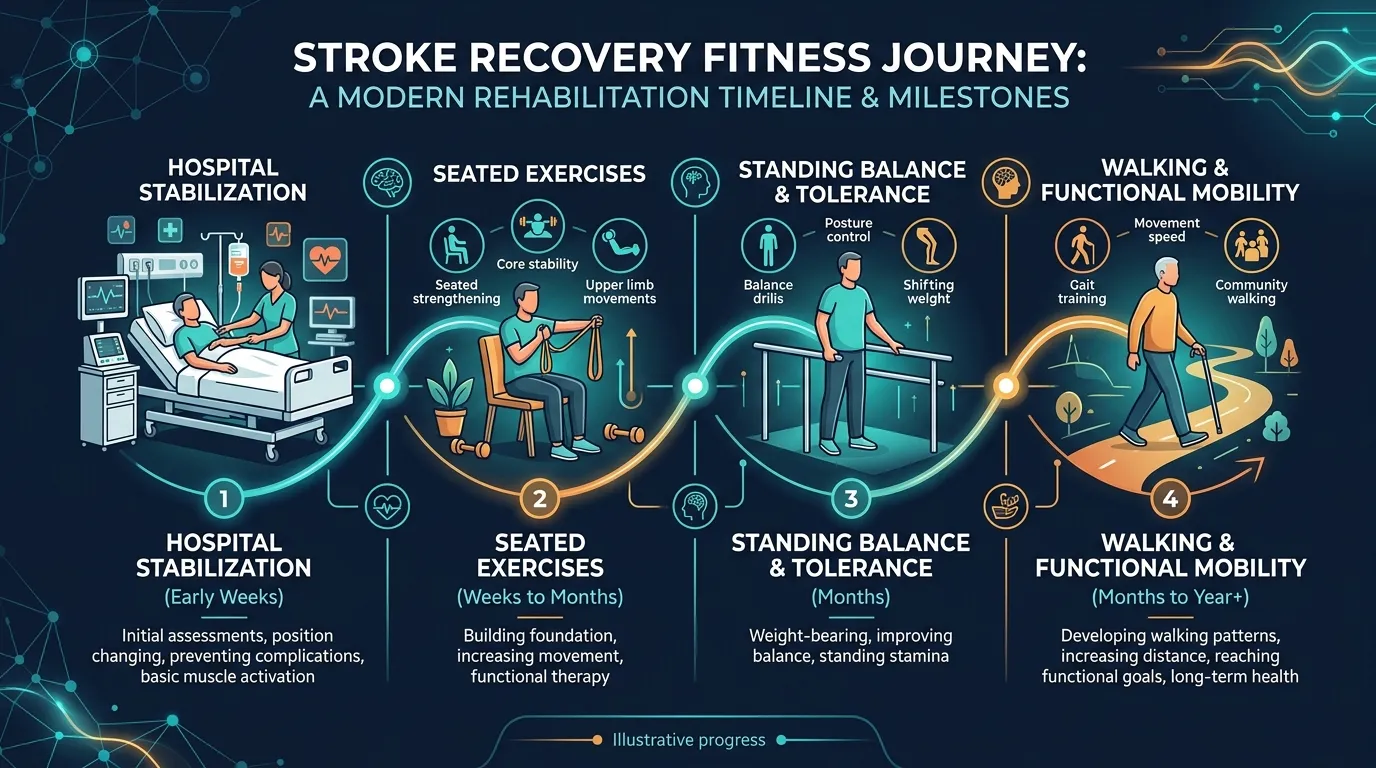
The timeline varies depending on the type and severity of your stroke, so your doctor is the best person to advise on when to start. Many stroke survivors begin gentle movement within days of their event as part of hospital-based rehabilitation, then transition to more structured exercise programs during outpatient recovery. The important thing is to start when your medical team gives the green light and to progress gradually.