You'll skip a workout to earn 100 points. But you won't skip one if it means losing 100 points you already have.
Same 100 points. Same workout. Completely different decision. That asymmetry is not a character flaw or a quirk of personality. It's loss aversion — one of the most powerful and well-documented forces in human psychology. And it has profound implications for how we design fitness systems that actually work.
This article examines the original science behind loss aversion, walks through three clinical trials that tested loss-framed interventions in real fitness contexts, and explains why the mechanism behind the loss matters more than the loss itself.
Kahneman & Tversky: The Science of Losses > Gains
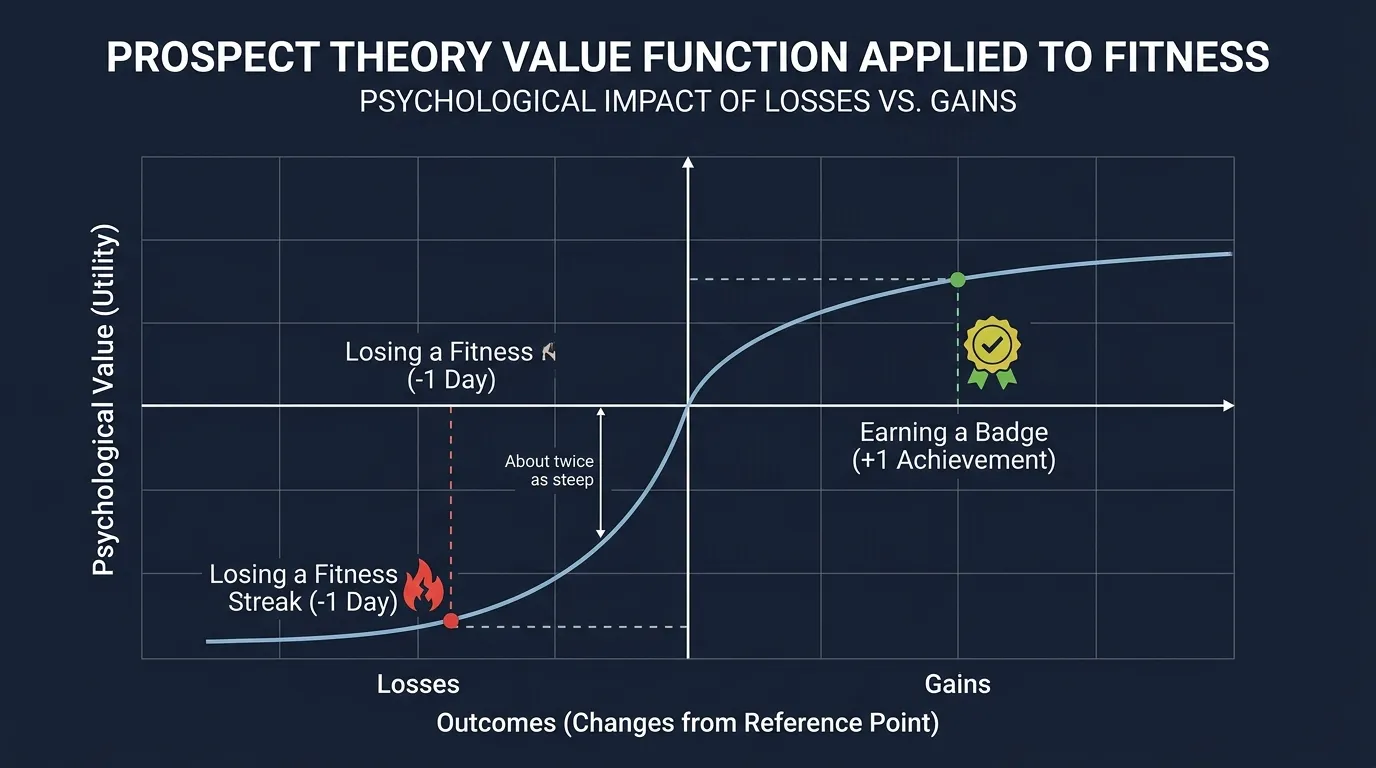
In 1979, Daniel Kahneman and Amos Tversky published "Prospect Theory: An Analysis of Decision Under Risk" in Econometrica — a paper that would eventually earn Kahneman the Nobel Prize in Economics (Tversky had passed away before the award). The paper introduced a deceptively simple finding that upended classical economic theory: losses are psychologically approximately twice as powerful as equivalent gains.
Classical economics assumed people evaluate outcomes rationally — that gaining $100 and losing $100 produce symmetrical emotional responses. Kahneman and Tversky proved this was wrong. Through a series of carefully designed experiments, they demonstrated that the pain of losing $100 is roughly twice the pleasure of gaining $100. The value function is steeper on the loss side than the gain side.
This isn't just a laboratory curiosity. Loss aversion has been replicated across cultures, ages, and contexts. It explains why people hold losing stocks too long (selling means realizing the loss), why they reject fair coin-flip bets (the potential loss looms larger than the potential gain), and why "limited time offer" marketing works (the fear of losing the deal outweighs the appeal of the deal itself).
The fitness implications are immediate. If you give someone 100 points at the start of each day and deduct points for missed activity goals, the psychological sting of losing those points is roughly twice as motivating as the satisfaction of earning them would be. You're not playing for reward. You're playing to protect what's already yours.
That insight — give people something first, then threaten to take it away — is the foundation of loss-framed fitness design. And three rigorous clinical trials have now tested it.
Three Clinical Trials Testing Loss-Framed Fitness
The theory is elegant, but science requires evidence. Over the past several years, three randomized controlled trials have put loss-framed fitness interventions to the test — each in a different population, each with a different design, and each revealing something important about when and why this approach works.
The ALLSTAR Trial (2025): Cancer Survivors
The ALLSTAR trial, published in 2025 in JACC CardioOncology (PMC12805409), enrolled 150 cancer survivors — a population where physical activity is clinically important but notoriously difficult to sustain. The cohort was 81% women, 64% Black, and 35% Hispanic, making it one of the most diverse exercise behavior trials conducted.
Participants in the loss-framed arm received a weekly endowment of points. Each day they missed their activity goal, points were deducted. They could see the deductions happening in real time — watching their balance shrink with each missed day.
The results were striking:
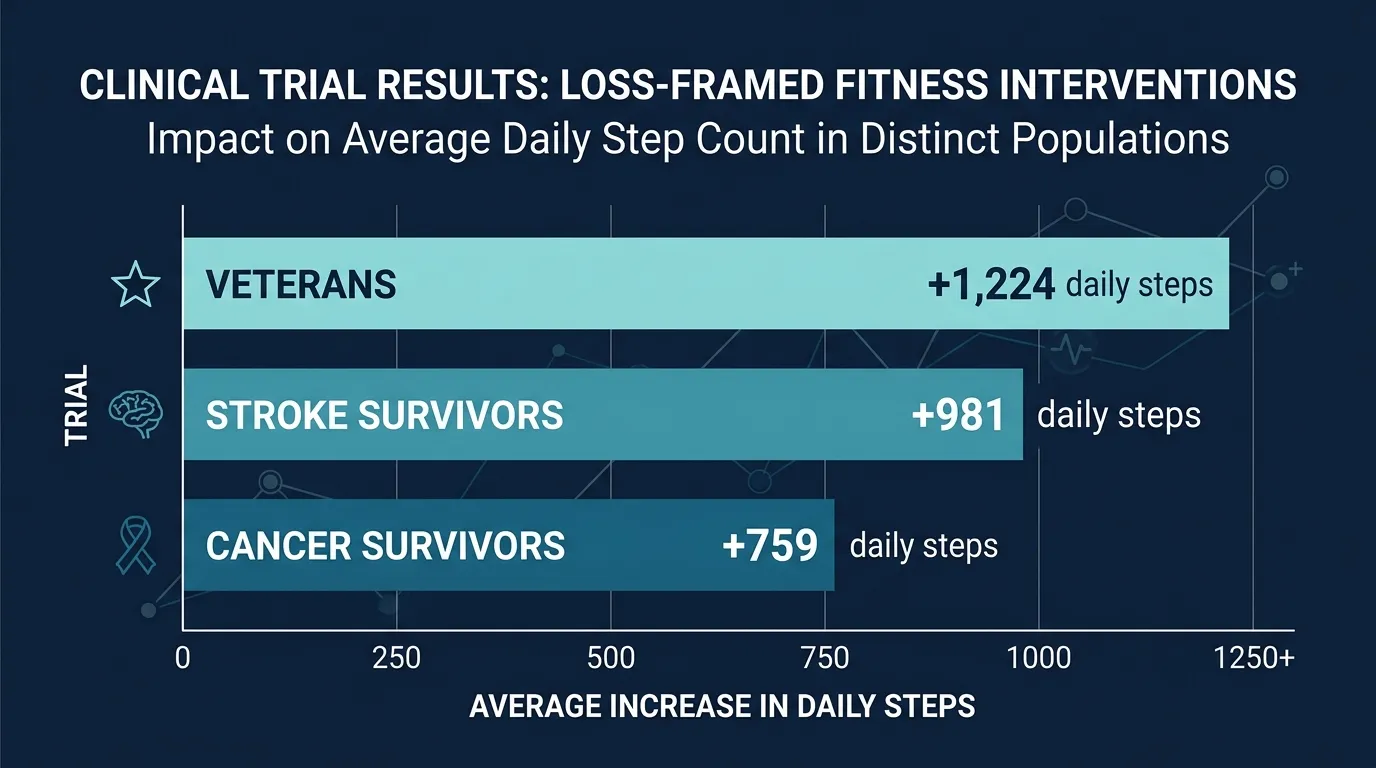
- +759 steps per day compared to control (P=.007)
- +16 minutes per week of moderate-to-vigorous physical activity (MVPA) (P=.010)
- During the follow-up period after the intervention ended, MVPA gains were partially retained: +11 minutes per week (P=.048)
That last number is critical. The ALLSTAR trial didn't just show that loss-framed points get people moving while the system is active. It showed partial retention after the intervention ended — suggesting that the behavior had begun to take root as something closer to habit rather than pure compliance.
Stroke Gamification RCT (2022): Stroke Survivors
Published in 2022 in JAMA Neurology, this trial enrolled 34 stroke survivors with a baseline of approximately 4,300 steps per day. The intervention combined loss-framed points with levels and a support partner — layering social accountability on top of loss aversion.
Each week, participants received a point endowment. Points were lost for each day they failed to meet their step goal. The level system added progression mechanics, and the support partner added social reinforcement.
Results:
- +981 steps per day compared to control (P=.01)
- +0.41 goal-achievement days per week (P<.001)
For a stroke survivor averaging 4,300 steps, adding nearly 1,000 more represents a 23% increase in daily activity — a clinically meaningful improvement achieved not through additional physical therapy, but through how the activity was framed. The exercise was the same. The framing changed the behavior.
Veterans RCT (2021): Loss-Framed Financial Incentives
This trial, published in 2021 in JAMA Network Open (PMC8271358), enrolled 180 veterans and tested something different: loss-framed financial incentives combined with gamification elements.
Participants in the loss-framed arm were endowed with $120 at the start of each month. For each week they failed to meet their step goal, $10 was deducted. They could watch their money disappear. The gamification arm received points, levels, and social elements — but without the financial stakes.
During the 12-week intervention, the combined loss-framed financial incentives + gamification arm produced the strongest result of any trial in this review:
- +1,224 steps per day (P=.005)
The follow-up period revealed an important design insight: the gains partially attenuated when the financial incentive was removed, highlighting that the type of loss matters for long-term sustainability. Financial loss aversion drives powerful short-term results, but lasting habits require the loss to be tied to something intrinsic — like effort you've invested — rather than money you were given.
This trial is arguably the most instructive of the three, because it reveals exactly why the mechanism behind the loss matters more than the size of the effect.
Loss Aversion vs. Financial Incentives: Why the Mechanism Matters
Stack these three trials side by side and a pattern emerges:
- ALLSTAR (loss-framed points, no money): +759 steps/day, with partial retention at follow-up
- Stroke RCT (loss-framed points + levels + support partner): +981 steps/day
- Veterans RCT (loss-framed real money + gamification): +1,224 steps/day — the strongest short-term effect
The Veterans trial produced the biggest short-term effect, but the intrinsic approaches showed better durability. Why?
Because what you stand to lose determines whether the habit sticks.
When the thing at risk is money you were given, the motivation is entirely extrinsic. You're not protecting something you built. You're protecting a windfall. The moment the windfall stops, the motivation stops with it. The behavior was never internalized — it was rented.
When the thing at risk is points you earned through your own effort — or a streak you built day by day — the loss is intrinsic. It's tied to your identity, your investment, your sense of personal progress. Losing it doesn't just cost you something external. It costs you something you made. And that distinction, according to self-determination theory (Deci & Ryan, 2000), is the difference between compliance and commitment. This is also why willpower-based fitness fails — it relies on extrinsic pressure rather than intrinsic investment.
The BE FIT trial (2017, n=200, PMC5710273) provides supporting evidence from a different angle. Using commitment consistency and social incentives — mechanisms that are inherently intrinsic — it achieved a goal completion rate of 53% vs. 32% in control. No financial stakes. No external loss. Just the psychological weight of personal commitment.
The lesson: loss aversion is a powerful engine. But the fuel matters. External losses drive short-term behavior. Internal losses — losing something you built — drive lasting change.
Streaks as Loss Aversion
This is where streaks enter the picture — and where the clinical data connects directly to everyday fitness behavior.
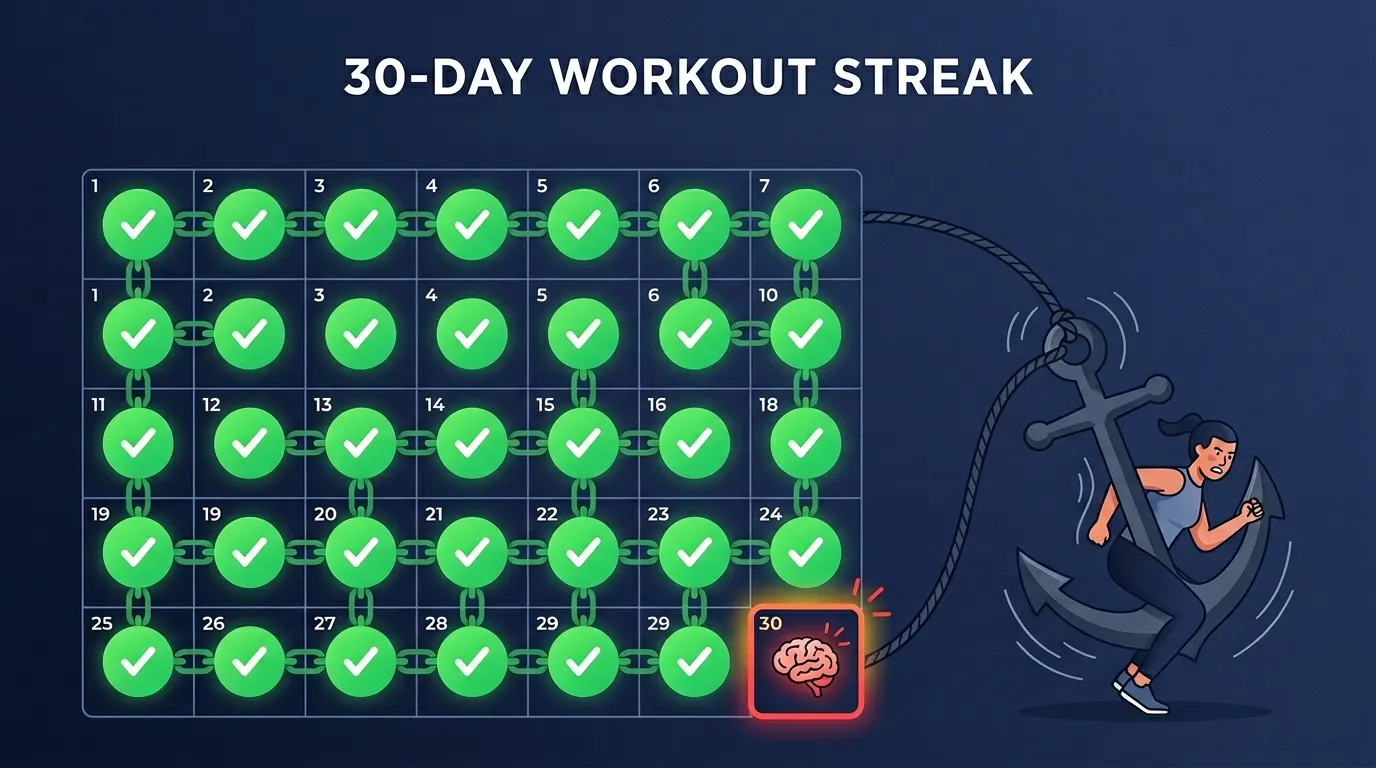
A workout streak is, at its core, a loss aversion mechanism. Every day you work out, your streak grows. Every day it grows, the prospect of losing it becomes more painful. By day 30, your streak represents 30 days of personal effort, discipline, and identity. Breaking it doesn't just reset a number. It erases something you built with your own hands.
This maps precisely onto the clinical findings. The ALLSTAR trial's loss-framed points worked because participants had to earn their weekly endowment through sustained effort — the points represented real behavioral investment. The Veterans trial's financial endowment failed to sustain because the money was given, not earned.
Streaks replicate the ALLSTAR model naturally. You don't receive a streak as a gift. You build it one day at a time. And every day you build it, the loss aversion coefficient grows. Kahneman and Tversky showed losses hurt 2x as much as equivalent gains. A 60-day streak doesn't just represent 60 days of effort — it represents 60 days of effort that would feel like losing 120 days of effort if you broke it.
This is why streak-breaking feels so devastating, and why it's such an effective behavioral lever. You're not just skipping a workout. You're destroying a possession that took weeks to build. And the research is clear: people will work harder to avoid that destruction than they ever would to earn a new reward.
See the science in action
FitCraft uses evidence-based streak mechanics to harness loss aversion — without financial stakes or toxic pressure. Take the free 2-minute assessment to see how it works for your goals.
Take the Free Assessment Free · 2 minutes · No credit cardHow FitCraft Applies This
The clinical evidence points to a specific design principle: loss aversion works for fitness when the thing at risk is intrinsic — built by the user, tied to their effort, and meaningful beyond the intervention period. Financial loss aversion is a blunt instrument that drives compliance without commitment. Streak-based loss aversion is a precision tool that builds habits.
FitCraft's streak system was designed around this distinction. Here's what that looks like in practice:
Streaks as Soft Loss Aversion
Every workout you complete extends your streak. Every day your streak grows, the psychological cost of breaking it increases — activating the same loss aversion that drove +759 steps/day in the ALLSTAR trial and +981 steps/day in the Stroke RCT. But there's no money on the line. No external punishment. The only thing at risk is something you built yourself, which the research suggests is exactly the type of loss that produces lasting behavior change.
Grace Days Prevent the Spiral
Loss aversion is powerful, but it cuts both ways. If losing a streak triggers the abstinence violation effect — the "I already lost it, so why bother?" spiral — then the mechanism that was supposed to keep you consistent becomes the mechanism that makes you quit. FitCraft's grace day system prevents this by ensuring that a single missed workout doesn't destroy weeks of progress. You feel the pull of protecting your streak without the catastrophic failure mode that makes rigid streaks toxic.
No Financial Stakes, By Design
The Veterans RCT (PMC8271358) showed that financial loss aversion produces powerful short-term effects (+1,224 steps/day) — but intrinsic approaches show better long-term durability, a pattern consistent with the engagement decay research. FitCraft deliberately avoids financial incentives. The loss aversion in FitCraft's system is entirely intrinsic — tied to your personal streak, your XP progression, your consistency record. The evidence says this is the type that lasts.
References
- Kahneman, D., & Tversky, A. (1979). Prospect theory: An analysis of decision under risk. Econometrica, 47(2), 263-291.
- Deci, E. L., & Ryan, R. M. (2000). The "what" and "why" of goal pursuits: Human needs and the self-determination of behavior. Psychological Inquiry, 11(4), 227-268.
- Fanaroff, A. C., Orr, J. A., Anucha, C., et al. (2025). Behaviorally Designed Gamification and Physical Activity Among Breast and Prostate Cancer Survivors. JACC: CardioOncology. doi:10.1016/j.jaccao.2025.10.001 PMC12805409.
- Patel, M. S., et al. (2022). Gamification with loss-framed incentives and a support partner to increase physical activity among stroke survivors. JAMA Neurology.
- Patel, M. S., et al. (2021). Effect of financially framed gamification with social incentives on daily step counts among veterans. JAMA Network Open. PMC8271358.
- Patel, M. S., et al. (2017). BE FIT: A randomized controlled trial using commitment and social incentives to increase physical activity. Preventive Medicine. PMC5710273.
Frequently Asked Questions
What is loss aversion in fitness?
Loss aversion is the psychological principle — established by Kahneman and Tversky's prospect theory (1979) — showing that losing something feels approximately twice as painful as gaining the same thing feels good. In fitness, this means people work harder to avoid losing points, streaks, or progress they already have than they would to earn new rewards. Clinical trials show loss-framed fitness interventions increase daily steps by 759 to 1,224 compared to controls.
Does loss-framed gamification actually increase physical activity?
Yes. Multiple randomized controlled trials confirm it. The ALLSTAR trial (2025, JACC CardioOncology, n=150) found loss-framed points increased daily steps by 759 (P=.007) and weekly moderate-to-vigorous activity by 16 minutes (P=.010). A 2022 JAMA Neurology trial (n=34) found loss-framed gamification added 981 steps per day for stroke survivors (P=.01). The effect is consistent across populations.
Is loss aversion better than reward-based motivation for exercise?
Loss-framed interventions consistently outperform gain-framed ones in clinical trials. However, the mechanism matters. Financial loss aversion (losing real money) drives strong short-term results but does not sustain after the incentive ends. Intrinsic loss aversion — like losing a streak or points you have earned through effort — tends to build habits because the loss is tied to personal investment rather than external stakes.
Why don't financial incentives create lasting exercise habits?
A 2021 JAMA Network Open RCT (n=180, PMC8271358) tested loss-framed financial incentives combined with gamification for veterans. During the intervention, participants gained an impressive 1,224 steps per day (P=.005). However, financial losses drive extrinsic motivation — when the money stops, the external lever disappears. Lasting habits require intrinsic mechanisms like streak protection and personal progress, where the thing at risk is something you built yourself.
How does FitCraft use loss aversion without financial stakes?
FitCraft uses streak mechanics as a form of soft loss aversion. Your workout streak represents personal effort you have invested — and the prospect of losing that streak activates the same loss aversion psychology that clinical trials have validated. Unlike financial incentives, streak-based loss aversion is intrinsic: the thing you stand to lose is something you built yourself, which research suggests is more sustainable for long-term habit formation.