You've told yourself the same thing a hundred times. "This time I'll be more disciplined." You set the alarm for 5:30 AM. You buy the gym membership. You download the app. And for a week — maybe two — you actually show up.
Then you don't. And the voice in your head says the same thing it always says: "You just didn't want it badly enough."
That voice is wrong. And we can prove it.
The problem isn't you. The problem is that every mainstream fitness approach is built on the same flawed assumption: that willpower is the engine of behavior change. Decades of research in psychology, behavioral economics, and exercise science tell a different story. Willpower is not a strategy. It's a resource — and it runs out.
Here's the science behind why discipline-based fitness fails, why roughly half of everyone who starts an exercise program quits within six months, and what actually works when willpower doesn't.
The Ego Depletion Model: Willpower as a Finite Resource
In 1998, psychologist Roy Baumeister and colleagues published a landmark study in the Journal of Personality and Social Psychology that changed how researchers think about self-control. The study was elegantly simple: participants were placed in a room with freshly baked cookies and radishes. Some were told to eat the cookies. Others were told to resist the cookies and eat only the radishes.
Afterward, both groups were given an unsolvable puzzle. The radish group — the one that had already burned through self-control resisting cookies — gave up significantly faster than the cookie group. Same puzzle. Same people. The only difference was that one group had already spent their willpower budget (Baumeister et al., 1998).
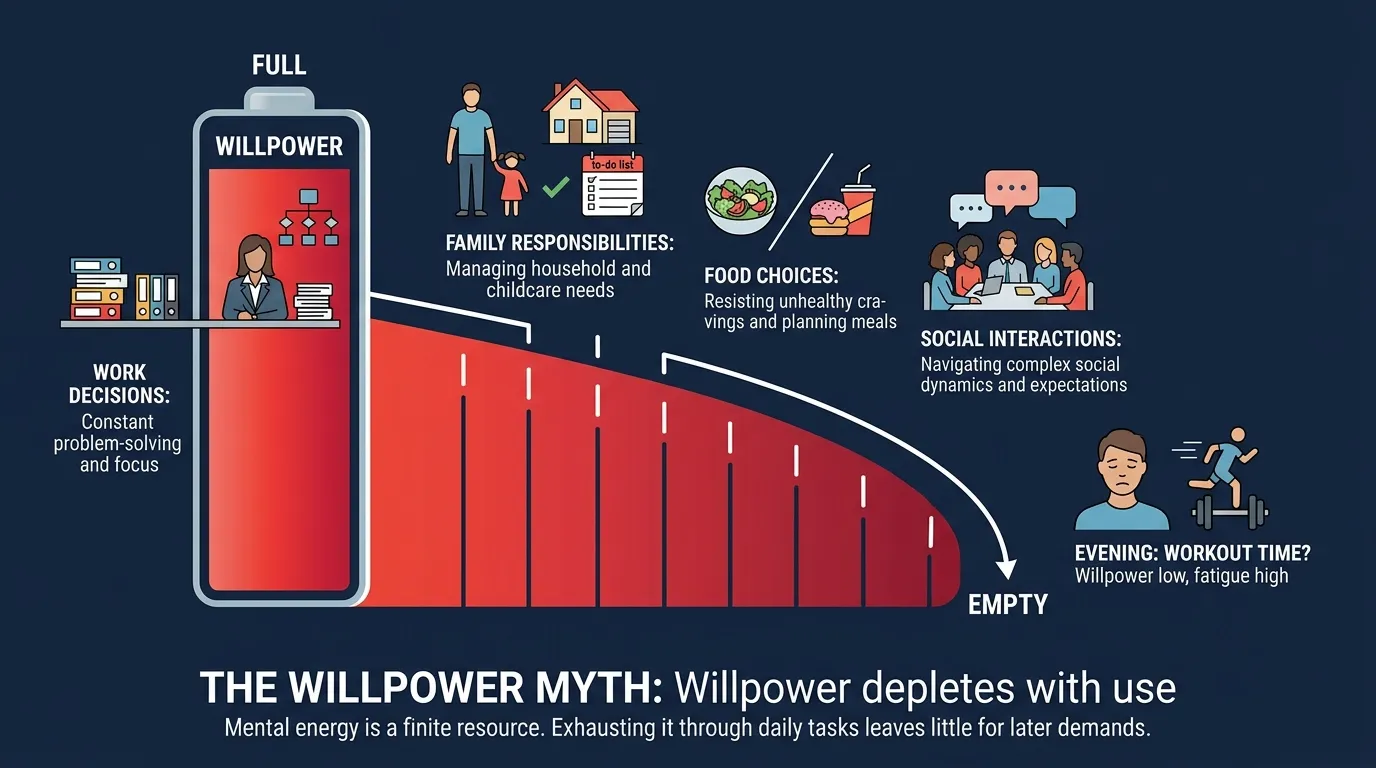
Baumeister called this ego depletion — the idea that self-control draws from a single, limited pool of mental energy. Use it resisting cookies, and you have less available for puzzles. Use it navigating a stressful workday, and you have less available for the 6 PM workout you promised yourself you'd do.
The theory spawned hundreds of follow-up studies. Across experiments involving everything from emotion suppression to financial decisions, the pattern repeated: exerting self-control on one task reliably impaired performance on the next. Willpower, it appeared, was like a battery — and modern life drains it before you ever lace up your sneakers.
The Replication Crisis Caveat (And Why It Doesn't Save Willpower)
Intellectual honesty demands a caveat here. In 2016, a large-scale replication attempt involving 23 laboratories and 2,141 participants failed to find a statistically significant ego depletion effect (Hagger et al., 2016). The effect size was essentially zero: d = 0.04. This study became a flagship example of psychology's replication crisis, and some researchers now argue that ego depletion — at least as originally formulated — may not be a real phenomenon at all.
Stanford psychologist Carol Dweck has proposed an alternative: that willpower depletion primarily affects people who believe willpower is limited. In other words, the belief itself may be the mechanism, not some finite biological fuel (Lurquin & Miyake, 2017).
But here's the thing: whether the mechanism is biological depletion or belief-driven fatigue, the practical outcome is identical. People who rely solely on willpower to maintain fitness routines overwhelmingly fail. The lab debate is fascinating. The real-world data is unambiguous.
And the real-world data is damning.
The 50% Dropout Problem
In 1988, exercise psychologist Rod Dishman published what would become one of the most cited statistics in fitness research: approximately 50% of people who begin a structured exercise program drop out within six months (Dishman, 1988).
That was nearly four decades ago. You'd think we'd have solved this by now. We haven't.
More recent research confirms the pattern. A 2022 analysis in the Translational Journal of the American College of Sports Medicine examining the STRRIDE randomized trials found that 295 of 947 participants dropped out, and that 67% of those who quit did so before or during the ramp-up period, prior to ever reaching the prescribed training volume (Collins et al., 2022). The most common reason given was lack of time.
Let that sink in. We have better gym equipment, better exercise science, better apps, better everything. And the dropout rate hasn't meaningfully budged in 35 years.
Why? Because every generation of fitness tools makes the same mistake: they give people a plan and expect willpower to do the rest. The plan isn't the problem. The engine powering it is.
Decision Fatigue: Death by a Thousand Choices
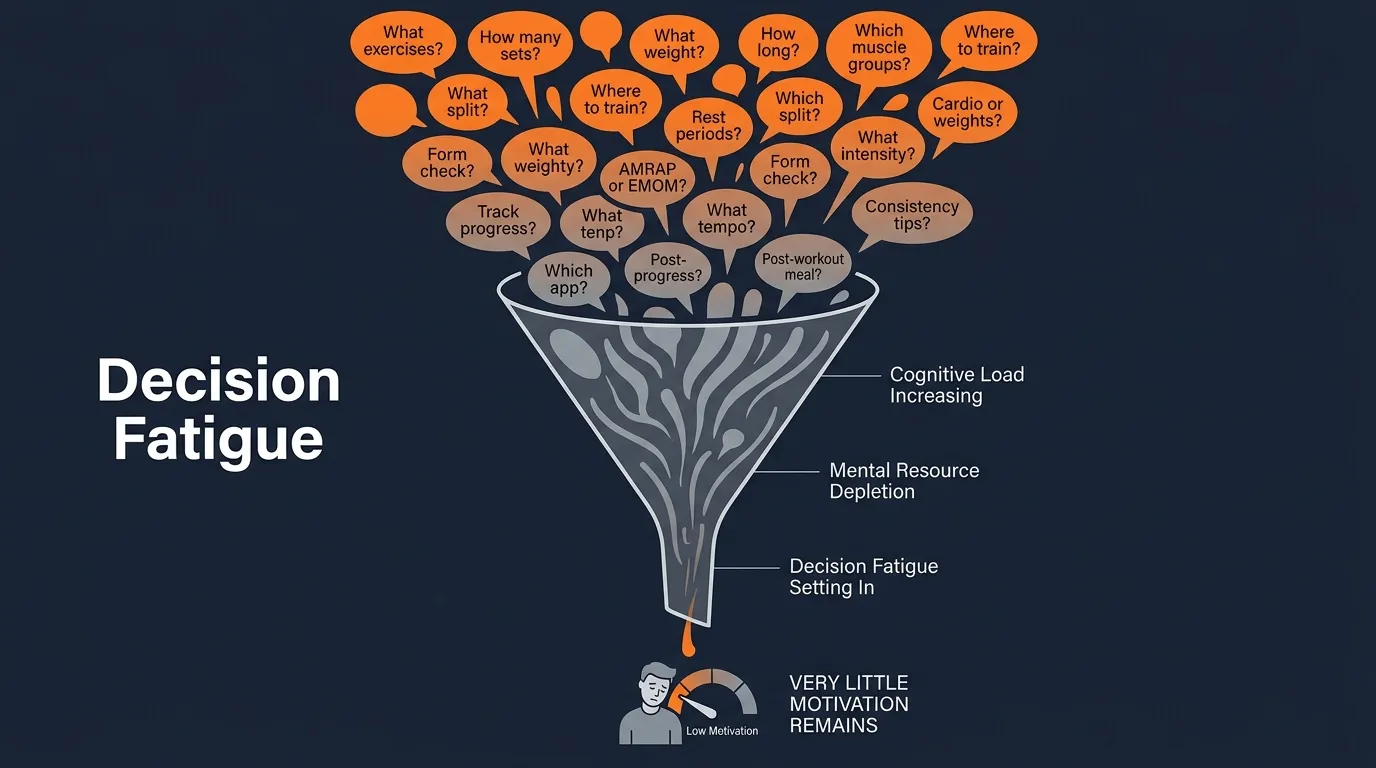
Even if you don't buy the ego depletion model, there's a closely related phenomenon with even stronger evidence: decision fatigue.
In 2011, researchers Danziger, Levav, and Avnaim-Pesso published a striking study in the Proceedings of the National Academy of Sciences. They analyzed 1,112 judicial rulings by Israeli parole board judges over a 10-month period. The finding: judges granted parole at a rate of roughly 65% right after a break, but that rate plummeted to nearly 0% by the end of each decision session — before snapping back to 65% after the next break (Danziger et al., 2011).
The quality of the case didn't predict the outcome. The position of the case in the sequence did. After dozens of consecutive decisions, judges defaulted to the easiest option: deny.
(Note: this study has faced methodological criticism regarding case ordering, but subsequent research in other judicial contexts has found similar patterns of decision quality degradation over time.)
Now think about what a typical fitness app asks you to do every single day:
- Should I work out today or rest?
- What time should I go?
- Which muscle group should I train?
- Which exercises should I pick?
- How many sets? How many reps? What weight?
- Should I do cardio today or skip it?
- Am I progressing fast enough? Should I change programs?
That's not a workout plan. That's a decision gauntlet. And every one of those micro-decisions chips away at the same cognitive resources you need to simply show up.
That gauntlet isn't priced the same for everyone. Executive function differences make each of those choices cost more, which is why an ADHD-friendly fitness app is judged less on how many options it offers than on how many it takes off your plate.
Research published in the Journal of Personality and Social Psychology confirmed that the act of choosing itself is depleting — the more choices a person makes, the more likely they are to give up, lose willpower, and struggle with endurance on subsequent tasks. Generic fitness apps don't remove decisions. They multiply them.
Why "Just Be More Disciplined" Is Terrible Advice
Here's where this gets personal — and where the fitness industry has a moral problem.
When someone quits a workout program, the standard narrative blames them. You weren't committed enough. You didn't want it badly enough. You need more discipline.
This is exactly wrong. And it's harmful.
Telling someone who quit an exercise program to "be more disciplined" is like telling someone who ran out of gas to "drive harder." The resource is depleted. Trying harder doesn't refill it.
What makes this especially toxic is the cycle it creates:
- You start a program built entirely on willpower.
- Willpower runs out (because it always does).
- You quit.
- You blame yourself.
- You feel shame and decreased self-efficacy.
- Lower self-efficacy makes the next attempt even harder.
- Repeat.
Each failed attempt doesn't just waste time — it actively erodes your belief that you can be consistent. This is one of the core reasons people quit fitness programs entirely. Research on self-efficacy theory (Bandura, 1977) shows that failed performance experiences are the most powerful destroyer of future motivation. Every willpower-based program that fails is teaching you, at a deep psychological level, that fitness isn't for you.
The problem was never you. The problem was always the system.
The Alternative: System Design Over Self-Control
If willpower is unreliable, what is reliable?
Systems.
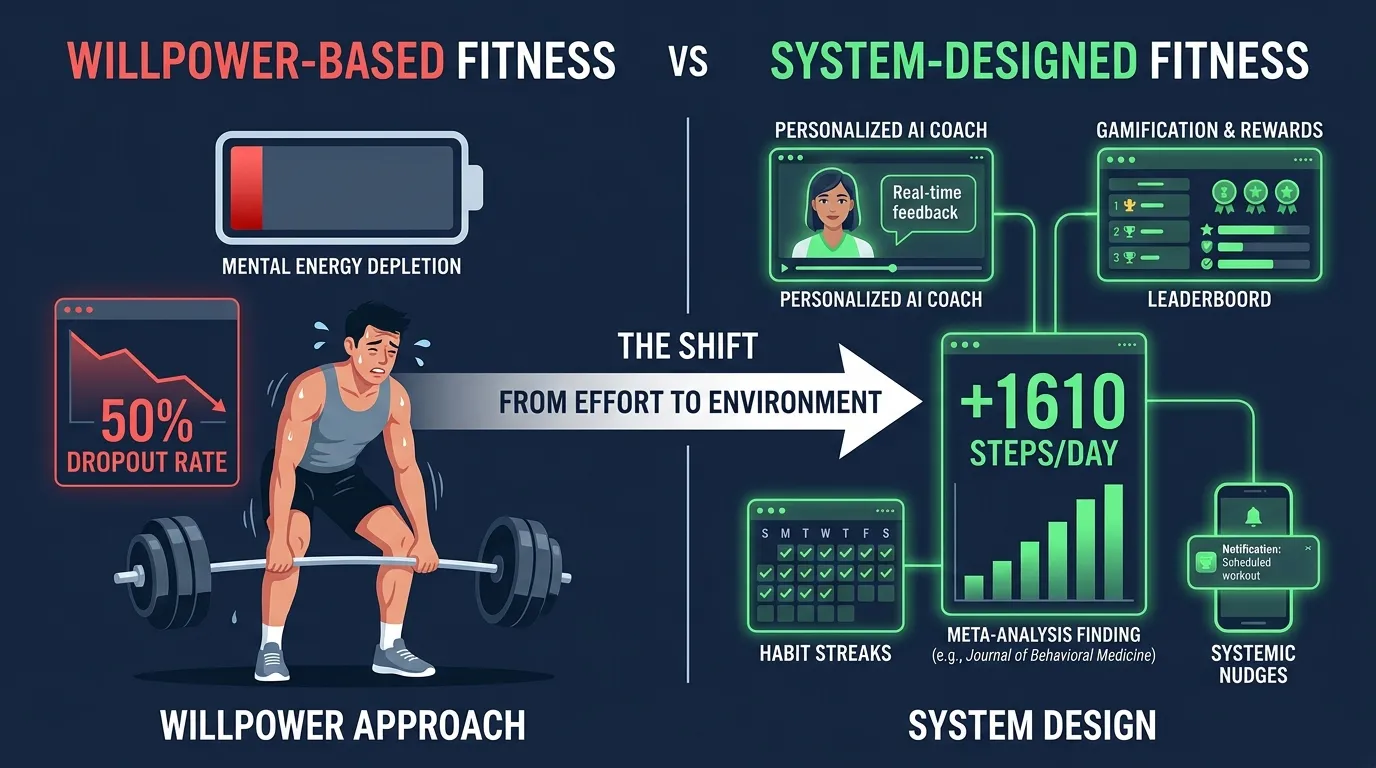
The behavioral science literature consistently points to the same conclusion: sustainable behavior change comes from designing environments and systems that make the desired behavior automatic — not from brute-forcing your way through resistance every day.
A 2012 review in the British Journal of General Practice by Benjamin Gardner and colleagues laid this out clearly: once a behavior reaches a threshold of automaticity — meaning it's triggered by contextual cues rather than conscious intention — it no longer depends on the limited self-control resources required for deliberate actions (Gardner et al., 2012).
Research by Wendy Wood at the University of Southern California found across five studies that habits improve goal pursuit specifically when people have limited willpower. When self-control was depleted, people with strong habits maintained their behavior — while people without habits collapsed (Neal, Wood & Drolet, 2013).
In other words: habits are willpower insurance. But here's the catch — research suggests it takes an average of 66 days for a new behavior to become automatic, with significant variation depending on the complexity of the action. For something as elaborate as a workout routine, you're looking at 2 to 5 months before automaticity kicks in.
That's the gap. You need willpower to build the habit, but willpower runs out before the habit forms. The 50% dropout rate at six months isn't a coincidence — it maps almost perfectly onto the timeline where willpower has faded but automaticity hasn't yet taken over.
The solution isn't more willpower. It's a system that bridges the gap.
Three Principles of Willpower-Free Fitness Systems
1. Make the right choice the default. Remove the decision of whether to work out. The system tells you when, what, and how. You just show up. When the right behavior requires zero decisions, it costs zero willpower.
2. Remove unnecessary decisions. Every choice you eliminate is willpower you preserve. The best systems don't give you a menu of 400 exercises and ask you to build your own program. They give you your workout, personalized, ready to go.
3. Replace internal motivation with external reward systems. Willpower is internal and finite. External reward systems — streaks, progression, achievement unlocks — create motivation that doesn't draw from the same depleted pool. The neuroscience of dopamine and rewards explains exactly why this works. A 2022 systematic review and meta-analysis in the Journal of Medical Internet Research found that gamified interventions significantly increased physical activity, with participants averaging 1,610 more daily steps than control groups (Mazeas et al., 2022).
Enjoying the article?
Start a new fitness routine today, written by me and coached by the AI I designed.
Take the Free Assessment Free · 2 minutes · No credit cardHow FitCraft Removes Willpower From the Equation
FitCraft wasn't built to inspire you. It was built to make inspiration irrelevant.
Every feature in the app maps to a specific failure point in the willpower model — and replaces it with a system that doesn't depend on your finite self-control reserves.
AI Makes the Decisions So You Don't Have To
Remember the decision gauntlet? FitCraft eliminates it entirely. Your AI coach Ty uses a 32-step diagnostic assessment to map your fitness level, goals, available equipment, schedule, and motivation patterns. Then it builds your program — exercise selection, sets, reps, weight progression, rest days, everything.
You don't decide what to do. You open the app and your workout is waiting. That's not laziness. That's decision engineering. Every choice Ty makes for you is willpower you didn't have to spend.
Gamification Provides Motivation That Doesn't Run Out
Willpower-based motivation depletes. Game-based motivation compounds.
FitCraft uses the same variable reward systems studied in behavioral research — streaks, quests, collectible cards, and avatar progression. These aren't gimmicks. They're external motivation sources that don't draw from your willpower reserves.
You don't need discipline to maintain a 47-day streak. The streak maintains you. The psychological cost of breaking it is higher than the cost of doing the workout. That's not willpower. That's loss aversion — one of the most powerful forces in human psychology — working for you instead of against you.
As Jim, 26, put it: "I kept telling myself I'd start Monday. FitCraft made me start on a Wednesday and I haven't stopped."
Streaks Provide Accountability That Scales
Here's something most people don't realize about accountability: it has to be immediate and visible to work. A goal written in a journal three months from now creates zero daily accountability. A streak counter that resets to zero if you skip today creates massive accountability — right now, when you need it.
FitCraft's streak system bridges the critical 66-day gap between starting a routine and reaching automaticity. By the time the external reward system has carried you through those first two months, the habit itself has taken root. You've graduated from needing the system to wanting it.
As Matt, a FitCraft user, said: "The real win is I actually want to work out now. That's never happened before."
The Real Lesson From the Research
Let's bring this full circle.
The ego depletion model — even in its contested form — taught us something important: self-control is not an infinite resource you can summon on demand. The decision fatigue research confirmed it from a different angle: every choice has a cognitive cost, and the costs accumulate. And four decades of exercise adherence data drove the point home: roughly half of everyone who relies on willpower to exercise will quit within six months.
The fitness industry's response to all of this evidence has been, essentially, to publish more motivational quotes on Instagram.
The behavioral science community's response is different: stop asking people to be more disciplined. Start building systems that make discipline unnecessary.
That's exactly what FitCraft does. Not by making you tougher. By making the system smarter.
That is the design brief behind FitCraft's page for people who hate working out.
The Studies Behind This Article
- Baumeister, R.F., Bratslavsky, E., Muraven, M., & Tice, D.M. (1998). "Ego depletion: Is the active self a limited resource?" Journal of Personality and Social Psychology, 74(5), 1252-1265. The foundational ego depletion study demonstrating that self-control is a finite, depletable resource.
- Hagger, M.S. et al. (2016). "A Multilab Preregistered Replication of the Ego-Depletion Effect." Perspectives on Psychological Science, 11(4), 546-573. The 23-lab replication attempt (N=2,141) that failed to find a significant ego depletion effect, catalyzing the ongoing debate.
- Dishman, R.K. (1988). "Exercise Adherence: Its Impact on Public Health." Human Kinetics. The seminal work establishing the ~50% exercise dropout rate within six months.
- Danziger, S., Levav, J., & Avnaim-Pesso, L. (2011). "Extraneous factors in judicial decisions." Proceedings of the National Academy of Sciences, 108(17), 6889-6892. The Israeli judges study demonstrating decision fatigue's impact on sequential decision-making quality.
- Gardner, B., Lally, P., & Wardle, J. (2012). "Making health habitual: The psychology of 'habit-formation' and general practice." British Journal of General Practice, 62(605), 664-666. Review establishing the ~66 day average for habit formation and automaticity.
- Neal, D.T., Wood, W., & Drolet, A. (2013). "How do people adhere to goals when willpower is low? The profits (and pitfalls) of strong habits." Journal of Personality and Social Psychology, 104(6), 959-975. Five studies showing that habits sustain goal pursuit when willpower is depleted.
- Mazeas, A., Duclos, M., Pereira, B., & Chalabaev, A. (2022). "Evaluating the Effectiveness of Gamification on Physical Activity: Systematic Review and Meta-analysis of Randomized Controlled Trials." Journal of Medical Internet Research, 24(1), e26779. Meta-analysis finding gamified interventions increased daily steps by 1,610 on average.
Frequently Asked Questions
Why doesn't willpower work for fitness?
Research suggests that willpower functions like a depletable resource. Every decision you make throughout the day — what to eat, what to wear, how to respond to emails — draws from the same limited pool. By the time your evening workout arrives, you've already spent your self-control budget on hundreds of other choices. This is why most people skip workouts at the end of the day, not the beginning.
What percentage of people quit exercise programs?
Research consistently shows that approximately 50% of people who start an exercise program drop out within the first six months (Dishman, 1988). More recent meta-analyses confirm this pattern: the average dropout rate for exercise interventions hovers around 20% overall, but half of all dropouts occur in the first six months — the critical window when willpower-based motivation fades.
What is decision fatigue and how does it affect exercise?
Decision fatigue is the deterioration of decision quality after making many consecutive choices. A landmark study by Danziger et al. (2011) found that Israeli judges granted parole at a 65% rate after breaks but dropped to nearly 0% after long decision sessions. Generic fitness apps force you to make dozens of daily decisions — which exercises, how many sets, what weight, what order — each one depleting the same mental resources you need to actually show up.
How does gamification help with exercise consistency?
Gamification replaces willpower-dependent motivation with system-driven motivation. A 2022 systematic review and meta-analysis published in the Journal of Medical Internet Research found that gamified interventions increased daily step counts by an average of 1,610 steps compared to control groups. Game mechanics like streaks, quests, and rewards create external accountability and dopamine-driven motivation loops that don't depend on your finite willpower reserves.
Can you build exercise habits without relying on discipline?
Yes. Research published in the British Journal of General Practice shows that once a behavior becomes habitual — meaning it's triggered automatically by contextual cues rather than conscious decision — it no longer depends on the finite self-control resources required for deliberate actions. The key is designing a system that bridges the gap between starting a routine and the point where it becomes automatic, which research suggests takes an average of 66 days.