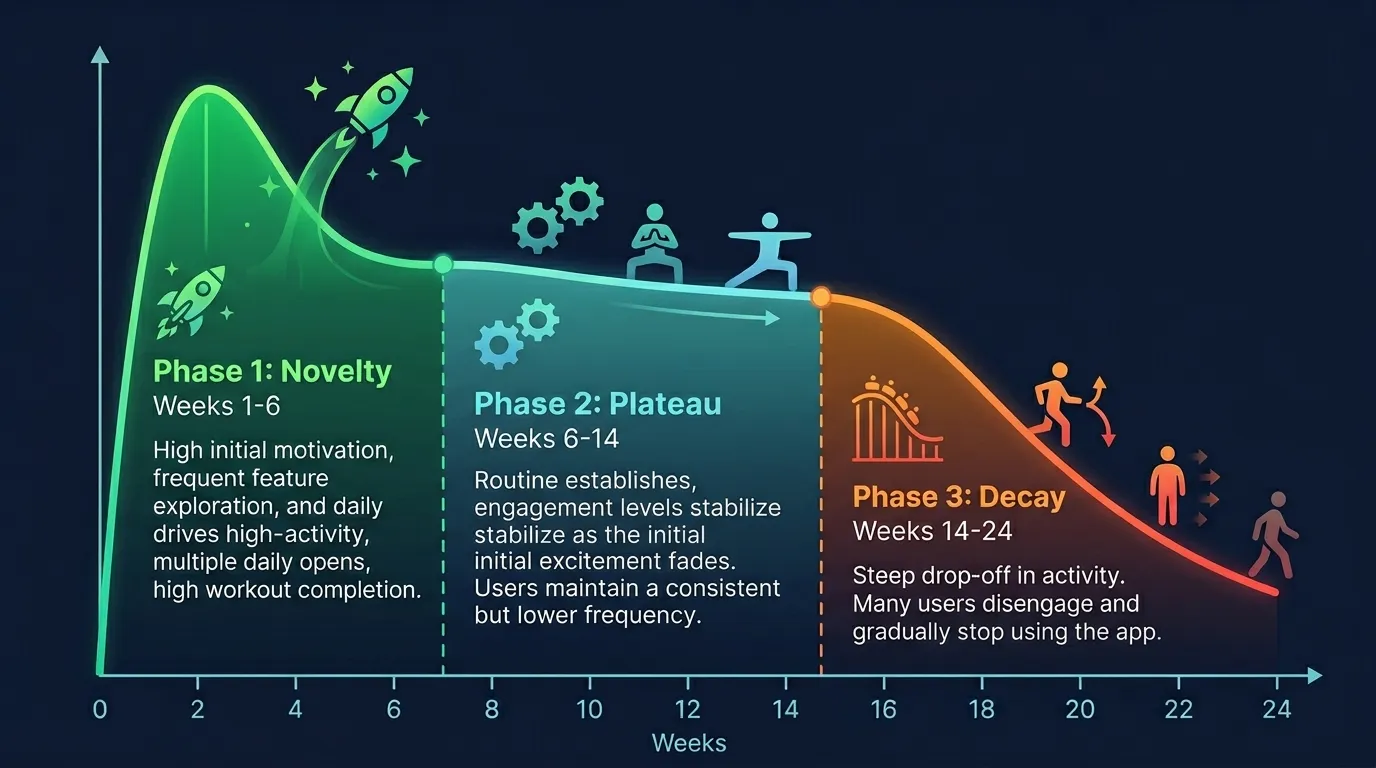
Here's the problem most fitness apps don't talk about: they lose users. Not after a week, not after a month — after about five months. And we don't just know this from download metrics and churn dashboards. We know it from randomized controlled trials with thousands of participants, published in top-tier medical journals, tracked over months of follow-up.
The pattern is so consistent it deserves a name. We call it the Week 20 Problem.
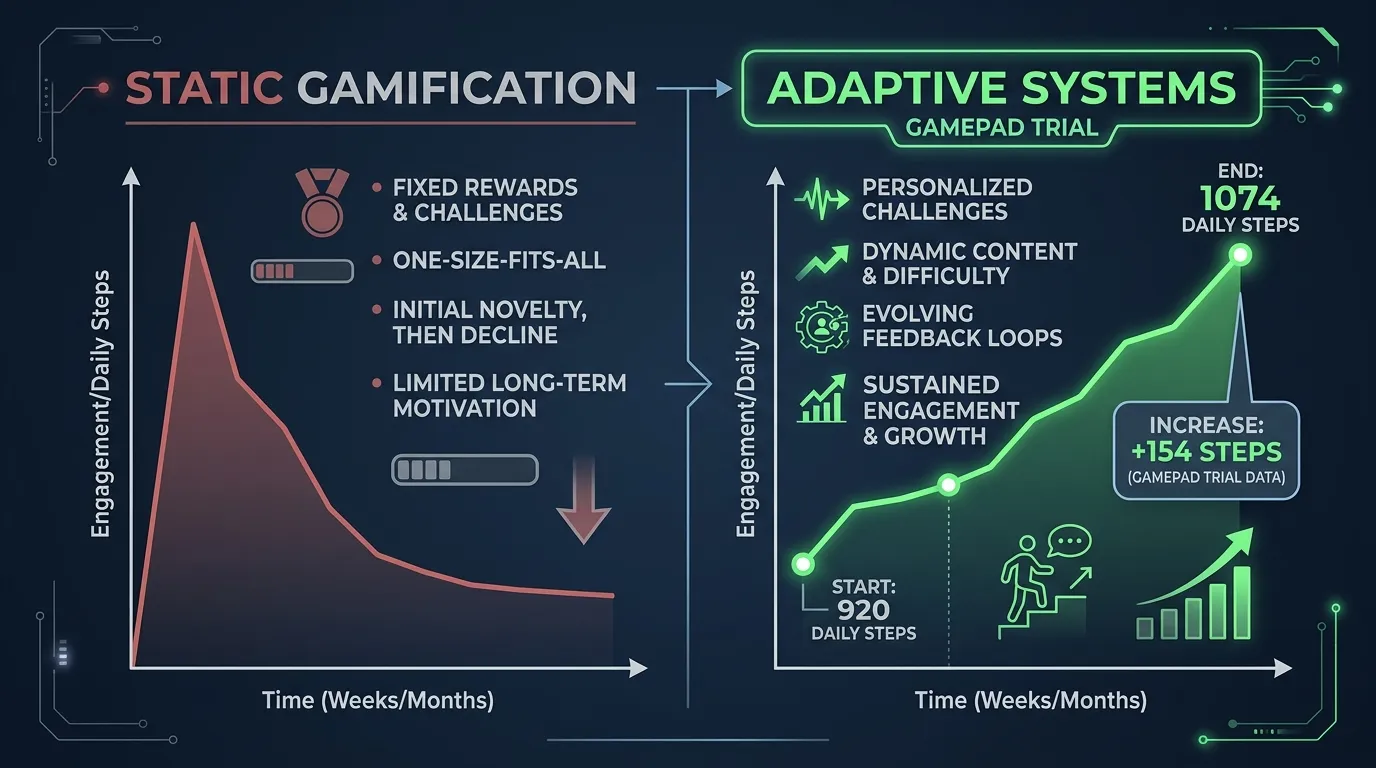
Gamification genuinely increases physical activity — the evidence for that is overwhelming. But most apps use static gamification: the same mechanics, the same rewards, and the same experience on day 140 as day 1. When the system doesn't evolve, the novelty fades, the rewards habituate, and users drift.
This isn't a failure of gamification as a concept. It's a design problem — and a solvable one. The trials that beat engagement decay all share one trait: they adapted with the user.
Let's walk through the evidence.
The Problem: Static Apps Follow a Predictable Pattern
We reviewed multiple major randomized controlled trials of app-based fitness interventions. The ones that used static, unchanging game mechanics showed a consistent pattern: strong gains during the intervention, followed by attenuation at follow-up. This is the design flaw that most fitness apps share.
BE FIT (2017, n=200) — PMC5710273
The Behavioral Economics Framingham Incentive Trial tested gamification among 200 adults from 94 families. During the 12-week intervention, the gamification arm gained +953 steps per day over controls. At the 12-week follow-up, that gain shrank to +494 steps per day — a 48% decline, though still statistically significant (P < .01).
The takeaway: gamification worked, and residual benefits persisted even after the intervention ended. But the static design lost roughly half its peak effect — illustrating why ongoing, adaptive engagement design matters.
STEP UP (2019, n=602) — PMC6735420
The largest gamified fitness trial to date. 602 overweight and sedentary adults across 40 US states were randomized to control or one of three gamification arms: competition, support, or collaboration.
During the 24-week intervention, the competition arm gained +920 steps per day. At the 12-week follow-up, competition still showed +569 steps (P=.009) — the most durable result. The support arm went from +689 to +428. All arms showed some attenuation once the static intervention ended.
Competition was the most durable mechanic — maintaining the strongest gains of any arm. But even competition lost some effect in a static system, reinforcing the need for adaptive design that continues evolving.
Veterans Trial (2021, n=180) — PMC8271358
This trial tested gamification among 180 veterans — a population with unique health challenges and generally lower baseline activity. During the intervention, the combined gamification-plus-incentives arm gained an impressive +1,224 steps per day (P=.005). The follow-up period showed a residual gain of +564 steps, highlighting the importance of ongoing engagement design rather than time-limited interventions.
ALLSTAR (2025, n=150) — PMC12805409
The most recent trial in this pattern. 150 participants, gamified intervention, same story. During the intervention: +759 steps per day. At follow-up: +581 steps per day (P = .070). The gains trended positive but no longer reached statistical significance.
The pattern across these trials points to a clear structural issue: static interventions that don't evolve with the user lose momentum over time. The question is what to do about it — and two trials answered that definitively.
Why Static Fitness Apps Lose Users
The consistency of this pattern across static fitness apps points to three fundamental psychological forces that any well-designed system must address:
1. Novelty Habituation
Every new app, every new system, every new game mechanic comes with a novelty boost. Your brain treats unfamiliar stimuli as potentially important and allocates extra attention and dopamine to processing them. This is why the first week of any fitness app feels exciting — everything is new, everything is discovery.
But the brain is an efficiency machine. It habituates to repeated stimuli. By week 8, the interface is familiar. By week 14, the reward animations don't trigger the same response. By week 20, the entire experience has been categorized as "known" and the novelty-driven engagement is gone. What's left has to stand on its own — and for most apps, there's not enough there.
Habituation runs on its own clock for every user. Brains that chase novelty hardest also exhaust it fastest, compressing that twenty-week curve into two or three — the reason an ADHD-friendly fitness app has to keep introducing new content rather than relying on the same loop indefinitely.
2. Variable Reward Saturation
Variable rewards are powerful — Skinner's research proved that decades ago. But they have a ceiling. When you've seen every type of badge, earned every tier of reward, and know the rough probability distribution of what you'll get, the "variable" part becomes predictable. The mystery evaporates. A variable reward schedule with a finite reward pool is really just a fixed schedule with extra steps.
3. Goal Fatigue
Static goals — walk 10,000 steps, complete 3 workouts, hit your calorie target — work well initially because they provide clear structure. But goals that don't evolve become wallpaper. You stop noticing them. The achievement of hitting 10,000 steps on day 1 feels meaningful. On day 140, it feels like checking a box. The goal hasn't changed, but your relationship to it has.
Together, these three forces create a predictable decay curve in static fitness apps: rapid engagement, plateau, slow decline, abandonment. Most fitness apps are riding this curve right now. They just can't see it because they measure monthly active users, not long-term behavioral outcomes. The solution isn't less gamification — it's adaptive gamification that evolves with the user.
The Solution: Adaptive Systems That Don't Decay
The good news: this problem is solvable. Two landmark trials broke the pattern completely — and the reasons why tell us everything we need to know about building fitness systems that last.
ENGAGE (2021, n=500) — PMC8411363
The ENGAGE trial tested a critical variable: what happens when users choose their own goals instead of being assigned them?
During the intervention, participants with self-chosen goals gained +1,384 steps per day. At follow-up? +1,391 steps per day. The effect didn't decay. It was maintained almost exactly — a virtually flat line where every other trial shows a downward slope.
Why? Because self-chosen goals tap into autonomy — the most powerful driver in Self-Determination Theory. When you pick your own target, the goal belongs to you. It's not an external system imposing a number. It's a reflection of your own intention. That psychological ownership creates a fundamentally different relationship with the behavior — one that doesn't depend on the app to maintain it.
GAMEPAD (2025, n=103) — PMC12826907
If ENGAGE is impressive, GAMEPAD is remarkable. This trial tested automated, adaptive coaching delivered through a gamified app. During the intervention, participants gained +920 steps per day. At follow-up, the gain didn't just hold — it grew to +1,074 steps per day.
Engagement didn't decay. It accelerated. The participants were more active after the intervention ended than during it.
The key difference: GAMEPAD's coaching system adapted to each user's behavior, adjusting goals, feedback, and challenges based on individual performance data. The system wasn't static — it evolved. By the time the formal intervention ended, the adaptive coaching had helped users internalize the behavior patterns. The app had effectively taught them how to maintain their own engagement.
These two exceptions share a common thread: the system matched the user's evolving needs. ENGAGE did it through autonomy (let users drive). GAMEPAD did it through adaptation (let the system respond). Both avoided the fatal flaw of static gamification — delivering the same experience on day 140 as day 1.
Built to beat the Week 20 Problem
FitCraft's AI coach adapts your workouts, quests, and challenges as you evolve — so week 30 feels as fresh as week 1.
Take the Free Assessment Free · 2 minutes · No credit cardWhy Thoughtful Gamification Design Matters
Not all gamification implementations are created equal. The research makes clear that simply adding points and badges to an existing app isn't enough — the game mechanics need to be deeply integrated into the user experience, evolving with the user's needs over time.
Gamification works by filling an engagement gap — bridging the distance between initial motivation and long-term habit. The most effective implementations combine multiple reinforcing mechanics (competition, progression, loss aversion, narrative) into a cohesive system that adapts as users grow. Shallow implementations that bolt on a points layer as an afterthought miss the point entirely.
The practical lesson: gamification is a structural solution to the engagement gap between initial motivation and lasting habit. The apps that succeed are the ones that treat game design as a core product discipline, not a decorative layer. We looked at which mainstream apps actually clear that bar in our roundup of the best fitness apps for consistency.
Pokemon GO: The Biggest Engagement Decay Story Ever Told
No discussion of engagement decay is complete without Pokemon GO — the largest natural experiment in gamified physical activity in history.
When Pokemon GO launched in July 2016, it generated a massive spike in physical activity. Large observational cohorts documented step increases of +1,473 per day among high-engagement users. People who hadn't walked voluntarily in years were suddenly covering miles to hatch eggs and catch Pokemon. Public health researchers were genuinely excited.
Then engagement decayed. Rapidly.
Within weeks of peak usage, step counts began reverting. Seasonal effects compounded the decline. The players who stuck around were the ones who would have been active anyway. The mass-market users — the ones public health researchers cared about most — drifted away as the novelty faded.
Pokemon GO is the Week 20 Problem at planetary scale. The game had extraordinary novelty, a massive variable reward system (catching Pokemon is a textbook variable ratio schedule), and powerful social mechanics (everyone was playing). But the core gameplay loop didn't evolve enough. Once you'd caught the available Pokemon, explored your local area, and leveled up past the initial curve, the system felt repetitive. The novelty engine ran out of fuel.
Niantic has spent years adding features to combat this — raids, community days, new generations of Pokemon, PvP battles. Some of these have been effective at retaining core users. But the mass-engagement spike was never recaptured, because you can't recreate novelty. You can only build systems that generate new novelty continuously.
What Actually Sustains Engagement: Lessons from the Data
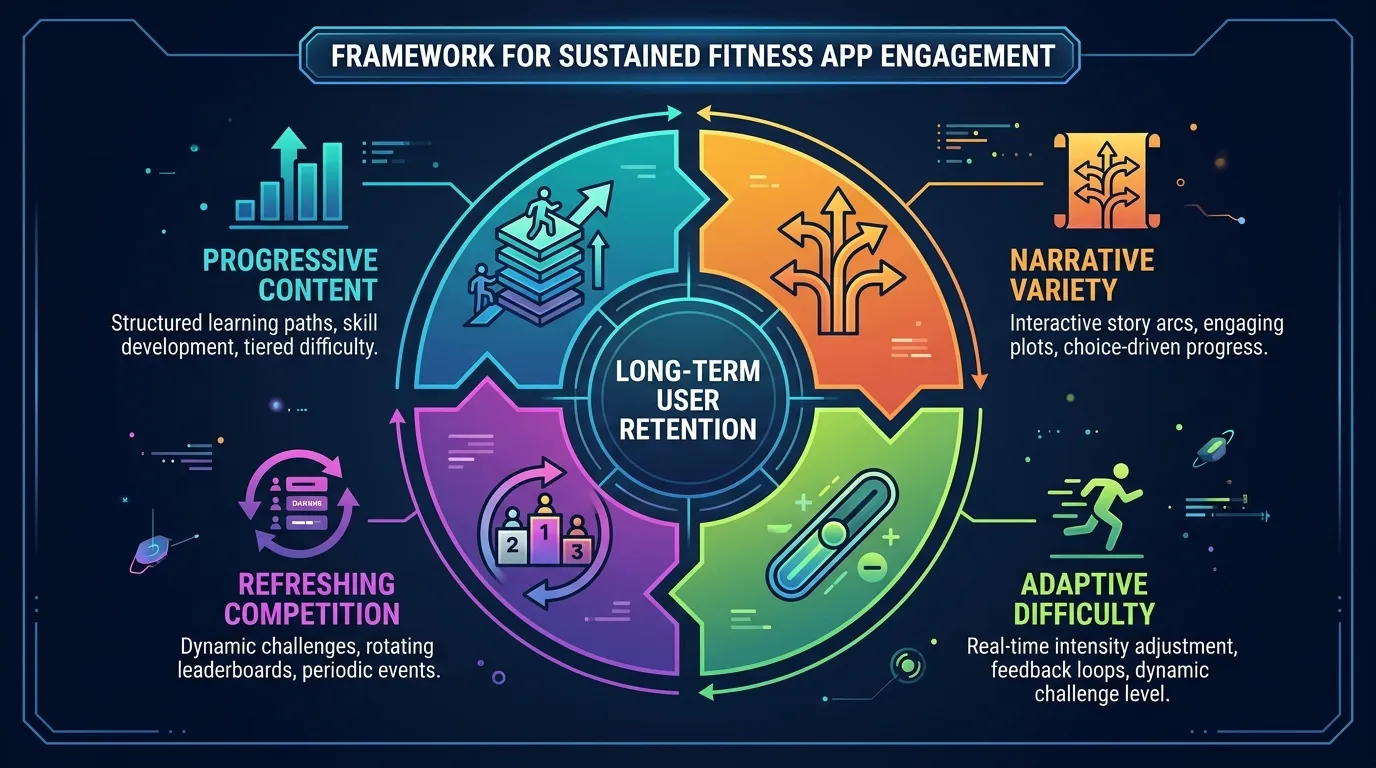
When you compare the static fitness apps that decayed with the adaptive systems that didn't — and add the Pokemon GO natural experiment — a clear picture emerges. Sustained engagement requires four specific design properties:
1. Progressive Content That Evolves
The GAMEPAD trial's adaptive coaching system didn't deliver the same content on week 20 as week 1. It evolved. New challenges, new goals, new feedback — all calibrated to the user's current state. This is the opposite of a static workout library where you pick from a fixed menu. Progressive content means the system has more to show you tomorrow than it showed you today.
2. Narrative Variety
Pokemon GO's initial success was partly narrative — you were exploring your neighborhood through a new lens, building a collection, experiencing a story. The decline came when the narrative became repetitive. Sustained engagement requires ongoing narrative — new quests, new story arcs, new contexts that make the same physical actions feel different.
3. Adaptive Difficulty
Both ENGAGE (self-chosen goals) and GAMEPAD (automated coaching) let the challenge level match the user. This is flow state engineering applied to fitness: when the challenge matches your current ability, you stay in the zone where effort feels rewarding rather than punishing or boring. Static difficulty is a ticking engagement bomb.
4. Competition That Refreshes
The STEP UP trial found that competition was the most durable gamification arm — it decayed less than support or collaboration. Competition works because it's inherently dynamic: other people are unpredictable. But even competition needs to refresh. Stale leaderboards become wallpaper just like stale goals. The most effective competitive systems reset, introduce new formats, and keep the social dynamics evolving.
How FitCraft Fights Engagement Decay
FitCraft was designed with the Week 20 Problem as a central engineering constraint. Every feature maps to a specific lesson from the decay research.
Progressive Quest Narratives
FitCraft's quest system doesn't repeat. New quest lines unlock as you progress, with evolving storylines and escalating challenges. This addresses novelty habituation directly: there's always new content ahead of you. You're not grinding the same quest on month 5 that you ran on month 1.
AI-Adaptive Programming
Like the GAMEPAD trial's automated coaching — which produced the only case of engagement growth in our review — FitCraft's AI coach Ty continuously adjusts your workouts based on your progress. The difficulty scales with you. The programming adapts. The system at week 30 is fundamentally different from the system at week 3, because you're different.
Expanding Reward Pools
Variable reward saturation happens when you've seen everything the reward system has to offer. FitCraft counters this by expanding the collectible card pool over time — introducing new card series, seasonal collections, and evolving rarity tiers. The variable in "variable rewards" stays variable because the pool keeps growing.
Streak Mechanics with Escalating Value
FitCraft's streak system doesn't just count consecutive days — it escalates the rewards and milestones as your streak grows. Week 1 streaks and week 20 streaks feel different because they are different. The system adds new streak benefits at higher tiers, keeping the commitment device fresh rather than routine.
Calendar Rewards That Compound
FitCraft's calendar tracking system rewards consistency with escalating benefits. As you log workouts over time, the calendar rewards grow — reinforcing the habit loop with visible proof of your commitment and unlocking new milestones the longer you stay consistent.
The goal isn't to prevent engagement decay through brute force — more notifications, more reminders, more guilt. The goal is to build a system where decay doesn't happen because the experience keeps evolving. The research is clear: static systems decay. Adaptive systems don't.
Frequently Asked Questions
Why do people stop using fitness apps after a few months?
Most fitness apps use static design — the same mechanics, rewards, and experience from day 1 to day 140. Clinical trials show this static approach loses momentum around the 20-week mark due to novelty habituation (the app stops feeling new), variable reward saturation (predictable rewards lose their pull), and goal fatigue (static targets become routine). The apps that beat this pattern use adaptive systems that evolve with the user.
What is the Week 20 problem in fitness apps?
The Week 20 problem refers to the consistent pattern seen in fitness apps that use static, unchanging game mechanics. These apps show strong early engagement but lose momentum around the 20-week mark because the experience stops evolving. The solution, validated by the ENGAGE and GAMEPAD trials, is adaptive design that grows with the user.
Can fitness app engagement be sustained long-term?
Yes, but only under specific conditions. The ENGAGE trial (2021, n=500) maintained step gains of +1,391 at follow-up (compared to +1,384 during intervention) by letting users choose their own goals. The GAMEPAD trial (2025, n=103) actually grew engagement from +920 to +1,074 by using automated, adaptive coaching. The common thread: systems that evolve with the user rather than delivering static content.
What makes gamification effective in fitness apps?
The most effective gamified fitness apps use adaptive systems that evolve with the user — not static mechanics that stay the same from day 1 to day 140. The GAMEPAD trial (2025, n=103) showed that adaptive coaching actually grew engagement over time, while the ENGAGE trial (2021, n=500) showed that self-chosen goals maintained full gains at follow-up. The key is designing gamification as a core product discipline, not a decorative layer.
How does FitCraft prevent engagement decay?
FitCraft is specifically designed around the engagement decay research. It uses progressive quest narratives that evolve (not repeat), AI-adaptive difficulty that scales with your fitness level, variable reward mechanics with expanding collectible card pools, and calendar rewards that reinforce consistency. The goal is to ensure that week 30 feels as fresh and challenging as week 3.