If you ask most people whether they'd be more motivated by competing against others or working together toward a shared goal, the majority will say collaboration. It feels right. Teamwork is positive. Competition is stressful. Surely the supportive option keeps people exercising longer.
The data tells a different story. Across two of the largest randomized controlled trials ever conducted on social incentives and physical activity — involving nearly 1,000 participants combined — competition consistently outperformed collaboration. Not by a trivial margin. By a clinically meaningful one. And the gap widened over time.
But before you go downloading a leaderboard app, there's a critical caveat: the type of competition matters enormously. Get it wrong, and you can actually make people less active. Here's what the research says about designing competition that works.
The STEP UP Trial: The Definitive Head-to-Head Test
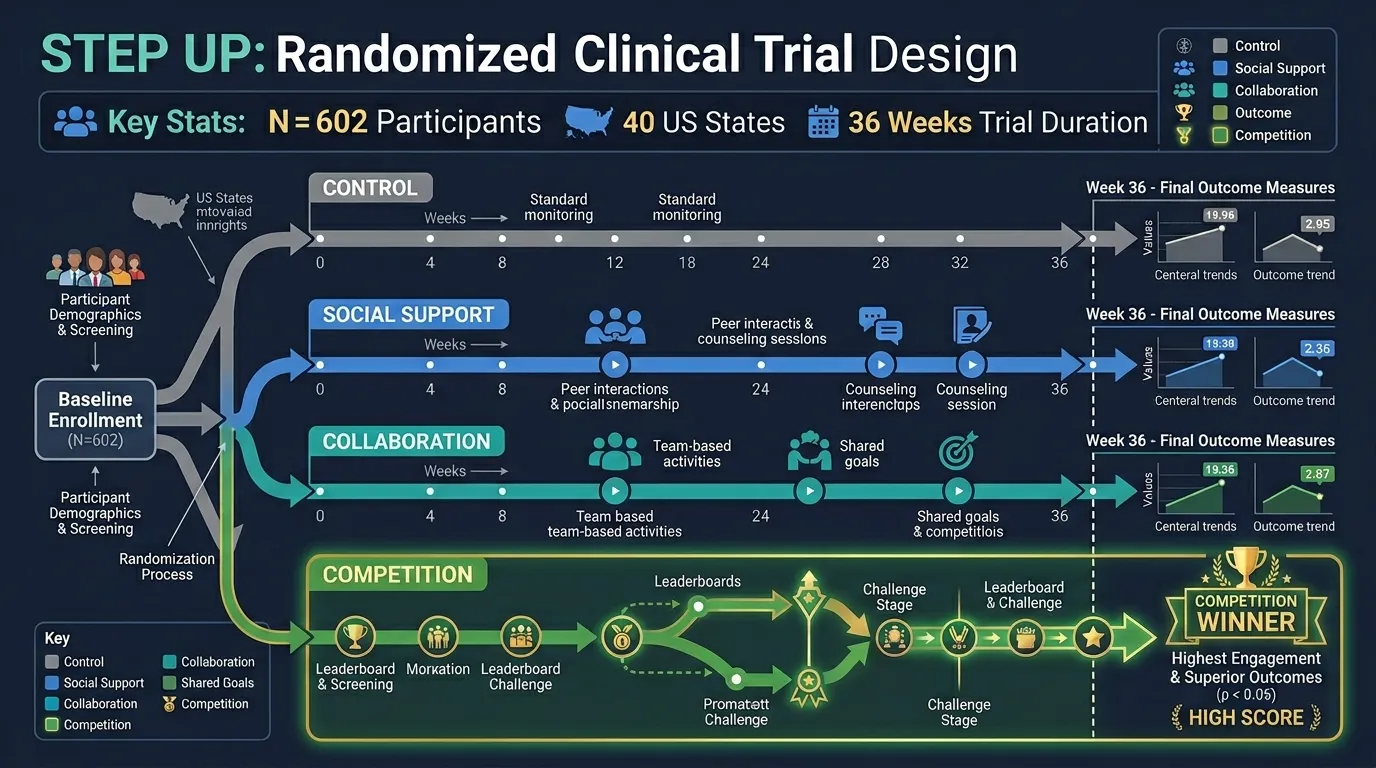
The STEP UP trial is the gold standard for this question. Published in JAMA Internal Medicine in 2019 (PMC6735420), it was a 36-week randomized clinical trial — 24 weeks of intervention followed by 12 weeks of follow-up — involving 602 overweight and obese adults across 40 US states. All participants had BMIs of 25 or higher and wore wearable step trackers.
What makes STEP UP uniquely valuable is its four-arm design. Participants were randomly assigned to one of four conditions:
- Control — Step tracking and daily feedback only
- Social support — A designated support partner received weekly updates and encouragement prompts
- Collaboration — Three-person teams with shared goals; the team succeeded or failed together
- Competition — Participants placed in groups and ranked on leaderboards with points-based standings
This wasn't a survey or an observational study. It was a properly powered, pre-registered RCT with objective step-count data. The results were unambiguous.
During the 24-week intervention
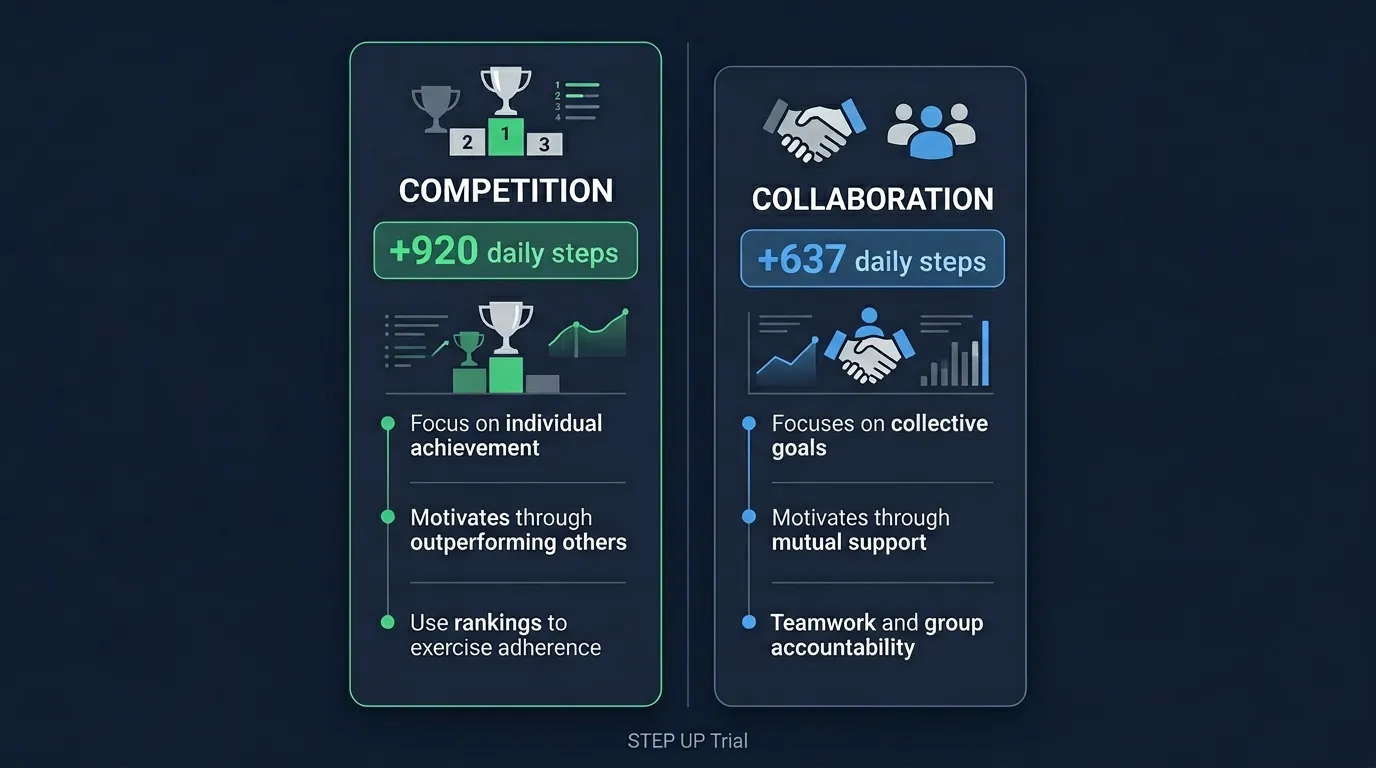
Competition produced the largest effect: +920 steps per day compared to control (P<.001). That's roughly 8-9 additional minutes of moderate activity daily — enough, if sustained, to meaningfully reduce cardiovascular risk.
Social support came in second at +689 steps/day (P<.001). Collaboration was third at +637 steps/day (P=.001). All three beat the control group. But competition beat them all by a substantial margin — 44% more effective than collaboration, and 34% more than support.
During the 12-week follow-up (no intervention)
This is where the story gets really interesting. After the gamification intervention was removed, here's what happened:
- Competition: +569 steps/day (P=.009) — still significant
- Support: +428 steps/day (P=.052) — trending positive
Competition was the arm that maintained the strongest and most statistically significant increase in physical activity after the intervention ended. This is the finding that matters most, because lasting behavior change is the entire point. Anyone can move more while a program is actively nudging them. The question is whether the effect persists — and competition demonstrated the most durable results.
Citation: Patel MS, Small DS, Harrison JD, et al. Effectiveness of Behaviorally Designed Gamification Interventions With Social Incentives for Increasing Physical Activity Among Overweight and Obese Adults Across the United States: The STEP UP Randomized Clinical Trial. JAMA Intern Med. 2019;179(12):1624-1632.
The iDiabetes Trial: Competition Wins Again in a Clinical Population
One trial is evidence. Two trials showing the same pattern is a signal you can't ignore.
The iDiabetes trial, published in JAMA Network Open in 2021 (PMC8144928), tested the same social incentive framework in a very different population: 361 adults with type 2 diabetes, mean age 52.5, approximately 51% Black. This matters because the STEP UP population was relatively young and healthy. iDiabetes extended the evidence to people with a chronic condition where physical activity is medically critical.
The results mirrored STEP UP almost exactly:
- Competition: +606 steps/day (P=.003) — the strongest result
- Support: +503 steps/day (P=.01)
Same ranking. Same story. Competition produced the strongest results across both trials. In a population where getting people to move more is literally a matter of disease management, competition was the most effective social mechanic — reinforcing the STEP UP findings in an entirely different clinical context.
Citation: Patel MS, Small DS, Harrison JD, et al. Effect of Behaviorally Designed Gamification With Social Incentives on Lifestyle Modification Among Adults With Uncontrolled Type 2 Diabetes: The iDiabetes Randomized Clinical Trial. JAMA Netw Open. 2021;4(5):e2110255.
Why Competition Outperforms Collaboration (Among Strangers)
Collaboration sounds good in theory. Shared goals, mutual support, collective accountability. So why does competition consistently produce stronger results in clinical trials?
The answer lies in a concept from social psychology called diffusion of responsibility. When your effort is pooled with a group — especially a group of strangers with no pre-existing relationship — individual accountability dissolves. If the team goal is 30,000 steps and there are three of you, your brain quickly realizes that your personal contribution is diluted. Whether you walk 8,000 or 12,000 steps, the team outcome won't change dramatically.
Compare this to competition, where every step you take directly affects your ranking. The feedback loop is tight and personal. You moved up two spots. You dropped below someone you were ahead of yesterday. That signal is impossible to ignore because it speaks directly to you — not to a team average.
There's also a dilution effect. In collaborative groups, if one person's effort drops, the group outcome absorbs it — reducing the personal feedback signal. Competition creates what psychologists call evaluation apprehension — the awareness that others can see how you're doing — which is one of the strongest drivers of effort in social contexts. Your name, your rank, your performance. That directness is what makes competition so powerful.
This doesn't mean collaboration never works. It likely works well among close friends, family members, or coworkers who have real social bonds — as our analysis of social accountability research confirms. But in the context of a fitness app where you're grouped with strangers? The data is clear: it's not enough. Apps take very different approaches to this design problem, which is why we scored them separately in our review of the best workout accountability apps.
Why Personalized Competition Works Best
If competition is so effective, the next question is how to maximize it. A 2022 econometric analysis of Fitbit leaderboard data (PMC10403254) studied how leaderboard exposure affected step counts across a large user base and revealed a key design principle:
- Sedentary users: +1,300 steps/day (+15%) — leaderboards were a powerful motivator
- Already-active users responded best when matched against peers at a similar level, rather than placed on undifferentiated global boards
The finding points to a phenomenon called social comparison optimization. When you compete against people at a similar fitness level, the gaps feel bridgeable and motivating. A beginner moving from last place to second-to-last sees visible, concrete progress. An experienced exerciser matched against similar peers sees a challenge worth pursuing.
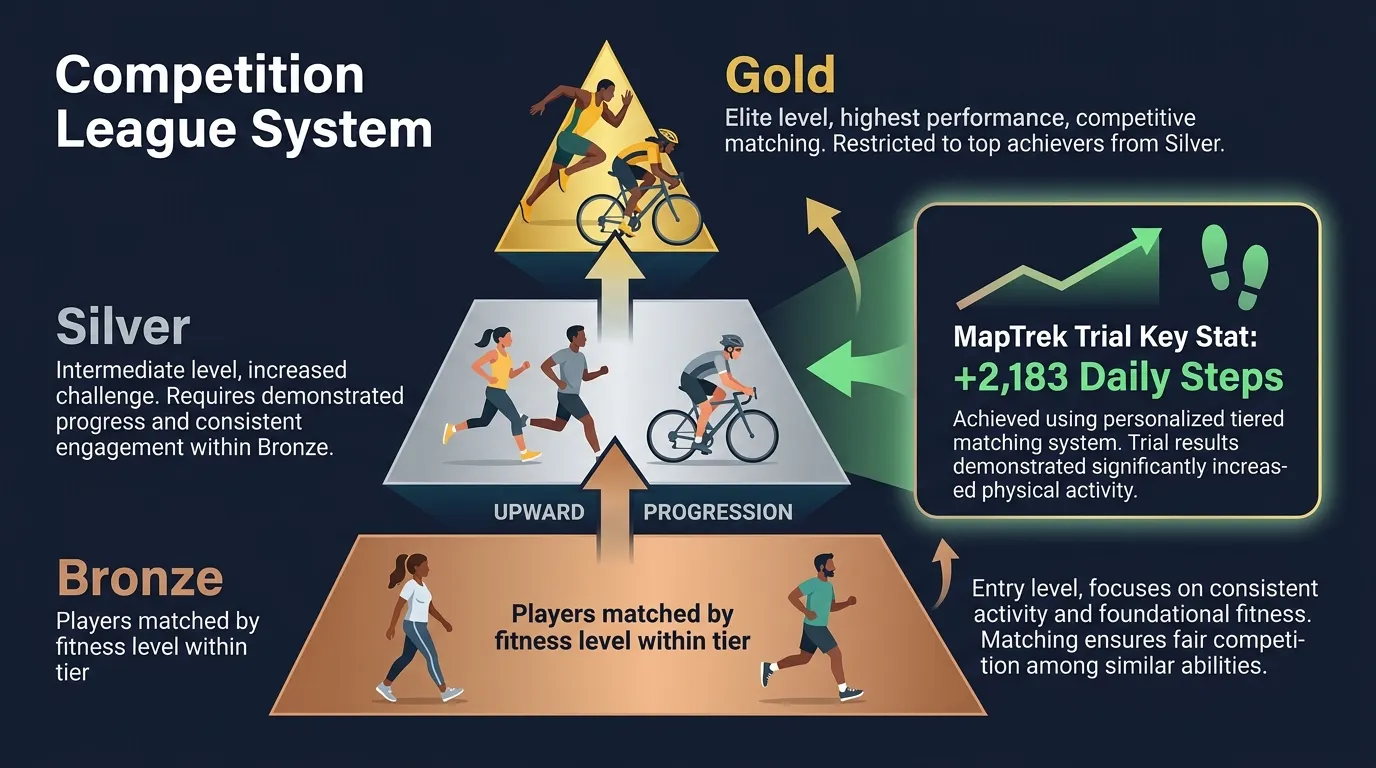
The takeaway is clear: personalized competition — matching people against peers at a similar level — is the optimal design. This is why tiered systems consistently outperform one-size-fits-all leaderboards in the research.
Gamification that's designed for YOUR level
FitCraft's AI trainer Ty adapts your workouts and progression to where you actually are — so every quest, streak, and level-up pushes you forward without crushing your motivation.
Take the Free Assessment Free · 2 minutes · No credit cardHow to Design Competition That Actually Works
The research converges on a clear set of design principles for effective competition in fitness contexts. Get these right, and competition is the most powerful social mechanic available. Get them wrong, and you'll drive away your most committed users.
1. Tiered matching, not global rankings
The Fitbit leaderboard data makes this non-negotiable. People need to compete against others at a similar level. The MapTrek trial (PMC6064890) demonstrated this beautifully: a gamified walking competition using leagues and virtual map progress produced an increase of +2,183 steps/day compared to control — one of the largest effects in the literature. The league structure meant participants were racing against peers, not against the entire population.
2. Relative progress, not absolute numbers
Showing raw step counts favors people who were already active. Showing percentage improvement or progress toward a personal goal levels the playing field. A beginner who goes from 2,000 to 4,000 steps has doubled their output — that's a more meaningful achievement than an athlete going from 12,000 to 13,000, even though the absolute number is lower.
3. Short cycles with fresh starts
Weekly or bi-weekly competition cycles prevent any single loss from feeling permanent. If you had a bad week, next week is a clean slate. This reduces the discouragement effect and keeps re-engagement friction low. The STEP UP trial used ongoing point standings, but the most effective real-world implementations reset regularly.
4. Visibility without humiliation
The STEP UP trial used leaderboards where participants could see their relative ranking. This creates evaluation apprehension — the motivation to perform because others are watching — without requiring public shaming. The key is making performance visible to a small, relevant peer group rather than broadcasting it to thousands of strangers.
How FitCraft Applies This Research
FitCraft's gamification system was designed directly from this evidence base. The research shows competition works because of tight personal feedback loops, visible progress, and bridgeable challenges. Here's how FitCraft captures those same psychological mechanisms:
Adaptive progression instead of global leaderboards. FitCraft's AI trainer Ty adapts your workouts based on your progress, ensuring the challenge always stays at your level. This mirrors the principle behind the MapTrek league model that produced +2,183 steps/day — the largest effect size in the literature. The gap between where you are and where you're headed is always bridgeable, because Ty adjusts the difficulty to match you.
Layered gamification for tight feedback loops. The STEP UP data shows competition works because every action has a visible outcome. FitCraft creates the same tight feedback loops through XP, leveling up, quests, streaks, collectible cards, and avatar progression. Every workout moves a visible needle — you gain XP, unlock a new card, advance your avatar, or extend a streak. That direct, personal feedback is exactly what makes competition powerful in the research.
Calendar tracking and streak rewards. Short competition cycles work because they offer fresh starts and prevent discouragement. FitCraft's calendar tracking and calendar rewards work the same way — each day and each week is a new opportunity to build momentum. Streaks reward consistency without punishing a single missed day, keeping re-engagement friction low.
Personal accountability through Ty. The iDiabetes and STEP UP trials showed that the personal, direct nature of competition is what drives results. FitCraft's AI trainer Ty provides that same directness — personalized encouragement, adaptive challenges, and progress tracking that speaks to you, not to a team average. The feedback loop is tight and personal, just like the competitive condition in the research.
The Bottom Line
The intuition that collaboration is more motivating than competition is wrong — at least in the context of exercise behavior among people who don't already know each other. (For the full statistical breakdown, see our gamification statistics page.) Two large randomized controlled trials, a replication in a clinical population, and a large-scale observational study all point to the same conclusion: competition produces larger, more durable increases in physical activity.
But competition works best when it's personalized. The evidence demands tight personal feedback loops, adaptive challenge levels, visible progress, and regular fresh starts — not competition as the sole mechanic. That's what separates effective gamification from generic leaderboards.
The research is clear. The question is whether your fitness app has actually read it.
Frequently Asked Questions
Is competition or collaboration better for exercise motivation?
Competition is more effective, according to multiple randomized controlled trials. The STEP UP trial (2019, JAMA Internal Medicine, n=602) found competition increased daily steps by 920 compared to 637 for collaboration. More importantly, competition was the only social mechanic that maintained significant effects 12 weeks after the intervention ended. The iDiabetes trial (2021, n=361) confirmed the same pattern in a clinical population with type 2 diabetes.
Do fitness leaderboards actually work?
Yes, especially with personalized matching. A 2022 econometric analysis of Fitbit leaderboard data found that sedentary users increased their steps by 1,300 per day (+15%) when exposed to leaderboards. The research shows that personalized competition — matching people against peers at a similar level — produces the strongest results across all fitness levels. Tiered matching ensures everyone has a bridgeable challenge.
Why does competition outperform collaboration in fitness apps?
Competition outperforms collaboration because it creates direct, personal feedback loops. When your performance is pooled with strangers, individual effort feels diluted. Both the STEP UP trial and iDiabetes trial found competition produced the strongest and most durable increases in physical activity. Collaboration works better with pre-existing social bonds — friends, family, coworkers — where accountability is personal, not anonymous.
How does FitCraft apply competition research to keep you motivated?
FitCraft applies the key insight from competition research — that tight, personal feedback loops drive results — through its AI trainer Ty and layered gamification. Instead of leaderboards, FitCraft uses XP, leveling up, quests, streaks, collectible cards, and avatar progression to create visible, personal progress after every workout. Ty adapts your workouts based on your progress, keeping challenges bridgeable at every level — the same principle that made tiered competition so effective in the MapTrek trial (+2,183 steps/day).
What is the STEP UP trial?
The STEP UP trial was a 36-week randomized clinical trial published in JAMA Internal Medicine in 2019 (PMC6735420). It enrolled 602 overweight and obese adults across 40 US states and tested four conditions: control, social support, collaboration, and competition. Competition produced the largest increase in physical activity (+920 steps/day) and was the only arm to maintain statistically significant effects during the 12-week follow-up period after the intervention ended.