Here is the uncomfortable truth about exercising alone: most people cannot sustain it. Not because they lack discipline. Not because they don't know what to do. But because humans are fundamentally social creatures, and isolated behavior change fights against millions of years of evolutionary wiring.
Every major gamification-and-exercise trial published in the last decade included a social component. That wasn't an accident — the researchers knew that game mechanics alone aren't enough. But the social element had to be designed carefully, because not all social accountability is created equal.
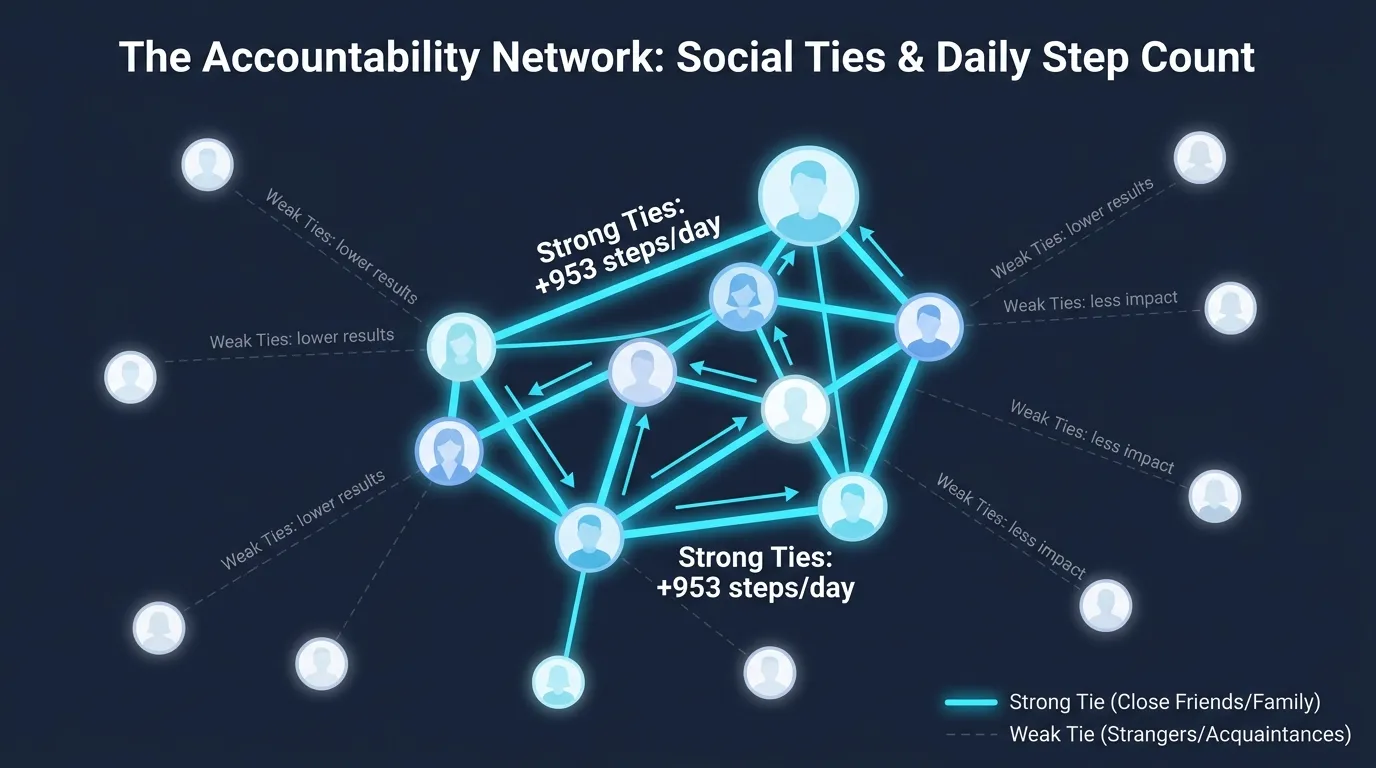
The consistent finding across six clinical trials: accountability from people you already know and care about significantly increases physical activity. Accountability from randomly assigned strangers often does not. The difference isn't minor. It's the difference between a mechanism that works and one that wastes everyone's time.
Here's what the trials actually found.
Family Accountability: The BE FIT Trial
The Behavioral Economics Framingham Incentive Trial (BE FIT) was published in JAMA Internal Medicine in 2017. It enrolled 200 adults from 94 families — not random strangers grouped together, but people who already lived under the same roof and had real relationships with each other.
The gamification intervention included points, levels, and daily feedback, all structured around family units. Family members could see each other's progress. They shared goals. They experienced the social consequences — pride or mild embarrassment — of hitting or missing their targets within a group that mattered to them.
The results were decisive. During the 12-week intervention, the gamification arm achieved step goals on 53% of days versus 32% for controls — an adjusted difference of 27 percentage points (P<.001). Mean daily steps increased by 953 more than controls. That's roughly 8-10 additional minutes of moderate activity per day, a clinically meaningful difference.
But the follow-up data is what makes this trial stand out. After the intervention ended, the gamification group still maintained +494 steps/day over controls (P<.01). The behavioral change partially persisted — and the researchers attributed this durability to the fact that family relationships didn't end when the study did. The accountability structure was baked into daily life.
The key insight: the game mechanics worked because they were layered on top of existing family bonds. Points and levels provided the structure. Family ties provided the stakes.
Citation: Patel MS, Benjamin EJ, Volpp KG, et al. Effect of a Game-Based Intervention Designed to Enhance Social Incentives to Increase Physical Activity Among Families. JAMA Intern Med. 2017;177(11):1586-1593. PMC5710273
Partner Support: The "Someone Is Watching" Effect
You don't need a whole family. Sometimes, one person is enough — as long as that person matters to you.
The STEP UP trial (2019, JAMA Internal Medicine, n=602) tested three gamification arms against a control group: support, collaboration, and competition. The support arm had a distinctive design: each participant selected a support partner — a friend or family member — who received automated weekly updates on the participant's progress. The partner didn't exercise with them. They just knew.
That was enough. The support arm increased daily steps by 689 over controls (P<.001). More importantly, the support arm sustained gains better than the collaboration arm during the 12-week follow-up period after the intervention ended. Knowing that someone you chose — someone whose opinion you valued — was watching your progress created a durable form of motivation that outlasted the game mechanics themselves.
A smaller but striking trial reinforced this finding. A 2022 randomized controlled trial published in JAMA Neurology (n=34) studied stroke survivors — a population with severe barriers to physical activity. The intervention assigned each participant a support partner who received weekly updates on their step count progress.
The result: +981 steps/day (P=.01). In a population where every additional step represents genuine clinical progress, that effect size is remarkable. And the mechanism was the same as STEP UP: not exercising together, but knowing that someone you care about can see whether you showed up.
The pattern is clear. You don't need a gym buddy. You need a witness — someone whose awareness of your behavior creates real psychological stakes.
For the ADHD-specific version of this idea, our guide to body doubling for workouts separates what people report from what the social-facilitation evidence can actually support.
Citations:
- Patel MS, Small DS, Harrison JD, et al. Effectiveness of Behaviorally Designed Gamification Interventions With Social Incentives for Increasing Physical Activity Among Overweight and Obese Adults Across the United States: The STEP UP Randomized Clinical Trial. JAMA Intern Med. 2019;179(12):1624-1632. PMC6735420
- Klachar SJ, et al. Gamification Intervention With Social Incentives to Increase Physical Activity After Stroke. JAMA Neurology. 2022.
Why Existing Relationships Outperform Stranger Pairings
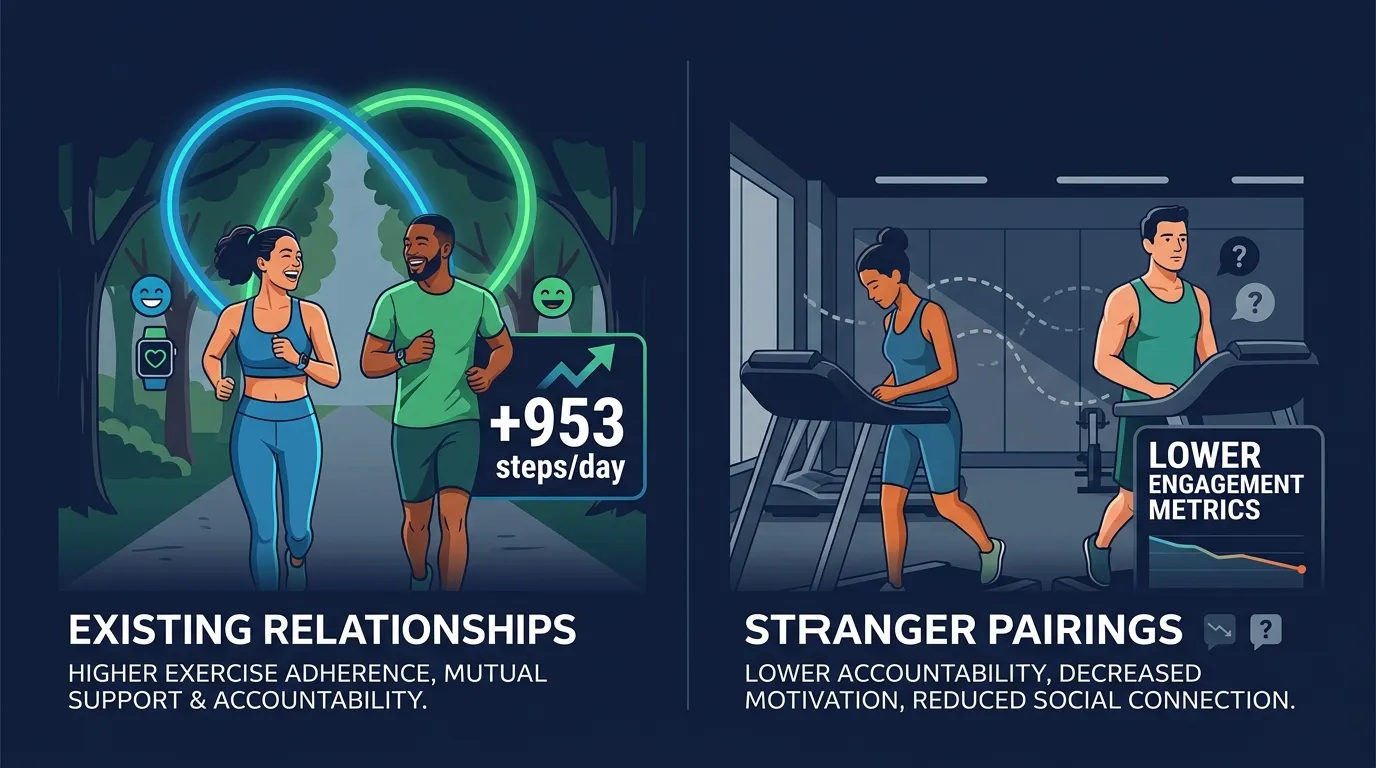
If accountability from family and chosen partners works so well, why not just pair everyone up with anyone? Because the research shows existing relationships produce dramatically stronger results.
The STEP UP trial included a collaboration arm where participants were placed into teams with other study participants — strangers, effectively. Team members worked toward shared goals and could see each other's progress. During the intervention period, this arm did produce a significant increase: +637 steps/day (P=.001). But during follow-up, the collaboration arm's gains faded faster than the support arm's. Without the ongoing structure of the study, strangers stopped being meaningful accountability partners.
The iDiabetes trial (2021, n=361) reinforced this finding. The support arm — where a chosen partner received updates — produced a significant +503 steps/day (P=.01), demonstrating the power of existing relationships. The support partner approach consistently outperformed stranger-based group designs across both major trials.
This is the critical design lesson that most fitness apps get wrong. They create communities of strangers — forums, leaderboards, randomly assigned teams — and assume that social proximity creates social accountability. But the research shows that accountability works best when it leverages relationships you already care about maintaining.
Think about it from a psychological perspective. If a stranger on your fitness app team sees that you skipped your workout, what's the cost? Essentially nothing. You don't know them. They don't know you. There's no relationship to damage, no reputation to protect, no dinner table where the conversation might come up. The social signal has no weight because the social bond has no depth.
Contrast that with your spouse, your sibling, or your best friend getting a notification that you missed your third workout this week. That's a different calculation entirely.
Citation: Patel MS, et al. Effect of Behaviorally Designed Gamification With Social Incentives on Lifestyle Modification Among Adults With Uncontrolled Type 2 Diabetes: The iDiabetes Randomized Clinical Trial. JAMA Netw Open. 2021;4(5):e2110255. PMC8144928
Accountability that actually works
FitCraft's AI trainer Ty keeps you accountable with adaptive encouragement, streaks, and gamification that makes consistency feel rewarding. See how it works for your goals.
Take the Free Assessment Free · 2 minutes · No credit cardSocial Accountability in Challenging Circumstances: The Postpartum Trial
If social accountability only worked for healthy, motivated adults, it would be interesting but limited. The Postpartum HDP trial (2022, JAMA Cardiology, n=127) tested whether it could work in far more challenging circumstances — and the answer was yes, with important caveats.
This trial enrolled postpartum women with a history of hypertensive disorders of pregnancy — a population at elevated cardiovascular risk. Roughly 55% of participants were Black and approximately 41% were on Medicaid, making this one of the most socioeconomically diverse exercise trials in the literature. The intervention combined team-based gamification with remote monitoring, text messaging, and social incentives.
The result: +647 steps/day compared to controls (P=.009). That's a meaningful increase for a population dealing with newborn care, sleep deprivation, and the physical recovery demands of recent pregnancy.
But the trial also surfaced an important finding: engagement disparities. Participants with lower socioeconomic status and certain racial/ethnic backgrounds showed lower rates of syncing their activity data — not necessarily lower activity, but lower engagement with the tracking infrastructure. This suggests that social accountability interventions need to account for access barriers, not just motivation barriers. The social mechanism works, but the technology pipeline between the behavior and the social feedback has to be frictionless for everyone, not just those with reliable devices and connectivity.
The broader takeaway: social accountability is robust enough to produce significant effects even in populations facing serious life constraints. But the delivery system matters as much as the mechanism.
The Relatedness Need: Why We're Wired for Social Exercise
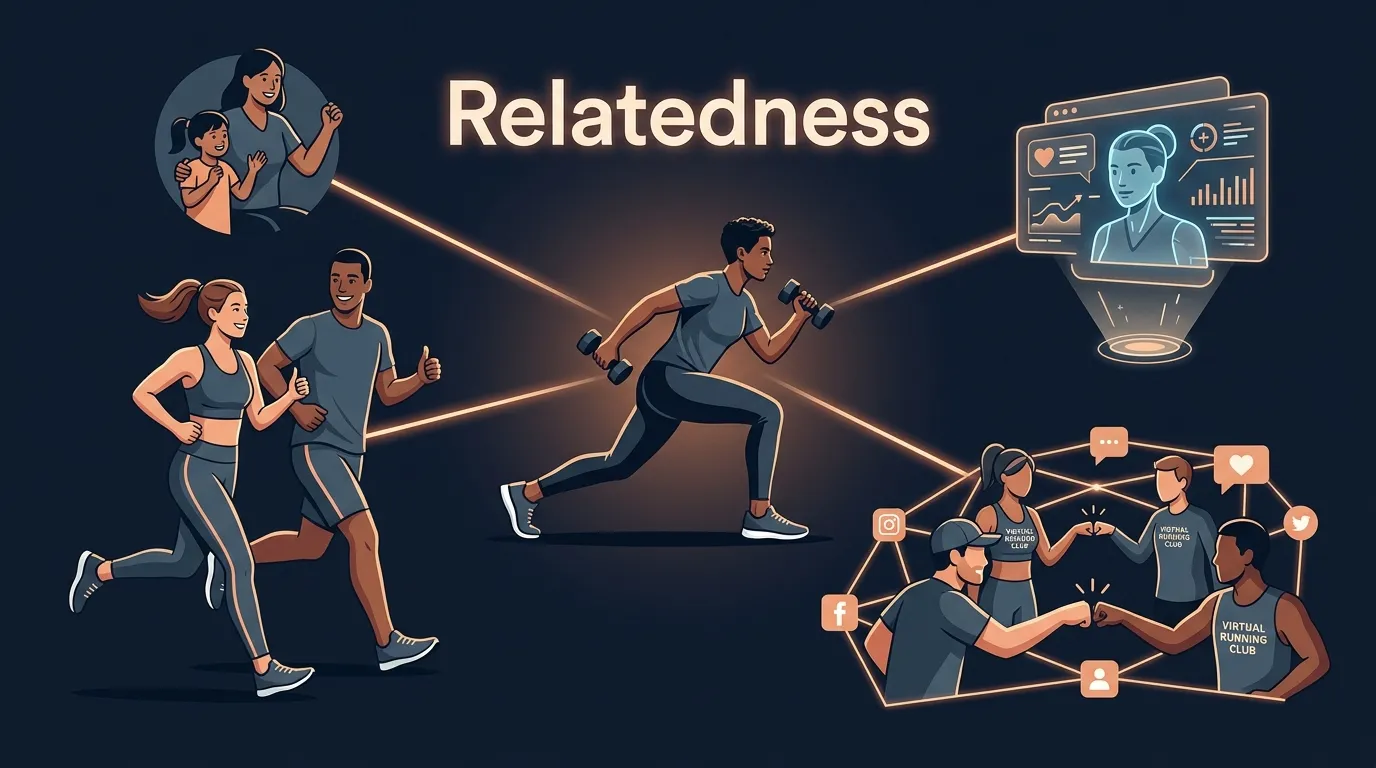
Self-Determination Theory, developed by psychologists Edward Deci and Richard Ryan, identifies three core psychological needs for sustained intrinsic motivation: autonomy (feeling that your actions are self-chosen), competence (feeling effective and growing), and relatedness (feeling connected to others).
Relatedness is the one most fitness apps ignore. They focus on autonomy (choose your workout) and competence (track your progress) but treat exercise as a fundamentally solo activity. The research above shows why that's a mistake.
Humans are social creatures. We evolved in groups where survival depended on cooperation. Activities embedded in social context — activities where other people notice, care, and respond to our behavior — tap into motivational circuits that are far older and more powerful than any rational decision to "get healthier." When your exercise behavior is visible to people you care about, it activates the relatedness need. The behavior becomes about more than physical health. It becomes part of your social identity, your relationships, your role in a group.
This explains the pattern across all six trials. Family accountability (BE FIT) worked because family relationships are the deepest social bonds most people have. Chosen partner support (STEP UP, Stroke RCT) worked because participants selected someone whose opinion they valued. The strongest results consistently came from designs that leveraged genuine relatedness — preexisting bonds that activated real social stakes.
The relatedness need isn't a nice-to-have. It's a core psychological requirement for sustained behavior change. Any fitness system that ignores it is working against human nature.
How FitCraft Builds on This Research
Most fitness apps handle the accountability problem in one of two ways: they either ignore it entirely (solo experience only) or they create stranger-based communities (forums, leaderboards, random team assignments). The research is clear that the first approach misses a critical motivational lever and the second approach doesn't produce durable results.
FitCraft takes a different path — one informed directly by the trial evidence on what makes accountability stick.
An AI trainer who knows you. FitCraft's AI trainer Ty provides personalized, adaptive encouragement — the kind of consistent awareness that mirrors the "someone is watching" effect validated in the STEP UP and Stroke RCTs. Ty tracks your consistency, adapts your workouts based on your progress, and responds when you show up or fall off. It's not a generic push notification. It's a persistent presence that makes your behavior feel observed and valued.
Streaks, XP, and calendar rewards that create visible stakes. The research shows that accountability works when your consistency becomes visible. FitCraft's streak tracking, calendar rewards, and XP system make your daily commitment tangible — you can see exactly how many days you've shown up, and what you stand to lose by skipping. This mirrors the social visibility mechanism from the trials, internalized into a personal tracking system.
Quest-based progression and collectible cards. Just like the BE FIT trial layered game mechanics on top of accountability structures, FitCraft uses quests, collectible cards, and avatar progression to create ongoing investment in your fitness journey. Each completed workout builds toward something concrete — a new card, a level-up, a quest milestone. These systems create the kind of accumulated stakes that make quitting costly, the same psychological principle that made family-based accountability so durable in the trials.
Gamification that compounds over time. The most important finding from the BE FIT trial was that accountability effects persisted after the intervention ended — because the social bonds didn't disappear. FitCraft applies the same principle: your avatar progression, card collection, and level carry forward. The longer you stay consistent, the more you've built, and the harder it is to walk away. The accountability isn't borrowed from an external relationship — it's built into the system itself.
Frequently Asked Questions
Does social accountability actually help with exercise?
Yes, but only when the relationship is right. Six randomized controlled trials show that accountability from family members or chosen partners consistently increases physical activity — by 500 to 980 additional steps per day. However, accountability from randomly assigned strangers often produces no significant effect. The key variable is whether a preexisting relationship creates genuine social stakes.
Why do existing relationships produce better fitness accountability?
Two major RCTs — STEP UP (n=602) and iDiabetes (n=361) — found that support arms using existing relationships consistently outperformed stranger-based collaboration designs. Preexisting emotional bonds create genuine social stakes — you care about what your partner, friend, or family member thinks of your consistency. That real social cost drives stronger and more durable behavior change.
What is the best type of accountability partner for fitness?
Research points to family members or close friends — people whose opinion you genuinely care about. The BE FIT trial used family-based accountability and achieved a 953 steps/day increase. The STEP UP support arm, where a chosen partner received weekly updates, sustained gains better than the collaboration arm. The partner does not need to exercise with you — they just need to be someone you would feel accountable to.
How does Self-Determination Theory explain social accountability in exercise?
Self-Determination Theory identifies relatedness — the need to feel connected to others — as one of three core psychological needs for sustained motivation (alongside autonomy and competence). Activities embedded in meaningful social relationships satisfy this relatedness need, making the behavior intrinsically more rewarding. Exercise done in isolation lacks this motivational layer, which is one reason solo fitness programs have high dropout rates.
How does FitCraft build on social accountability research?
FitCraft applies the core insight from this research — that sustained motivation requires more than solo willpower — by creating persistent accountability through its AI trainer Ty, gamification systems like streaks, XP, and collectible cards, and quest-based progression. These mechanics mirror the "someone is watching" effect by providing consistent, personalized encouragement and making your consistency visible through calendar tracking and avatar progression.