You've tried to build a workout habit before. You downloaded the app, picked a program, showed up for a week — maybe two — and then quietly stopped. Not because you didn't want it. Because wanting it wasn't enough.
You're not broken. You're experiencing one of the most well-documented phenomena in behavioral science: the motivation gap. Initial enthusiasm fades, novelty wears off, and willpower — which researchers have shown is a depletable resource — runs out. Every fitness app that relies on motivation alone is building on a foundation that's guaranteed to crack.
Gamification is the fix. Not the buzzword version — not slapping a badge on a workout and calling it a day. Real gamification means applying the specific psychological mechanisms that make games compelling to the problem of exercise adherence. And the research supporting it isn't theoretical. It's tested in randomized controlled trials, published in top-tier medical journals, and replicated across thousands of participants.
Here's what the science actually says — and how FitCraft was built on top of it.
What Gamification Actually Means (It's Not Just Badges)
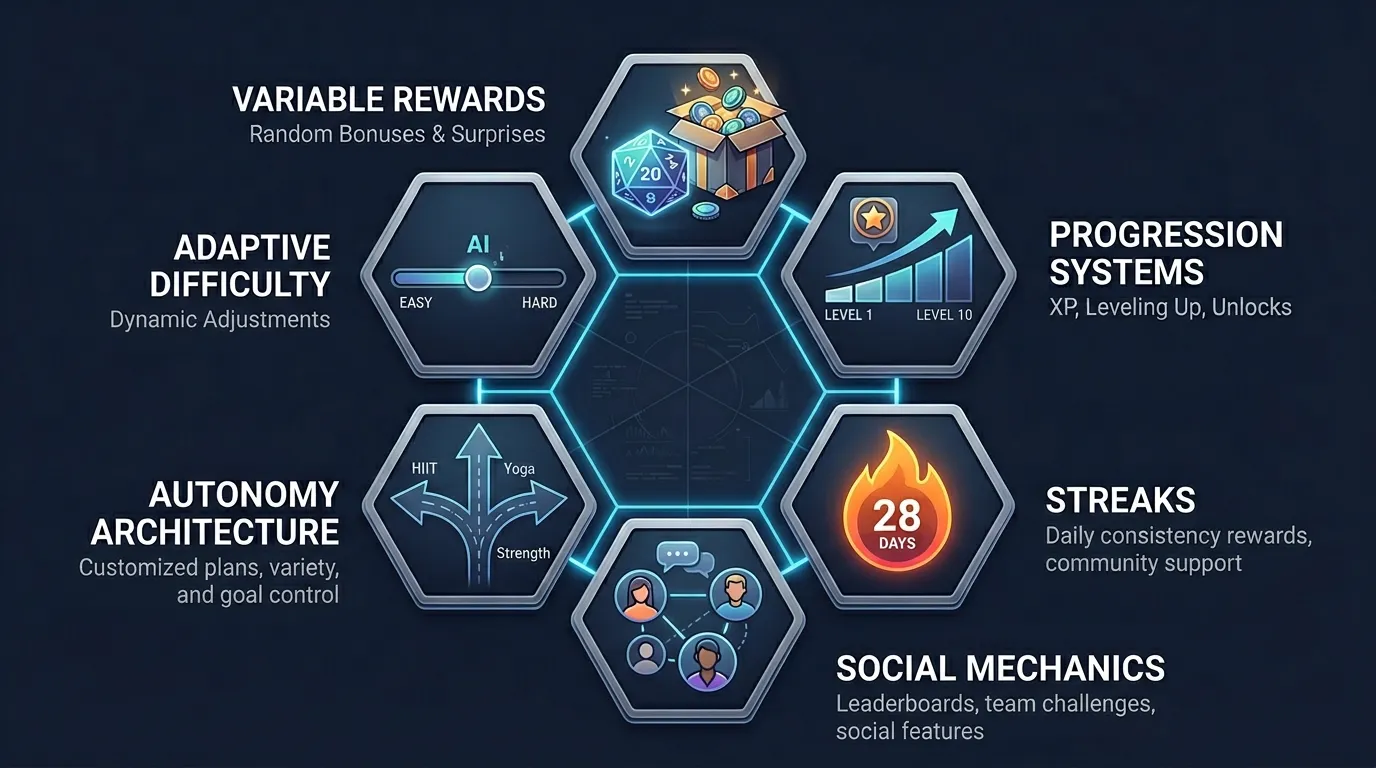
When most people hear "gamification," they picture gold stars and leaderboards. That's the shallow version — and it's why so many gamified products fail. Real gamification draws from decades of behavioral psychology research and incorporates multiple interlocking systems. If you want to see how the major apps actually score on these mechanics, we ranked them in our comparison of the best gamified fitness apps. The systems that matter:
- Variable reward schedules — Unpredictable rewards that create curiosity and anticipation, the same mechanism behind slot machines and collectible card games (see how operant conditioning drives fitness)
- Progression systems — Visible advancement through levels, milestones, or skill trees that give you a tangible sense of growth
- Commitment devices — Streaks, challenges, and social contracts that make quitting psychologically costly
- Social mechanics — Collaboration, friendly competition, and shared identity that tap into our need for belonging
- Autonomy architecture — Meaningful choices within a structured framework, so you feel in control of your journey
- Adaptive difficulty — Challenges that scale with your skill level, keeping you in the sweet spot between boredom and frustration
Each of these maps to a specific psychological theory backed by decades of research. Let's walk through the evidence.
The BE FIT Trial: Gamification Significantly Increases Physical Activity
The Behavioral Economics Framingham Incentive Trial (BE FIT) was a randomized clinical trial published in JAMA Internal Medicine in 2017. Researchers at the University of Pennsylvania's Center for Health Incentives and Behavioral Economics studied 200 adults from 94 families to test whether gamification could increase physical activity.
The study design was rigorous. All participants tracked daily step counts using wearable devices or smartphones, established personal baselines, selected individualized step goal increases, and received daily feedback. The gamification arm used game mechanics rooted in behavioral economics — including points, levels, and social incentives — while the control arm received only standard feedback.
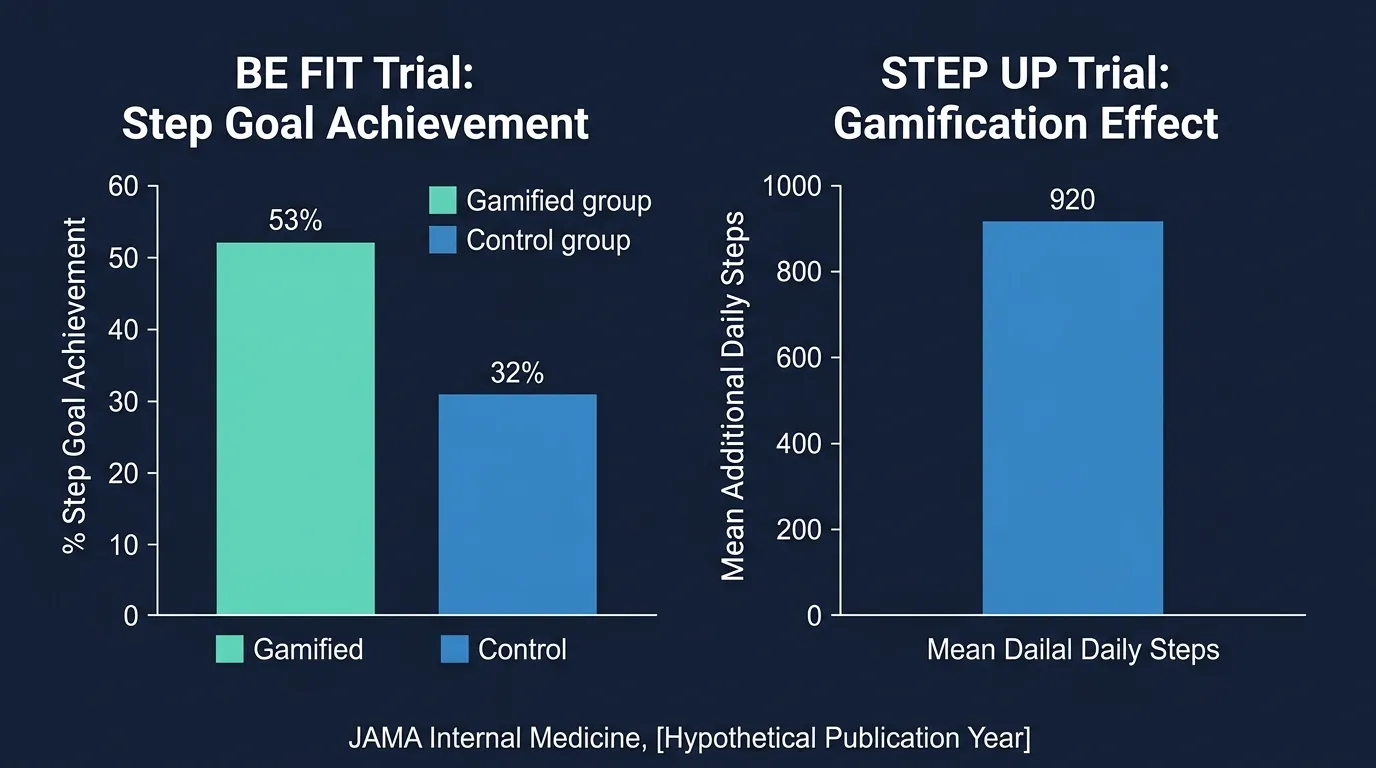
The results were striking. During the 12-week intervention period, participants in the gamification arm achieved their step goals on 53% of days compared to just 32% in the control group — a significant adjusted difference of 27 percentage points (95% CI, 0.20-0.33; P < .001). They also increased their mean daily steps by 1,661 compared to 636 in the control group, an adjusted difference of 953 additional steps per day.
What's especially notable is what happened after the intervention ended. During the 12-week follow-up period, physical activity in the gamification arm declined but remained significantly higher than controls — 44% goal achievement vs. 33%, with mean daily steps still 494 higher than controls (P < .01). The game mechanics had created lasting behavioral change, not just temporary compliance.
Citation: Patel MS, Benjamin EJ, Volpp KG, et al. Effect of a Game-Based Intervention Designed to Enhance Social Incentives to Increase Physical Activity Among Families: The BE FIT Randomized Clinical Trial. JAMA Intern Med. 2017;177(11):1586-1593.
The STEP UP Trial: Gamification Works for Sedentary, Overweight Adults
If BE FIT showed gamification works in families, the STEP UP trial proved it works at scale — including for the exact population that needs it most: overweight and sedentary adults who struggle to exercise consistently.
Published in JAMA Internal Medicine in 2019, the STEP UP trial was a 36-week randomized clinical trial (24-week intervention, 12-week follow-up) involving 602 adults from 40 US states with BMIs of 25 or higher. Participants were randomly assigned to a control group or one of three gamification interventions: support, collaboration, or competition.
All three gamification interventions significantly increased physical activity during the 24-week intervention period. The competition arm was the most effective, producing an increase of 920 additional steps per day compared to the control group. This translates to roughly 8-9 additional minutes of moderate-to-vigorous physical activity daily — a clinically meaningful difference that, if sustained, meaningfully reduces cardiovascular risk.
The trial also revealed that competition-based gamification had the most durable effects. During the 12-week follow-up period (after the intervention ended), only the competition arm maintained significantly greater physical activity than controls — suggesting that competitive social mechanics create deeper behavioral grooves than support or collaboration alone.
Citation: Patel MS, Small DS, Harrison JD, et al. Effectiveness of Behaviorally Designed Gamification Interventions With Social Incentives for Increasing Physical Activity Among Overweight and Obese Adults Across the United States: The STEP UP Randomized Clinical Trial. JAMA Intern Med. 2019;179(12):1624-1632.
Meta-Analyses Confirm: Gamification Has a Reliable, Positive Effect
Individual trials are compelling. But when multiple research teams, studying different populations with different methods, all find the same pattern — that's when the evidence becomes hard to ignore.
A 2022 systematic review and meta-analysis published in the Journal of Medical Internet Research analyzed 16 randomized controlled trials involving 2,407 participants aged 9 to 73. The analysis found a small-to-medium summary effect of gamified interventions on physical activity behavior (Hedges' g = 0.42). When compared with inactive control groups, the effect was even larger (g = 0.58). Gamified participants also showed a mean increase of 1,421 additional steps per day.
A separate 2022 systematic review in JMIR mHealth and uHealth examined 50 studies on mHealth-based gamification interventions and physical activity participation. The review found consistent evidence that gamification improves physical activity, particularly when combined with wearable activity trackers — which 60% of the included studies used. The authors noted that gamification combined with self-monitoring created a powerful feedback loop: wearables provide the data, and game mechanics provide the motivation to act on it.
Both reviews converge on the same conclusion: gamification reliably increases physical activity across diverse populations, age groups, and study designs.
Citations:
- Mazeas A, Duclos M, Greer B, Beaune B. Evaluating the Effectiveness of Gamification on Physical Activity: Systematic Review and Meta-analysis of Randomized Controlled Trials. J Med Internet Res. 2022;24(1):e26779.
- Xu L, Shi H, Shen M, et al. The Effects of mHealth-Based Gamification Interventions on Participation in Physical Activity: Systematic Review. JMIR Mhealth Uhealth. 2022;10(2):e27794.
Self-Determination Theory: Why Gamification Satisfies What We Actually Need
The studies above show that gamification works. Self-Determination Theory (SDT) explains why.
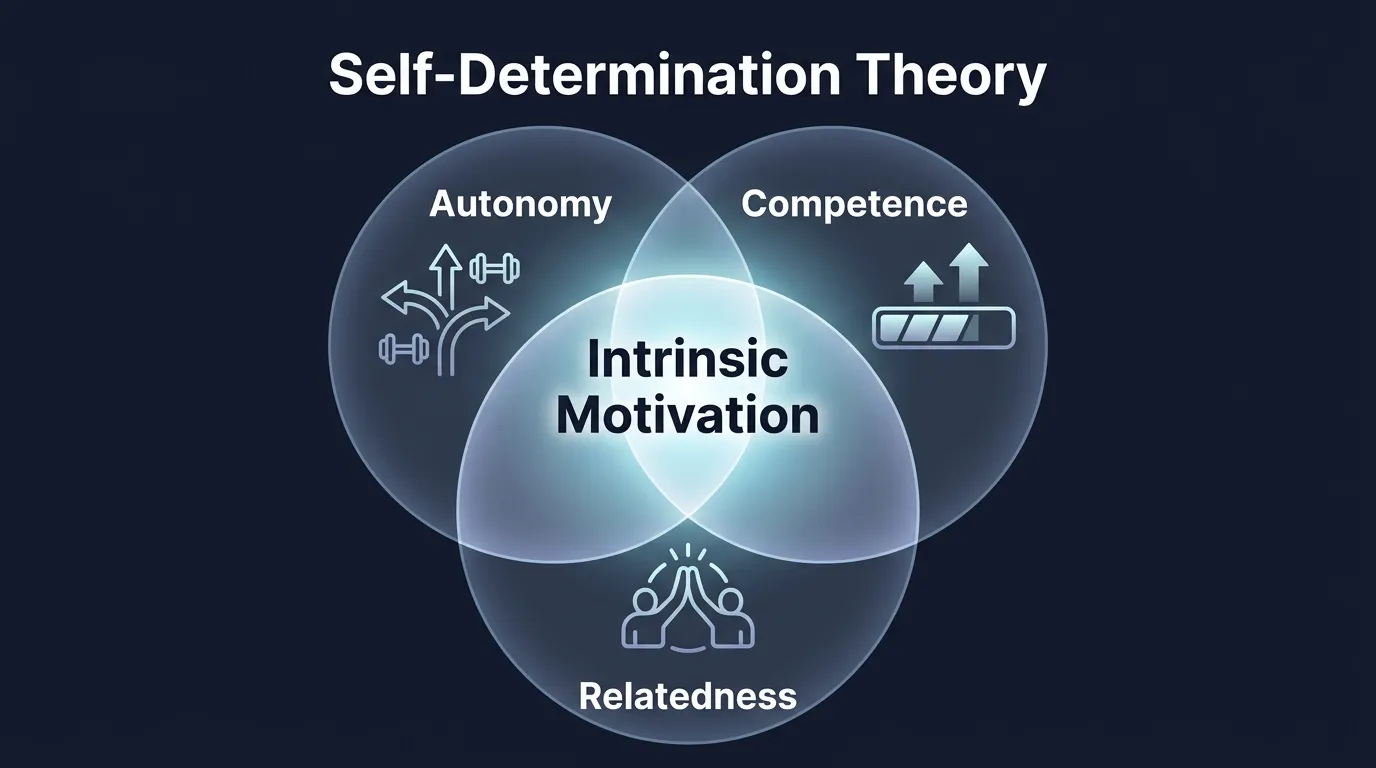
Developed by psychologists Edward Deci and Richard Ryan, SDT is one of the most extensively researched frameworks in motivational psychology. The core premise is simple: humans have three basic psychological needs that, when satisfied, produce intrinsic motivation — the kind of motivation that sustains behavior without external pressure.
Autonomy — the need to feel that your actions are self-chosen, not forced. When you're told exactly what to do with no input, motivation drops. When you have meaningful choices within a structure, you feel ownership over the process.
Competence — the need to feel effective, to experience growth and mastery. This is why clear feedback, progressive challenges, and visible improvement are so motivating. Without a sense of getting better, effort feels pointless.
Relatedness — the need to feel connected to others. Humans are social creatures, and activities done in isolation are harder to sustain than those embedded in a community.
Well-designed gamification satisfies all three simultaneously. Progression systems and skill-based challenges feed competence. Meaningful choice architecture feeds autonomy. Social mechanics — teams, shared challenges, community features — feed relatedness. Research published in TechTrends (2024) confirms that gamification designs addressing these three SDT needs promote autonomous motivation and sustained engagement.
This is why a badge by itself doesn't work. A badge is a surface-level reward that doesn't address any of the three needs. But a progression system where you choose your path (autonomy), see yourself leveling up (competence), and share the journey with others (relatedness)? That's intrinsic motivation — and it's the engine behind lasting behavior change.
Variable Ratio Reinforcement: Why Collectible Cards Are Addictive
B.F. Skinner's research on reinforcement schedules — conducted across decades of laboratory studies starting in the 1950s — revealed something counterintuitive: unpredictable rewards produce stronger and more persistent behavior than predictable ones.
Skinner identified four primary reinforcement schedules, but the variable ratio schedule — where rewards come after an unpredictable number of responses — produces the highest response rates and is the most resistant to extinction (meaning the behavior continues longest even when rewards stop). This is the mechanism behind slot machines, loot boxes, collectible card packs, and every "mystery reward" system you've ever encountered.
It works because of anticipation. When you know exactly when the reward is coming, there's no curiosity — you can mentally discount it. When the reward could come at any time, every single action carries the possibility of a payoff. Your brain stays engaged because it's perpetually in a state of "maybe this time."
Applied to fitness, variable ratio reinforcement means that random workout completions unlock surprise rewards — a rare collectible card, a bonus quest, an unexpected achievement. You can't predict which workout will deliver the dopamine hit, so every workout feels worth completing. This is fundamentally different from a fixed schedule where you get a badge every 10 workouts. By workout 8, you already know the badge is coming and the reward has lost its motivational power.
FitCraft's collectible card system is built directly on this principle. Cards are earned through workouts but with variable rarity — sometimes you get a common card, sometimes a rare one, and occasionally an ultra-rare card that triggers a genuine thrill. The unpredictability keeps the reward circuitry active across every single session.
Flow State: The Sweet Spot Between Boredom and Frustration
Hungarian-American psychologist Mihaly Csikszentmihalyi introduced the concept of "flow" in his 1975 book Beyond Boredom and Anxiety and spent the next four decades studying it. Flow is the mental state where you're so absorbed in an activity that time seems to disappear — action and awareness merge, self-consciousness fades, and the experience becomes intrinsically rewarding.
The critical ingredient is the balance between challenge and skill. If a task is too easy for your skill level, you get bored. If it's too hard, you get anxious and frustrated. Flow happens in the narrow channel between the two — and it requires that both challenge and skill increase over time. A properly designed flow activity is dynamic: as your skill grows, the challenge scales to match.
A systematic review of flow states in exercise published in Psychology of Sport and Exercise found that flow is positively associated with exercise engagement, intrinsic motivation, and long-term adherence. Athletes and regular exercisers report flow experiences more frequently than sedentary individuals — but the research suggests this is a consequence of well-matched challenges, not an innate trait.
This has direct implications for fitness app design. Most workout apps give everyone the same program, or offer a few static difficulty levels. Neither approach maintains the challenge-skill balance as users improve. The result: the program is too hard at first (anxiety, quitting) or too easy after a few weeks (boredom, quitting).
FitCraft's AI coach Ty continuously adjusts workout difficulty based on your progress. When you're improving, challenges scale up. When you're struggling, they pull back. The goal is to keep you in that flow channel — the zone where exercise feels demanding enough to be engaging but achievable enough to be satisfying. This is adaptive difficulty matching, and it's the same principle that keeps you playing a well-designed video game for hours.
Enjoying the article?
Start a new fitness routine today, written by me and coached by the AI I designed.
Take the Free Assessment Free · 2 minutes · No credit cardHow FitCraft Implements Each Mechanism
Understanding the research is one thing. Building a product that actually applies it is another. Here's how each peer-reviewed principle maps to a specific FitCraft feature — designed by an Ivy League-trained exercise scientist, NSCA-certified strength coach who studied these frameworks extensively.
Streak System → Commitment Consistency + Loss Aversion
FitCraft tracks your workout streaks — consecutive days or weeks of completed sessions. This leverages two well-documented psychological forces: the commitment consistency principle (once you've started a chain, breaking it feels like losing progress) and loss aversion (losing a streak hurts more than gaining one feels good). The BE FIT trial demonstrated that these commitment devices significantly increase goal achievement over time.
As Mike, 23, a FitCraft user, put it: "The streak system got me hooked. I didn't want to break my chain."
Collectible Cards → Variable Ratio Reinforcement
After workouts, you earn collectible cards with varying rarity levels. You never know exactly when a rare card will drop — that's Skinner's variable ratio schedule in action. The unpredictability maintains engagement session after session, because every workout carries the possibility of a surprise. This is the same mechanism that makes trading card games and gacha systems compelling, redirected toward a healthy behavior.
Quest System → Autonomy + Competence (SDT)
FitCraft's quest system gives you meaningful choices about which challenges to pursue. You're not following a rigid script — you're selecting missions that align with your goals and interests. This satisfies the autonomy need identified by Self-Determination Theory. Completing quests provides clear feedback and visible progress, satisfying the competence need. Together, these create intrinsic motivation that doesn't depend on willpower.
Avatar Progression → Visible Growth + Identity
Your FitCraft avatar evolves as you train. This serves two purposes: it provides a visible, tangible representation of your progress (feeding the competence need), and it creates an identity shift. You stop being "someone trying to work out" and start being "someone who works out." Research on identity-based habit formation shows that behavior change is most durable when it becomes part of who you are, not just something you do.
AI-Adaptive Programming → Flow State
FitCraft's AI coach Ty uses your 32-step diagnostic assessment and ongoing performance data to keep workouts in the flow channel — challenging enough to engage you, achievable enough to avoid frustration. As Csikszentmihalyi's research shows, this balance is the key to sustained intrinsic motivation. Unlike static programs that become too easy or too hard, Ty dynamically adjusts to keep you in the zone.
Calendar Rewards → Consistency Reinforcement + Loss Aversion
FitCraft's calendar tracking system provides visible proof of your consistency and unlocks escalating rewards as you maintain your habit. This taps into the same commitment consistency and loss aversion principles validated by the clinical trials — once you see weeks of completed workouts on your calendar, the motivation to keep the chain going becomes self-reinforcing.
Why This Matters: The Real Cost of Quitting
Here's the part that doesn't show up in the research abstracts. Every time you start a fitness program and quit, you don't just lose the progress. You reinforce a story about yourself — that you're someone who can't stick with things. That narrative compounds. Each failed attempt makes the next one harder to start, because now you're fighting both the motivation gap and the belief that you'll fail again.
Gamification breaks that cycle because it doesn't ask you to be motivated. It creates systems that make showing up the path of least resistance. The streak makes quitting feel costly. The variable rewards make every session potentially exciting. The progression system makes your effort visible. The calendar rewards reinforce your consistency. And the adaptive difficulty ensures the workouts actually match where you are — not where some generic program assumes you should be.
As Katie, a FitCraft user, said: "I've tried everything. This is the first time I've stuck with something past two weeks."
That's not a testament to willpower. That's behavioral science, applied correctly.
FitCraft turns these mechanisms into the product itself, which we walk through on the gamified workout app page.
Frequently Asked Questions
Does gamification actually work for fitness?
Yes. Multiple randomized controlled trials confirm it. The BE FIT trial (2017) found gamified exercise interventions significantly increased daily steps and goal achievement compared to controls. The STEP UP trial (2019) showed gamification increased physical activity among overweight and sedentary adults across 40 US states. A 2022 meta-analysis of 16 RCTs published in the Journal of Medical Internet Research found a small-to-medium positive effect of gamification on physical activity behavior across 2,407 participants.
What is gamification in fitness?
Gamification in fitness means applying game design principles — such as progression systems, variable rewards, streaks, quests, and social mechanics — to exercise programs. It goes far beyond simple badges. Effective gamification uses behavioral psychology principles like variable ratio reinforcement schedules and Self-Determination Theory to make exercise intrinsically motivating rather than relying on willpower alone.
Why do people quit fitness apps?
Most people quit fitness apps because the apps rely on initial motivation, which naturally fades after 2-3 weeks. Without game mechanics to sustain engagement — like streaks that create commitment, variable rewards that trigger curiosity, and progression systems that provide a sense of growth — there is nothing to bridge the gap once the novelty wears off. Gamification addresses this by replacing willpower with psychological pull.
How does FitCraft use gamification research?
FitCraft implements specific research-backed mechanisms: streak systems for commitment consistency, collectible cards using variable ratio reinforcement schedules, quest-based progression for autonomy and competence (Self-Determination Theory), AI-adaptive difficulty matching for flow state, and calendar rewards for consistency reinforcement. Every game mechanic maps to a peer-reviewed principle. Programs are designed by an Ivy League-trained exercise scientist, NSCA-certified strength coach.
Is gamified fitness just for gamers?
No. The psychological principles behind gamification — variable rewards, progression, social connection, autonomy — are universal human motivators, not gamer-specific traits. The research trials (BE FIT, STEP UP) studied general populations including families and overweight adults, not gamers. Anyone who has ever been hooked by a streak on Duolingo or a step counter responds to the same mechanics.