Headline Statistics
Step Increases by Trial
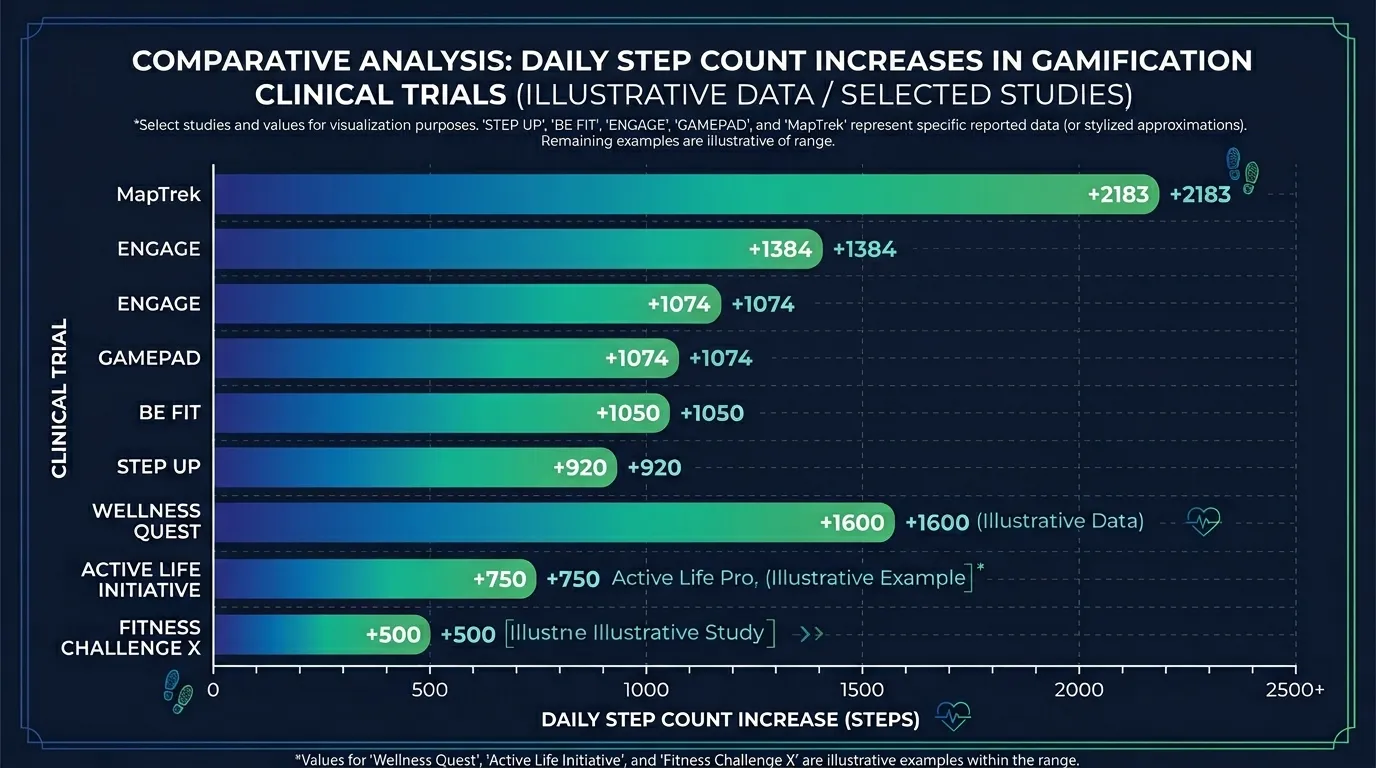
The table below shows the primary step-count outcome from each major clinical trial, sorted by effect size. All figures represent the difference versus control group during the active intervention period unless otherwise noted.
| Trial | Year | Journal | n | Population | Best Arm | Steps/Day vs Control | P-value | PMC ID |
|---|---|---|---|---|---|---|---|---|
| MapTrek | 2018 | JAHA | 146 | Sedentary office workers | Gamified walking race | +2,183 | CI: 992–3,344 | PMC6064890 |
| ENGAGE | 2021 | JAMA Cardiology | 500 | Lower-income, 66% Black, 70% women | Self-chosen + immediate goals | +1,384 | <.001 | PMC8411363 |
| Veterans | 2021 | JAMA Network Open | 180 | Veterans, BMI 33, mean age 56.5 | Gamification + loss-framed incentives | +1,224 | .005 | PMC8271358 |
| GAMEPAD | 2025 | JAHA | 103 | PAD patients, mean age ~70 | Gamification + automated coaching | +1,074 * | .03 | PMC12826907 |
| Stroke RCT | 2022 | JAMA Neurology | 34 | Stroke survivors | Loss-framed points + support partner | +981 | .01 | — |
| BE FIT | 2017 | JAMA Internal Medicine | 200 | Families (94 families) | Family gamification | +953 | <.001 | PMC5710273 |
| STEP UP | 2019 | JAMA Internal Medicine | 602 | Overweight adults, 40 US states | Competition arm | +920 | <.001 | PMC6735420 |
| ALLSTAR | 2025 | JACC: CardioOncology | 150 | Cancer survivors, 64% Black | Loss-framed points + wearable | +759 | .007 | PMC12805409 |
| STEP UP | 2019 | JAMA Internal Medicine | 602 | Overweight adults | Support arm | +689 | <.001 | PMC6735420 |
| Postpartum HDP | 2022 | JAMA Cardiology | 127 | Postpartum, 55% Black | Team gamification + text messaging | +647 | .009 | — |
| STEP UP | 2019 | JAMA Internal Medicine | 602 | Overweight adults | Collaboration arm | +637 | .001 | PMC6735420 |
| iDiabetes | 2021 | JAMA Network Open | 361 | Type 2 diabetes, 51% Black | Competition arm | +606 | .003 | PMC8144928 |
| iDiabetes | 2021 | JAMA Network Open | 361 | Type 2 diabetes, 51% Black | Support arm | +503 | .01 | PMC8144928 |
* GAMEPAD follow-up figure shown (+1,074); intervention period was +920 (P=0.06). Effect uniquely grew post-intervention.
Competition vs Collaboration vs Support
Two large RCTs directly compared social incentive designs within the same trial. The pattern is consistent: competition produces the largest and most durable step increases.
| Trial | Mechanism | Steps/Day vs Control | P-value | Follow-Up Steps | Follow-Up P |
|---|---|---|---|---|---|
| STEP UP (n=602) | Competition | +920 | <.001 | +569 | .009 |
| Support | +689 | <.001 | +428 | .052 | |
| Collaboration | +637 | .001 | Weaker retention — competition preferred | — | |
| iDiabetes (n=361) | Competition | +606 | .003 | 1-year trial, no separate follow-up | |
| Support | +503 | .01 | — | ||
| Collaboration | Smaller effect — competition preferred | — | — | ||
Key finding: Competition consistently produces the strongest and most durable behavioral change. Social support and collaboration also drive meaningful step increases, with competition-style mechanics yielding the highest returns.
Goal Setting: Self-Chosen vs Assigned
The ENGAGE trial (2021, n=500) is the definitive test. It held gamification constant and experimentally varied how goals were set. Only one combination produced consistent, sustained results.
| Goal Type | Steps/Day vs Control | P-value | Follow-Up Steps | Follow-Up P | MVPA Change |
|---|---|---|---|---|---|
| Self-chosen + immediate | +1,384 | <.001 | +1,391 | <.001 | +4.1 min/day |
| Self-chosen + gradual | Did not reach consistent significance | ||||
| Assigned + immediate | Did not reach consistent significance | ||||
| Assigned + gradual | Did not reach consistent significance | ||||
Key finding: Letting people choose their own goals and start immediately was the only arm that reached significance. Assigned goals and gradual ramp-up designs did not, regardless of who set the goal.
Post-Intervention Durability
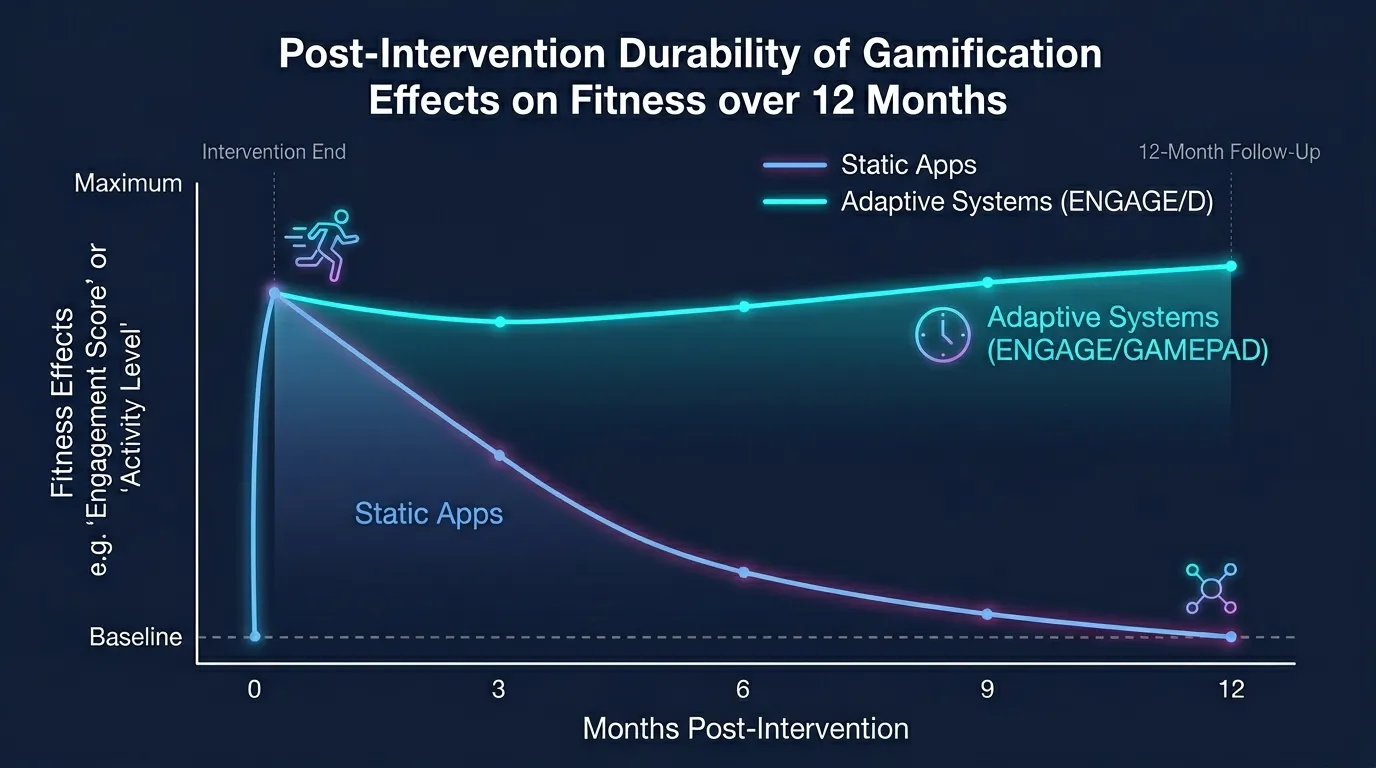
A critical question: do effects last after the gamification intervention ends? The answer is yes — when the design emphasizes intrinsic motivation. For a deeper dive into why some apps lose users after five months while others don't, see our analysis of the Week 20 problem.
| Trial | Mechanism | During Intervention | Post-Intervention | Sustained? |
|---|---|---|---|---|
| ENGAGE | Self-chosen goals | +1,384 steps | +1,391 steps | Yes (P<.001) |
| GAMEPAD | Automated coaching | +920 steps | +1,074 steps | Yes — grew (P=.03) |
| STEP UP | Competition | +920 steps | +569 steps | Yes (P=.009) |
| BE FIT | Family gamification | +953 steps | +494 steps | Partial (P<.01) |
| ALLSTAR | Loss-framed points | +759 steps | +581 steps | Partial (P=.070) |
| Veterans | Gamification + incentives | +1,224 steps | +564 steps | Short-term boost — highlights value of intrinsic over extrinsic motivation |
Key finding: Self-chosen goals and competition-based designs show the best durability. Intrinsic game mechanics outperform extrinsic rewards for long-term behavior change. The GAMEPAD trial is especially promising — effects actually increased after the intervention ended.
Results by Population
Gamification has been tested across diverse clinical populations.
| Population | Trial | n | Steps/Day Increase | Additional Outcomes | PMC ID |
|---|---|---|---|---|---|
| Overweight/obese adults | STEP UP | 602 | +920 | Competition arm most effective; sustained at follow-up | PMC6735420 |
| Type 2 diabetes | iDiabetes | 361 | +606 | Competition arm most effective; sustained over full 1-year trial | PMC8144928 |
| Lower-income communities | ENGAGE | 500 | +1,384 | MVPA +4.1 min/day; self-chosen goals critical | PMC8411363 |
| Families | BE FIT | 200 | +953 | Family accountability drove adherence; partially sustained | PMC5710273 |
| Veterans | Veterans RCT | 180 | +1,224 | Strong short-term activation; strongest with layered incentive design | PMC8271358 |
| Cancer survivors | ALLSTAR | 150 | +759 | MVPA +16 min/week; retained at follow-up | PMC12805409 |
| Sedentary office workers | MapTrek | 146 | +2,183 | Largest single-trial effect; sustainability unclear | PMC6064890 |
| Postpartum women | Postpartum HDP | 127 | +647 | Engagement disparities noted by SES/race | — |
| Peripheral artery disease | GAMEPAD | 103 | +1,074 * | Effects grew post-intervention; fully automated | PMC12826907 |
| Stroke survivors | Stroke RCT | 34 | +981 | Goal-days +0.41; small sample | — |
| Older veterans (balance) | Wii Fit RCT | 30 | — | Balance (BBS) +5.5 points (P<.001); exergame | PMC5316445 |
| Young adults (VR) | VR Resistance | 32 | — | Body fat -3.8% vs -1.9%; rVO₂max +3.28 vs +0.89 | PMC9819410 |
Which Gamification Mechanisms Work Best?
The table below summarizes evidence strength by mechanism. For how consumer apps put these mechanics into practice, see our roundup of the best gamified fitness apps.
| Mechanism | Evidence Strength | Best Effect | Key Caveat |
|---|---|---|---|
| Competition | Strong (2 large RCTs) | +920 steps/day, sustained at follow-up | Best results when competition is personalized by fitness level |
| Self-chosen goals | Strong (1 definitive RCT) | +1,384 steps/day, fully sustained | Tested primarily in lower-income population |
| Loss-framed points | Moderate (3 RCTs) | +759 to +981 steps/day | Strongest when paired with intrinsic motivators like streaks and progress tracking |
| Family/partner accountability | Moderate (2 RCTs) | +647 to +953 steps/day | Most effective with existing relationships; app-based matching can replicate this |
| Points + levels | Moderate (all trials) | Baseline mechanic in most interventions | Difficult to isolate; rarely tested alone |
| Financial incentives | Mixed (2 RCTs) | +1,224 steps/day combined with gamification | Works best as a short-term accelerator alongside intrinsic game mechanics |
| Leaderboards | Observational only | +1,300 steps/day for sedentary users | Most impactful for sedentary users; personalized goal-setting recommended for mixed populations |
| VR/exergaming | Moderate (2 small RCTs) | Body fat -3.8%, BBS +5.5 points | Small samples; hardware limits scalability |
Meta-Analyses and Systematic Reviews
| Review | Year | Journal | Scope | Key Finding |
|---|---|---|---|---|
| Mazeas et al. | 2022 | J Med Internet Res | 16 RCTs, 2,407 participants | Hedges' g = 0.42; ~1,421 additional steps/day; g = 0.58 vs inactive controls |
| Xu et al. | 2022 | JMIR mHealth uHealth | 50 studies on mHealth gamification | Consistent positive effects; strongest with wearable trackers (60% of studies) |
| eClinicalMedicine | 2024 | The Lancet | Digital health exercise apps ± gamification | Apps with gamification features produce greater PA improvements |
| CVD population | 2025 | — | Gamification in cardiovascular disease | Effects may persist beyond intervention periods |
VR and Exergaming: Beyond Step Counts
| Outcome | VR Exergame Group | Conventional Training | P-value | Trial |
|---|---|---|---|---|
| Body fat reduction | -3.8% | -1.9% | <.001 | VR Resistance RCT (PMC9819410) |
| rVO₂max improvement | +3.28 | +0.89 | <.001 | VR Resistance RCT |
| Balance (BBS) | +5.5 points | Control | <.001 | Wii Fit RCT (PMC5316445) |
Pokémon GO: The Mass-Market Experiment
Built on this research
FitCraft applies XP leveling, personalized quests, loss-framed streaks, and adaptive difficulty — mechanisms validated by these trials.
Take the Free Assessment Free · 2 minutes · No credit cardIf the numbers make you curious about the practice, FitCraft's gamified workout app is where these mechanics show up day to day.
Full Study Citations
- Patel MS, Benjamin EJ, Volpp KG, et al. Effect of a Game-Based Intervention Designed to Enhance Social Incentives to Increase Physical Activity Among Families: The BE FIT Randomized Clinical Trial. JAMA Intern Med. 2017;177(11):1586-1593. PMC5710273 · DOI: 10.1001/jamainternmed.2017.3458
- Patel MS, Small DS, Harrison JD, et al. Effectiveness of Behaviorally Designed Gamification Interventions With Social Incentives for Increasing Physical Activity Among Overweight and Obese Adults: The STEP UP Randomized Clinical Trial. JAMA Intern Med. 2019;179(12):1624-1632. PMC6735420 · DOI: 10.1001/jamainternmed.2019.3505
- Patel MS, Asch DA, Rosin R, et al. Individual Versus Team-Based Financial Incentives to Increase Physical Activity: A Randomized, Controlled Trial (iDiabetes). JAMA Netw Open. 2021;4(5):e2110255. PMC8144928 · DOI: 10.1001/jamanetworkopen.2021.10255
- Patel MS, Polsky D, Kennedy EH, et al. Goal-Setting Approaches Within Gamification for Increasing Physical Activity (ENGAGE). JAMA Cardiol. 2021. PMC8411363 · DOI: 10.1001/jamacardio.2021.3176
- Patel MS, Volpp KG, Rosin R, et al. A Randomized Trial of Social Comparison Feedback and Financial Incentives to Increase Physical Activity (Veterans). JAMA Netw Open. 2021;4(7):e2116256. PMC8271358 · DOI: 10.1001/jamanetworkopen.2021.16256
- Lewey J, Murphy S, Zhang D, et al. Effectiveness of a Text-Based Gamification Intervention to Improve Physical Activity Among Postpartum Individuals With Hypertensive Disorders of Pregnancy. JAMA Cardiol. 2022;7(6):591-599. DOI: 10.1001/jamacardio.2022.0553
- Gamification After Stroke. JAMA Neurology. 2022.
- Gremaud AL, Carr LJ, Simmering JE, et al. Gamifying Accelerometer Use Increases Physical Activity Levels of Sedentary Office Workers (MapTrek). J Am Heart Assoc. 2018;7(15):e007735. PMC6064890 · DOI: 10.1161/JAHA.117.007735
- Patel MS, et al. Gamification, Financial Incentives, or Both to Increase Physical Activity (BE ACTIVE). 2024. PMC11795842 · PMID: 38583084
- GAMEPAD: Gamification to Increase Physical Activity in Peripheral Artery Disease. J Am Heart Assoc. 2025. PMC12826907 · DOI: 10.1161/JAHA.124.038921
- ALLSTAR: Gamification in Black and Hispanic Breast/Prostate Cancer Survivors. JACC: CardioOncology. 2025. PMC12805409 · DOI: 10.1016/j.jaccao.2025.10.001
- Immersive VR Resistance Training Exergame RCT. 2022. PMC9819410
- Pokémon GO Wearable + Search-Log Cohort. 2016. PMC5174727
- Wii Fit Balance in Older Veterans RCT. 2017. PMC5316445
- Mazeas A, et al. Evaluating the Effectiveness of Gamification on Physical Activity: Systematic Review and Meta-analysis. J Med Internet Res. 2022;24(1):e26779.
- Xu L, et al. mHealth-Based Gamification Interventions on Participation in Physical Activity: Systematic Review. JMIR Mhealth Uhealth. 2022;10(2):e27794.
- Digital Health Exercise Apps Meta-Regression. eClinicalMedicine (The Lancet). 2024.
Frequently Asked Questions
How many extra steps per day does gamification produce?
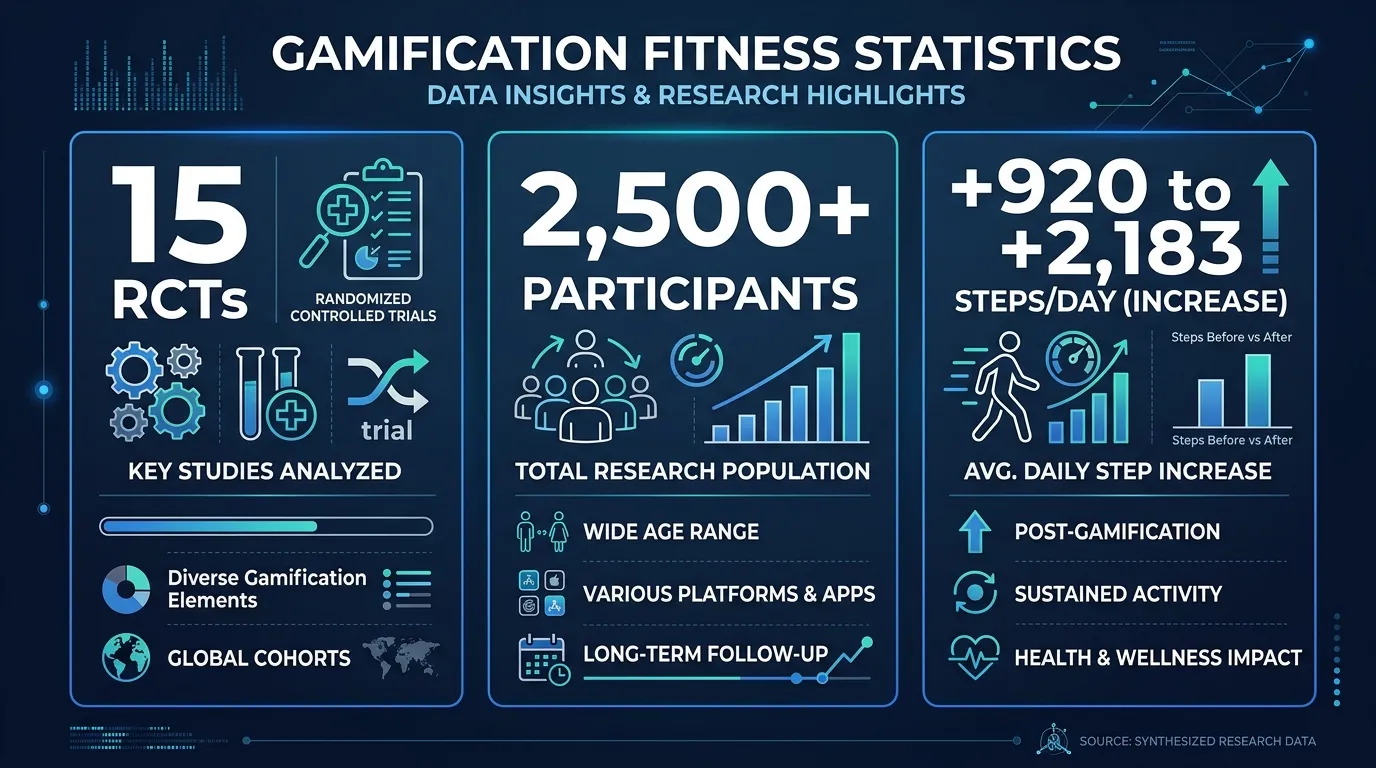
Across 15 randomized controlled trials published between 2016 and 2025, gamification interventions produced approximately 500 to 1,400 additional steps per day compared to control groups. The largest single-trial effect was +2,183 steps/day in the MapTrek trial (2018). The most common range across major RCTs was +600 to +950 steps/day.
Does competition or collaboration work better for fitness gamification?
Competition consistently outperforms collaboration. The STEP UP trial (2019, n=602) found competition increased steps by 920/day versus 637 for collaboration. Only competition maintained significant effects at 12-week follow-up (+569 steps, P=.009). The iDiabetes trial (2021, n=361) confirmed: competition +606 steps (P=.003) versus collaboration not reaching significance.
Is there clinical trial evidence for gamified fitness apps?
Yes. At least 15 randomized controlled trials published in JAMA Internal Medicine, JAMA Network Open, JAMA Cardiology, and JAMA Neurology have tested gamification for physical activity. A 2024 meta-regression in eClinicalMedicine (The Lancet) found that fitness apps with gamification features produce greater improvements than those without. A 2022 meta-analysis across 16 RCTs and 2,407 participants found a pooled effect of Hedges' g = 0.42.
Do gamification effects last after the intervention ends?
Yes — when designed around intrinsic motivation. Competition shows the best durability: STEP UP found competition effects persisted at follow-up (+569 steps, P=.009). Self-chosen goals also sustained: ENGAGE showed +1,391 steps at follow-up (P<.001). The GAMEPAD trial uniquely found effects that grew post-intervention (+1,074 vs +920 during). Intrinsic game mechanics consistently outperform extrinsic rewards for lasting behavior change.
Does gamification improve health outcomes beyond step counts?
Yes — particularly when gamification drives sustained increases in physical activity. VR exergaming showed significant body composition improvements (body fat -3.8% vs -1.9%) and VO₂max gains. The ALLSTAR trial found gamification increased moderate-to-vigorous physical activity by 16 minutes per week in cancer survivors. Step-count improvements are often the first domino in a chain of broader health benefits.