Open any fitness app. Within 60 seconds, it will assign you a goal. Walk 10,000 steps. Burn 500 calories. Complete three workouts this week. The number may vary, but the dynamic is always the same: the app decides, and you comply.
What if that's the problem?
Not the workouts. Not the exercises. Not even the tracking. But the simple fact that someone — or something — else is telling you what your goal should be.
A 500-person clinical trial suggests exactly that. And the size of the difference might surprise you.
The ENGAGE Trial: 500 People, One Clear Winner
The ENGAGE trial, a randomized controlled study published in the American Journal of Preventive Medicine (PMC8411363), enrolled 500 participants and tested different approaches to setting step goals. Some participants were assigned specific step targets. Others received gradually increasing goals. And one group simply chose their own.
The results weren't even close.
Participants who selected their own immediate goals increased their daily steps by 1,384 compared to baseline (P<.001). They also added 4.1 extra minutes of moderate-to-vigorous physical activity (MVPA) per day. And here's the part that matters most: at follow-up, the gains held. Self-chosen goal setters were still walking 1,391 more steps per day.
Self-chosen goals were the clear winner. Not by a slim margin — by a margin that translates to roughly an extra mile of walking every single day.
The other goal types — assigned targets, gradually increasing goals — all produced weaker results. Not because those approaches are bad. But because they're missing something fundamental about how human motivation actually works.
Why Autonomy Matters: Self-Determination Theory
The ENGAGE results make perfect sense when you understand Self-Determination Theory (SDT), a framework developed by psychologists Edward Deci and Richard Ryan over four decades of research.
SDT identifies three core psychological needs that drive intrinsic motivation — the same framework that explains why most fitness apps fail: autonomy (feeling that your actions are self-directed), competence (feeling capable), and relatedness (feeling connected to others). When these needs are met, people are naturally motivated. When they're thwarted, motivation withers — no matter how good the plan is.
Autonomy is the big one for goal-setting. When an app assigns you 10,000 steps, it might be a perfectly reasonable target. But it doesn't feel like yours. You're following instructions. You're complying. And compliance is a fragile form of motivation — it works right up until the moment it doesn't.
When you choose your own goal, the psychology shifts completely. The goal becomes an expression of what you want, not what an algorithm calculated. You internalize it. You own it. And research consistently shows that internalized motivation outlasts external pressure by a wide margin.
That's why the ENGAGE participants who chose their own goals didn't just do better in the short term — they sustained their gains at follow-up. Autonomy doesn't just spark motivation. It builds the kind that lasts.
But What About Unrealistic Goals?
Here's the objection you're probably thinking: "If people choose their own goals, won't they just pick something too easy? Or too ambitious?"
It's a fair question. And the data answers it clearly: no.
In the ENGAGE trial, self-chosen goals outperformed every other condition — including the ones designed by researchers to be optimally challenging. People didn't sandbag. They didn't set impossible targets. They chose goals that fit their lives.
This makes sense when you think about it. You know your schedule. You know your energy levels. You know whether you're recovering from a tough week or ready to push harder. No algorithm has access to all of that context. But you do.
When people set their own targets, they naturally calibrate to the sweet spot — challenging enough to feel meaningful, realistic enough to actually achieve. Each small win reinforces confidence and builds momentum for the next goal. It's a positive feedback loop that assigned goals rarely create.
Ready to set goals that actually stick?
Take the free FitCraft assessment and build a plan around your goals — not someone else's.
Take the Free Assessment Free · 2 minutes · No credit card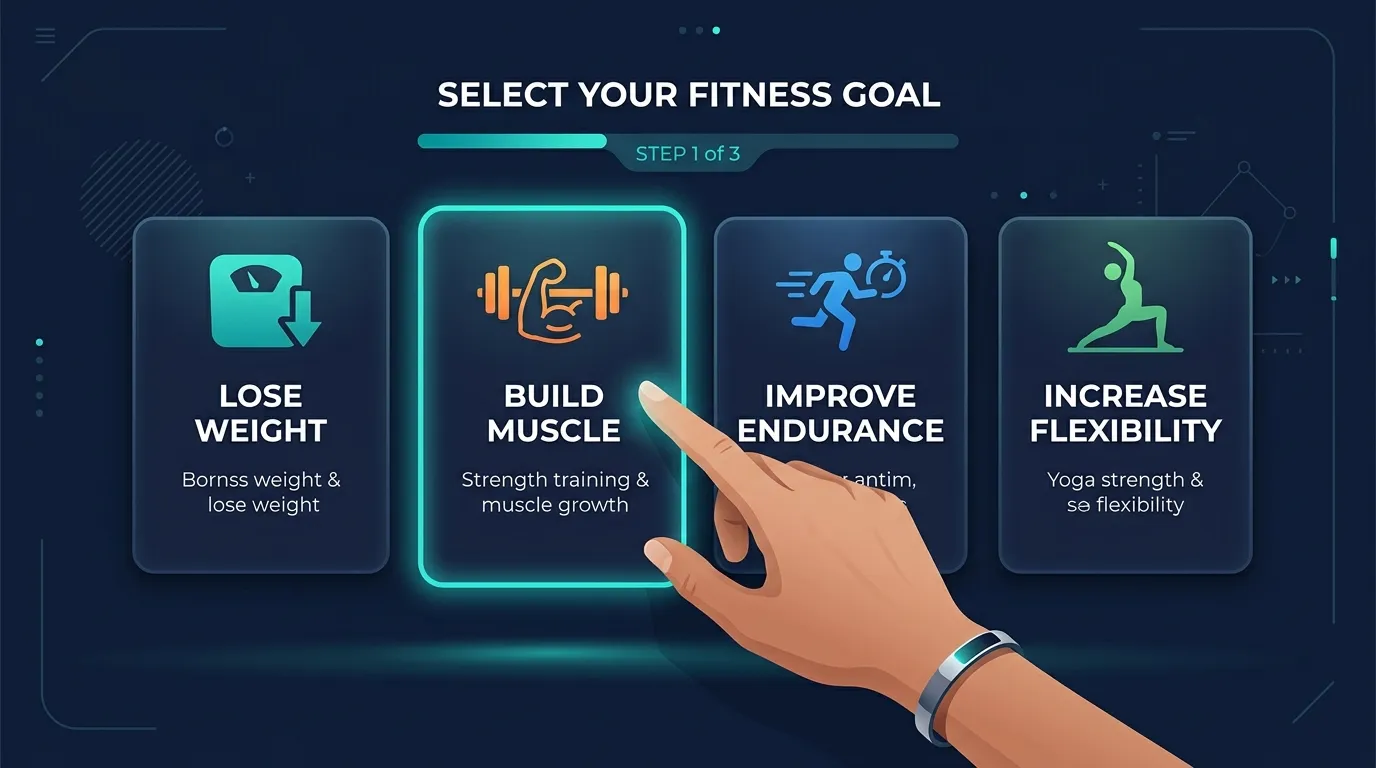
How FitCraft Puts You in the Driver's Seat
FitCraft was built on this principle from day one: your goals should be yours.
During your initial assessment, you define what matters to you. Want to build strength? Lose weight? Improve endurance? Just stay consistent enough to feel good? You choose. Your AI coach Ty then builds a personalized program around those choices — selecting exercises, setting progression schemes, and structuring your week based on what you said you wanted.
And it doesn't stop at the initial setup. You can adjust your goals anytime. Life changes. Priorities shift. A goal that made sense in January might not fit in March. FitCraft adapts because your coach adapts — Ty recalibrates your program whenever your goals evolve.
The structure is there. The guidance is there. The progression science is there. But the direction? That's always yours. Because 1,384 extra steps per day aren't created by better algorithms. They're created by giving people the one thing most fitness apps take away: the freedom to decide what they're working toward.
The Bottom Line
The next time a fitness app assigns you a goal, ask yourself: is this what I want? Or is this what the app decided I should want?
The ENGAGE trial makes it clear — when people choose their own goals, they move more, they sustain longer, and they build the kind of motivation that doesn't evaporate after two weeks. Not because self-chosen goals are magically better. But because autonomy is a fundamental human need, and goals that satisfy it create motivation that sticks.
Stop following someone else's script. Choose your own goals. The science says you'll walk 1,384 steps further every day because of it. For the full evidence on gamification and physical activity, see what 15 studies actually found.
Picking your own direction is half the fun, and the beginner side of FitCraft is designed around that idea.
Frequently Asked Questions
What is the ENGAGE trial and what did it find about fitness goals?
The ENGAGE trial was a 500-person randomized controlled trial (PMC8411363) that tested different goal-setting strategies for physical activity. Participants who chose their own immediate step goals increased their daily steps by 1,384 compared to baseline (P<.001), and maintained that gain at follow-up (+1,391 steps/day). Self-chosen goals were the clear winner across all goal types tested, including assigned goals and gradually increasing goals.
Why do self-chosen fitness goals work better than assigned goals?
Self-Determination Theory (SDT) explains that humans have a core psychological need for autonomy — the feeling that your actions are your own choice, not imposed by someone else. When you choose your own fitness goals, you internalize the motivation rather than relying on external pressure. This creates intrinsic motivation, which research consistently shows is more durable and effective than extrinsic motivation for long-term behavior change.
Can self-chosen goals lead to setting targets that are too easy or unrealistic?
Research suggests most people are surprisingly good at calibrating their own goals. In the ENGAGE trial, self-chosen goals outperformed all other conditions — including externally optimized ones. When people set their own targets, they naturally factor in their schedule, energy levels, and life constraints. They tend to set goals that are challenging enough to feel meaningful but realistic enough to actually achieve, which creates a positive feedback loop of success and confidence.
How does FitCraft let you choose your own fitness goals?
FitCraft is built around the principle that your goals should be yours. During the initial assessment, you define what matters to you — whether that's building strength, losing weight, improving endurance, or just staying consistent. Your AI coach Ty then builds a personalized program around those choices, and you can adjust your targets anytime. FitCraft provides the structure and guidance while keeping you in the driver's seat.