Practical, research-backed articles on building a fitness habit that actually lasts — from the psychology of motivation to the real economics of getting fit.
Latest Articles

Does cardio burn muscle?
Not on its own. Protein supplies only a trickle of the fuel for aerobic work, and Schumann et al. (2022) pooled 43 studies to find no hypertrophy penalty from adding cardio to lifting. What costs you muscle is a steep deficit, protein under 1.6 g/kg, or the lifting you dropped. Covers the Garthe and Mettler deficit trials, what masters endurance athletes look like under MRI, and how to space sessions.

Does Jump Rope Help Lose Weight?
Rope skipping is coded at 11.0 METs in the 2024 Adult Compendium, about 157 calories per 10 continuous minutes at 180 lb. The trials are soberer: Tang et al. (2021) found skipping alone moved nothing without calorie restriction. Includes calorie tables by body weight, impact and contraindications, a 4-week progression, and a walking and running comparison.

How long does it take to get in shape?
Three clocks are running and they do not finish together. Strength moves first because early gains are neural, aerobic capacity takes 8 to 12 weeks, and visible change comes last. Covers the evidence behind each timeline, a week-by-week table of what actually changes, the three things that genuinely speed it up, and the five mistakes that quietly add months.

How long should I rest between sets?
Two to five minutes for strength, one to three for muscle, thirty to sixty seconds for endurance. Grgic et al. (2018) found trained lifters need more than 2 minutes to maximize strength, and Miranda et al. (2009) showed 3-minute rests beat 1-minute rests for total volume on every upper-body exercise tested. Covers autoregulated rest by breathing, supersets that cut session time 37 percent, and rest tables by goal and by exercise type.
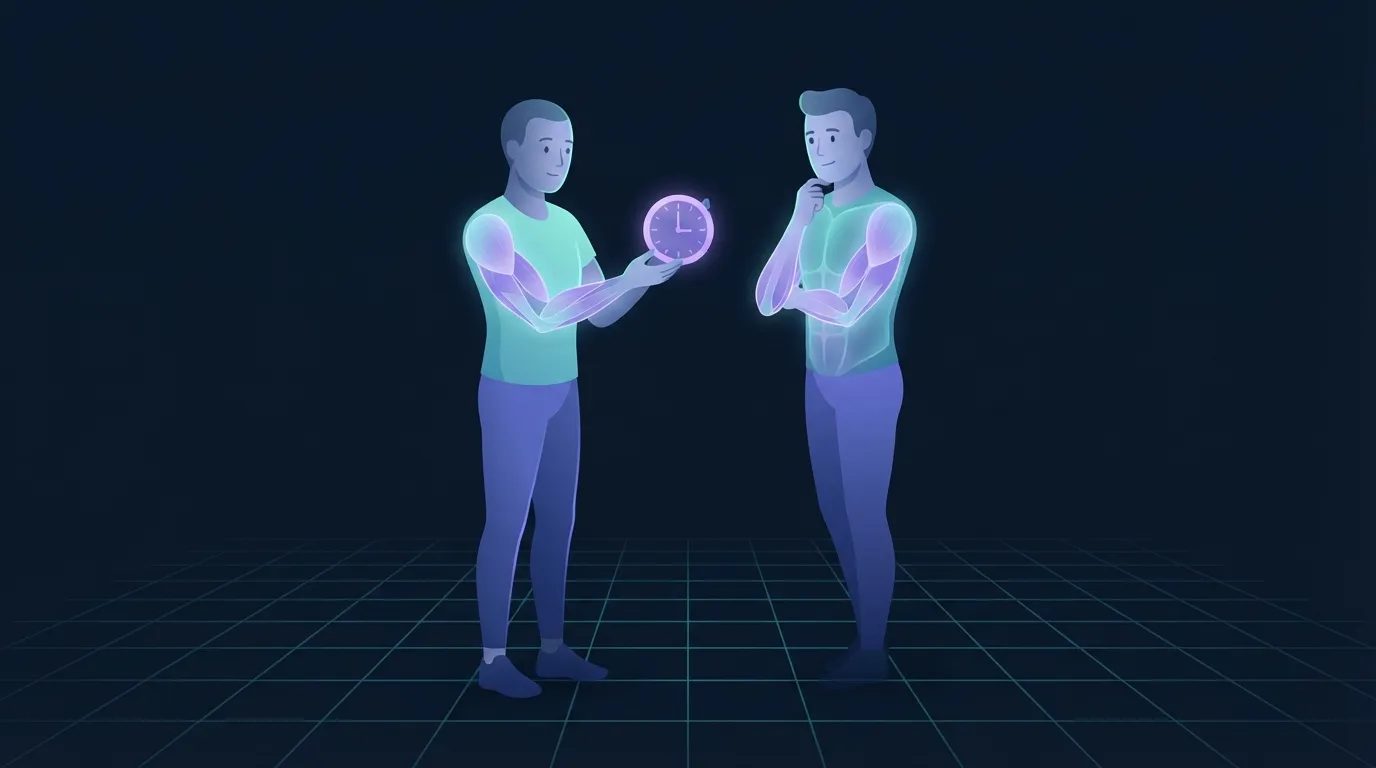
How long does it take to break a habit?
The 21-day rule is a myth from a 1960 plastic surgery book. Lally 2010 (European Journal of Social Psychology) tracked 96 adults building a new habit and found a median of 66 days to plateau, range 18-254. Breaking habits reverses that process: older habits, stronger cues, and higher-frequency triggers all extend the timeline. Cue disruption and replacement beat willpower.

How much weight can you lose in a month?
Four to eight pounds for most adults, and the honest answer is a percentage rather than a number. The research-backed rate is 0.5 to 1 percent of body weight a week, scaled here by starting weight. Covers why week one is glycogen water, what a 500 calorie deficit really buys in 30 days, and the lean mass that fast loss costs.

How to Stop Eating Late at Night
The 10 p.m. kitchen raid is almost never decided at 10 p.m. Seven steps that change the hours before it: front-load protein at breakfast, eat a dinner that actually ends the day, fix sleep first, and write a closing ritual as an if-then plan. Includes what the time-restricted eating trials really show about cutoff times, and when night eating is a clinical pattern rather than a habit.

Is running bad for your knees?
No, and the data leans the other way. Alentorn-Geli et al. (2017) pooled 25 studies and 125,810 people: hip and knee arthritis in 3.5 percent of recreational runners, 10.2 percent of non-runners and 13.3 percent of elite competitors. Covers why cartilage adapts to loading, the 30 percent progression threshold from Nielsen et al. (2014), why runner's knee is not arthritis, and the cadence and strength work that protect the joint.

Why Am I So Hungry After Working Out?
Hard exercise suppresses acylated ghrelin and raises PYY, so hunger drops during a session and comes back about an hour later. Broom et al. (2007) tracked that curve across a 60-minute run, and Laan et al. (2010) found people ate 14 to 18 percent more at the next meal anyway. Covers why cardio and lifting differ, the four amplifiers, and a seven-item checklist.

Why do I sweat so much when I workout?
Usually because you are fitter, bigger or hotter than you realize. Buono and Sjoholm (1988) found trained adults sweating at roughly twice the rate of sedentary adults, and Cramer and Jay (2015) showed heat production and body surface area explain most of the gap between two people. Covers gland density, why humidity beats temperature, why sweat is not a calorie count, a weigh-in method for your own fluid needs, and when heavy sweating is worth a doctor's visit.

Does walking count as exercise?
Yes, once you clear about 2.5 mph, which is the exact point walking hits the guidelines' moderate-intensity threshold. Ding et al. (2025) pooled 57 studies and tied 7,000 steps a day to 47 percent lower mortality. Covers a MET-by-pace table, what walking does and does not do for muscle and bone, three ways to raise the dose, and why it needs two strength sessions beside it.

How much cardio is too much?
Almost certainly more than you are doing. Arem et al. (2015) pooled 661,137 adults and found the mortality benefit flattening at 3 to 5 times the guidelines, with no harm past 10 times. The real ceiling is recovery, not your heart. Covers the athlete cardiac studies read honestly, the overreaching signals that matter, how small the interference effect really is, and a weekly ceiling table by goal.

Is cardio or weights better for fat loss?
Cardio removes more fat per hour, weights keep the muscle underneath, and combined beats both. In STRRIDE AT/RT, Willis et al. (2012) measured fat mass down 1.66 kg with aerobic training, 0.26 kg with resistance and 2.44 kg with combined across 8 months. Includes the two network meta-analyses, why lifting protects lean mass in a deficit, a weekly split at three and four days, and a verdict.

Is it OK to workout twice a day?
Yes for most healthy adults, if only one of the two sessions is hard and they sit at least 6 hours apart. Robineau et al. (2016) tested 0, 6 and 24-hour gaps in 58 rugby players and found the gap mattered most. Covers when two-a-days make sense, how to structure one, a sample week, who should skip them, and the signs that mean back off.

Should I workout when sore?
Usually yes. Nosaka and Clarkson (1995) had men repeat hard eccentric work while still sore and weak, and found it neither worsened the damage nor slowed repair. Covers the DOMS timeline, a four-step decision rule, how to tell soreness from injury, and an honest read on stretching, massage, light movement and cold water immersion.

Why am I gaining weight while working out?
Almost always glycogen, water and short-term muscle swelling. Fernandez-Elias et al. (2015) confirmed by biopsy that each gram of glycogen is stored with at least 3 g of water, and Damas et al. (2016) found early thigh size gains are partly edema. Covers the fat-gain arithmetic that rules fat out, appetite compensation past week 8, the four measurements that beat the scale, and when to actually cut calories.

Why am I so tired after working out?
A dip for 30 to 120 minutes is normal. Being flattened all day, every time, points at under-fueling, sleep debt or load added faster than you recover. Puetz and colleagues (2008) cut fatigue 65 percent using 20-minute easy sessions three times a week. Includes the six causes, how to scale training so it energizes you, and when to see a doctor.

Why do I feel sick after working out?
Exercise nausea is a blood flow problem more than a fitness problem. Hard effort pulls circulation away from the gut, adrenaline adds to it, and heat, dehydration and a recent meal finish the job. Wilson (2019) found nausea about six times more common on hard runs than easy ones. Includes the six fixes that work and the symptom combinations that need urgent care.

Why Am I Not Sore After Working Out?
Usually because your body has adapted, not because the session did not work. Damas et al. (2016) in J Physiol showed muscle protein synthesis and hypertrophy stop being explained by damage after the first few weeks of a program, so most muscle is built after soreness quiets down. Hyldahl, Chen and Nosaka (2017) summarize the repeated bout effect. Schoenfeld and Contreras (2013) put the case in one sentence: postexercise soreness is not a valid indicator of muscular adaptations. What to track instead, and when a lack of soreness actually is a problem.

Why Am I Not Losing Weight in a Calorie Deficit?
You are almost certainly not in the deficit you think. Lichtman (1992) in NEJM found people underreport intake by 47% on average and overreport activity by 51%. Six research-backed reasons ranked by frequency, from mis-tracking and water shifts through NEAT drops and sleep loss to real adaptive thermogenesis. Includes the six-step diagnostic order that tells you which one applies before you touch the plan.

How Many Rest Days a Week Do You Need?
One to three per week for most adults, and at least one is close to mandatory. What matters more than the weekly count is 48 hours per muscle group. Schoenfeld, Ogborn and Krieger (2016) put twice-weekly per-muscle training above once, and Damas et al. (2015) show muscle protein synthesis stays elevated 24 to 72 hours after a hard session. Includes the common patterns (3-4-5-6 training days), what to actually do on a rest day, how the answer changes past 50, and the five mistakes to avoid.

How Many Reps Should I Do? A Range for Every Goal
Rep ranges by goal, what the Schoenfeld 2017 meta-analysis actually found, and why effort close to failure decides the outcome more than the exact rep number.
Read article →
Is It Bad to Workout Every Day?
Not by itself. Daily easy movement is what the 2018 US Physical Activity Guidelines actively recommend (Piercy et al., JAMA 2018). Daily hard resistance training on the same muscle groups is a problem, because a trained muscle needs roughly 48 hours to recover before its next hard session (Schoenfeld, Ogborn & Krieger, 2016). Real overtraining syndrome exists but is rare, and it takes weeks of excessive load plus inadequate recovery, food and sleep to develop (Meeusen et al. 2013 ECSS/ACSM consensus). The rule that fits almost everyone: yes to daily movement, no to daily hard work on the same lift or the same muscle group. Includes a seven-day template that rotates three hard sessions with easy or restful ones.

How Many Days a Week Should I Workout?
Three to five days covers almost everyone. Schoenfeld, Ogborn & Krieger (2016, Sports Medicine, 10 studies) found training a muscle twice a week beat once a week (effect size 0.49 vs 0.30). Schoenfeld, Grgic & Krieger (2019, 25 studies) and Ralston (2018, 74 treatment groups) then found frequency stops mattering once weekly volume is equated. Bull (2020) WHO guidelines set the floor at 150-300 min aerobic plus 2 strength days; Momma (2022) put peak mortality benefit at 30-60 min/week of strength work; O'Donovan (2017, n=63,591) found 1-2 sessions a week already carried HR 0.70. Day counts by goal, experience level and rest needs.

How Many Push Ups Should I Be Able to Do?
The published norm table, not a made-up one. Payne (2000) Canadian musculoskeletal fitness norms, N=571 adults aged 15 to 69: a man 20 to 29 rates Good at 22 to 28 standard push-ups and Excellent at 36+; a man 30 to 39 rates Good at 17 to 21; a woman 20 to 29 rates Good at 15 to 20 modified knee push-ups. Full table for both sexes, ages 20 to 69. Plus Yang (2019, JAMA Network Open, 1,104 firefighters over 10 years): more than 40 push-ups meant a 96 percent lower cardiovascular event rate than fewer than 10. Includes the test protocol, the load ladder if you cannot do one yet, and an 8-week rep-building template.

Can You Lose Weight by Walking?
Yes, and the trials say by how much per dose. Church (2009) DREW trial: 411 postmenopausal women, 72 min/wk of walking-and-cycling dropped 1.4 kg over 6 months; 136 min/wk dropped 2.1 kg. Donnelly (2009) ACSM position stand: over 150 min/wk = 2 to 3 kg; 225 to 420 min/wk = 5 to 7.5 kg; over 250 min/wk to maintain. Slentz (2004) STRRIDE, Paluch (2022) Lancet Public Health mortality dose-response, and Creasy (2018) Step-Up secondary analysis map the step-count and bouted-MVPA pattern that separates the biggest losers.

Should I Eat Before or After a Workout?
Both, ideally. Aragon & Schoenfeld (2013, JISSN) recommend pre- and post-workout meals within 3 to 4 hours of each other (5 to 6 for larger meals). Schoenfeld, Aragon & Krieger (2013, meta-analysis of 23 studies) show the timing effect on hypertrophy is small once total daily protein is equalized. Kerksick et al. ISSN 2017 lands on 20 to 40 g per feeding. Practical windows for morning, midday, afternoon, and evening training.

What Are the Best Sources of Fiber?
Adults need 25 to 38 g of fiber a day and most of us hit less than half. Cooked legumes lead the list (15 to 16 g per cup), whole grains and berries fill the middle, and chia seeds pack 10 g into 2 tablespoons. Reynolds et al. (Lancet, 2019) pooled 40 years of data and found 25 to 29 g/day cuts total mortality 15 to 30 percent.

10 Best Balance Exercises for Seniors
Ten balance exercises ordered easiest to hardest, from marching at the counter up to warrior 3, plus the CDC's 10-second 4-stage self-test and a weekly schedule that hits the researched dose. Balance and functional exercises cut the rate of falls 24% across 39 trials in the 2019 Cochrane review; walking programmes on their own did not show the same effect.

The Best Exercises for Longevity, Ranked by the Evidence
Ten exercise capacities ranked strictly by how strongly they predict all-cause mortality, with the actual hazard ratios. Cardiorespiratory fitness first (HR 5.04 low vs elite, 122,007 adults, Mandsager 2018), the sitting-rising floor transfer second (HR 5.44), grip strength third (16% higher risk per 5 kg lost, PURE, n=139,691). Steps, stairs, and balance earn a place further down. Flexibility earns none.

Best Exercises for Desk Workers
The 12 best exercises for desk workers, ranked, plus an hourly protocol with 2-minute and 5-minute tiers you can run without changing clothes. The standing hip flexor stretch is number one because sitting shortens the hip flexors more than any other tissue. Duran 2023: five minutes of light movement every 30 minutes was the only break pattern that blunted post-meal glucose. Andersen 2011: two minutes a day of resistance work cut neck and shoulder pain over 10 weeks.

Apartment Workout: No-Jumping Quiet Moves
12 no-jumping exercises for apartment workouts, each rated silent or soft for the neighbors downstairs. Ten are completely silent, two move feet without landing anything. Glute bridges and wall sits lead the list, walk-out burpees and marching in place replace jump-based cardio, and the slow-tempo trick adds intensity without adding impact.

Best Glute Exercises at Home: No Equipment Needed
12 bodyweight glute exercises ordered as a five-phase progression: activation, bridges, squat and hinge, lunge patterns, then single-leg work. The glute bridge is the best starting move, the Bulgarian split squat is the strongest bodyweight move on the list, and when 15 to 20 clean reps feel easy it's time to add weight. One form cue per move.

Best Arm Exercises Without Weights
The 8 best arm exercises without weights, ranked by muscle. Diamond push-ups win overall: highest triceps activation of eight exercises in ACE-sponsored EMG research. Pike push-ups take shoulders. For biceps the honest answer is chin-ups if any bar exists and towel rows if one doesn't, because biceps are the one arm muscle bodyweight training struggles to load.

Best Dumbbell Exercises for Beginners
11 dumbbell exercises in learning order: the core six first (goblet squat, dumbbell deadlift, chest press, bent-over row, shoulder press, Romanian deadlift), then five month-two add-ons. The goblet squat is the best first dumbbell exercise, period. Pick a weight you can lift 8 to 12 times with 2 or 3 reps left in the tank, and move up when 12 gets easy.

Best Low-Impact Exercises for Bad Knees
11 knee-friendly exercises ordered from gentlest to most demanding, plus a do-this-skip-that swap table. Wall sits and glute bridges are the two best starting moves: both strengthen the muscles that protect the joint while the knee itself barely moves. For cardio, cycling and swimming beat walking on bad days. Strengthening is one of the best-supported treatments in sports medicine for painful knees.

Why Are Legumes So Healthy?
Cheap, dense in fiber and protein, and one of the few foods with randomized-trial evidence for lowering LDL cholesterol and improving satiety. Ha et al. 2014 (CMAJ, 26 RCTs): one serving/day drops LDL 0.17 mmol/L. Li et al. 2014 (Obesity): 31% greater satiety. Kim et al. 2016 (AJCN, 21 RCTs, 940 participants): -0.34 kg body weight. Thorisdottir 2023 confirms modest glucose and insulin resistance improvements. Underrated for cultural, not clinical, reasons.

Exercise, ADHD, and Burnout: What Changes for Women
Two things standard training advice ignores. Girls are diagnosed at a fraction of the rate boys are, so a missed week reads as a verdict rather than a gap. And executive function varies measurably across the menstrual cycle, with attention and impulse control dipping in the mid-luteal and premenstrual phases. The fix is varying a session's structural demand, not just its intensity.

Body Doubling for Workouts
The ADHD community uses body doubling for chores and desk work. Applied to training, the evidence is more specific than the usual advice: body doubling itself is untested, and the social facilitation literature it borrows from (Bond and Titus 1983, 241 studies) shows a small effect that speeds up simple, familiar tasks while impairing complex ones. Practical read: use it for sessions you already know, learn technique alone.

How Do You Run Longer Mentally?
Long-run failure is usually a perception-of-effort ceiling, not a muscle-fatigue one. Blanchfield 2014 improved endurance 18% with two weeks of self-talk practice at the same physiological load. Van Cutsem 2017 confirmed mental fatigue before a run reduces endurance while leaving strength intact. Here's the practical toolkit: chunking, self-talk cues, and protecting the 90 minutes before the run.

Do I Need to Lift Weights on Ozempic?
Short answer: yes, and it matters more than most people on a GLP-1 realize. Here's what the muscle-loss research and a new 2026 activity study say about lifting weights on Ozempic and Wegovy.

HRV Low Today? Should You Still Work Out
Your wearable flashed a low number. Before you cancel, run this framework. A single low reading is mostly noise from sleep, alcohol, and stress; the signal is your rolling 7-day trend. When it's genuinely down, reduce intensity rather than skip. Vesterinen 2016 found the HRV-guided group swapped hard days for easy ones and still improved race times most. Keep the habit.

Can ChatGPT Write You a Good Workout Plan?
Research says ChatGPT's exercise advice is about 90% accurate, and the right prompts get you its best work. Copy the five prompts inside, then read the honest limits: no memory of your lifts, no real progression, no adaptation, and safety gaps if you have a health condition.

Can You Rebuild Muscle After 55?
Short answer: yes, and it's not close. Fiatarone's 1994 NEJM trial saw a 113% strength jump in frail 87-year-olds after 10 weeks. Peterson 2010, Chen 2021, and Radaelli's 2025 network meta-analysis of 151 trials confirm reliable strength and muscle gains after 60. The catch is anabolic resistance. The fix is progressive loading twice a week plus enough protein.

Why Do We Eat 3 Meals a Day?
The three-meal pattern is roughly 200 years old, a product of the Industrial Revolution and the British Royal Navy rather than human biology. Randomized-trial evidence keeps landing in the same place. Schoenfeld, Aragon and Krieger 2015 (Nutrition Reviews, 15 studies) found no robust body-composition advantage for higher meal frequencies. Blazey et al. 2023 (Int J Behav Nutr Phys Act, 16 RCTs) found no meaningful weight-change difference between 3 meals and 4+ (MD -0.62 kg, 95% CI -2.76 to 1.52, p=0.57). Total calories, per-meal protein, and adherence matter far more than the count.

Is It Okay to Run Without a Goal?
Running without a race or plan is not slacking, and the exercise-motivation research actually favors it long-term. Teixeira 2012 SDT review of 66 studies: intrinsic motivation predicts long-term adherence more strongly than external goals. Oswald 2020 scoping review of 116 studies: 22/23 acute-bout studies improved mood, most in recreational (non-competitive) runners. Verhoeven 2023 MOTAR trial: 16 weeks of running (2x45 min/wk) matched SSRIs on mental-health outcomes and beat them on physical health.

Can a High Heart Rate Damage Your Heart?
Peak heart rate during a hard workout is a signal of intensity, not damage. Newman 2021 BJSM (13-study meta-analysis) found endurance athletes had OR 2.46 for atrial fibrillation vs non-athletes. Zhang 2020 Frontiers in Cardiovascular Medicine (12 studies, 1,359 participants) found 7.2x higher odds of late gadolinium enhancement on cardiac MRI. Both apply to decades of high-volume endurance training, not any single hard session. Warning signs that matter: chest pressure, unusual breathlessness, lightheadedness, persistent palpitations, multi-day post-exercise fatigue.

When Does Running Become Too Much?
The honest answer sits at three ceilings: injury (Nielsen 2014 showed >30% weekly progression roughly doubled overuse injury rate), overtraining physiology (Meeusen 2013 ECSS/ACSM consensus lists persistent fatigue, resting HR rise, sleep drop, and mood shift as the early flags), and exercise addiction (Szabo 2026: 8-9% of amateur runners screen at-risk on validated inventories). Practical checklist and what to do at each ceiling.

Why Does My Body Shake During Exercise?
Shaking during a hard set is almost always neural fatigue, not a warning sign. Lippold 1981 (Ciba Found Symp) found tremor amplitude can rise an order of magnitude for hours after a 2-minute maximal effort, and the cause vanished when the muscle was driven by electrical stimulation instead of voluntary effort. Gandevia 2001 (Physiol Rev) showed the fatigue is layered (peripheral, spinal, central). The size principle explains why squats shake your legs but walking does not. Less common causes: low blood sugar and dehydration.

What Are the Best Bodyweight Exercises?
Six movement patterns cover every major muscle at home: push, squat, horizontal pull, hinge, anti-extension core, and single-leg. Kikuchi & Nakazato 2017 (J Exerc Sci Fit): 8 weeks of push-ups produced 18.3% pec hypertrophy, matching low-load bench press. Wei 2023 (Sci Rep): progressive bodyweight squats matched barbell squats for leg strength in sedentary women. Lasevicius 2022 confirmed the mechanism: low load works when sets go to failure.

What Is a Normal Walking Gait?
Normal adult cadence is 100-120 steps per minute. Stride length around 1.4m. Walking speed 1.2-1.4 m/s (Bohannon & Williams 2011). Studenski 2011 JAMA pooled 34,485 older adults and found every 0.1 m/s of walking speed tracked with 12% lower mortality risk. Plus the five signs of an abnormal gait worth flagging.

How Many Blueberries Should You Eat per Day?
One cup a day (about 150g) is the trial dose where heart and brain benefits keep showing up. Cassidy 2013 Circulation: top anthocyanin intake -32% myocardial infarction risk in 93,600 women. Curtis 2019 AJCN: one cup of freeze-dried blueberries daily for 6 months improved arterial stiffness and HDL in metabolic-syndrome adults. Why frozen and wild frozen are as good or better than fresh.

Why Is Getting in Shape So Hard?
Getting fit is not a willpower problem. Lally 2010: habits take ~66 days to automate (range 18-254). Ekkekakis 2011: hard exercise reliably feels unpleasant above the ventilatory threshold. HERITAGE Family Study: VO2 max gains from identical training range from 0 to 40%+. Three structural barriers and what behavior research says actually works.

Why Are Some People Strong But Don't Look Strong?
Muscle size and strength correlate, but loosely. Moritani & deVries 1979: early strength gains are mostly neural, not structural. Maden-Wilkinson 2020 (J Appl Physiol): long-term lifters were stronger than untrained controls by more than their size gap predicted. Four hidden factors swing the relationship: neural drive, motor skill, tendon insertion geometry, and fiber type composition.

Are seed oils bad for you?
A 2018 Cochrane review of 19 randomized trials found higher omega-6 intake produced a small reduction in cardiovascular events. Marklund 2019 (Circulation) pooled 30 cohorts and found higher blood linoleic acid associated with lower cardiovascular mortality. The AHA 2017 Presidential Advisory recommends seed oils over saturated fats. The viral story does not match the meta-analytic evidence.
Read the article →
What are the benefits of strength training for women?
Roberts, Nuckols & Krieger 2020 meta-analysis: women gain similar relative strength and hypertrophy as men, on a smaller absolute scale. Momma 2022 (BJSM) pooled 16 cohorts: 30-60 min/week of strength work cut all-cause mortality 10-20%. Watson 2018 LIFTMOR trial: 8 months of supervised lifting raised bone density in postmenopausal women with osteopenia while controls lost ground.

Are Beans Good for You? The Science, Honestly
Afshin 2014 (AJCN, 5 cohorts, 198,904 participants): 4 weekly servings of legumes cut ischemic heart disease 14%. Becerra-Tomás 2018 (PREDIMED): top quartile cut type 2 diabetes 35% (HR 0.65). Li 2014 (Obesity): pulses produced 31% greater satiety. One cup of beans is 15g protein, 15g fiber, low GI. The bean evidence base is unusually strong.

What's the Best Temperature for Running?
The marathon-performance data is unusually clean: peak times happen between about 4 and 10 C (40-50 F). El Helou (2012) analyzed 1.79M finishers; Ely (2007) showed slower runners pay a bigger heat penalty than elites. Here's the science plus a practical playbook for hot and cold conditions.

Is It OK to Take Walk Breaks While Running?
A 3,000-upvote r/running thread admits the cultural rule: "if another runner is running toward me, I always keep running, cannot show weakness." Hottenrott 2016 J Sci Med Sport randomized 42 marathon runners and found run-walk finish times statistically equal to continuous (4:14 vs 4:07, p=0.377) with significantly less muscle pain. The Jeff Galloway method explained.

Is It Easier to Run in the Cold or the Heat?
A 3,083-upvote r/running thread declared "Running in the cold > the heat." The 1.79-million-finisher marathon dataset (El Helou 2012 PLOS ONE) agrees: performance peaks 5-15 C, with a steeper penalty for heat than cold. Here is the science and how to adjust your training to the season.

What Foods Seem Healthy But Aren't? The Research
The 2019 NIH inpatient RCT (Hall et al.): people ate 508 extra calories per day on ultra-processed diets matched for sugar, sodium, and fiber. Auerbach 2024 JAMA Pediatrics meta-analysis of 42 studies linked 100% fruit juice to BMI gain. Flavored yogurt, granola, smoothies, "multigrain" bread. What the research actually says, and two rules that beat memorizing a list.
Read article →
Are Cold Showers Actually Good for You?
The 3,018-person Buijze 2016 RCT found cold showers cut self-reported sick days by 29% — but actual illness days didn't budge. Brown fat lights up under cold (NEJM 2009). Muscle gains stall if you ice-bath right after lifting (Roberts 2015). Here's the real research separated from podcast hype.
Read article →
Why Am I Embarrassed to Run in Public?
A 3,408-upvote r/running thread asks "will people make fun of me?" The spotlight effect research (Gilovich, Medvec, Savitsky 2000) says people notice you about half as much as you think. Here's the science, the bias your nervous system runs on, and a practical playbook for stepping outside anyway.

How Do You Prevent Runner's Trots?
Up to 90% of endurance runners get mid-run GI symptoms. Parnell 2020 (388 runners) and Lis 2018 (low-FODMAP) show the patterns that work: lower fiber, lower fat, smarter pre-run timing, and gut training on long runs. A research-backed 5-layer prevention protocol.
Read article →
Running for Weight Loss: What Actually Happens, By Month
A 3,046-upvote r/running thread asked how someone dropped 100 pounds running. The science is more specific. ACSM 2009 puts the dose for meaningful fat loss at 300+ min/week. King 2008 (n=58) showed actual weight loss runs at ~half of calorie math because of compensation. Here's the real timeline by month, the week-6 plateau, and how to keep going.
Read article →
Is "Toned" a Real Thing? What Toning Actually Means
A 2,021-upvote r/xxfitness thread asked why we keep pretending "toned" is a real thing. It isn't a separate training mode. It's visible muscle plus lower body fat. Schoenfeld 2017 (21-study meta) and Morton 2016 show light loads build the same muscle as heavy when sets reach failure. Roberts 2020 explains why women won't accidentally bulk up.
Read article →
Why Do I Feel Depressed When I'm Not Working Out?
An r/Fitness thread (↑5,957 💬910) asked if anyone else feels crappy when they skip workouts. The research is clear: Berlin 2006 randomized 40 habitual exercisers and saw depressive mood and fatigue rise within 7 days of cessation. Antunes 2016 tracked the same pattern alongside inflammation shifts. Schuch 2016 meta-analysis explains why: exercise is an active antidepressant treatment, not a distraction.
Read article →
What "Healthy" Habits Sabotage Your Weight Loss?
A 2,546-upvote r/loseit thread asked which "healthy" habit secretly sabotaged people's weight loss. Hall 2019 explains the ultra-processed trap (+508 kcal/day). Lichtman 1992 shows self-report is 47% low. Chandon & Wansink 2007 documented the health halo. The fix is measurement, not virtue.
Read article →
Are Fasted Workouts Good for Weight Loss?
Yes, fasted cardio burns more fat during the workout. No, that does not translate to more fat loss over weeks. Five meta-analyses including Schoenfeld 2014 and Hackett & Hagstrom 2017 confirm: total weekly caloric deficit drives fat loss, not meal timing.
Read article →
What Small Habits Actually Change Your Life?
A 1,960-upvote r/getdisciplined thread asked which "boring" habit quietly transformed people's lives. Lally 2010 puts the median at 66 days. Wood & Rünger 2016 explain why context cues, not motivation, do the work. Here's why boring beats ambitious.
Read article →
Is Oatmeal Good for Weight Loss?
Plain oatmeal wins on satiety per calorie because of beta-glucan (Rebello 2013 RCT, n=47). Where it loses: 2 tbsp peanut butter, a banana and granola turn a 150 cal base into a 645 cal jar. The topping-calorie math and three templates that actually work.
Read article →
Is Fiber Good for Weight Loss?
Ma 2015 (n=240) gave one group a single goal — eat 30g of fiber a day — and they lost as much weight at 12 months as a full AHA diet. Jovanovski 2020 confirmed viscous fiber drops body weight without calorie restriction. Most adults eat half of what they need.
Read article →
Is Running Every Day Bad for You?
Lee 2014 (n=55,137) found 30% lower mortality at under an hour a week. Schnohr 2015: light joggers outlived strenuous ones. Nielsen 2012: most injuries come from training jumps, not daily running. The U-shaped truth.
Read article →
Why Do I Overeat at Night?
Your circadian clock raises hunger 17% by 8 p.m. (Scheer 2013). Late eating drops leptin and shifts fat storage (Vujović 2022). Short sleep makes it worse. The real fixes are upstream.
Read article →
Biggest Fitness Myths That Won't Die
Spot reduction, lifting makes women bulky, cardio kills gains, no pain no gain, soreness equals growth. Five myths the research keeps disproving and the gym keeps repeating.
Read article →
How To Do Your First Pull-Up
The 5-step beginner pull-up progression: dead hangs, scapular pulls, Australian rows, negatives, band-assisted reps. Most people get their first rep in 8 to 12 weeks.
Read article →
First-Time Running Tips
Why your first run feels brutal, when it gets easier, and a research-backed four-week walk-run plan with the actual physiology behind pacing, breathing, and cadence.
Read article →
What Happens to Your Body When You Lose Weight?
Loose skin, hair shedding, mood crashes, slowed metabolism. The honest, research-backed list of what actually happens when you lose weight, and which side effects are temporary vs permanent.
Read article →
How to Dress for Cold Runs (the 10-Degree Rule)
The 10-degree rule, the three-layer system, and the temperature thresholds where cold actually becomes a safety problem. A practical guide for winter runs.
Read article →
How Much Protein Do You Actually Need a Day?
The plain-English answer. The 1.6 g/kg sweet spot, what a chicken breast and an egg actually have in them, and whether you really need that scoop of powder.
Read article →
Weighted Vest Walking: Does It Really Work?
The viral 2026 walking trend, sorted out. What a 10-20 lb vest actually does to calorie burn, bone density, and VO₂ max. And why the muscle-building claims don't hold up.
Read article →
How to Start Running When You're Out of Shape
The walk-run protocol that actually works for overweight or untrained beginners, plus the social-psychology research that explains why nobody is actually watching you.
Read article →
Wall Pilates at Home: What Works and What's Hype
TikTok made wall Pilates the most-searched home workout of the year. The Pilates research that actually backs it, why the wall helps, and a 20-minute weekly plan.
Read article →
Bone Density Exercises at Home: What Actually Works
You don't need a gym to fight back against bone loss. What jumping, progressive bodyweight, and resistance bands really do for hip and spine BMD, with a simple home protocol.
Read article →
Creatine for Women: What the 2026 Research Actually Says
The supplement of 2026 keeps showing up in every women's health feed. Here's what creatine really does for strength, bones, brain, and mood, with no hype and a simple dose.
Read article →
Walking After Meals: The 10-Minute Glucose Reset
A short walk right after eating beats a longer walk later in the day for blood sugar. The research, the numbers, and how to make the habit stick.
Read article →
The Leucine Threshold: How Much Protein Per Meal Builds Muscle
The 2.5-gram leucine number you keep hearing on podcasts, decoded. What it looks like on a plate, why meal spacing matters more than you think, and what older adults need to do differently.
Read article →
The 6-6-6 Walking Challenge: What the Science Says
The viral 6-week walking protocol decoded: what 60 minutes of brisk walking actually does, why the 6 a.m./6 p.m. timing barely matters, and how to finish without quitting in week 3.
Read article →
VO2 Max at Home: How to Test and Train Without a Lab
Why VO2 max predicts longevity, how to estimate yours without a lab, and the bodyweight interval protocols (including the Norwegian 4x4) that actually move the number.
Read article →
Cortisol and Exercise: What the Research Shows
Does working out raise cortisol or lower it? A look at what the science actually shows about exercise, the cortisol response, overtraining, and the viral cortisol face trend.
Read article →
Rucking for Beginners: A Science-Backed Starter Guide
Walking with a weighted backpack delivers cardio plus low-impact strength in one session. How much weight to start with, the 4-week beginner plan, and the common mistakes to avoid.
Read article →
Do I Need Creatine? An Honest, Science-Backed Answer
The most-Googled supplement question of 2026, answered. Who actually benefits, dosing simplified (3-5g/day, skip the loading phase), and the kidney/hair-loss myths sorted out.
Read article →
Ozempic and Exercise: How to Preserve Muscle on GLP-1 Medications
Up to 40% of weight lost on Ozempic, Wegovy, or Mounjaro is muscle. The 2025 resistance training and protein protocol that protects your lean mass.
Read article →
Somatic Exercises for Stress Relief: What They Are and Why They Work
Slow, body-aware movements that calm your nervous system at the source. The science of vagal stimulation, cortisol reduction, and 5 moves to try today.
Read article →
How to Do Body Recomposition at Home
Research confirms it's real, under specific conditions. Who benefits most, why bodyweight training works, and the protein rule that makes or breaks it.
Read article →
The Japanese Walking Method: Science Behind Interval Walking
Interval Walking Training (IWT) from Shinshu University — why alternating fast and slow walking outperforms steady-pace exercise for fitness, strength, and blood pressure.
Read article →
Zone 2 Cardio at Home: The Complete 2026 Guide
How to do Zone 2 training without equipment — heart rate zones, 6 home exercises, dosing research, and the consistency trap most people fall into.
Read article →
The Science of Habit Loops in Fitness
How the cue-routine-reward cycle determines whether your workout habit sticks or dies — and how to engineer each stage.
Read article →
Why New Year's Fitness Resolutions Fail (And What Works Instead)
80% of resolutions fail by February. Here's the research on why — and a system-based alternative that actually works.
Read article →
How Video Games Taught Us to Build Better Fitness Apps
The game design principles behind FitCraft — from variable reward schedules to flow state theory.
Read article →
Exercise and Mental Health: What the Research Actually Says
Beyond "exercise is good for you" — the specific mechanisms, dosages, and types of exercise that impact anxiety and depression.
Read article →
The Streak Effect: Why Missing One Day Feels So Bad
The psychology of loss aversion, sunk cost, and why your 47-day streak is more powerful than any personal trainer.
Read article →
What Fitness Apps Get Wrong About Motivation
Most fitness apps assume motivation is the input. It's actually the output. Here's the difference and why it matters.
Read article →
Progressive Overload for Beginners: The Simple Guide
The single most important principle in fitness, explained without jargon. If you only learn one thing, learn this.
Read article →
How FitCraft's AI Adapts Your Workouts
Inside the system that personalizes difficulty, selects exercises, and adjusts to your progress — without overwhelming you.
Read article →
Why AI Coaches Are Replacing Personal Trainers
AI fitness coaching isn't about replacing humans — it's about making expert programming accessible to everyone.
Read article →
Gym Membership vs Fitness App: Cost Per Workout
Dues, hidden fees, and utilization rates, and what a gym and an app each cost you per workout you actually finish.
Read article →
How to Work Out at Home (And Actually See Results)
The research shows home workouts can match gym results — if you follow these programming principles.
Read article →
Yes, Gamification Actually Works for Fitness — 15 Studies Prove It
15 clinical trials, 2,500+ participants, published in JAMA. Here's what "backed by science" actually looks like.
Read article →
Why Competing With Friends Makes You 920 Steps Fitter Per Day
A 602-person clinical trial proved it: competition is the most effective way to get people moving.
Read article →
Why Choosing Your Own Fitness Goals Works Better (1,384 Steps Better)
A 500-person trial tested four goal-setting approaches. Only one worked — and it's the one most apps don't use.
Read article →
The Week 20 Problem: Why Most Fitness Apps Lose You
Clinical trials reveal a predictable engagement pattern — and the adaptive designs that break it.
Read article →
Did Pokémon GO Actually Make People Healthier?
The wearable data says yes — but only for engaged players. Here's what the research found.
Read article →
VR Fitness: What the Research Actually Shows
VR resistance training cut body fat by 3.8% and boosted VO₂max. The clinical data is surprisingly strong.
Read article →
The Psychology Behind Points and Levels in Your Fitness App
Operant conditioning, loss aversion, and goal-gradient effects — why those numbers going up actually make you exercise more.
Read article →
Fitness Apps with 3D Exercise Demonstrations
Why interactive 3D demos are superior to videos for learning form — and how pinch-and-zoom changes everything.
Read article →
Can You Build Muscle with Just a Fitness App?
The evidence for app-based muscle building — progressive overload at home with bodyweight and dumbbells.
Read article →
Best Fitness Apps That Work Offline
Which workout apps work without internet — for travel, outdoor sessions, and spotty wifi.
Read article →
What Does an AI Fitness Coach Actually Do?
How AI coaching works in fitness apps — capabilities, limitations, and the current state of AI fitness in 2026.
Read article →
Workout Apps vs YouTube Workouts
Free YouTube is great for discovery — but here's when structured apps win for actual results.
Read article →
Best Fitness Apps for Couples
Research shows couples who exercise together have 6x lower dropout — which apps support it?
Read article →
Getting Back Into Working Out After a Break
Detraining happens faster than you think — but muscle memory means you'll bounce back faster than you expect.
Read article →
How Long Should a Workout Be?
Research on minimum effective dose — why 25 minutes can outperform 90 when intensity is right.
Read article →
Working Out When Tired: Push Through or Rest?
The energy paradox: exercise usually increases energy — but there are real signals to back off. Here's how to tell the difference.
Read article →
Not Seeing Workout Results? Here's Why
The most common reasons progress stalls — and the evidence-based fixes for each.
Read article →
Are Paid Fitness Apps Worth It?
When free is fine and when it isn't: retention data, personalization gaps, and what premium actually buys you.
Read article →
What to Look for in a Fitness App: A Buyer's Guide
The features that actually drive results versus the ones that just look good in screenshots.
Read article →
How to Build an Exercise Habit Without Willpower
Systems over motivation — environment design, identity-based habits, and the research that makes willpower irrelevant.
Read article →
Zone 2 Cardio Explained: The Science, the Hype, and How to Do It at Home
What Zone 2 actually is, what the 2025 research says, and how to do it without a treadmill or bike.
Read article →