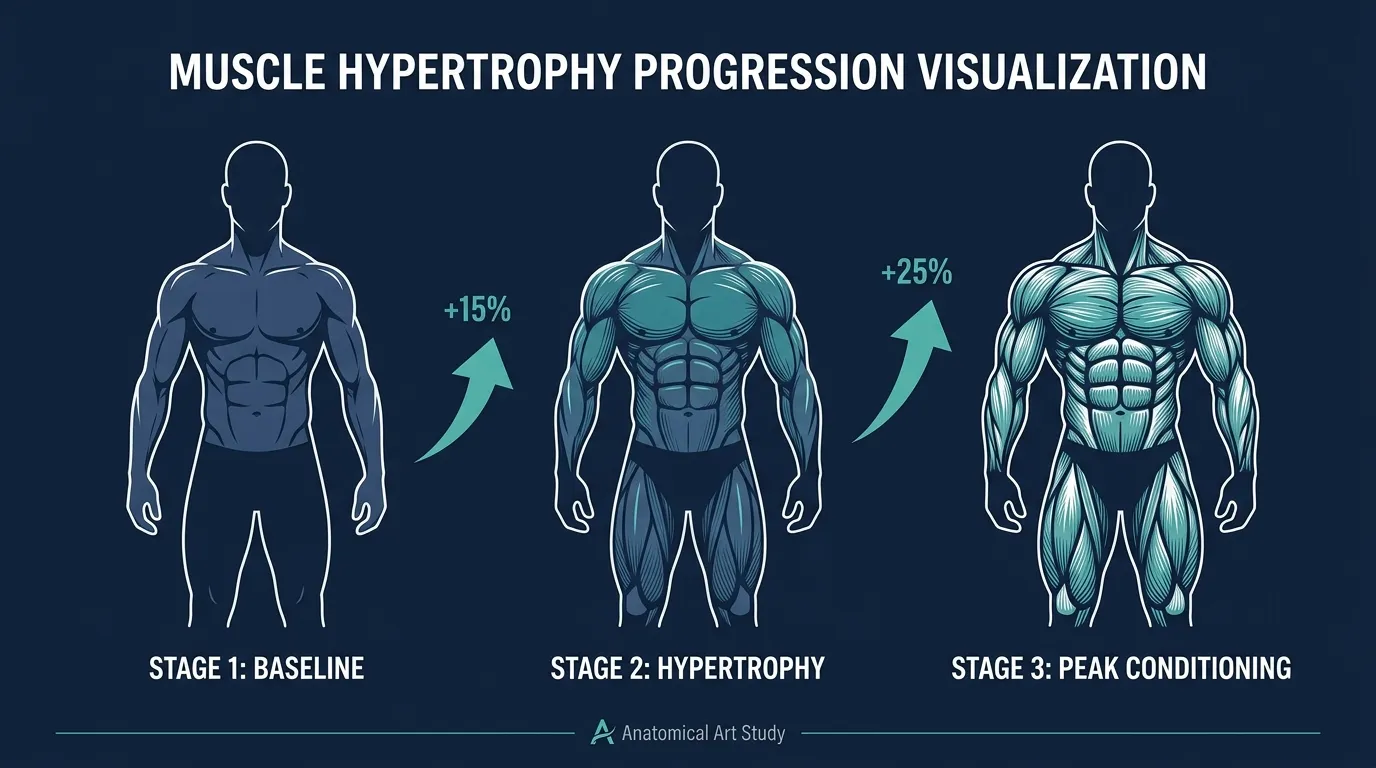
You've probably heard it a hundred times: if you want to build muscle, you need a gym membership, a barbell, and a progressive strength program. Anything less is just "toning" or "maintenance."
Here's the problem with that advice: it's wrong. Or at least, it's wildly oversimplified.
A growing body of research demonstrates that meaningful muscle hypertrophy — actual, measurable muscle growth — is achievable with bodyweight exercises, dumbbells, and resistance bands. No squat rack required. No gym commute. No waiting for the bench press to open up.
But there's a catch. Building muscle at home requires something that most people struggle with on their own: structured, progressive programming and the consistency to follow through. That's where AI-driven fitness apps enter the picture — and where the real question gets interesting.
The Science: Can You Actually Build Muscle Without a Gym?
Let's start with what the research says, because the evidence is clearer than most people realize.
Bodyweight Training Produces Real Hypertrophy
A 2017 study by Kikuchi and Nakazato, published in the Journal of Exercise Science & Fitness, compared push-up training against bench press training over eight weeks. The results were striking: push-ups produced 18.3% pectoralis major muscle growth compared to 19.4% for bench press — a statistically negligible difference. Triceps growth was similarly comparable at 9.5% vs. 10.3%.
Read that again. A bodyweight exercise — one you can do in your living room with zero equipment — produced nearly identical chest muscle growth to one of the most popular gym exercises in the world.
The key? Both groups trained with equivalent relative intensity and progressive overload. The push-up group used modified positions (kneeling, elevated feet, weighted vests) to maintain challenge as they got stronger. That's the principle that matters: it's not what you lift — it's whether the stimulus is challenging enough and progressing over time.
Low-Load Training Works — If You Push Hard Enough
The push-up study reflects a broader finding in exercise science. A 2021 re-examination of the "repetition continuum" by Schoenfeld et al., published in Sports, concluded that similar muscle hypertrophy can be achieved across a wide spectrum of loading ranges — as low as ~30% of one-rep max — as long as training is performed close to muscular failure.
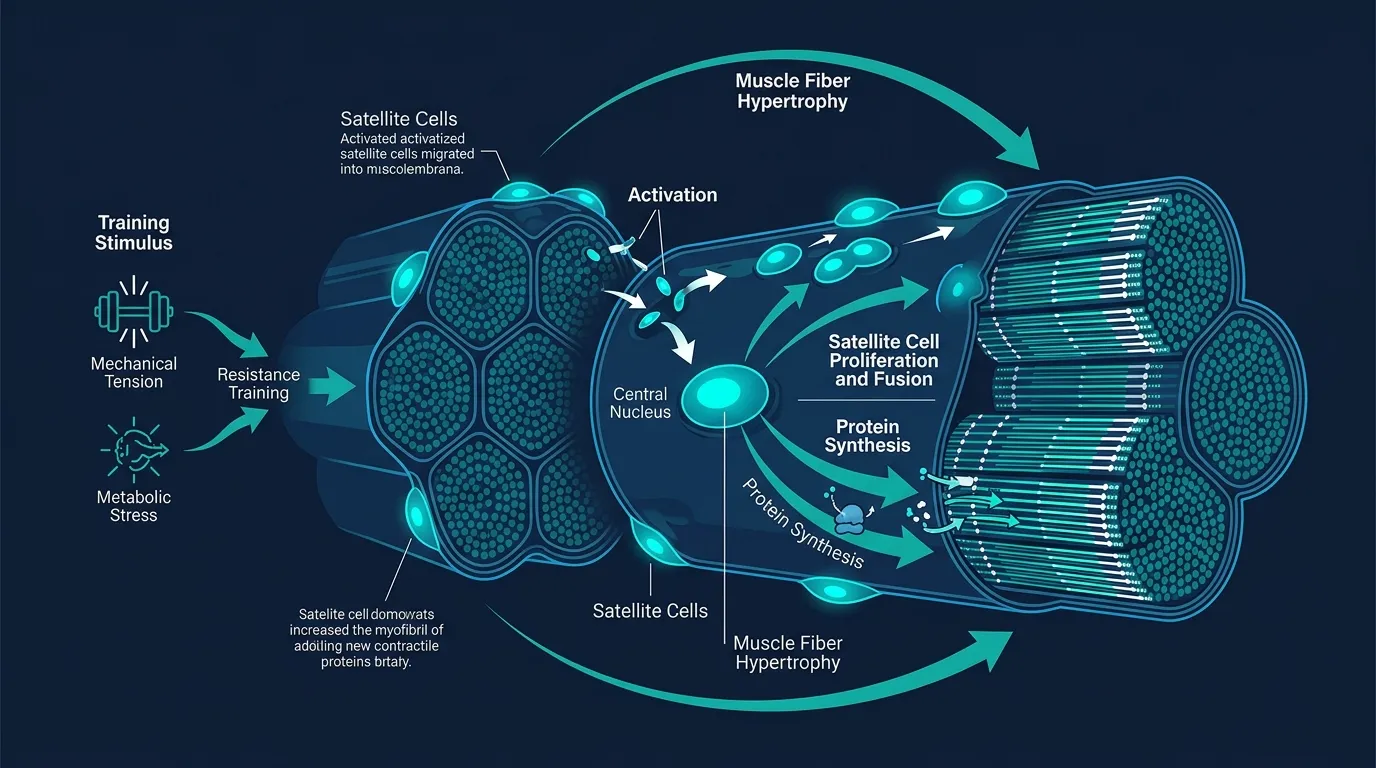
This is a paradigm shift from the old "6-12 reps for hypertrophy" dogma. What the research actually shows is that muscle growth is driven primarily by mechanical tension and metabolic stress — and you can create both with lighter loads, higher reps, and effort near failure. An umbrella review in Frontiers in Physiology (2022) confirmed that load itself is less important than the effort and volume applied.
What does this mean for home training? Dumbbells, resistance bands, and your own bodyweight are legitimate hypertrophy tools. You don't need to load up a barbell with 225 pounds to build muscle. You need to train hard, train close to failure, and systematically increase the difficulty over time. If dumbbells are your main tool at home, our comparison of the best dumbbell workout apps looks at which programs handle that progression properly.
Progressive Overload Is the Non-Negotiable
A 2024 study by Chaves et al. in the International Journal of Sports Medicine directly compared different overload progression strategies — increasing load vs. increasing repetitions — and found that both approaches produced significant and comparable gains in strength and muscle size.
This is critical for home training. When you can't easily add weight (especially with bodyweight exercises), you can still progressively overload by:
- Adding reps — going from 8 to 12 push-ups before progressing to a harder variation
- Adding sets — increasing total training volume per muscle group
- Changing leverage — moving from knee push-ups to standard to decline
- Slowing tempo — 3-second eccentric push-ups are brutally effective
- Reducing rest periods — increasing training density
The study confirms what practical experience has long suggested: as long as the overall demand on your muscles is increasing over time, they will grow. The specific method of progression matters far less than the consistency of it.
So Why Do Most People Fail to Build Muscle at Home?
If the science is clear that you can build muscle without a gym, why do so many home trainees spin their wheels and see nothing? The answer isn't about equipment. It's about three structural problems that almost everyone runs into. Structure is the first of those problems, and a push, pull and legs rotation built on dumbbells is one of the simplest ways to fix it without a rack.
Problem #1: No Progressive Programming
Most people who work out at home follow random YouTube videos or repeat the same routine week after week. They do 3 sets of 10 push-ups on Monday, 3 sets of 10 on Wednesday, and 3 sets of 10 on Friday — for months. Their muscles adapted in week three. Everything after that is maintenance, not growth.
Building muscle requires systematic, week-over-week progression. Most people know this intellectually. Almost nobody does it consistently without a structured program telling them exactly what to do next.
Problem #2: No Tracking
Progressive overload only works if you know what you did last time. "I think I did about 12 reps" is not tracking — it's guessing. Without data on your previous sessions, you can't make informed decisions about when and how to progress. You're flying blind.
A 2022 systematic review found that digital interventions that include tracking features significantly increase exercise adherence compared to untracked home programs. The act of recording your workouts creates accountability and makes progression visible.
Problem #3: Quitting Before Results Arrive
Muscle hypertrophy takes time. Research consistently shows that measurable changes in muscle thickness require 6-8 weeks of consistent training. Visible changes — the kind you notice in the mirror — typically take 8-12 weeks.
Most people quit before week three — right around the week 3 motivation dip. Not because the program doesn't work, but because the gap between effort and visible results creates a motivation desert. You're working hard and seeing nothing. That's not a discipline problem — it's a design problem. The program needs to provide something that keeps you engaged during the weeks when the mirror doesn't.
Ready to put this into practice?
Take the free FitCraft assessment and get a personalized plan based on behavioral science, not willpower.
Take the Free Assessment Free · 2 minutes · No credit card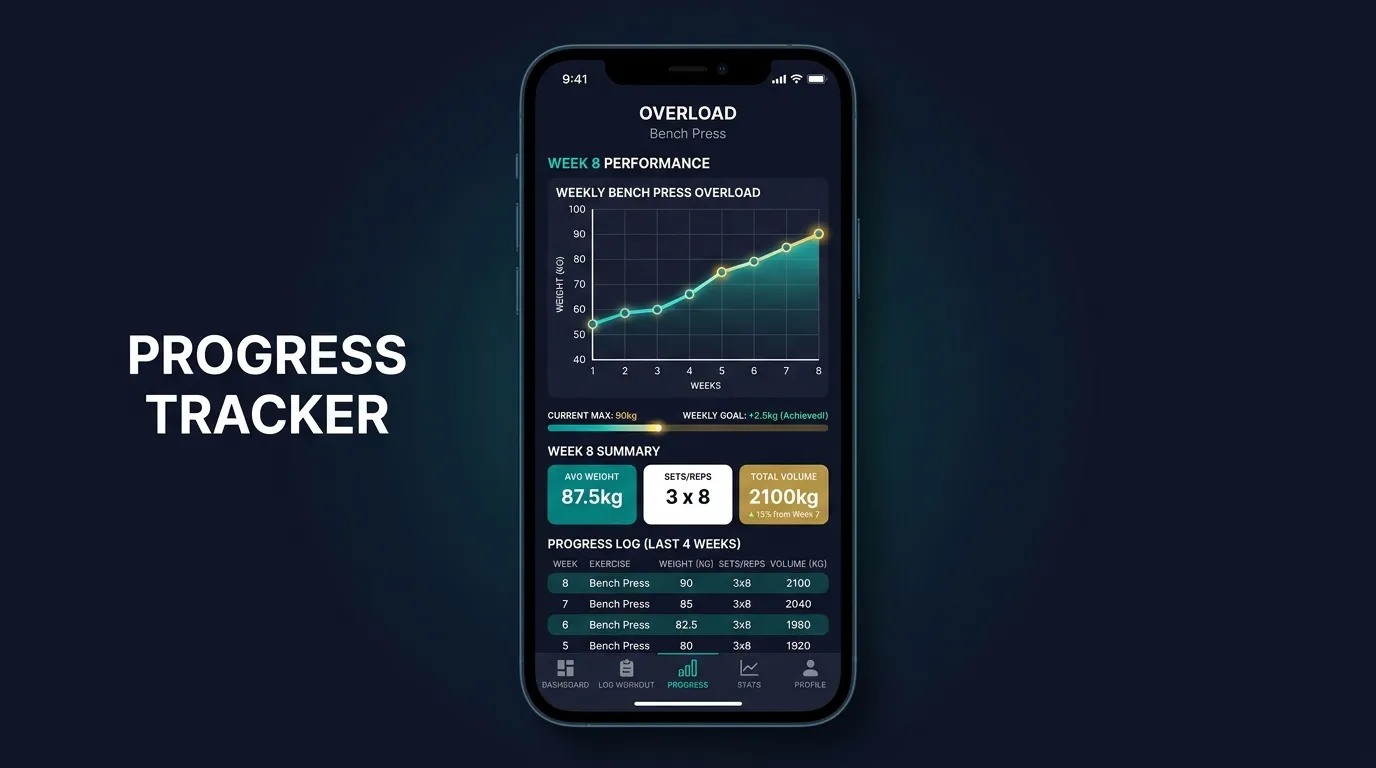
How AI-Driven Apps Solve the Structure Problem
Here's where technology becomes genuinely useful — not as a gimmick, but as a solution to the three problems that derail home muscle building.
Adaptive Programming That Progresses Automatically
An AI-driven fitness app doesn't hand you a static 12-week PDF and wish you luck. It adjusts. FitCraft's AI coach, Ty, builds workouts personalized to your goals, available equipment, and current fitness level — then adapts those workouts based on your actual progress.
If you're training with bodyweight only, Ty programs the right exercise variations and progresses you through them systematically. If you have dumbbells and resistance bands, the programming incorporates those tools to expand your training options. The progression is built in — you don't have to figure out when to move from knee push-ups to standard push-ups to decline push-ups. That decision is made for you, informed by exercise science principles.
Programs within FitCraft are designed by an Ivy League-trained exercise scientist, NSCA-certified strength coach, covering strength (dumbbells, resistance bands, bodyweight), yoga, mobility, cardio, and dynamic movement. The AI layer personalizes the delivery. The science layer ensures the programming is sound.
Interactive 3D Exercise Demos for Proper Form
Form matters enormously for hypertrophy. A push-up done with poor form shifts the load away from the target muscles, reducing the growth stimulus. At home without a trainer watching, form breakdown is one of the most common reasons people fail to see results.
FitCraft addresses this with interactive 3D exercise demos that let you pinch and zoom to examine form from any angle. Unlike flat demonstration videos, 3D models let you rotate the camera to see exactly where your elbows should be, how deep to go, and what proper spinal alignment looks like. It's the closest thing to having a coach in the room — without actually needing one.
Calendar Tracking That Makes Progress Visible
FitCraft's calendar tracking system gives you a visual record of every completed workout. Over time, this becomes a powerful motivational tool — you can see your consistency building day by day. Calendar rewards add an extra layer of reinforcement, giving you tangible recognition for showing up consistently.
This addresses the tracking problem directly. Every session is recorded. Your progress over time is visible. And you can see exactly how your effort is accumulating — even during those early weeks when the mirror hasn't caught up yet.
Why Gamification Matters for Muscle Building
Building muscle isn't a 4-week project. It's a months-long commitment that requires consistent training 3-5 times per week. And this is where most people — even motivated ones — fall apart.
A 2024 systematic review and meta-analysis by Guo et al., published in eClinicalMedicine, examined randomized controlled trials on digital health apps with gamification. The finding: apps with gamification elements significantly improved physical activity levels compared to non-gamified alternatives. Gamification doesn't just make exercise more fun — it structurally changes the relationship between effort and reward.
XP, Levels, and the Psychology of Progress
FitCraft uses XP (experience points) and a leveling system to create a sense of progression that exists independently of the mirror. You earn XP for completing workouts. You level up as you accumulate XP. This creates a feedback loop where every session feels productive — even when your muscles haven't visibly changed yet.
This isn't trivial. The motivation desert between week one and week eight — when you're training hard but can't see results yet — is where most people quit. Gamification fills that gap with a parallel progression system that makes every workout feel like it counted.
Collectible Cards and Intrinsic Motivation
FitCraft's collectible card system adds a layer of motivation that taps into something deeper than vanity metrics. As you complete workouts and hit milestones, you earn collectible cards — a tangible representation of your effort and achievements. It's the same psychology that makes people complete collections in games: the desire for completeness and the satisfaction of earning something through effort.
A 2023 review in the International Journal of Environmental Research and Public Health found that gamification elements like rewards and achievement systems positively ensure continuity of active participation in exercise programs. The effect is particularly strong in the first 8-12 weeks — exactly the window where muscle-building consistency matters most.
Your AI Coach Provides the Encouragement a Gym Buddy Would
One underappreciated advantage of gym training is the social element: a workout partner who pushes you to finish that last rep, who notices when you skip a day, who celebrates your progress. Home training is often lonely.
FitCraft's AI coach Ty fills this role with personalized, adaptive encouragement. Ty recognizes when you're on a streak and reinforces it. Ty acknowledges when you push through a tough workout. This isn't generic "great job!" feedback — it's contextual encouragement that responds to your actual behavior patterns.
A Realistic Muscle-Building Plan with Just an App
So what does this actually look like in practice? Here's a realistic framework for building muscle with a fitness app, based on the research we've covered:
Weeks 1-4: Foundation
- Frequency: 3 sessions per week (full body or upper/lower split)
- Equipment: Bodyweight + dumbbells or resistance bands (whatever you have)
- Focus: Learning proper form via 3D demos, establishing the workout habit
- Progression: Add 1-2 reps per exercise each week
- Gamification bridge: XP gains and early card unlocks keep you engaged before physical changes appear
Weeks 5-8: Building
- Frequency: 3-4 sessions per week
- Focus: Progressive overload — adding reps, sets, or moving to harder variations
- Progression: First measurable changes in muscle thickness (based on Kikuchi study timelines)
- Key milestone: Your consistency streak on the calendar becomes its own motivator
Weeks 9-12: Visible Results
- Frequency: 4 sessions per week
- Focus: Continued progressive overload with adaptive adjustments from AI coaching
- Progression: Visible muscle definition changes — the mirror finally catches up to your effort
- By this point: The habit is established, the gamification systems are reinforcing consistency, and the results are compounding
As Mike, 23, put it after four months with FitCraft: "The streak system got me hooked. I didn't want to break my chain. And then one day I looked in the mirror and realized I was visibly stronger. I didn't even notice it happening."
What This Means for You
The science is unambiguous: you do not need a gym to build muscle. Bodyweight exercises, dumbbells, and resistance bands — when programmed with progressive overload and performed with sufficient effort — produce hypertrophy that rivals traditional gym training.
But knowing that isn't enough. The real bottleneck has never been access to equipment. It's the structure, the tracking, and the consistency to keep showing up week after week while your body slowly transforms.
That's the problem AI-driven fitness apps actually solve. Not by replacing the work — you still have to push through those last difficult reps — but by handling the programming, the progression, and the motivation architecture that makes consistency feel natural instead of forced.
You've probably tried working out at home before. Maybe you followed a YouTube program for a few weeks. Maybe you did push-ups every morning until you didn't. That's not a character flaw. It's what happens when there's no structure, no progression system, and no feedback loop telling you that your effort is actually going somewhere.
The research says you can build muscle at home. The question is whether you have the right system to actually follow through.
If a pair of dumbbells is what you have, FitCraft's dumbbell workout app page shows how the programming progresses from there.
Frequently Asked Questions
Can you really build muscle without going to a gym?
Yes. Research published in the Journal of Exercise Science & Fitness found that bodyweight push-ups produced muscle hypertrophy comparable to bench pressing — 18.3% pectoralis growth with push-ups vs. 19.4% with bench press over 8 weeks (Kikuchi & Nakazato, 2017). As long as you train close to failure with progressive overload, your muscles respond to the stimulus regardless of whether it comes from a barbell, dumbbell, resistance band, or your own bodyweight.
How do fitness apps help with muscle building?
Fitness apps help with muscle building by providing structured programming, progressive overload tracking, and adaptive workout adjustments — the three elements most people fail to manage on their own. AI-driven apps like FitCraft go further by automatically adjusting your workouts based on your progress, ensuring you're consistently challenged without overtraining. Apps also improve adherence: a 2024 systematic review found that digital interventions with gamification significantly increase physical activity levels compared to non-gamified approaches.
Do you need heavy weights to build muscle?
No. A 2021 re-examination of the repetition continuum published in Sports found that similar muscle hypertrophy can be achieved across a wide spectrum of loading ranges — as low as 30% of your one-rep max — as long as sets are performed close to muscular failure (Schoenfeld et al., 2021). This means bodyweight exercises, light dumbbells, and resistance bands can all produce meaningful muscle growth when programmed correctly.
What equipment do you need to build muscle at home?
You can start building muscle with zero equipment using bodyweight exercises like push-ups, squats, lunges, and planks. Adding a set of adjustable dumbbells and resistance bands expands your options significantly. FitCraft adapts workouts to whatever equipment you have available — bodyweight only, dumbbells, resistance bands, or a combination — so you don't need a full gym setup to see results.
How long does it take to see muscle growth from home workouts?
Most beginners can expect to see measurable changes in muscle thickness within 6-8 weeks of consistent resistance training, based on research timelines. Visible changes in muscle definition often take 8-12 weeks. The key factor isn't location — home vs. gym — but consistency and progressive overload. Apps that use gamification and adaptive programming can significantly improve consistency, which is the most common bottleneck for muscle growth.