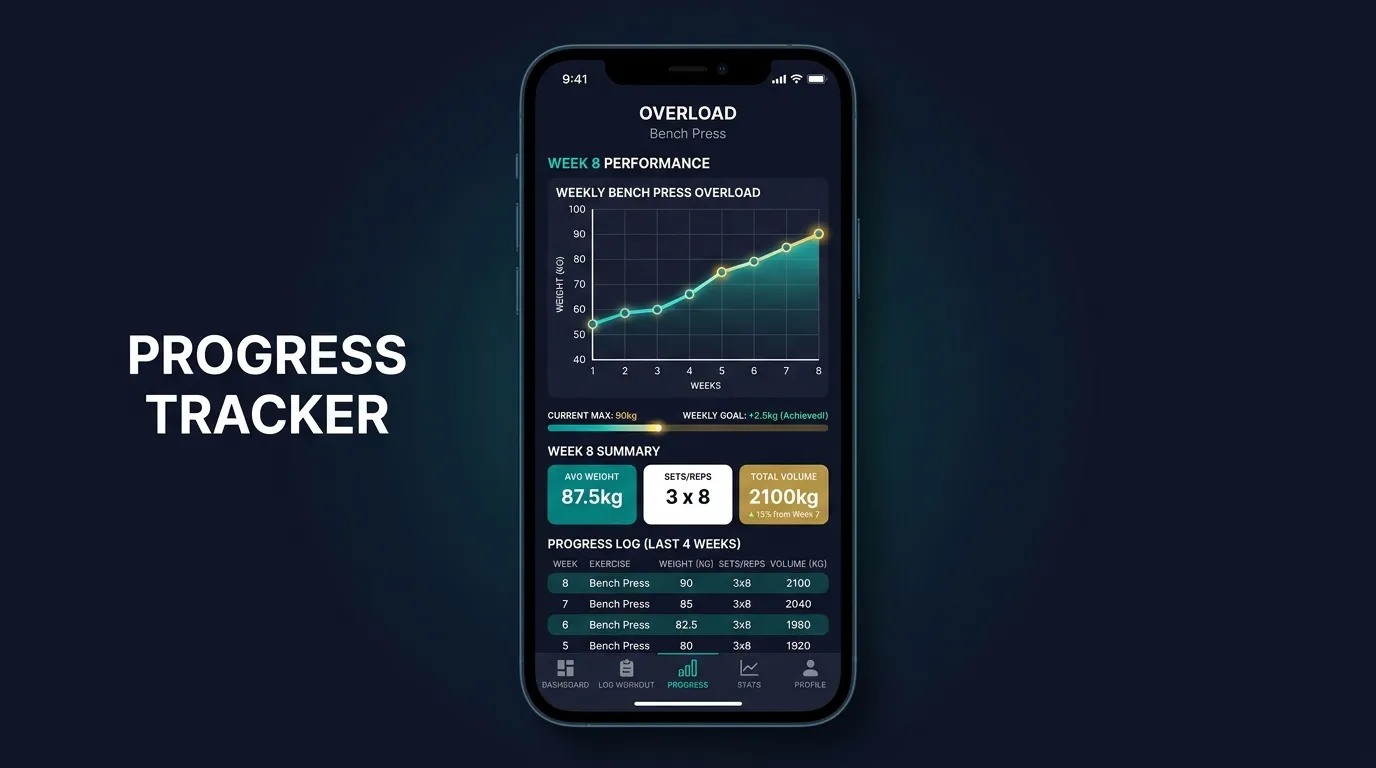
If you only learn one concept in fitness, make it this one. Progressive overload is the reason some people transform their bodies and others spin their wheels for years doing the same workouts with nothing to show for it. It's also the principle that makes home workouts actually produce results.
The good news: it's not complicated. The bad news: almost nobody does it right — especially beginners. Not because they're lazy, but because nobody explained it to them in a way that actually makes sense.
Let's fix that.
What Is Progressive Overload?
Progressive overload is a simple idea: to get stronger, you need to gradually increase the demands you place on your body.
Your muscles don't grow because you exercise. They grow because you give them a reason to. When you lift a weight that challenges your muscles, tiny micro-tears form in the muscle fibers. Your body repairs those fibers and makes them slightly stronger and larger — so they can handle that stress next time. This is called muscle protein synthesis, and it's the biological engine behind every visible result you've ever seen in a gym.
But here's the catch: your body adapts. That weight that challenged you in week one becomes easy by week four. If you keep lifting the same weight for the same reps, your body has no reason to keep adapting. You've reached equilibrium. Growth stops.
Progressive overload breaks that equilibrium by systematically increasing the stimulus. A little more weight. A few more reps. An extra set. Your body never gets comfortable — so it never stops adapting.
This isn't a theory. It's one of the most well-established principles in exercise science. A foundational study by Kraemer and Ratamess (2004), published in Medicine & Science in Sports & Exercise, confirmed that progressive overload is the fundamental principle underlying resistance training adaptations — including increases in muscle size, strength, and endurance.
Why It Matters More Than Anything Else
The fitness industry loves to overcomplicate things. Periodization schemes. Muscle confusion. Drop sets, supersets, giant sets. There's an endless buffet of advanced techniques — and they're all secondary to this one principle.
Without progressive overload, nothing else matters. The fanciest workout split in the world won't build muscle if you're lifting the same weights month after month. The most Instagram-worthy exercise selection won't produce results if there's no systematic progression.
A 2017 meta-analysis by Schoenfeld, Ogborn and Krieger in the Journal of Sports Sciences examined the dose-response relationship between weekly resistance training volume and muscle hypertrophy across 34 treatment groups from 15 studies. The clear conclusion: training volume is a primary driver of muscle growth. Each additional weekly set per muscle was associated with roughly 0.37% more growth, and groups training at the higher of two volumes gained significantly more than groups training at the lower.
Here's what that means for you as a beginner: you don't need the perfect program. You need a progressive one. A simple program with built-in progression will outperform a complex program without it, every single time.
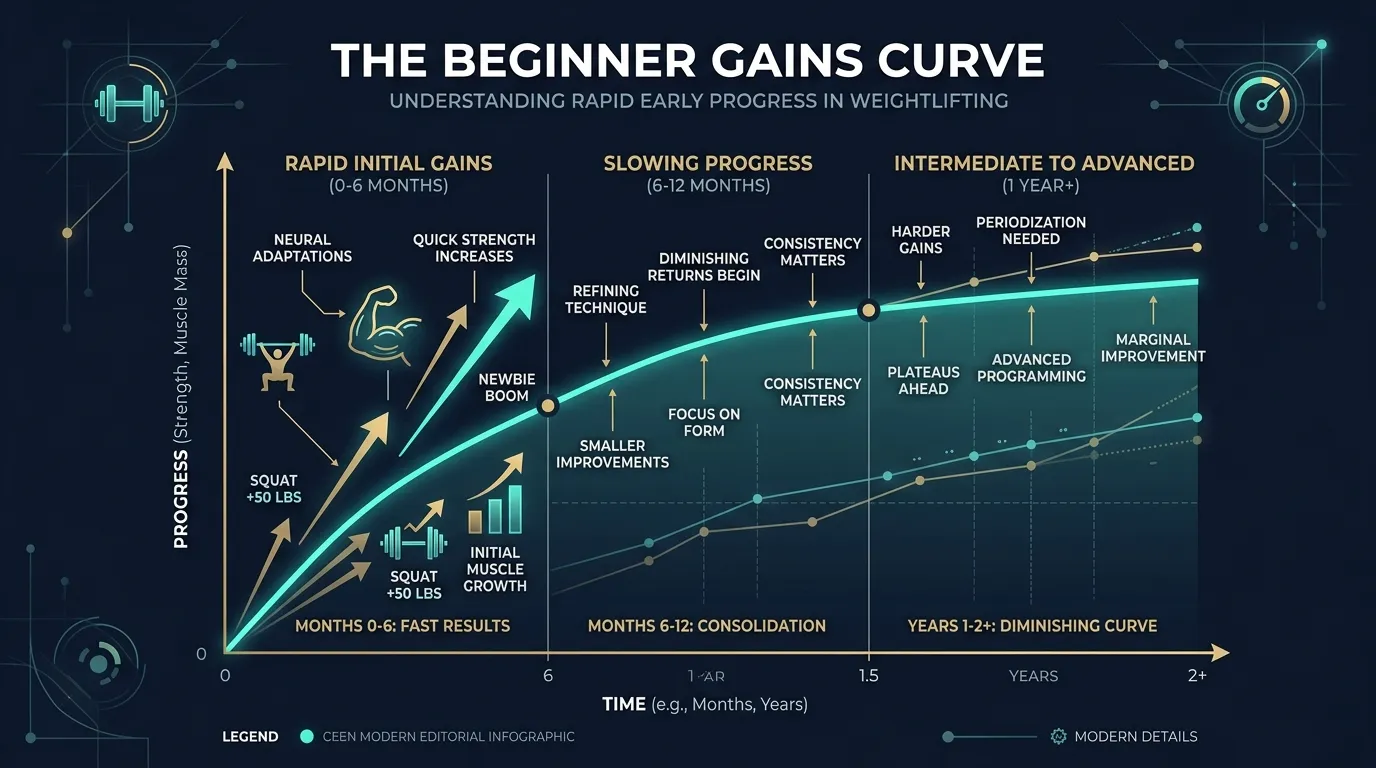
The 4 Ways to Progress
When most people hear "progressive overload," they think it means adding more weight to the bar every week. That's one way — but it's not the only way. And for many beginners, it's not even the best way to start.
There are four primary methods of progression. Think of them as four different roads to the same destination:
1. More Weight (Load Progression)
The most obvious method. If you squatted 95 pounds last week, you squat 100 this week. Simple and effective.
When to use it: This is your primary progression method for compound movements (squats, deadlifts, bench press, rows, overhead press). As a beginner, you can add weight frequently — sometimes even session to session.
How much to add: For upper body exercises, add 2.5-5 lbs per increase. For lower body, add 5-10 lbs. These increments might sound small. Over six months, that's 60-120 lbs added to your squat. Small jumps compound into massive progress. If you train at home with dumbbells, the same increments apply, and our guide to the best dumbbell exercises for beginners covers which movements to build around.
2. More Reps (Volume Progression)
Same weight, but you do more repetitions. If you did 3 sets of 8 reps at 100 lbs last week, you do 3 sets of 10 reps at 100 lbs this week.
When to use it: This is ideal when you're not quite ready to jump to a heavier weight. It's also the primary progression method for bodyweight exercises where adding weight isn't practical. Build up your reps, then increase the weight and reset to the lower rep range.
A practical example: Your program calls for 3 sets of 8-12 reps on bench press. You start at 8 reps with 135 lbs. Over the next few weeks, you work up to 12 reps. Once you can do 3 sets of 12, you increase to 140 lbs and drop back to 8 reps. Repeat the cycle. Our guide on how many reps you should do covers why 8-12 is the general-purpose range and when other ranges fit better.
3. More Sets (Volume Progression)
Same weight, same reps, but you add an extra set. If you did 3 sets of squats last week, you do 4 sets this week.
When to use it: This works well when you've plateaued on reps and aren't ready to increase weight. It's also useful for isolation exercises (bicep curls, lateral raises) where small weight jumps aren't always available.
A word of caution: Don't go overboard. A 2022 systematic review by Baz-Valle and colleagues in the Journal of Human Kinetics puts the practical range at 12 to 20 sets per muscle group per week. Above that it found no further benefit for the quadriceps or biceps, so extra sets mostly buy you recovery cost.
4. Less Rest (Density Progression)
Same weight, same reps, same sets — but you rest less between sets. If you rested 90 seconds between sets last week, you rest 75 seconds this week.
When to use it: This is the least common method and typically the last lever you'd pull. It's useful for improving muscular endurance and work capacity. It can also be effective when other progression methods have stalled temporarily.
Be careful: Reducing rest too aggressively can compromise your performance on subsequent sets, actually reducing the total work you do. Cut rest time gradually — 10-15 seconds at a time.
How to Know When It's Time to Progress
This is where most beginners get stuck. You know you need to progress, but how do you know when?
Here's a simple rule that works for most people: when you can complete all prescribed sets and reps with good form for two consecutive sessions, it's time to progress.
Let's say your program calls for 3 sets of 10 reps on the bench press. On Monday, you do 10, 10, and 9 reps at 135 lbs. Not quite there — you missed the last rep on the last set. On Wednesday, you do 10, 10, and 10. You hit it. On Friday, you do 10, 10, and 10 again. Two sessions in a row with all prescribed reps completed. Time to add weight.
This "two-for-two" rule gives you enough data to confirm the weight is genuinely manageable — not just a one-off good day. It also prevents the common mistake of increasing weight after a single good session, only to get crushed the next time.
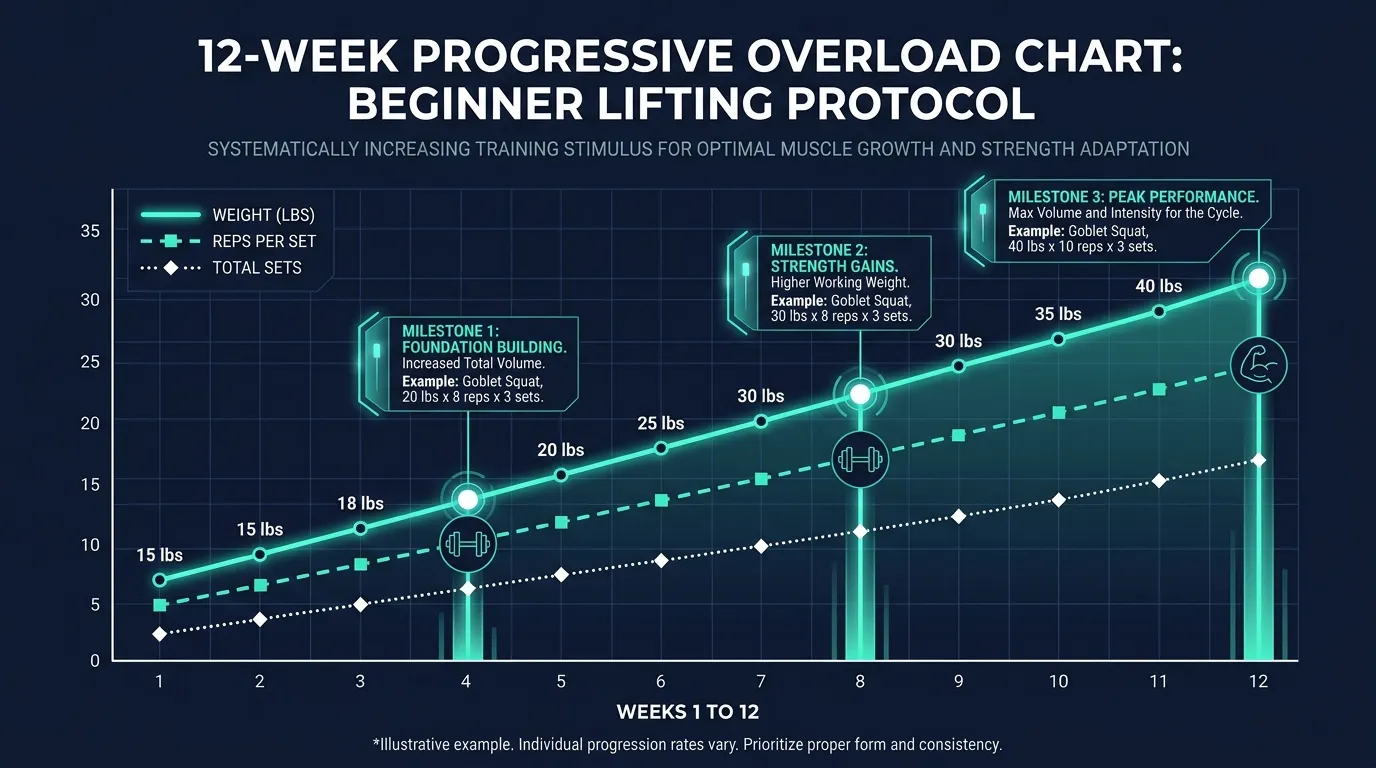
The 5 Biggest Progressive Overload Mistakes
Understanding the principle is one thing. Applying it without shooting yourself in the foot is another. Here are the mistakes that trip up almost every beginner — and how to avoid them:
Mistake #1: Progressing Too Fast
You're feeling strong. You've been adding 10 pounds every week to your squat. Everything is going great — until your knee starts aching and your form falls apart.
Progressing too fast is the most dangerous mistake because it leads to injury. Your muscles may adapt quickly, but your tendons, ligaments, and joints adapt much more slowly. A 2020 review in the British Journal of Sports Medicine found that rapid increases in training load are a primary risk factor for overuse injuries in both recreational and competitive athletes (Gabbett, 2020).
The fix: Patience. Stick to small increments. 2.5-5 lbs for upper body, 5-10 lbs for lower body. If you're unsure, progress with reps first, then add weight once the rep ceiling is solidly met.
Mistake #2: Progressing Too Slowly
The opposite problem — and equally common. You've been using the same 20-pound dumbbells for six months because they "feel right." You're comfortable. Your form is perfect. And you're getting absolutely zero results.
Comfort is the enemy of progress. If your workouts feel easy, they've stopped being effective. Your body has adapted, and without a new stimulus, it has no reason to change.
The fix: Track your workouts. If you've been at the same weight and reps for more than 2-3 weeks with good form, it's time to step up. Even one more rep per set is progress.
Mistake #3: Not Tracking Workouts
This is the silent killer. You can't progressively overload if you don't know what you did last time. And "I think I used the 30-pound dumbbells" isn't tracking — it's guessing.
Without records, you have no idea whether you're actually progressing, plateauing, or regressing. You might feel like you're working hard, but feelings are unreliable. Data doesn't lie.
The fix: Log every workout. Every exercise, every weight, every set, every rep. Use an app, a notebook, a spreadsheet — anything. The format matters less than the habit.
Mistake #4: Sacrificing Form for Heavier Weight
Your program says add weight, so you add weight. Your bench press goes from 135 lbs with solid form to 145 lbs with your back arched like a bridge and the bar bouncing off your chest. Technically, the weight went up. Practically, you're doing a different (and less effective) exercise.
Bad form reduces the load on the target muscle (because other muscles compensate) and increases injury risk. It's the illusion of progress.
The fix: Film yourself occasionally. Compare your form at the heavier weight to your form at the lighter weight. If it looks significantly different — more body English, shorter range of motion, less control — the weight is too heavy. Drop back down and build up properly.
Mistake #5: Trying to Progress on Everything at Once
You try to add weight to every single exercise in the same week. Your body can't recover from that much new stimulus at once, so everything stalls. Or worse, something breaks.
The fix: Prioritize progression on compound movements first (squat, deadlift, bench, row, overhead press). These give you the most bang for your buck. Let isolation exercises (curls, lateral raises, tricep extensions) progress more slowly and organically.
Ready to put this into practice?
Take the free FitCraft assessment and get a personalized plan based on behavioral science, not willpower.
Take the Free Assessment Free · 2 minutes · No credit cardHow FitCraft Handles Progressive Overload Automatically
Here's the reality: progressive overload is simple in theory and hard in practice. Not because the concept is complex, but because it requires consistent tracking, intelligent decision-making about when and how to progress — which is exactly what AI-driven workout adaptation was built to solve, and the discipline to make small adjustments every session.
Most people — especially beginners — don't want to become amateur exercise programmers. They want to show up, work hard, and know that what they're doing is actually leading somewhere.
That's exactly what FitCraft's AI coach Ty was built to handle. Here's how it works:
Ty tracks everything automatically. Every rep, every set, every weight. No manual logging required. After each session, Ty knows exactly what you did and how it compared to your previous performance.
Ty decides when to progress — and how. Based on your performance data, Ty determines whether to increase weight, add reps, add sets, or keep things steady for another session. The decisions are informed by exercise science principles from programs designed by an Ivy League-trained exercise scientist, NSCA-certified strength coach — not generic algorithms.
Ty keeps you in the sweet spot. Too much progression and you risk injury or burnout. Too little and you plateau. Ty calibrates your progression rate based on your individual response — not a one-size-fits-all formula.
As Mike, 23, put it: "I spent two years going to the gym and looking the same. Three months with FitCraft and I can actually see the difference. Turns out I wasn't progressing — I was just exercising."
The Simple Takeaway
Progressive overload isn't a hack. It isn't advanced. It's the fundamental mechanism behind every fitness result you've ever admired. Without it, you're just moving your body around. With it, you're systematically building a stronger, more capable version of yourself.
Here's all you need to remember:
- Your body adapts to stress. Once it adapts, growth stops.
- To keep growing, gradually increase the stress. More weight, more reps, more sets, or less rest.
- Track everything. You can't progress what you don't measure. (Fitness apps solve this with automatic logging.)
- Progress slowly and consistently. Small jumps over months beat big jumps over weeks.
- Prioritize form. A rep only counts if you did it right.
That's it. The most important principle in fitness, in five bullet points. Everything else is details.
The app can carry that math for you, which is the idea behind our beginner fitness app page. Our comparison of the best workout apps for beginners ranks the field on whether they handle it for you.
Frequently Asked Questions
What is progressive overload in simple terms?
Progressive overload means gradually increasing the demands you place on your body over time. This can mean adding more weight, doing more reps, adding more sets, or reducing rest time between sets. It's the fundamental principle behind all muscle growth and strength gains — your body adapts to stress, so you need to progressively increase that stress to keep seeing results.
How often should beginners increase weight?
Most beginners can increase weight every 1-2 weeks on compound movements like squats, deadlifts, and bench press. A good rule of thumb: when you can complete all prescribed reps with good form for two consecutive sessions, it's time to add weight. For upper body exercises, increase by 2.5-5 lbs. For lower body, increase by 5-10 lbs.
Can you progressive overload without adding weight?
Absolutely. Progressive overload doesn't require adding weight. You can also progress by doing more reps with the same weight, adding more sets, reducing rest time between sets, increasing range of motion, or slowing down the tempo. These methods are especially useful for bodyweight exercises or when you've hit a weight plateau.
What are common progressive overload mistakes?
The most common mistakes are: progressing too fast (adding weight before your form is solid, risking injury), progressing too slowly (staying at the same weight for months because it feels comfortable), not tracking workouts (making it impossible to know if you're actually progressing), and sacrificing form for heavier weight (which reduces muscle activation and increases injury risk).
Does FitCraft handle progressive overload automatically?
Yes. FitCraft's AI coach Ty tracks your performance across every session and automatically adjusts your programming to apply progressive overload at the right pace. It increases weight, volume, or intensity based on your actual performance data — so you don't have to figure out when or how to progress on your own.