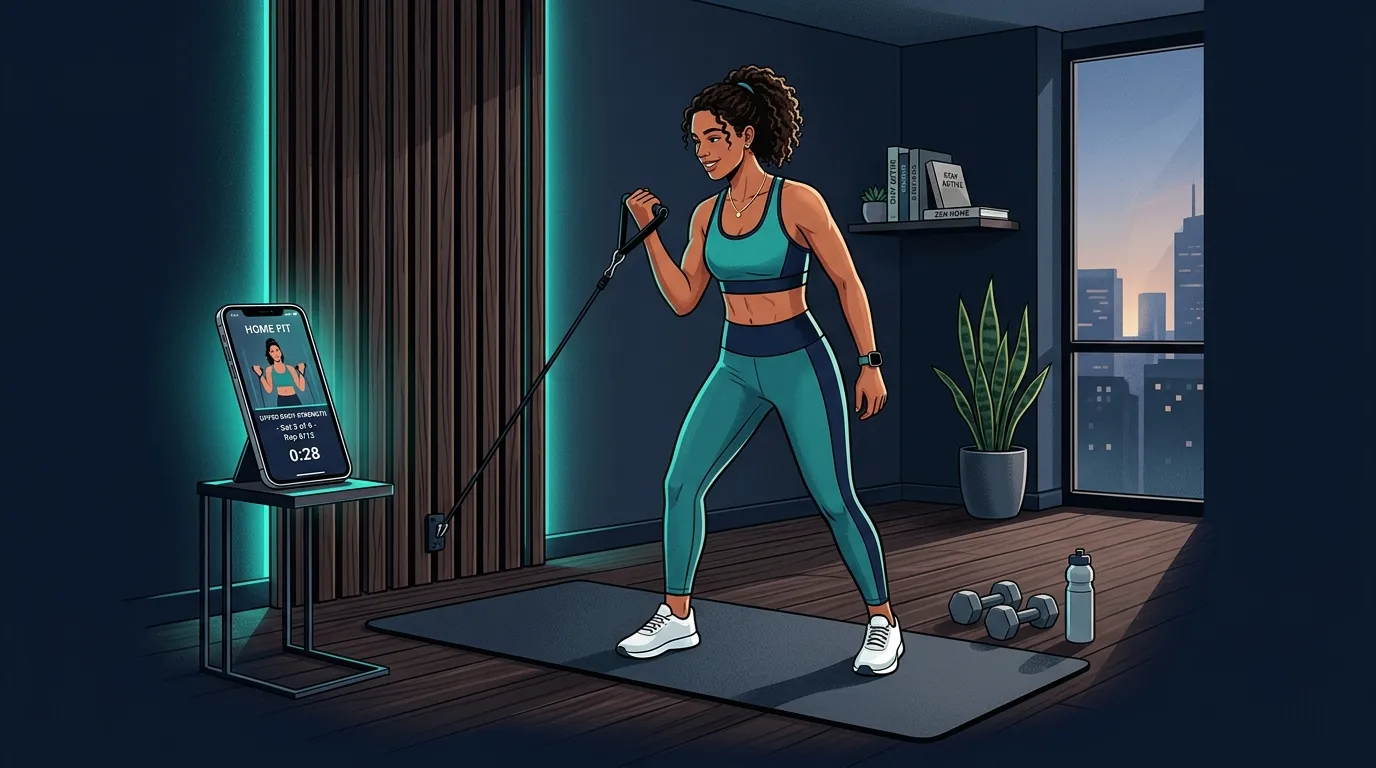
You've probably heard two competing narratives about home workouts. The first: "You can build an amazing body from your living room with zero equipment!" The second: "Home workouts are a waste of time — you need a gym for real results."
Both are wrong. Or rather, both are half-right — and the difference between which half you get depends entirely on how you train.
The research is clear: home workouts can match gym results for most fitness goals. But only if you apply the same principles that make gym training effective — particularly progressive overload, proper programming, and consistency. Without those, you'll do random YouTube workouts for three weeks, see nothing change, and conclude that home training "doesn't work."
It does work. But not the way most people do it.
The Science: Bodyweight Training vs. Gym Training
Let's start with what the research actually says, because this question has been studied directly.
A 2017 study published in Physiology & Behavior compared bodyweight training to traditional weight training over an 8-week period. Both groups followed structured programs and trained to similar levels of effort. The result: both groups showed comparable gains in muscle thickness and strength (Kikuchi & Nakazato, 2017). The bodyweight group wasn't at a disadvantage — as long as the training stimulus was sufficient and progressive.
A 2020 systematic review in the International Journal of Environmental Research and Public Health examined multiple studies on home-based resistance training during the COVID-19 lockdowns. The conclusion: structured home-based exercise programs maintained or improved muscular fitness in previously trained individuals, even without access to gym equipment (Gentil et al., 2020). The key factor wasn't the equipment — it was whether the program was structured and progressive.
The takeaway: your muscles don't know whether they're in a gym or your garage. They respond to progressive mechanical tension. Period.
Progressive Overload at Home: How to Keep Progressing Without a Weight Rack
Progressive overload — gradually increasing the demands on your muscles — is the single most important principle in fitness. It's also the reason most home workouts fail. People do the same 20 push-ups and 30 bodyweight squats every day, wonder why nothing changes, and blame the lack of a gym.
The problem isn't the location. It's the lack of progression. Here are seven ways to progressively overload at home:
1. Increase Reps
The simplest method. If you did 3 sets of 10 push-ups last week, do 3 sets of 12 this week. This works until you're doing very high rep ranges (20+), at which point you're training endurance more than strength or hypertrophy.
2. Progress to Harder Variations
This is the bodyweight equivalent of adding weight to the bar. For push-ups alone, the progression chain might look like: wall push-ups, knee push-ups, standard push-ups, diamond push-ups, decline push-ups, archer push-ups, one-arm push-up progressions. Each variation increases the load on the target muscles without adding a single piece of equipment.
For squats: bodyweight squats, pause squats, Bulgarian split squats, pistol squat progressions, shrimp squats. For rows: inverted rows (using a table edge), single-arm rows with a band, archer rows. Every movement pattern has a progression chain that can keep you challenged for months or years.
3. Slow Down the Tempo
Instead of pumping out reps as fast as possible, slow the lowering (eccentric) phase to 3-5 seconds. A push-up with a 4-second lowering phase is dramatically harder than a push-up at normal speed, and a 2015 meta-analysis by Schoenfeld, Ogborn and Krieger in Sports Medicine found that repetition durations anywhere from about 0.5 to 8 seconds produce similar muscle growth. Slowing down costs you nothing while making each rep harder, which is exactly what you need when you cannot add weight. The same review found results get worse past roughly 10 seconds per rep, so there is no reason to go slower than that.
4. Reduce Rest Between Sets
Cutting your rest from 90 seconds to 60 seconds increases the metabolic stress on your muscles — another driver of hypertrophy. This works as a progression tool, but don't overdo it. Too-short rest periods compromise performance on subsequent sets.
5. Add Pauses
Pause at the bottom of a push-up for 2-3 seconds. Hold the bottom of a squat for 3 seconds before standing up. Pauses eliminate the stretch reflex (the "bounce" at the bottom of a movement) and force your muscles to generate force from a dead stop. It's a simple tweak that makes any exercise significantly more demanding.
6. Increase Volume (Sets)
If you've been doing 3 sets per exercise, add a 4th set. More total volume means more mechanical tension, which means more growth stimulus. A 2017 meta-analysis by Schoenfeld et al. found a dose-response relationship between training volume and hypertrophy — more sets generally produced more growth, up to a point of diminishing returns around 10-20 sets per muscle group per week.
7. Add External Resistance
A resistance band, a backpack full of books, a gallon jug of water — even small amounts of external resistance can extend the life of bodyweight exercises. Band-resisted push-ups, for example, add resistance at the top of the movement where bodyweight alone provides the least challenge.
The Minimum Equipment That Makes a Real Difference
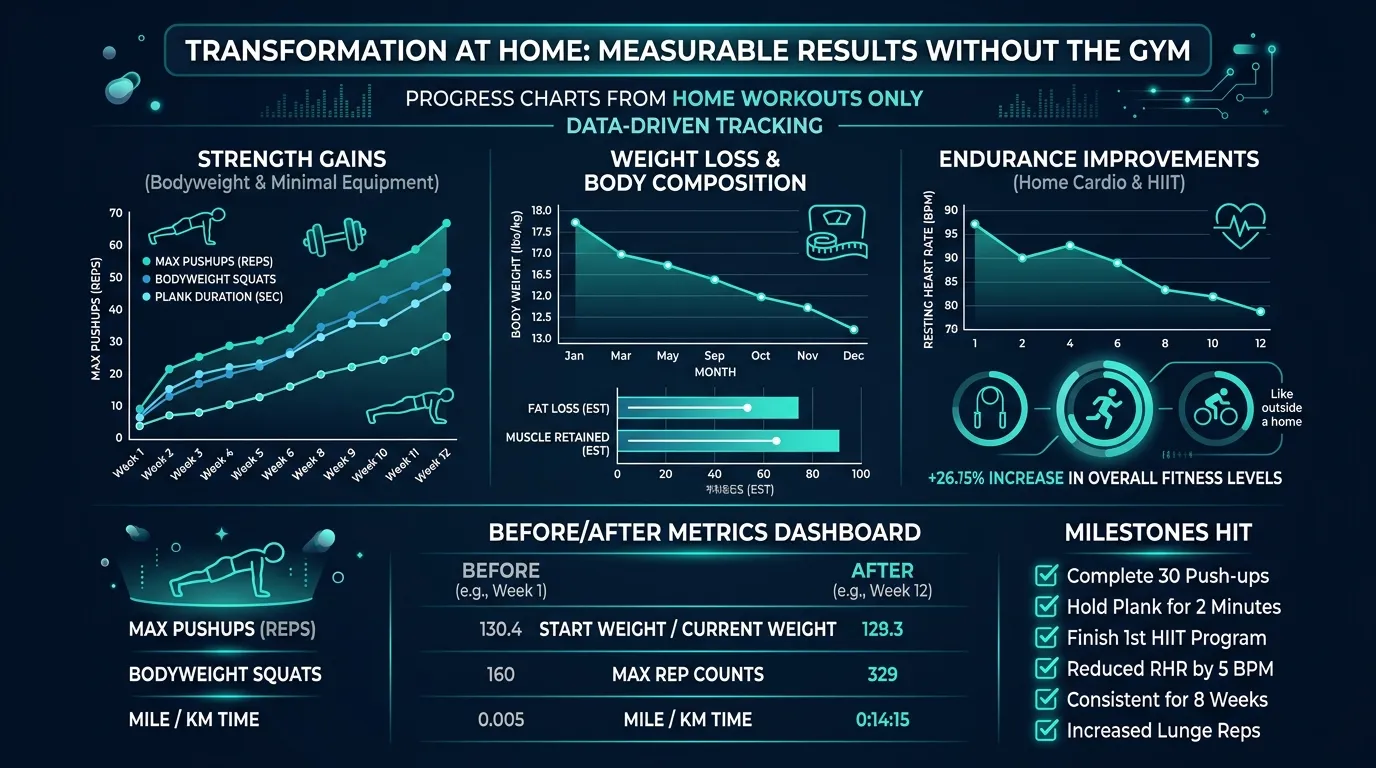
You can get legitimate results with zero equipment. But a small investment in basic gear dramatically expands your options and extends the timeline before you hit a progression ceiling.
Here's what we recommend, in order of priority:
Resistance Bands ($15-30)
A set of loop bands or tube bands is the single highest-value purchase for home training. Bands add variable resistance to any movement, work for both upper and lower body, are infinitely portable, and create loading options that bodyweight alone can't match. Band-assisted pull-ups, band-resisted push-ups, banded squats, lateral band walks, face pulls — the exercise library with bands is enormous.
Pull-Up Bar ($20-40)
A doorframe pull-up bar opens up the single best back exercise available — the pull-up — plus chin-ups, hanging leg raises, and inverted rows. The back is notoriously difficult to train with bodyweight alone, and a pull-up bar solves that problem completely. Most door-mounted bars require no installation and can be set up in seconds.
Adjustable Dumbbells ($100-300)
If you're willing to invest a bit more, adjustable dumbbells are the most versatile single piece of home equipment. They replace an entire rack of fixed dumbbells, work for every muscle group, and allow precise load progression — the exact same method you'd use in a gym. Options like Bowflex SelectTech or PowerBlock adjust from 5 to 50+ pounds per dumbbell.
With these three items — total investment of $135-370 — you have essentially everything you need for a comprehensive training program that can produce results for years.
Programming Principles for Home Training
Having the right equipment (or no equipment) is only half the equation. The other half is programming — and this is where most home exercisers go wrong.
Frequency: Train Each Muscle Group 2x Per Week
A 2016 meta-analysis by Schoenfeld, Ogborn and Krieger in Sports Medicine found that training each muscle group twice per week produced significantly more muscle growth than training it once per week. For home training, this typically means either:
- 3-day full-body program: Monday, Wednesday, Friday — each session hits all major muscle groups. Best for beginners and those with limited time.
- 4-day upper/lower split: Upper body Monday and Thursday, lower body Tuesday and Friday. Allows more volume per session while maintaining the twice-per-week frequency.
Volume: 10-20 Sets Per Muscle Group Per Week
Research consistently shows this range is the sweet spot for muscle growth. For beginners, start at the lower end (10-12 sets per muscle group per week) and build up over months. More is not always better — exceeding your recovery capacity leads to diminishing returns and increased injury risk.
Intensity: Train Close to Failure
This is especially important for bodyweight training, where loads are lighter relative to your capacity. A 2021 systematic review in the Journal of Strength and Conditioning Research found that training within 1-3 reps of muscular failure was critical for maximizing muscle growth with lower loads. In practical terms: if you can do 15 push-ups, stopping at 8 isn't enough stimulus. You need to push to 12-14 — close enough to failure that the last few reps are genuinely hard.
Progression: Have a Plan
This is the non-negotiable. You need a systematic progression plan — not "I'll add reps when I feel like it." Decide in advance what your progression triggers are (e.g., when you hit 15 reps on all sets, move to a harder variation) and follow them religiously.
Ready to put this into practice?
Take the free FitCraft assessment and get a personalized plan based on behavioral science, not willpower.
Take the Free Assessment Free · 2 minutes · No credit card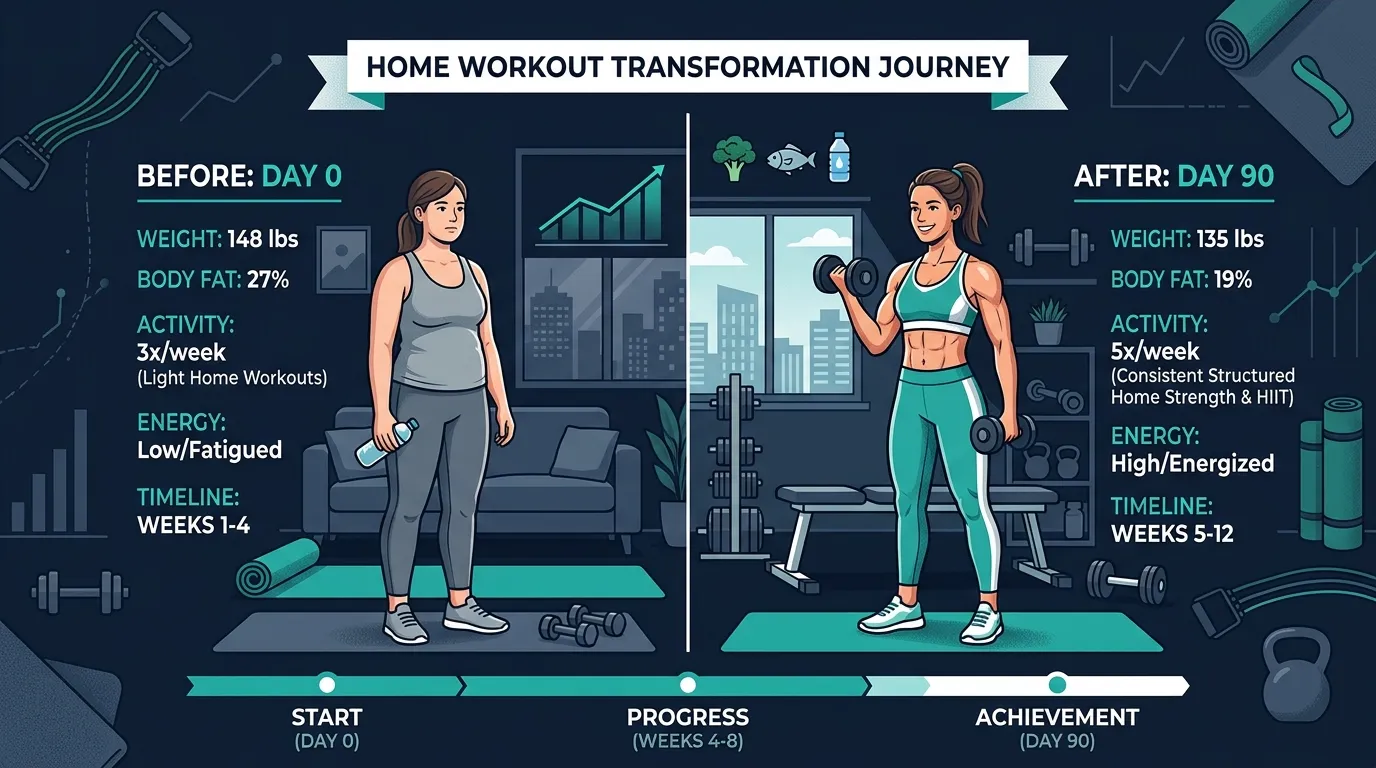
The 4 Mistakes That Keep Home Exercisers Stuck
If you've tried home workouts before and didn't see results, you probably made one (or more) of these mistakes. They're incredibly common — and entirely fixable.
Mistake #1: No Progression
This is the big one. You found a 20-minute bodyweight circuit on YouTube six months ago and you've been doing the exact same thing ever since. It felt hard the first week. By month two, it was a breeze. By month four, it was basically a warm-up. And your body looked exactly the same because it had zero reason to adapt.
The fix: Apply progressive overload using the seven methods described above. Your workout should get slightly harder over time — every week or every other week. If it doesn't, you're maintaining at best.
Mistake #2: No Structure
Monday you do a random arm workout. Tuesday you feel like doing abs. Wednesday you search "full body HIIT" on YouTube and do whatever comes up. Thursday you skip because nothing appeals to you. This isn't training — it's random physical activity. And random activity produces random results (usually none).
The fix: Follow a structured program with planned exercises, sets, reps, and progressions. The specific program matters less than having one at all. A mediocre plan followed consistently beats a "perfect" random approach every time.
Mistake #3: Workouts Are Too Easy
Many home workout videos are designed to be accessible, which often means they're not challenging enough to stimulate muscle growth. If you can comfortably chat through your entire workout, it's not hard enough. If you finish every set with 5+ reps "in the tank," the stimulus is insufficient.
The fix: Push sets close to failure (within 1-3 reps). If standard push-ups are easy for 20+ reps, switch to a harder variation. If bodyweight squats are a breeze, move to Bulgarian split squats or pistol progressions. Your muscles need a reason to grow — and "comfortable" isn't it.
Mistake #4: No Tracking
If you don't write down what you did, you can't know whether you're progressing. "I think I did more reps than last time" isn't progress — it's wishful thinking. Without data, progressive overload is impossible because you don't have a baseline to progress from.
The fix: Log every workout. Record the exercise, variation, sets, reps, and any notes about difficulty. Review your logs weekly to ensure you're actually moving forward.
How FitCraft Adapts to Home-Only Setups
This is exactly the problem FitCraft was designed to solve. Not just for home exercisers — but for anyone whose environment doesn't fit the standard "3x/week at a commercial gym" template.
FitCraft's 32-step diagnostic assessment includes detailed questions about your training environment. What equipment do you have access to? Where do you work out? What's your space like? Based on your answers, the AI coach Ty builds a program specifically for your setup.
No equipment? Ty builds a bodyweight program with progressive variations, tempo manipulations, and volume progression built in. You'll never do the same easy workout twice.
Resistance bands and a pull-up bar? Ty integrates those tools into your programming, using bands for progressive resistance and the bar for back training that bodyweight alone can't match.
Full home gym? Ty designs a program that takes full advantage of your equipment, with the same exercise science principles used in commercial gym programming.
The programming is designed by an Ivy League-trained exercise scientist, NSCA-certified strength coach and adapted by AI to your specific situation. And the gamification system — streaks, quests, collectible cards, avatar progression — provides the accountability and engagement that keeps you consistent when there's no gym buddy or trainer waiting for you.
As Stacy, 41, put it: "I was skeptical about home workouts because I'd tried YouTube videos and never stuck with them. FitCraft gave me an actual program that progresses — not just random workouts. The gamification keeps me coming back, and I've seen more progress in four months at home than I did in a year at the gym."
The Bottom Line
Home workouts aren't a compromise. They're a legitimate training modality backed by research and used effectively by millions of people. The difference between home workouts that produce results and home workouts that waste your time comes down to three things:
- Progressive overload. Your training must get harder over time. Not randomly harder — systematically harder.
- Structured programming. Follow a plan with intentional exercise selection, volume, and progression. Don't wing it.
- Consistency. The best program in the world is worthless if you do it for two weeks and stop. Find a system — gamification, accountability, whatever works for you — that keeps you showing up.
Get those three things right, and the question stops being "Can I get results at home?" and becomes "Why would I need a gym?"
Getting there is mostly a scheduling problem, which is what our no-equipment home workout page is built to solve.
Frequently Asked Questions
Can you build muscle with just bodyweight exercises?
Yes. Research published in Physiology & Behavior (2017) found that bodyweight training produced comparable muscle gains to traditional weight training in beginners and intermediates when both groups trained to similar levels of effort. The key is applying progressive overload — harder variations, more reps, slower tempos, or less rest — rather than doing the same easy routine indefinitely.
What minimal equipment do I need for effective home workouts?
You can get excellent results with zero equipment. However, three items dramatically expand your options: resistance bands ($15-30), a pull-up bar ($20-40), and adjustable dumbbells ($100-300). These three items cover virtually every muscle group and progression method for a total investment of $135-370.
How do you progressive overload with bodyweight exercises?
Increase reps, progress to harder variations (push-ups to diamond push-ups to archer push-ups), slow down the tempo (3-5 second lowering phase), reduce rest between sets, add pauses at the hardest point, or add external resistance with bands or a weighted vest. The principle is the same as with weights — gradually increase the demand on your muscles over time.
How many days per week should I work out at home to see results?
Research suggests 3-4 days per week is the sweet spot. A 2016 meta-analysis in Sports Medicine found that training each muscle group twice per week produced significantly more muscle growth than once per week. A 3-day full-body program or 4-day upper/lower split both achieve this frequency while allowing adequate recovery.
Does FitCraft work for home-only workouts?
Yes. FitCraft's 32-step diagnostic assessment includes your available equipment and training location. The AI coach Ty builds your program specifically for your setup — whether that's zero equipment, basic home gear, or a full gym. The programming adapts to what you have while still applying progressive overload and expert exercise science principles.