- YouTube workouts are genuinely great for variety, accessibility, and zero-cost exploration — but they lack structure, progression, and personalization, which makes long-term consistency difficult.
- Structured workout apps beat YouTube for consistency because they remove decision fatigue, track your progress, and build in progressive overload — the key driver of results.
- AI-driven apps add personalization that YouTube cannot match — adaptive difficulty, personalized encouragement, and programs built around your goals, equipment, and schedule.
- The best approach depends on where you are. YouTube is perfect for exploring and learning. But if you've tried free workouts and keep quitting after a few weeks, a structured app solves the actual problem.
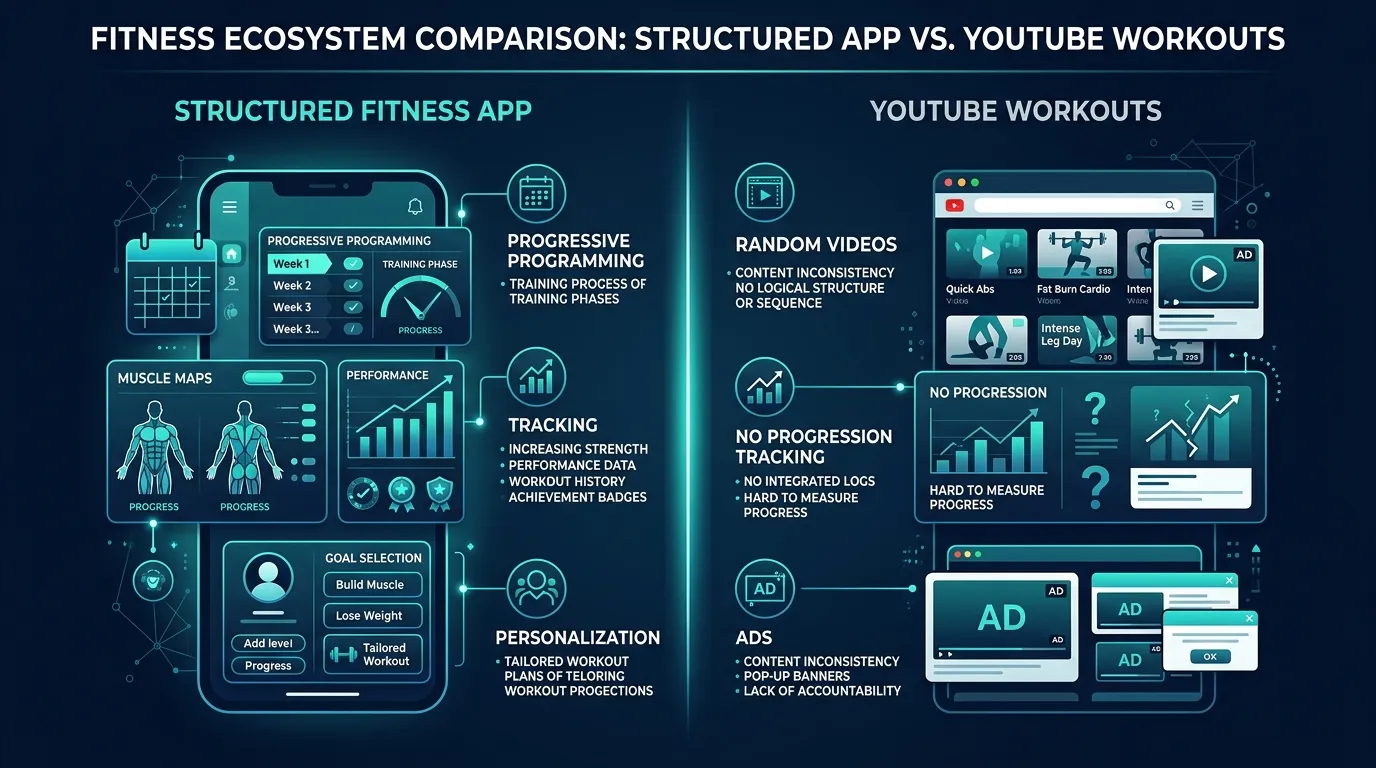
Search "home workout" on YouTube and you'll get over 100 million results. Free, high-quality fitness content from certified trainers, professional production, every style from HIIT to yoga to strength training. It's never been easier to find a workout.
And yet, most people who use YouTube workouts quit within weeks. A 2022 longitudinal study published in JMIR Formative Research found that engagement with web-based fitness videos shows the sharpest decline within the first week, with views dropping by an average of 24,700 per day across channels (Sui et al., 2022). That pattern mirrors the well-documented ~50% dropout rate from traditional fitness programs.
So the question isn't whether good free workouts exist on YouTube — they clearly do. The question is: why do people keep quitting them, and does a workout app actually solve that problem?
This article breaks down the honest pros and cons of each approach — where YouTube genuinely wins, where structured apps have the edge, and how AI-driven personalization has changed the equation entirely.
The Case for YouTube Workouts: Where Free Content Genuinely Wins
Let's start with what YouTube does well, because dismissing free content would be dishonest. YouTube has real, meaningful advantages that no paid app can fully replicate.
Zero Cost, Zero Commitment
The most obvious advantage is price: YouTube is free. You can try 50 different workout styles without spending a dollar. For someone who doesn't know whether they prefer yoga, HIIT, strength training, or dance cardio, YouTube is the perfect low-risk testing ground. No subscription to cancel, no buyer's remorse, no sunk cost guilt.
Unmatched Variety
No single app can match YouTube's sheer breadth of content. Want a 10-minute mobility routine? A 45-minute dumbbell workout? A Pilates class set to lo-fi beats? A strength session in Spanish? It exists on YouTube. This variety is genuinely valuable — especially for people who get bored doing the same style repeatedly.
Learn From Anyone, Anywhere
YouTube gives you access to trainers you'd never meet in person. Channels like Sydney Cummings, Caroline Girvan, Heather Robertson, and Jeff Nippard have built enormous followings by delivering legitimately excellent fitness instruction for free. Many of these creators are certified professionals sharing real expertise. The democratization of fitness knowledge through YouTube is a genuine public good.
Great for Supplementing an Existing Routine
If you already have a structured program and want to add a yoga flow on your rest day, or learn proper form for a new exercise, YouTube is ideal. It works brilliantly as a supplement — a resource you dip into intentionally when you know exactly what you need.
The Problem with YouTube Workouts: Why Free Doesn't Mean Effective
Here's where the honest assessment gets harder. Because while YouTube's content is excellent, the platform itself is designed for entertainment, not fitness outcomes. And that design mismatch creates specific problems that undermine your results.
No Progression System
This is the biggest issue, and it's structural. Progressive overload, gradually increasing the challenge on your muscles over time, is one of the foundational principles in exercise science. A 2017 meta-analysis in the Journal of Sports Sciences found a graded dose-response between weekly training volume and muscle growth, so without a mechanism to keep raising the work, you plateau (Schoenfeld et al., 2017).
YouTube has no mechanism for progression. There's no system tracking that you did 3 sets of 12 push-ups last Tuesday and should do 3 sets of 14 this week. There's no automatic difficulty adjustment. There's no way for a pre-recorded video to know whether the workout was too easy or too hard for you specifically. Every session starts from zero context.
Decision Fatigue Kills Consistency
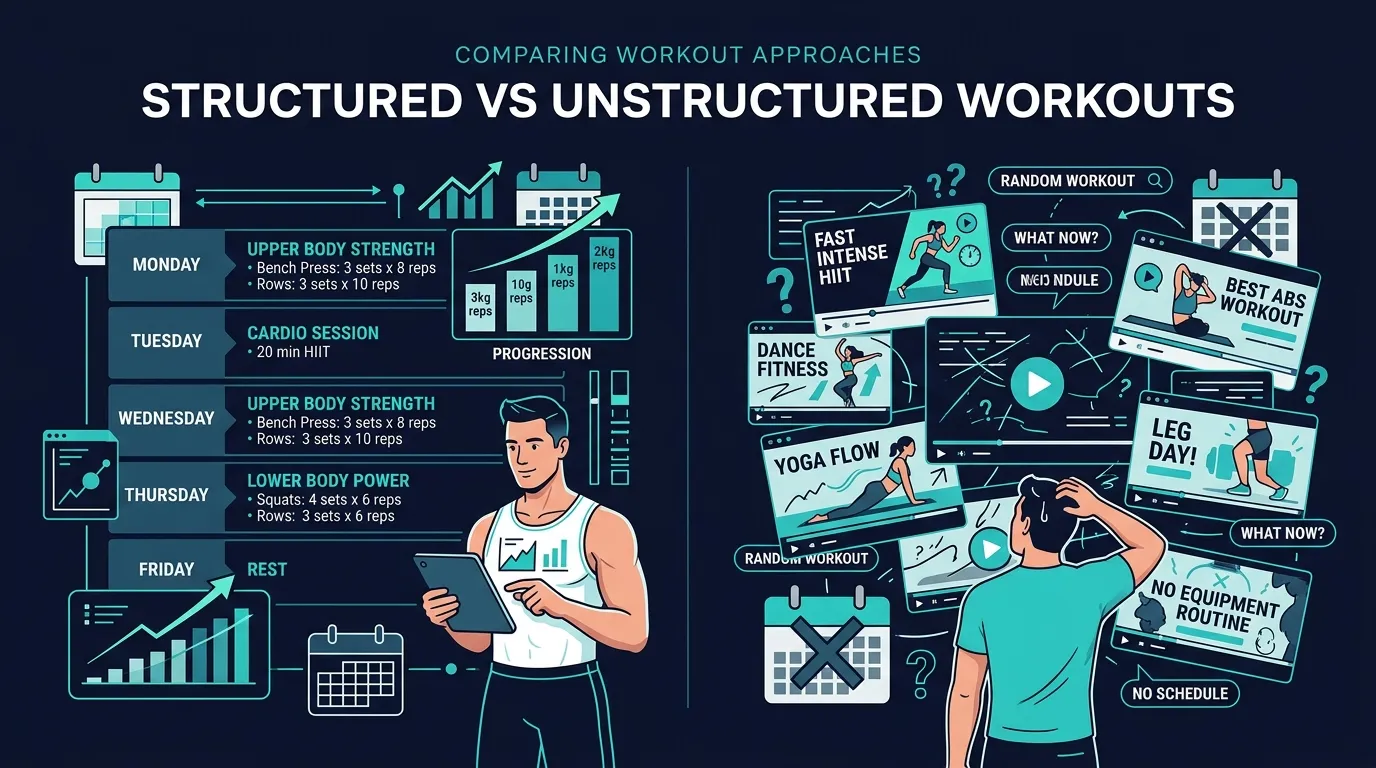
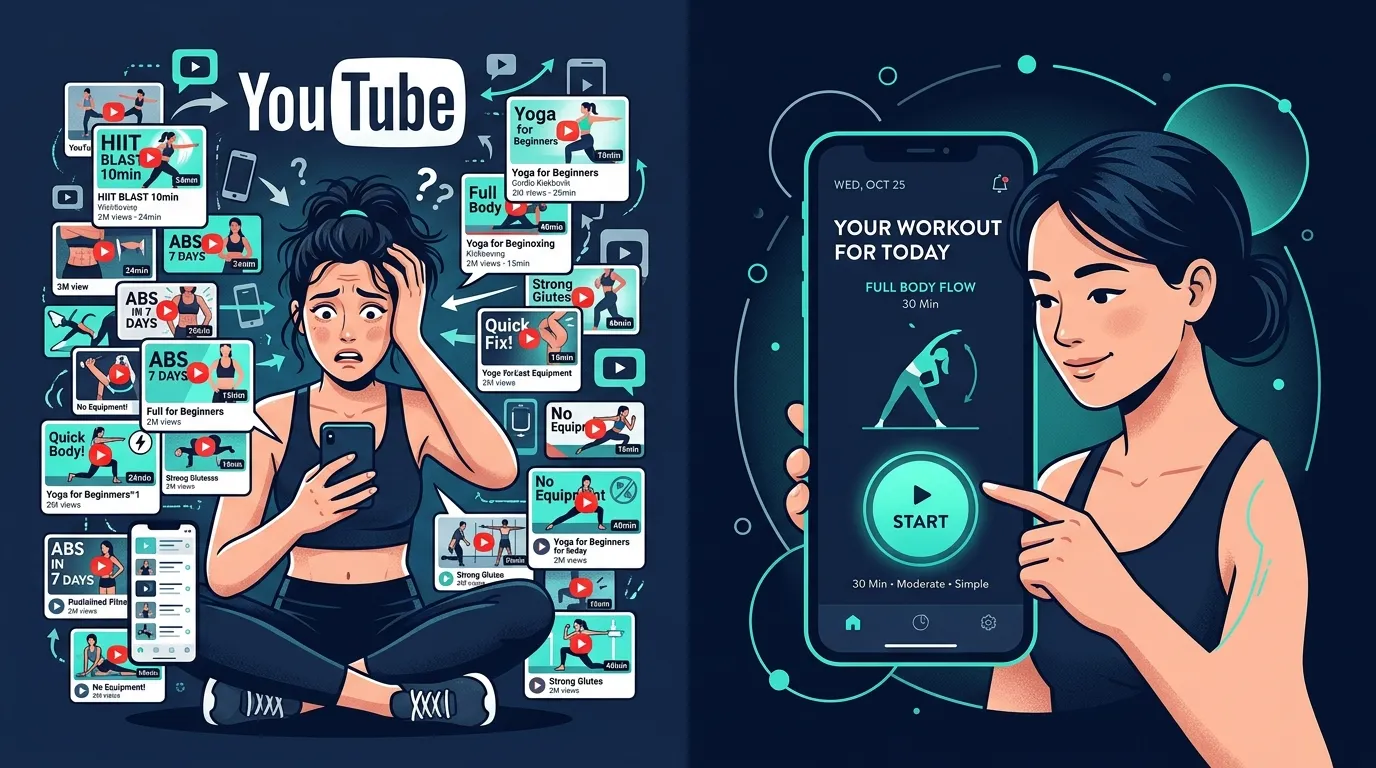
Every time you open YouTube for a workout, you face the same question: What should I do today? You scroll through thumbnails. You compare video lengths. You read titles. You start one video, decide it's not right, back out, try another. By the time you've chosen, you've burned mental energy that should have gone toward actually exercising.
This is decision fatigue — and research consistently shows it's a consistency killer. The more choices you have to make before starting a behavior, the less likely you are to start at all. YouTube's infinite library, paradoxically, makes it harder to begin.
No Personalization
A YouTube video doesn't know your fitness level, your injury history, your available equipment, your goals, or your schedule. A "beginner full body workout" might be perfect for one viewer and completely wrong for another. There's no assessment, no adaptation, no customization. You're fitting yourself to the video instead of the video fitting to you.
The Algorithm Works Against You
YouTube's recommendation algorithm optimizes for watch time, not your fitness goals. It shows you what's trending, what gets clicks, what keeps you scrolling — not what's programmatically next in your training plan. A structured workout program requires doing specific exercises in a specific order with specific progression. YouTube's algorithm has zero interest in that structure.
The Case for Workout Apps: Structure, Tracking, and Accountability
Structured workout apps solve most of the problems that make YouTube workouts inconsistent. Here's how.
Built-In Progressive Overload
Good workout apps track what you did and adjust what comes next. They know your last session's reps, sets, and difficulty level. They automatically progress your workouts — harder variations, increased volume, new exercises introduced at the right time. This is the single most important advantage apps have over YouTube: they make progression automatic instead of something you have to figure out yourself.
Zero Decision Fatigue
Open the app, see today's workout, press start. No scrolling, no comparing, no second-guessing. The program is built, the decisions are made, and all you have to do is show up. For people who struggle with consistency, removing the "what should I do?" question is transformative. It turns fitness from a daily negotiation into a simple default behavior.
Tracking Creates Accountability
When every workout is logged, you can see your progress — or lack of it. Calendar tracking shows your streak. Completed workouts accumulate. Skipped days are visible. This data creates a gentle accountability loop that YouTube simply doesn't have. You can't see your consistency pattern on YouTube because YouTube isn't tracking it for fitness purposes.
Structured Programs Match Your Goals
Apps can ask: What's your goal? What equipment do you have? How many days per week can you train? How long should each session be? Then they build a program that fits those constraints. Instead of searching for a video that sort-of matches your situation, the app builds the workout for your situation. If you're just starting out and weighing which one to try, our guide to the best fitness apps for beginners ranks the structured options.
Ready to put this into practice?
Take the free FitCraft assessment and get a personalized plan based on behavioral science, not willpower.
Take the Free Assessment Free · 2 minutes · No credit cardHow AI-Driven Apps Change the Equation
Traditional workout apps are already better than YouTube for structure and progression. But AI-driven fitness apps add a layer of personalization that brings the experience closer to working with a human trainer — something neither YouTube nor basic apps can match.
Personalized Programming From Day One
AI-powered apps don't just ask your goal and hand you a generic plan. They assess your fitness level, available equipment, schedule, workout preferences, and training history to build a program that's genuinely yours. Not a template. Not a "beginner plan" that 10,000 other people are also doing. A program designed around your specific constraints and objectives.
FitCraft's AI coach Ty, for example, uses a diagnostic assessment to understand not just what you want to achieve but how you're wired — then builds adaptive workouts across yoga, mobility, strength (bodyweight, dumbbells, resistance bands), cardio, and dynamic movement based on that profile.
Adaptive Difficulty Based on Your Progress
A YouTube video is static. It was filmed once and plays the same way every time, whether you've done it once or fifty times. An AI-driven app adapts. As you progress, the workouts adjust — harder variations, increased volume, new movement patterns introduced at the right time based on your actual performance data.
This is what progressive overload looks like in practice: a system that automatically ensures your training keeps challenging you, without requiring you to manually research and plan your own progressions.
Personalized Encouragement That Adapts to You
One of the most underrated advantages of AI coaching is personalized encouragement. A YouTube trainer says the same motivational phrases to every viewer. An AI coach like Ty adapts its communication to your patterns — acknowledging your streak, celebrating milestones, and providing encouragement calibrated to your journey. It's not generic hype. It's recognition of your specific progress.
Interactive Exercise Guidance, Not Passive Video
YouTube workouts are passive — you watch and follow along. AI-driven apps like FitCraft use interactive 3D exercise demos with pinch-and-zoom camera control, letting you examine each movement from any angle. You're not stuck with a single camera perspective chosen by a video editor. You can rotate, zoom, and study the form cues that matter most for your body. That's a fundamentally different learning experience than pressing play on a video.
The Engagement Problem: Why Gamification Matters More Than Content Quality
Here's an uncomfortable truth: the quality of your workout matters less than whether you actually do it. The best program in the world produces zero results if you quit after two weeks.
A 2024 systematic review and meta-analysis published in eClinicalMedicine (The Lancet) examined digital health apps with gamification features and found that gamification elements — points, levels, rewards, progress tracking — produced meaningful improvements in physical activity levels compared to non-gamified approaches (Nishi et al., 2024).
A 2021 cross-sectional survey of 839 US fitness app users in the Journal of Medical Internet Research found that gamification-related app features moderated how strongly enjoyment of an app predicted the intention to keep using it, and that intention to use a fitness app in turn predicted the intention to be physically active (Yang and Koenigstorfer, 2021).
YouTube has none of these engagement mechanics. There's no streak to maintain, no XP to earn, no level to reach, no collectible reward for showing up five days in a row. The motivation to return is entirely self-generated — which works for the most disciplined people, but leaves the majority without the behavioral scaffolding they need.
What Gamification Actually Looks Like in Practice
FitCraft's approach to gamification goes beyond a simple streak counter. The system includes:
- XP and leveling up — every workout earns experience points that contribute to your overall level, creating a tangible sense of progression beyond physical changes (which take weeks to notice)
- Collectible cards — unique cards earned through workout milestones, adding a collection mechanic that taps into completionist motivation
- Calendar tracking with rewards — visual representation of your consistency with rewards for maintaining your schedule
- Adaptive workouts based on progress — the gamification feeds into the programming, so your workouts evolve as you level up
As Matt, a FitCraft user, put it: "The real win is I actually want to work out now. That's never happened before." That shift — from exercise as obligation to exercise as something you look forward to — is what gamification makes possible and what YouTube's passive format cannot create.
When YouTube Is the Right Choice (Honestly)
This isn't a one-sided argument. There are clear situations where YouTube is genuinely the better option:
- You're brand new to fitness and want to explore different workout styles before committing to anything. YouTube's zero-cost, zero-commitment format is perfect for discovery.
- You're already self-disciplined and can structure your own progressive program. If you know exercise science well enough to self-program, YouTube provides the movement library and you provide the structure.
- You want a single session, not an ongoing program. Traveling, need a quick hotel room workout, want to try a new yoga flow — YouTube is ideal for one-off sessions.
- You want to learn specific exercises. YouTube tutorials for individual movements — proper squat form, how to do a Turkish get-up, mobility drills for hip pain — are excellent educational resources.
- Budget is your absolute top priority. If you genuinely cannot afford any subscription and need free content, YouTube's library is remarkably good for the price of zero dollars.
YouTube is a fantastic fitness resource. The issue is treating it as a fitness system. Resources inform. Systems produce results.
When a Workout App Is the Right Choice
A structured workout app becomes the better choice when:
- You've tried free workouts before and quit. If your pattern is "start strong, skip a few days, give up by week three," the problem isn't content quality — it's structure and engagement. That's exactly what apps are designed to solve.
- You don't know how to program workouts. Most people don't have exercise science knowledge, and that's fine. An app handles programming, progression, and exercise selection so you don't have to.
- Decision fatigue is killing your consistency. If you spend more time choosing a workout than doing one, you need a system that removes the choice and just tells you what to do today.
- You want to track progress over time. Seeing your consistency, workout history, and progression data creates accountability that YouTube's platform doesn't provide.
- You respond to game-like motivation. If streaks, levels, achievements, and collectible rewards motivate you, a gamified app provides engagement mechanics that YouTube fundamentally cannot.
The Real Question: Resource vs. System
The debate between workout apps and YouTube usually focuses on content quality. But content quality isn't the bottleneck for most people. You can find excellent workouts on YouTube. You can find excellent workouts in apps. The content is roughly equivalent.
The actual bottleneck is consistency. And consistency isn't a content problem — it's a systems problem. Do you have progressive overload built in? Do you have tracking? Do you have engagement mechanics that keep you coming back on the days you don't feel like it? Do you have a plan that adapts to your progress instead of staying static?
YouTube gives you content. A good workout app gives you a system. And systems beat content every time — because a mediocre workout done consistently for six months will always outperform a perfect workout done sporadically for two weeks.
As Katie, a FitCraft user, said: "I've tried everything. This is the first time I've stuck with something past two weeks." She didn't lack access to good workouts. She lacked a system that made consistency feel automatic.
That's the real difference. Not better exercises. Not fancier production. A system designed around the behavioral science of why people actually stick with things — and why they quit.
Frequently Asked Questions
Are YouTube workouts effective for building muscle?
YouTube workouts can be effective for building muscle if you select videos that apply progressive overload and follow them consistently over weeks and months. The challenge is that most people use YouTube reactively — picking a different video each session — which eliminates the structured progression that drives muscle growth. A 2017 meta-analysis in Medicine & Science in Sports & Exercise confirmed that progressive overload is the primary driver of hypertrophy, regardless of the platform delivering the workout.
Is it worth paying for a workout app when YouTube is free?
It depends on your consistency history. If you can self-structure a progressive program using free YouTube content and stick with it for months, you may not need a paid app. However, research shows that approximately 50% of people who start an exercise program quit within the first few weeks. Paid workout apps that include personalization, progression tracking, and engagement features like gamification address the specific reasons most people quit — removing the decision fatigue and lack of structure that derail free approaches.
What can a workout app do that YouTube cannot?
Workout apps offer several capabilities YouTube cannot match: adaptive programming that adjusts to your progress, built-in tracking so you know what you did last session, personalized exercise selection based on your equipment and goals, and engagement systems like gamification that sustain motivation over months. AI-driven apps add another layer by personalizing encouragement and modifying workout difficulty based on your progression data — something a pre-recorded video cannot do.
When is YouTube the better choice for workouts?
YouTube is an excellent choice when you are exploring fitness for the first time and want zero financial commitment, when you need a single workout for travel or a change of pace, when you want to learn a specific exercise or technique, or when you are already experienced enough to self-program and just need movement inspiration. YouTube's massive free library is genuinely unmatched for variety and accessibility.
How does AI personalization in workout apps improve results?
AI-powered workout apps personalize the exercise experience in ways pre-recorded content cannot. They assess your fitness level, goals, available equipment, and schedule to build a program specifically for you. As you progress, the AI adapts workout difficulty and provides personalized encouragement — creating an experience closer to working with a personal trainer than following a generic video. Research published in eClinicalMedicine (2024) found that digital health apps with gamification and personalization features produced meaningful improvements in physical activity levels.