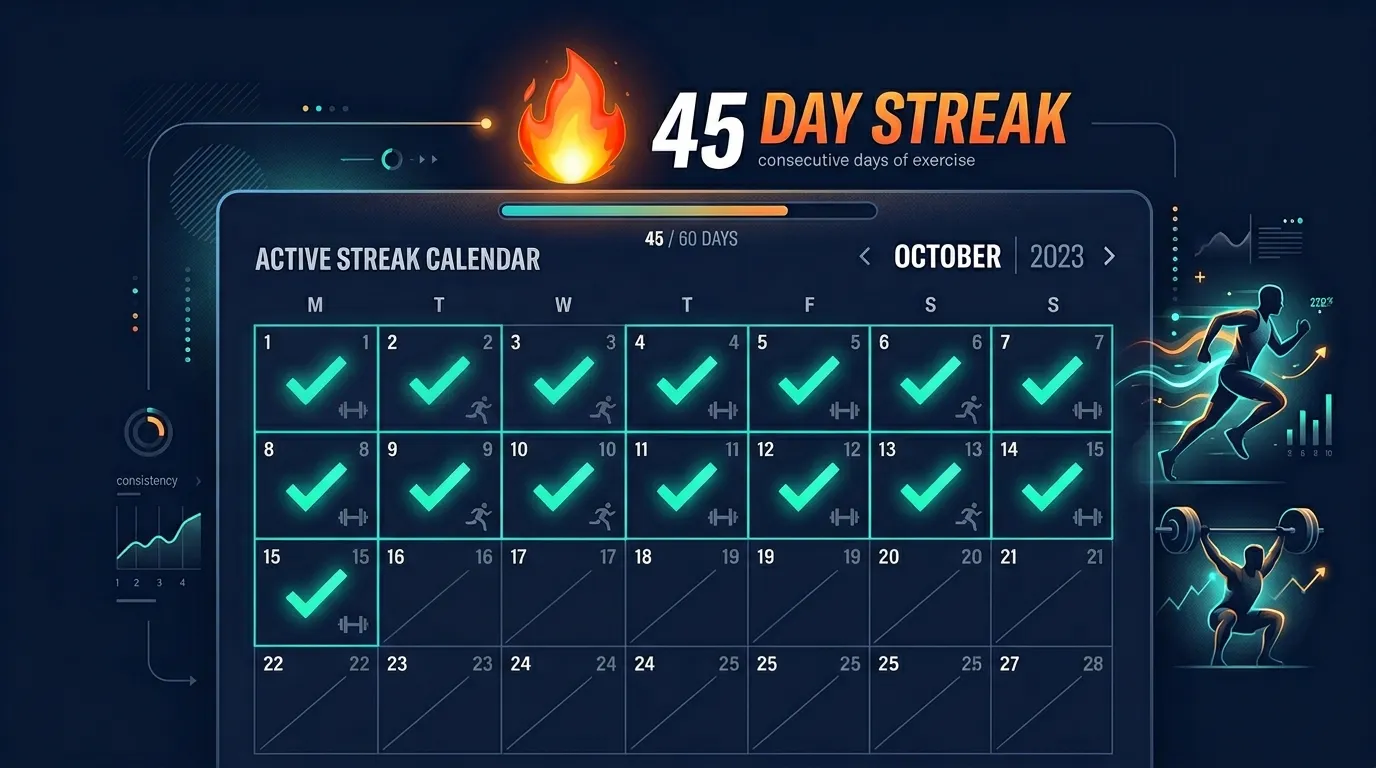
You haven't missed a workout in 47 days. Not when it rained. Not when you worked late. Not when your friends bailed on the gym. Forty-seven days of showing up, stacking one green checkmark on top of the last, watching that number climb.
Then on day 48, life happens. Your kid gets sick. A deadline explodes. You just... don't make it.
And the feeling that hits you is wildly disproportionate to what actually happened. You didn't lose muscle. You didn't gain weight. Physiologically, nothing changed. But emotionally? It feels like the whole thing collapsed. Like you're back to zero.
That feeling has a name. And understanding it is the difference between building a fitness habit that lasts years — or one that crumbles the first time you miss a day.
Loss Aversion: Why Losing a Streak Hurts More Than Building One Felt Good
In 1979, psychologists Daniel Kahneman and Amos Tversky published what would become one of the most cited papers in behavioral economics: Prospect Theory. Their central finding was deceptively simple — losses hurt roughly twice as much as equivalent gains feel good.
They called it loss aversion, and it explains nearly everything about why a broken workout streak feels devastating.
Here's what happens in your brain: every day you complete a workout and maintain your streak, you experience a small positive reward. Day 12 feels good. Day 30 feels great. Day 47 feels like you've become a different person. But the emotional weight of those daily gains accumulates slowly — it's a gentle upward slope.
Breaking the streak, however, isn't a gentle downward slope. It's a cliff. Kahneman and Tversky's research, published in Econometrica, demonstrated that the pain of losing $100 is psychologically equivalent to the pleasure of gaining roughly $200. Applied to your streak: the pain of losing 47 days feels about twice as intense as the satisfaction of building them felt.
This isn't weakness. It's how human brains are wired. And every app that uses streaks — from Duolingo to Snapchat to your fitness tracker — is leveraging this exact asymmetry.
The Endowed Progress Effect: Why Your Streak Feels Like "Yours"
Loss aversion explains why breaking a streak hurts. But there's a second mechanism that explains why you care about the streak in the first place — even when nobody's watching.
In 2006, researchers Joseph Nunes and Xavier Dreze published a study in the Journal of Consumer Research on what they called the endowed progress effect. In a clever experiment at a car wash, they gave customers loyalty cards. One group got a card requiring 8 stamps for a free wash (starting from zero). The other group got a card requiring 10 stamps — but with 2 stamps already filled in.
Both groups needed exactly 8 more purchases. But the group with the "head start" completed their cards at nearly twice the rate — 34% versus 19%.
The lesson: when people feel they've already made progress toward a goal, they're dramatically more motivated to continue. Your 47-day streak isn't just a number. It's invested progress. Your brain treats it like an asset you own — and losing an asset triggers that loss aversion response all over again.
This is why a streak number on a screen can create more motivation than an expensive personal trainer. The trainer provides external pressure. The streak creates internal ownership. You're not working out because someone told you to. You're working out because this thing is yours, and you don't want to lose it.
Identity Attachment: When the Streak Becomes Who You Are
Something shifts around the three-week mark. The streak stops being something you do and starts becoming something you are.
Psychologist James Clear describes this as identity-based habit formation — the idea that lasting behavior change happens when your habits become part of your self-concept. You're no longer "someone trying to work out more." You're "someone who doesn't miss workouts." That's a fundamentally different relationship with exercise.
A 2014 study published in the European Journal of Social Psychology by Phillippa Lally and colleagues at University College London found that habit formation takes an average of 66 days — but the range was enormous, from 18 to 254 days depending on the person and the behavior. What mattered more than the exact timeline was consistency without long gaps. The occasional missed day didn't reset the habit formation process. But a string of missed days did.
This is where streaks become genuinely powerful. They give you a visible, tangible representation of your emerging identity. Each day the number goes up, the story you tell yourself gets stronger: I'm the kind of person who shows up.
And that's exactly why breaking the streak feels like more than missing a workout. It feels like losing a piece of who you've become.
The Dark Side: When Streaks Become Toxic
Here's where we need to be honest — because not all streak mechanics are created equal, and some are actively harmful.
Toxic streaks create anxiety instead of motivation. They punish you for being human. They make you work out when you're sick, skip important events, or exercise through injuries — all because the app threatens to reset your counter to zero.
Research on this is emerging but clear. A 2021 study in Computers in Human Behavior found that rigid streak mechanics in habit-tracking apps were associated with increased guilt, anxiety, and a higher likelihood of abandoning the habit entirely after a break. The mechanism is straightforward: when the cost of failure is losing everything, people who fail once often don't restart. They quit.
You've probably experienced this yourself. Think about Duolingo. Millions of people have kept a language-learning streak for months — only to miss one day, lose the streak, and never open the app again. The streak that was supposed to keep them learning became the reason they stopped.
The same thing happens with fitness. Rigid streak systems create an all-or-nothing mentality:
- Working out with an injury because you can't bear to see the counter reset
- Feeling guilty on rest days even though recovery is essential for progress
- Skipping social events to protect the number
- Complete abandonment after a break because starting from zero feels pointless
The irony is brutal: the very feature designed to create consistency ends up destroying it. A streak that doesn't account for real life isn't a motivation system. It's a trap.
Ready to put this into practice?
FitCraft's streak system is built on this research — designed to motivate, not punish. Take the free 2-minute assessment to see how it works.
Take the Free Assessment Free · 2 minutes · No credit card
How to Design Streaks That Actually Work
The research points to a clear set of principles for building streak systems that drive long-term consistency instead of short-term anxiety. Here's what the evidence says works:
1. Grace Days
A grace day lets you miss a scheduled workout without breaking your streak — typically one per week or a set number per month. This single mechanic transforms the entire psychology of the streak. Instead of "miss once and lose everything," it becomes "miss once and you're fine — miss a pattern and we need to talk."
Grace days align with what Lally's UCL research found: occasional misses don't meaningfully delay habit formation. What matters is getting back on track quickly. A grace day removes the catastrophic thinking that causes people to abandon their habit after a single lapse.
2. Streak Shields
Streak shields are earned protections — rewards you accumulate through consistency that can absorb a missed day. The behavioral brilliance here is that consistent users build up a buffer that protects against life's unpredictability. Travel, illness, emergencies — they don't destroy months of progress.
This taps directly into the endowed progress effect. Your shield isn't just a feature — it's something you earned. Using it doesn't feel like cheating. It feels like spending a resource wisely.
3. Counting Consistency, Not Perfection
The most effective streak systems measure your consistency rate over time rather than consecutive-day counts. Did you complete 4 of 4 planned workouts this week? That's a perfect week — even if you took Wednesday and the weekend off.
This reframes the entire relationship with exercise. Rest days aren't threats to your streak. They're part of the plan. Recovery isn't failure — it's how you get stronger. The streak measures whether you're doing what you committed to, not whether you're exercising every single day without exception.
4. Layered Rewards Beyond the Number
Streaks work best when they're part of a larger reward ecosystem — not the only metric that matters. When a streak exists alongside quests, achievements, progression systems, and collectible rewards, a broken streak doesn't feel like you've lost everything. It's one metric in a broader picture of your progress.
This is the difference between a streak that motivates and a streak that controls. Multiple reward layers ensure that even when the streak resets, you still have visible proof of how far you've come.
Why FitCraft Uses Flexible Streak Mechanics
We built FitCraft's streak system after studying exactly these patterns. The goal was never to create a number people are afraid to lose. It was to create a system people are excited to build.
FitCraft's approach includes grace days that absorb real-life interruptions, streak shields you earn through consistent training, and a system that measures whether you're following your personalized plan — not whether you exercised 365 days straight. Your AI coach Ty adapts your schedule around your life, so the streak reflects your consistency, not some arbitrary daily requirement.
The streaks sit inside a broader gamification ecosystem of quests, collectible cards, and avatar progression — so even if a streak resets, your overall progress is visible and protected. You never feel like you're starting from zero because you're not. Every workout you've ever completed still counts.
As Mike, 23, put it: "The streak system got me hooked. I didn't want to break my chain."
That's the streak effect working as intended. Not anxiety. Not guilt. Just a genuine pull to keep showing up — because the system was designed around how human psychology actually works.
The Real Takeaway
Missing one day of exercise doesn't matter. Physiologically, it's irrelevant. Your muscles don't know what day it is. Your cardiovascular system doesn't check a calendar.
But psychologically, it can matter enormously — depending on the system you're using. A rigid streak punishes the miss and makes quitting feel logical. A well-designed streak absorbs the miss and makes returning feel natural.
The research is clear: loss aversion is real, the endowed progress effect is powerful, and identity attachment to habits is the engine of lasting change. The question isn't whether to use streaks. It's whether the streak system you're using is working for you or against you.
The best streak is one that survives a bad day. Because bad days are inevitable. A fitness habit that only works when conditions are perfect isn't a habit — it's a fantasy. The streak effect, designed correctly, is what turns fantasy into something that lasts.
Frequently Asked Questions
Why does breaking a workout streak feel so bad?
Breaking a workout streak triggers loss aversion — a cognitive bias discovered by Kahneman and Tversky showing that losses feel roughly twice as painful as equivalent gains feel good. After building a streak, your brain treats that accumulated progress as something you own, making a break feel like a genuine loss rather than just a missed day.
Is it okay to miss one day of exercise?
Yes. Missing one day of exercise has virtually zero impact on your physical fitness. Research shows that short breaks do not erase weeks or months of training adaptations. The real risk is psychological — if one missed day spirals into a longer break. The key is having a system that lets you absorb a missed day without losing all your progress markers.
How do I recover from a broken workout streak?
Start again immediately — don't wait for Monday or next month. Research on the "fresh start effect" shows that any day can serve as a psychological reset point. Focus on your total consistency over the past 30 days rather than an all-or-nothing streak count. Apps like FitCraft use grace days and streak shields specifically to prevent one missed day from erasing your progress.
What is a healthy workout streak length?
A healthy workout streak is one that includes planned rest days. Working out every single day without recovery is counterproductive and increases injury risk. Effective streak systems count consistency — showing up on your scheduled training days — rather than consecutive calendar days. A streak of completing 4 planned workouts per week for 12 weeks is more valuable than 84 consecutive days of forced exercise.
Does FitCraft have workout streaks?
Yes. FitCraft uses a flexible streak system designed around behavioral science. Instead of punishing you for a single missed day, FitCraft includes grace days and streak shields that let you absorb life's interruptions without losing your progress. The system is designed to motivate consistency over time, not create anxiety around perfection.