Over 15 million people have read Atomic Habits by James Clear. Most of them highlighted passages about fitness. And most of them are still struggling to work out consistently.
That's not because the book is wrong. It's because reading about behavior change and designing a system for behavior change are two very different things. Clear's framework is arguably the most practical model for habit formation ever published. But applying it to fitness — where the behavior is physically uncomfortable, the rewards are delayed by weeks or months, and the failure rate hovers around 73% within the first few weeks — requires more than underlining a few paragraphs.
This article breaks down exactly how each of Clear's 4 Laws of Behavior Change maps to workout consistency. Not in theory. In practice. With the research behind each principle and the specific design choices that make it work at a system level.
The Problem Clear Identified (And Why Fitness Is the Hardest Test)
James Clear's central argument is deceptively simple: You do not rise to the level of your goals. You fall to the level of your systems.
Most people approach fitness with goals. Lose 20 pounds. Run a 5K. Get visible abs by summer. But goals create a dangerous illusion — they make you think the outcome is the thing to focus on, when it's actually the process that determines whether you succeed or fail.
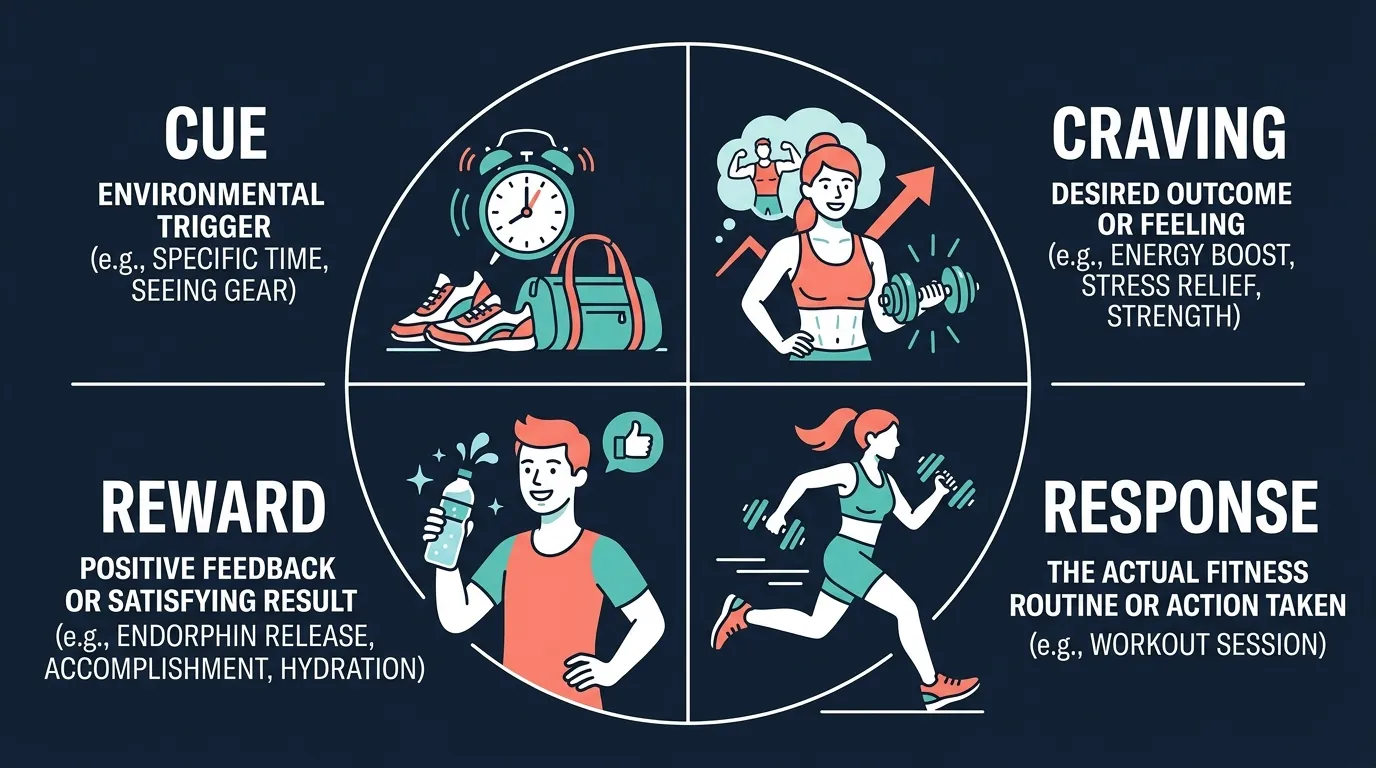
Clear builds his framework on the habit loop — the neurological cycle first mapped by researchers at MIT studying the basal ganglia, and later popularized by Charles Duhigg. The loop consists of a cue, a craving, a response, and a reward. Every habit, good or bad, follows this pattern. And Clear's 4 Laws are designed to engineer each stage of the loop deliberately, rather than leaving it to chance.
Fitness is the hardest application of this framework for three reasons:
- The reward is delayed. You don't see results for weeks. Your brain struggles to connect today's effort with next month's outcome.
- The behavior is effortful. Unlike drinking a glass of water (a behavior used in Phillippa Lally's landmark habit study), exercise requires physical discomfort.
- Decision fatigue compounds the problem. What exercises? How many sets? What weight? Every unanswered question is friction that erodes your willpower before you even start.
That's why you need more than motivation. You need architecture. Here's how to build it, law by law.
Law 1: Make It Obvious — Environmental Design for Exercise
Clear's first law addresses the cue — the trigger that initiates the habit loop. His argument: most people fail not because they lack motivation, but because they never encounter the right cue at the right time. The solution is to make the cue so obvious it becomes unavoidable.
Research supports this. Gardner, Lally, and Wardle (2012), writing in the British Journal of General Practice, found that context-dependent repetition — performing the same behavior in the same environment at the same time — is the single most reliable predictor of habit automaticity.1 It's not willpower. It's context.
How to apply this to fitness:
- Implementation intentions. Clear recommends the formula: "I will [BEHAVIOR] at [TIME] in [LOCATION]." For fitness: "I will do my workout at 6:30 AM in my living room." Research by Gollwitzer (1999) showed that implementation intentions roughly doubled the likelihood of follow-through on exercise goals.2
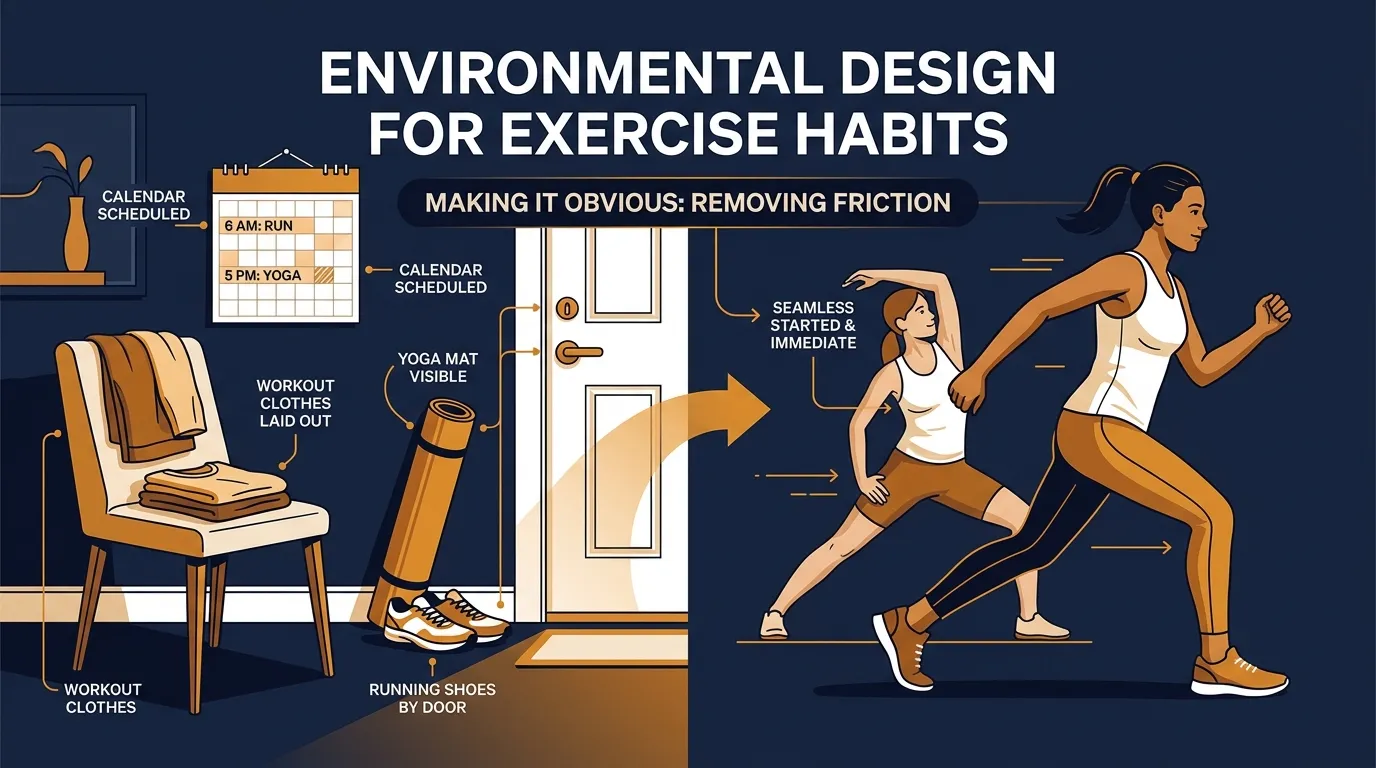
- Environmental cues. Set out your workout clothes the night before. Place your running shoes by the door. Keep your yoga mat unrolled in the corner of your bedroom. Every visible cue reduces the cognitive distance between intention and action.
- Habit stacking. Attach your workout to a behavior you already do automatically. "After I pour my morning coffee, I will put on my workout clothes." The existing habit becomes the cue for the new one.
- Schedule anchoring. Block your workout on your calendar like a meeting. Research on time-based cues shows that when exercise is tied to a specific time rather than left to "whenever I feel like it," adherence increases significantly.
The key insight: you're not relying on remembering to work out. You're designing an environment where forgetting is harder than remembering.
Law 2: Make It Attractive — The Craving That Pulls You In
The second law targets the craving — the motivational force behind every habit. Clear argues that habits are attractive when they're associated with positive feelings. The more attractive a behavior, the more likely it becomes habit-forming.
This is where most fitness approaches collapse. Traditional workout programs rely on the attractiveness of future results — a better body, more energy, longer life. But as behavioral economists have demonstrated repeatedly, humans are terrible at valuing delayed rewards. We're wired for immediate payoff.
How to apply this to fitness:
- Temptation bundling. Pair your workout with something you genuinely enjoy. Clear credits Katy Milkman's research at Wharton for this concept — linking a behavior you need to do with a behavior you want to do. Only listen to your favorite podcast while exercising. Only watch that show while on the treadmill.
- Gamification. This is where the science gets compelling. The STEP UP randomized clinical trial, published in JAMA Internal Medicine (2019), studied 602 overweight and obese adults across 40 U.S. states. Participants in gamified exercise interventions — particularly those with competitive elements — showed a significant increase of 920 steps per day compared to control groups.3 Game mechanics like streaks, points, levels, and rewards tap into the same dopamine-driven feedback loops that make social media and video games irresistible. Applied to fitness, they make the process of working out inherently attractive, not just the distant outcome.
- Social connection. Clear emphasizes that we adopt habits from three social groups: the close (friends and family), the many (the broader culture), and the powerful (those with status). Surrounding yourself with people who exercise — even digitally — reframes working out as normal and desirable.
- Reward bundling with identity. When exercise is tied to a community, a progress system, or a personal narrative ("I'm on a 30-day streak"), it becomes more than physical labor. It becomes something you're proud of — and pride is one of the most powerful attractors in behavioral science.
Law 3: Make It Easy — Reduce Friction Until Action Is Effortless
Clear's third law is arguably the most counterintuitive: the best way to build a new habit is to make it as easy as possible. Not effective. Not optimal. Easy.
This directly contradicts the "go hard or go home" culture that dominates fitness. But the research is unambiguous. Lally et al. (2010), in the most rigorous study of habit formation ever conducted, tracked 96 participants over 12 weeks and found that the median time to automaticity was 66 days — but the range was 18 to 254 days, and simpler behaviors became automatic faster.4 The more friction involved, the longer the habit takes to form — if it forms at all.
How to apply this to fitness:
- The 2-minute rule. Clear's most famous tactical advice: scale any habit down to something that takes 2 minutes or less. For fitness, this means: "Put on your workout clothes." That's it. You're not committing to an hour-long session. You're committing to the gateway behavior. Once you're dressed, momentum carries you forward most of the time.
- No-equipment options. Every piece of equipment you need to find, set up, or travel to is friction. Bodyweight workouts at home eliminate the commute, the locker room, the search for an open squat rack. Friction reduction isn't laziness — it's engineering.
- Remove decision fatigue. This is the hidden killer of workout consistency. When you have to decide what to do, how many sets, what weight, and what order — every decision drains the limited willpower you started with. An AI coach that builds your workout for you eliminates dozens of micro-decisions before you even start. You just show up and press play.
- Progressive scaling. Start absurdly small and increase gradually. A 10-minute walk becomes a 15-minute jog becomes a 20-minute run. The 2022 systematic review in JMIR mHealth and uHealth found that gamified interventions using progressive difficulty were more effective than those that demanded high effort from the start.5
Clear writes: "The idea is to make your habits so easy that you'll do them even when you don't feel like it." In fitness, this is everything. Because the days you don't feel like it are the days that determine whether you build the habit or abandon it.
Enjoying the article?
Start a new fitness routine today, written by me and coached by the AI I designed.
Take the Free Assessment Free · 2 minutes · No credit cardLaw 4: Make It Satisfying — Immediate Rewards vs. Delayed Results
The fourth law is the one most fitness programs get catastrophically wrong. Clear's principle: What is immediately rewarded is repeated. What is immediately punished is avoided.
Exercise is punished immediately (discomfort, fatigue, soreness) and rewarded on delay (strength gains, weight loss, improved health). This is the worst possible combination for habit formation. Your brain registers the pain now and discounts the benefit later. Without intervention, the math never works in exercise's favor.
The solution is to engineer immediate satisfaction into the process itself.
How to apply this to fitness:
- Streak tracking. Maintaining an unbroken streak creates an immediate, tangible reward every time you work out: the streak survives. Clear calls this "the paper clip strategy" — visual progress that you don't want to break. Research on loss aversion shows that the fear of breaking a streak can be a more powerful motivator than the desire to start one.
- Quest completion. Framing workouts as missions or quests with clear start and end points gives each session a discrete accomplishment. You didn't just "exercise" — you completed something. That completion signal triggers a dopamine release that your brain associates with the behavior.
- Collectible rewards. Earning cards, badges, or avatar upgrades after workouts taps into the variable reward schedule that behavioral psychologist B.F. Skinner identified as the most powerful reinforcement pattern. You don't know exactly what you'll earn, which makes the anticipation itself rewarding.
- Progress visualization. Seeing your streak count, your level, your completed quests — all of this makes the invisible work of fitness visible. You can't see your cardiovascular improvement. But you can see that you've worked out 47 days in a row, and that feels like progress because it is.
The STEP UP trial data reinforces this: gamification arms that included immediate feedback and reward elements maintained significantly higher activity levels than the control group throughout the 24-week intervention period.3
The Identity Shift: The Hidden Fifth Principle
Clear argues that the deepest form of behavior change is identity change. His three layers of change — outcomes, processes, and identity — form a hierarchy, and most people start at the wrong level.
Outcome-based habits: "I want to lose 20 pounds." (Focused on what you get.)
Process-based habits: "I want to work out 4 times per week." (Focused on what you do.)
Identity-based habits: "I am someone who works out." (Focused on who you are.)
The difference between "I'm trying to work out" and "I am someone who works out" is not semantic. It's neurological. Research published in Frontiers in Psychology (2019) found significant correlations between habit strength and identity integration — people who incorporated behaviors into their self-concept maintained those behaviors with less conscious effort and greater consistency.6
Every workout you complete is a vote for the identity of someone who exercises. Miss one day, and it's a single missed vote — not a broken identity. But stack enough votes, and the identity solidifies. You stop being someone who is trying to be consistent and start being someone who simply is consistent.
This is where streaks, levels, and progression systems aren't just gamification gimmicks — they're identity architecture. When you see a 60-day streak, you don't just see a number. You see evidence that you're the kind of person who shows up. That evidence changes how you think about yourself, which changes what you do next.
The 1% Rule: Compound Interest Applied to Fitness
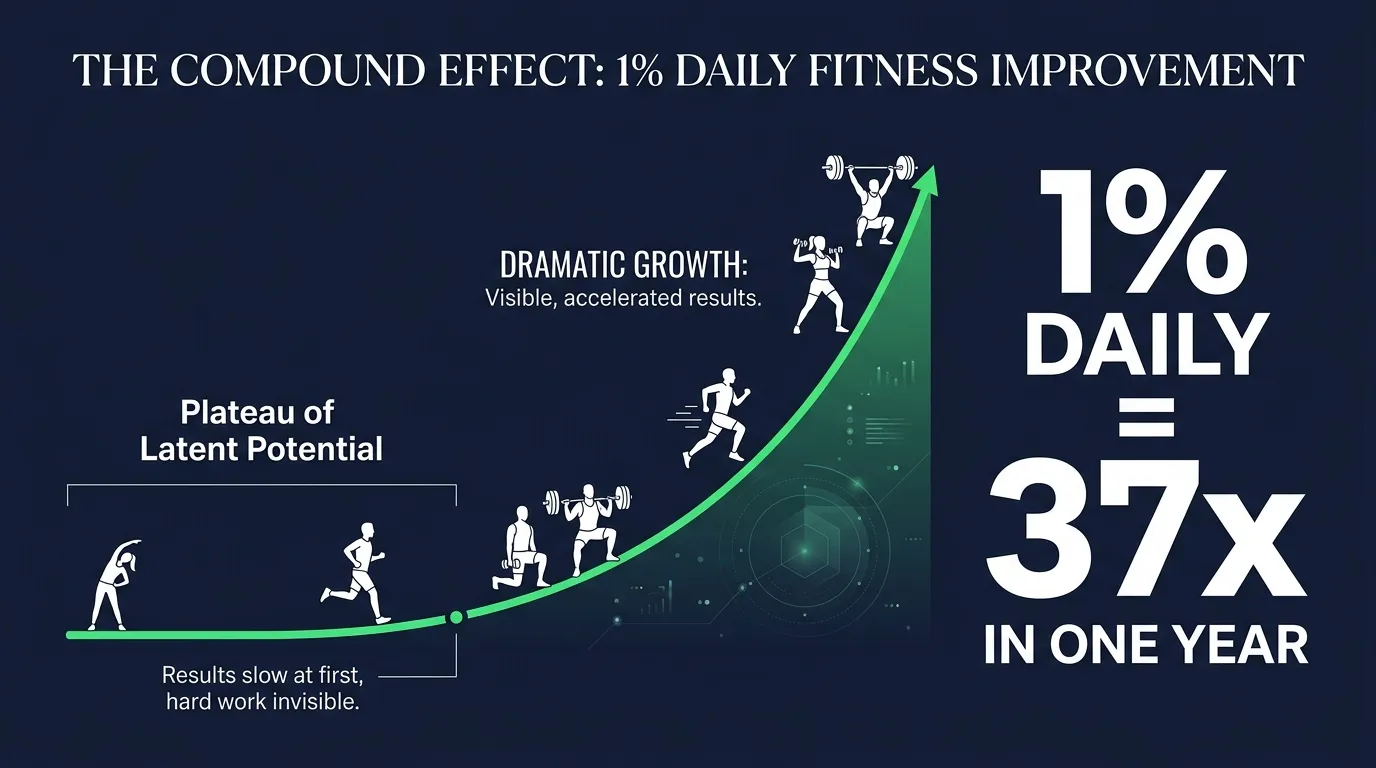
One of Clear's most powerful concepts is the math of marginal gains: if you improve by just 1% each day, you'll be 37 times better after one year. If you decline by 1% each day, you'll be nearly at zero.
In fitness, this plays out in concrete ways:
- Adding one rep per session
- Increasing weight by the smallest available increment
- Extending your walk by two minutes
- Showing up for a 10-minute session instead of skipping because you "don't have time" for a full hour
The trap is thinking that small improvements don't matter because they're not visible yet. Clear calls this the "Plateau of Latent Potential" — the gap between what you expect to happen and what actually happens in the early stages. Most people quit during this plateau because the results haven't caught up to the effort.
But the effort isn't wasted. It's being stored. And when the results finally break through — often suddenly and dramatically — they reflect all the invisible work that came before.
This is why systems that make you want to keep showing up during the plateau are so critical. You need something that rewards you today for work that won't pay off for weeks. That's not a gimmick. That's the entire game.
How FitCraft Maps to Each of Clear's Laws
FitCraft was not built as an "Atomic Habits app." It was built to solve the consistency problem in fitness — the fact that most people quit within the first few weeks. But when you map FitCraft's design to Clear's framework, the alignment is striking:
| Clear's Law | The Principle | How FitCraft Applies It |
|---|---|---|
| Make It Obvious | Design cues into your environment | Push notifications, scheduled workout times, AI coach Ty prompts you when it's time |
| Make It Attractive | Pair the habit with positive feelings | Gamification: quests, collectible cards, avatar progression, streak rewards make workouts feel like play |
| Make It Easy | Reduce friction; remove decisions | AI builds your workout. No equipment required. 32-step diagnostic personalizes everything. Just show up and press play. |
| Make It Satisfying | Provide immediate rewards | Streak tracking, quest completion, card collection, level-ups — every session ends with a visible win |
| Identity Shift | Become the person who does this | Your avatar, your streak, your quest log — all visible proof that you are someone who works out |
As Katie, a FitCraft user, put it: "I've tried everything. This is the first time I've stuck with something past two weeks."
And Barry, 42, reported even more tangible results: "-28 lbs, 4 months."
These aren't outliers. They're what happens when you stop trying to out-motivate the problem and start designing a system that handles the motivation for you.
The Bottom Line
Systems Beat Goals. Every Time.
James Clear's Atomic Habits isn't just a bestselling book — it's a blueprint for behavior change backed by decades of research from Lally, Gardner, Gollwitzer, Milkman, and others. The 4 Laws of Behavior Change work. But they only work when they're implemented as a system, not as a list of tips you try to remember.
The fitness problem was never about knowing what to do. It was about showing up to do it — again, and again, and again — until the behavior becomes automatic and the identity shift is complete.
That's what it means to build atomic habits for fitness. Not one dramatic transformation. A thousand tiny votes for the person you're becoming.
References
- Gardner, B., Lally, P., & Wardle, J. (2012). Making health habitual: the psychology of 'habit-formation' and general practice. British Journal of General Practice, 62(605), 664-666.
- Gollwitzer, P. M. (1999). Implementation intentions: Strong effects of simple plans. American Psychologist, 54(7), 493-503.
- Patel, M. S., et al. (2019). Effectiveness of Behaviorally Designed Gamification Interventions With Social Incentives for Increasing Physical Activity Among Overweight and Obese Adults Across the United States: The STEP UP Randomized Clinical Trial. JAMA Internal Medicine, 179(12), 1624-1632.
- Lally, P., van Jaarsveld, C. H. M., Potts, H. W. W., & Wardle, J. (2010). How are habits formed: Modelling habit formation in the real world. European Journal of Social Psychology, 40(6), 998-1009.
- Xu, L., et al. (2022). The Effects of mHealth-Based Gamification Interventions on Participation in Physical Activity: Systematic Review. JMIR mHealth and uHealth, 10(2), e27794.
- Gardner, B., & Lally, P. (2019). Habit and Identity: Behavioral, Cognitive, Affective, and Motivational Facets of an Integrated Self. Frontiers in Psychology, 10, 1504.
- Clear, J. (2018). Atomic Habits: An Easy & Proven Way to Build Good Habits & Break Bad Ones. Avery/Penguin Random House.
Frequently Asked Questions
How do you apply Atomic Habits to working out?
Apply James Clear's 4 Laws of Behavior Change to fitness: (1) Make it obvious by setting out workout clothes and scheduling sessions at the same time daily, (2) Make it attractive by pairing workouts with things you enjoy like music or gamification, (3) Make it easy by using the 2-minute rule and removing friction like equipment decisions, and (4) Make it satisfying by tracking streaks and rewarding consistency immediately rather than waiting for long-term results.
How long does it take to build an exercise habit?
According to research by Lally et al. published in the European Journal of Social Psychology, it takes an average of 66 days for a new behavior to become automatic — not the commonly cited 21 days. However, the range was 18 to 254 days depending on the person and the complexity of the behavior. The key is consistent repetition in the same context, and missing a single day does not significantly derail the habit formation process.
What is the 1% rule in fitness?
The 1% rule, popularized by James Clear in Atomic Habits, states that getting 1% better each day compounds into dramatic improvement over time. Applied to fitness, this means focusing on tiny, consistent improvements — adding one rep, increasing weight by the smallest increment, or simply showing up even for a short session — rather than trying to overhaul your entire routine at once. Over a year, 1% daily improvement compounds to being 37 times better.
Why do most people quit their workout routine?
Most people quit because their workout system relies on motivation and willpower instead of habit architecture. Research shows motivation is unreliable — it fluctuates with mood, stress, and energy. The real problem is usually a design problem: too much friction to start, no immediate reward for completing a session, and an identity that hasn't shifted from "someone trying to exercise" to "someone who exercises." Effective fitness systems address all four behavioral layers identified by James Clear.
Does gamification actually help with workout consistency?
Yes. The STEP UP randomized clinical trial published in JAMA Internal Medicine (2019) found that gamification interventions significantly increased physical activity among overweight and obese adults, with the competition arm showing a 920-step daily increase over controls. A 2022 systematic review in JMIR mHealth and uHealth confirmed that gamified fitness interventions improve exercise participation, particularly when multiple game elements and behavioral theory are combined.