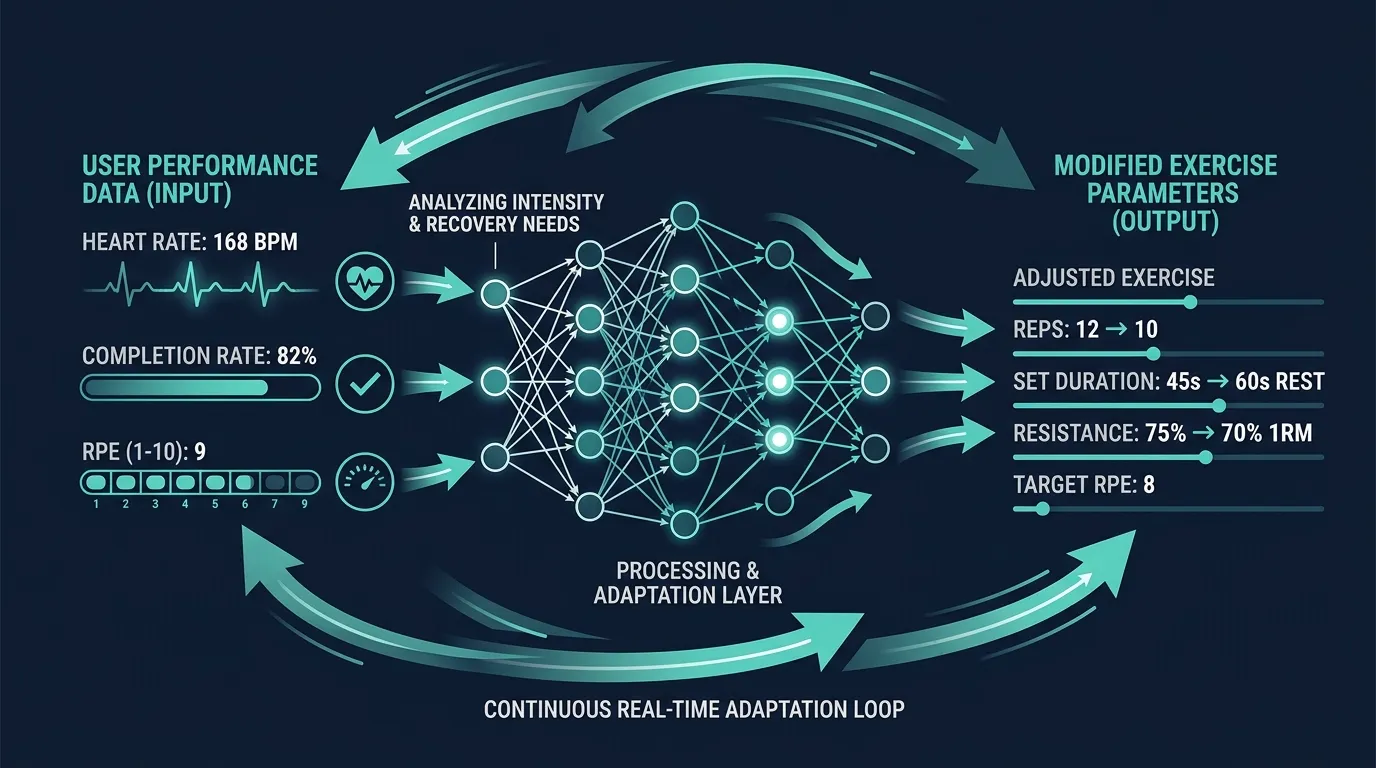
Most fitness apps give you a static plan. You pick a program, follow it until you get bored or it gets too easy (or too hard), and eventually quit. The app never notices. It just keeps serving the same workouts to everyone.
FitCraft works differently. Every workout is shaped by your data — what you've done, how you've progressed, and what your body is ready for next. This isn't a marketing claim. It's a design philosophy baked into how the AI coach Ty operates at every level.
Here's how it actually works.
Step 1: The 32-Step Diagnostic
Adaptation starts before your first workout. When you open FitCraft, Ty walks you through a 32-step assessment designed to capture the variables that matter most for programming:
- Current fitness level. Not just "beginner, intermediate, advanced" — Ty probes for specific capabilities, training history, and experience with different movement patterns.
- Goals. Weight loss, muscle building, flexibility, general health, stress relief. Your goal shapes everything from exercise selection to rep ranges to workout structure.
- Available equipment. Dumbbells, resistance bands, bodyweight only — or a combination. Ty won't prescribe exercises you can't perform with what you have.
- Schedule and preferences. How many days per week, how long per session, which workout types interest you. A program you can't stick to is a bad program, regardless of how scientifically optimal it looks on paper.
This assessment isn't a formality. It's the foundation that every subsequent decision builds on. Individual responses to an identical training program vary widely, which is exactly why the starting assessment matters. Personalization isn't a nice-to-have — it's the single biggest driver of results.
Step 2: Building Your First Program
Once Ty has your assessment data, it constructs a program tailored to your specific situation. This isn't random exercise selection — it's systematic programming built on frameworks designed by an Ivy League-trained exercise scientist, NSCA-certified strength coach.
The AI selects from a library spanning multiple training modalities:
- Strength training — dumbbells, resistance bands, bodyweight exercises
- Yoga — flexibility and mindfulness-focused sessions
- Mobility — joint health and range-of-motion work
- Cardio — heart-rate-elevating sessions
- Dynamic movement — functional, multi-plane exercises
Exercise selection depends on your goals, equipment, and fitness level. Someone training for muscle growth with dumbbells gets a fundamentally different program than someone focused on mobility with bodyweight only. That sounds obvious, but most apps treat these as cosmetic differences — same structure, different exercise labels. Ty builds structurally different programs because different goals require different programming architectures.
Every prescribed exercise comes with interactive 3D demos — not pre-recorded videos, but fully rotatable 3D models you can pinch and zoom to examine the movement from any angle. This matters because form issues are often only visible from specific angles, and a static front-facing video can miss exactly the cue you need.
Step 3: Progress-Based Adaptation
Here's where the AI earns its name. Your program isn't static — it evolves as you do.
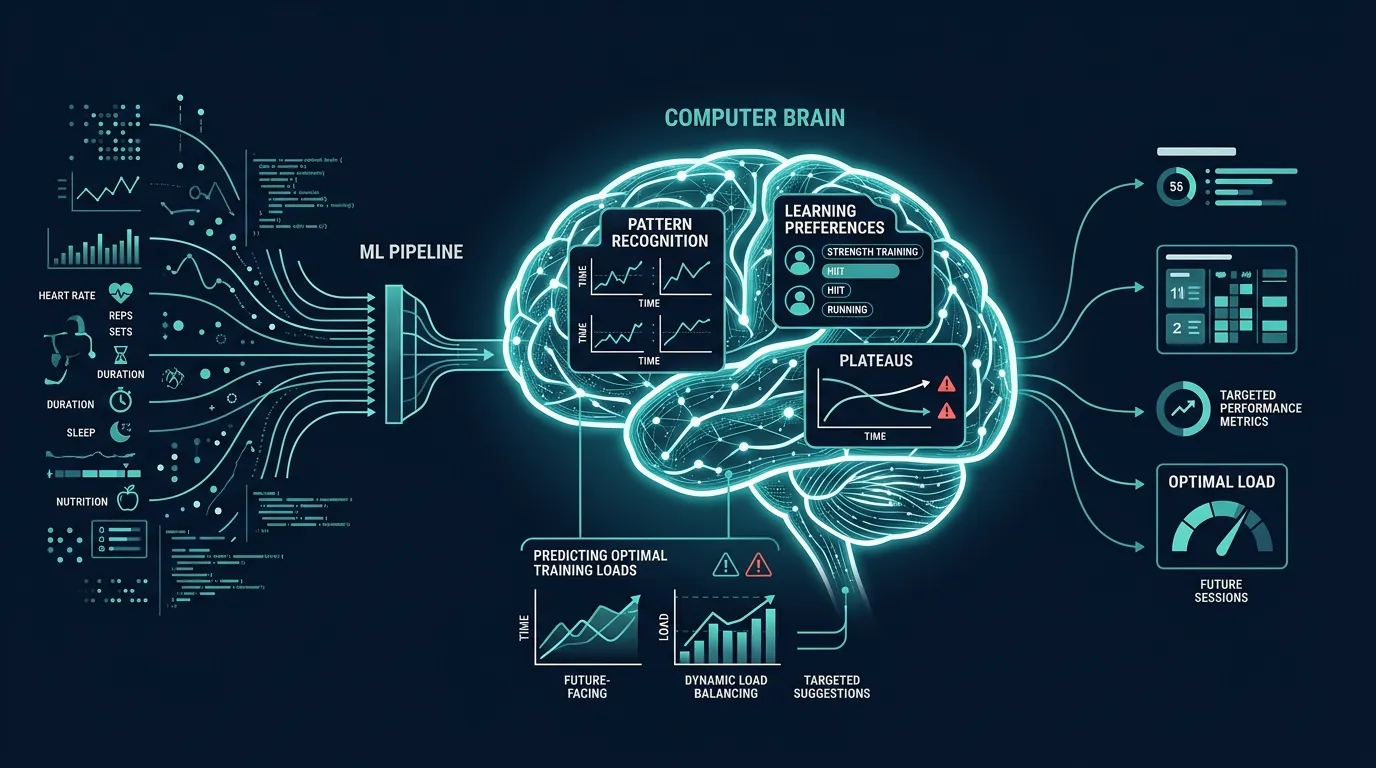
As you train, Ty tracks everything: sets completed, weights used, exercises performed, and consistency patterns over time. This data feeds directly into programming decisions for future workouts.
The core principle is progressive overload — the foundational concept in exercise science that says your body adapts to stress, so the stress must gradually increase for continued improvement. A 2017 meta-analysis in the Journal of Sports Sciences pooled 34 treatment groups from 15 studies and found a graded dose-response between weekly training volume and muscle growth, with each additional weekly set worth roughly 0.37% more gain (Schoenfeld et al., 2017). Doing progressively more over time is what drives the adaptation.
Most people understand progressive overload in theory. The problem is execution. Without tracking, you forget where you left off. Without analysis, you don't know when to push and when to hold. Without a system, progression happens randomly — if it happens at all.
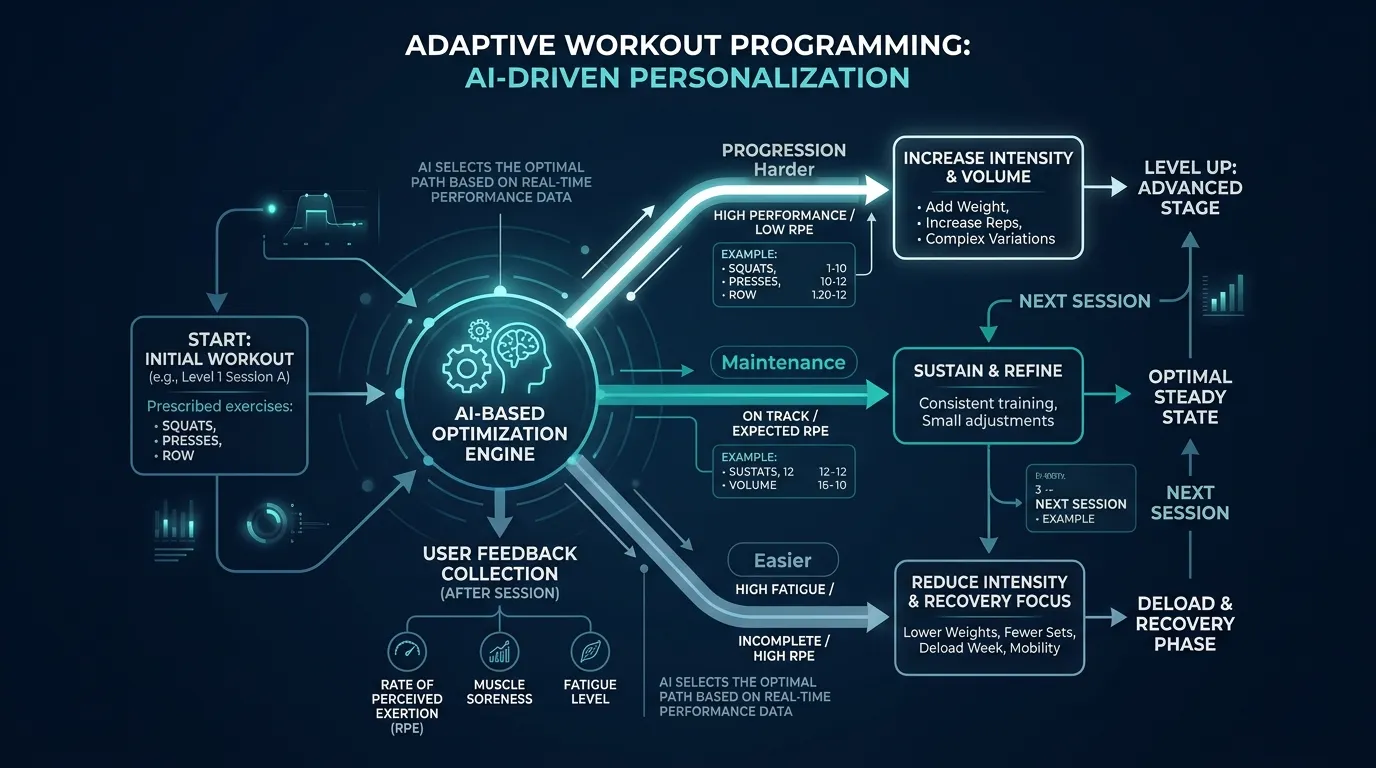
Ty automates this entire process. When your performance data shows you're consistently completing prescribed work — hitting rep targets, maintaining form standards — the AI recognizes you've adapted and increases the challenge. This might mean:
- Adding reps or sets to exercises you've mastered
- Progressing to harder exercise variations (e.g., from standard push-ups to decline push-ups)
- Adjusting workout volume and structure as your capacity grows
- Introducing new movement patterns to prevent plateaus
Step 4: The Challenge Calibration Problem
The hardest thing to get right in fitness programming isn't making workouts hard. Anyone can make a workout that destroys you. The hard part is calibrating challenge so it's productive — difficult enough to drive adaptation, but not so difficult that it causes burnout, injury, or dropout.
Exercise scientists call this the "dose-response relationship." Too little stimulus and nothing happens. Too much and you accumulate fatigue faster than you can recover, performance declines, and eventually you quit or get hurt. The optimal zone is narrow, and it shifts as you get fitter.
Human trainers solve this with intuition and experience. They watch your face during a set, listen to your breathing, note how you're moving. Good trainers develop a feel for where the line is.
AI solves it differently — with data. Ty doesn't need to read your facial expressions. It has your complete training history: every workout, every performance trend, every pattern of consistency or inconsistency. It can detect that your performance has been climbing steadily for three weeks (time to increase challenge) or that you've missed several sessions and your output has dipped (time to scale back and rebuild momentum).
Neither approach is inherently superior. But the AI approach has one critical advantage: it scales. A trainer can hold maybe 20-30 clients' histories in their head with any fidelity. Ty holds yours with perfect accuracy, indefinitely.
Ready to see how Ty adapts to you?
Take the free 32-step assessment and get a personalized program built for your goals, equipment, and fitness level.
Take the Free Assessment Free · 2 minutes · No credit cardStep 5: Exercise Variety Without Randomness
One of the most common complaints about workout apps is monotony. You do the same exercises every week until your brain checks out. Some apps "solve" this by randomizing exercises — which feels novel but is terrible for progression because you can't track improvement on movements that keep changing.
Ty takes a different approach: structured variety. Core compound movements remain consistent long enough to track and progress. But accessory exercises, workout structures, and movement combinations rotate to prevent staleness while maintaining training coherence.
This mirrors how good human coaches program. A strength coach doesn't change your squat variation every session — they keep it stable so you can add weight and measure progress. But they'll rotate accessory work, adjust tempo prescriptions, and vary conditioning formats to keep training engaging without sacrificing the progressive overload that drives results.
The Motivation Layer: Why Gamification Matters for Adaptation
Here's something that gets overlooked in discussions about AI-powered fitness: the best programming in the world is worthless if you don't show up.
Physical adaptation is a slow process. Muscle growth happens over months, not days. Strength gains are measured in small increments. Flexibility improvements are gradual. During any given week, the physical changes from training are essentially invisible. This creates a motivation gap — you're doing the work, but you can't see the results, so your brain starts questioning whether it's worth continuing.
This is where FitCraft's gamification layer plays a critical role in the adaptation system:
- XP and leveling up provide immediate, visible progress after every workout. Your body hasn't visibly changed, but your level has — and that triggers the same reward circuitry that keeps you coming back.
- Collectible cards add a discovery element. Completing specific challenges or milestones unlocks new cards, creating secondary goals beyond physical performance.
- Calendar tracking and rewards make consistency tangible. You can see your streak, and breaking it has a psychological cost that keeps you showing up on the days when motivation is low.
A 2019 randomized controlled trial (the STEP UP study, published in JAMA Internal Medicine) found that gamification-based interventions significantly increased physical activity compared to standard tracking alone (Patel et al., 2019). The mechanism isn't mysterious — gamification provides the short-term feedback loops that bridge the gap between daily effort and long-term physical results.
For Ty's adaptation system, this matters because adaptation requires consistency, and consistency requires motivation. Progressive overload only works if you keep training. Gamification keeps you training. The two systems are complementary — not separate features bolted onto the same app, but parts of a single system designed to produce results.
Adaptive Encouragement: Coaching That Meets You Where You Are
Beyond programming adjustments, Ty adapts its coaching tone and encouragement to your situation. This isn't generic "great job!" feedback — it's contextual.
Coming back after missing a few days? Ty acknowledges the gap without guilt-tripping and recalibrates expectations. Crushing a streak? Ty recognizes the momentum and reinforces it. Struggling with a particular workout type? Ty adjusts its messaging to keep you engaged rather than discouraged.
This adaptive encouragement is subtle but important. Research on self-determination theory (Deci & Ryan, 2000) consistently shows that autonomy-supportive coaching — which encourages without controlling — produces better long-term adherence than directive or critical approaches. Ty is designed around this principle: support your autonomy, acknowledge your effort, and keep the focus on progress rather than perfection.
What AI Adaptation Can't Do (Yet)
Transparency matters, so here's what Ty doesn't do:
- Real-time form correction. Ty provides detailed form cues and interactive 3D demos for every exercise, but it can't watch you move and correct your technique in the moment. For complex lifts, especially if you're a complete beginner, a few sessions with a qualified human trainer to learn fundamental movement patterns is a worthwhile investment (see our breakdown of AI coaches vs. personal trainers).
- Injury rehabilitation. If you're recovering from an injury, you need hands-on assessment from a qualified professional. Ty can work around equipment limitations and adjust difficulty, but it's not a substitute for a physical therapist or a trainer with rehabilitation expertise.
- Emotional intuition. A great human trainer can read your body language, hear it in your voice, and know when to push harder or back off. Ty uses data signals to make similar decisions, but it's data, not intuition. For most people, the data-driven approach is more than sufficient. But if you need that human connection, that's completely valid.
The Bottom Line
FitCraft's AI adaptation system isn't magic. It's a systematic application of well-established exercise science principles — progressive overload, individualized programming, structured variety — executed with the consistency and data-processing capacity that only software can provide.
The 32-step assessment builds the foundation. Progress tracking provides the data. The AI applies the principles. Gamification sustains the motivation. And the whole system compounds over time — the longer you use it, the more data Ty has, and the more precisely it can calibrate your training.
That's the real advantage of AI-adapted workouts. Not that they're smarter than a great human coach on any given day. But that they're available every day, they never forget your history, they never have an off day, and they cost a fraction of what personalized coaching has historically demanded. If you want to see how different apps handle this kind of adaptation, our guide to the best AI fitness coach apps compares them on exactly that.
For the millions of people who would benefit from personalized, adaptive programming but could never access it before — that's not an incremental improvement. That's a fundamentally different category of fitness experience.
If you want the short version of how that plays out in practice, our AI coaching page walks through it.
Frequently Asked Questions
How does FitCraft's AI personalize workouts?
FitCraft's AI coach Ty starts with a 32-step diagnostic assessment that captures your fitness level, goals, available equipment, schedule, and experience. From that baseline, Ty builds a personalized program across workout types including strength (dumbbells, resistance bands, bodyweight), yoga, mobility, cardio, and dynamic movement. As you train, Ty tracks your progress — sets completed, weights used, consistency patterns — and adjusts future workouts to match your evolving capabilities.
Does FitCraft adjust workout difficulty automatically?
Yes. FitCraft's AI uses progress-based adaptation to adjust workout difficulty over time. When your performance data shows you're consistently completing prescribed work, the AI increases the challenge — adding reps, sets, or progressing to harder exercise variations. If your progress stalls or dips, the AI scales back intensity to keep you in a productive training zone rather than pushing you into overtraining.
How does FitCraft's AI select exercises for my workouts?
Exercise selection is driven by your goals, equipment availability, and fitness level — all captured during the initial 32-step assessment. The AI draws from a library spanning strength training (dumbbells, resistance bands, bodyweight), yoga, mobility, cardio, and dynamic movement exercises. Each exercise includes interactive 3D demos with pinch-and-zoom camera control so you can study the movement from any angle. As you progress, the AI introduces new exercises and variations to prevent plateaus and maintain progressive overload.
What types of workouts does FitCraft's AI support?
FitCraft supports yoga, mobility, strength training (with dumbbells, resistance bands, or bodyweight only), cardio, and dynamic movement workouts. The AI personalizes programming across all of these modalities based on your goals and equipment access. You're not locked into one training style — the AI can blend workout types into a cohesive program.
How does FitCraft keep workouts challenging without being overwhelming?
FitCraft's AI applies the principle of progressive overload — gradually increasing training demands as your body adapts. Rather than making random jumps in difficulty, the AI uses your actual performance data to calibrate challenge level. It also uses gamification (XP, leveling up, collectible cards, and calendar streaks) to keep motivation high during the inevitable periods where physical progress feels slow. This combination of data-driven progression and psychological engagement prevents both boredom and burnout.