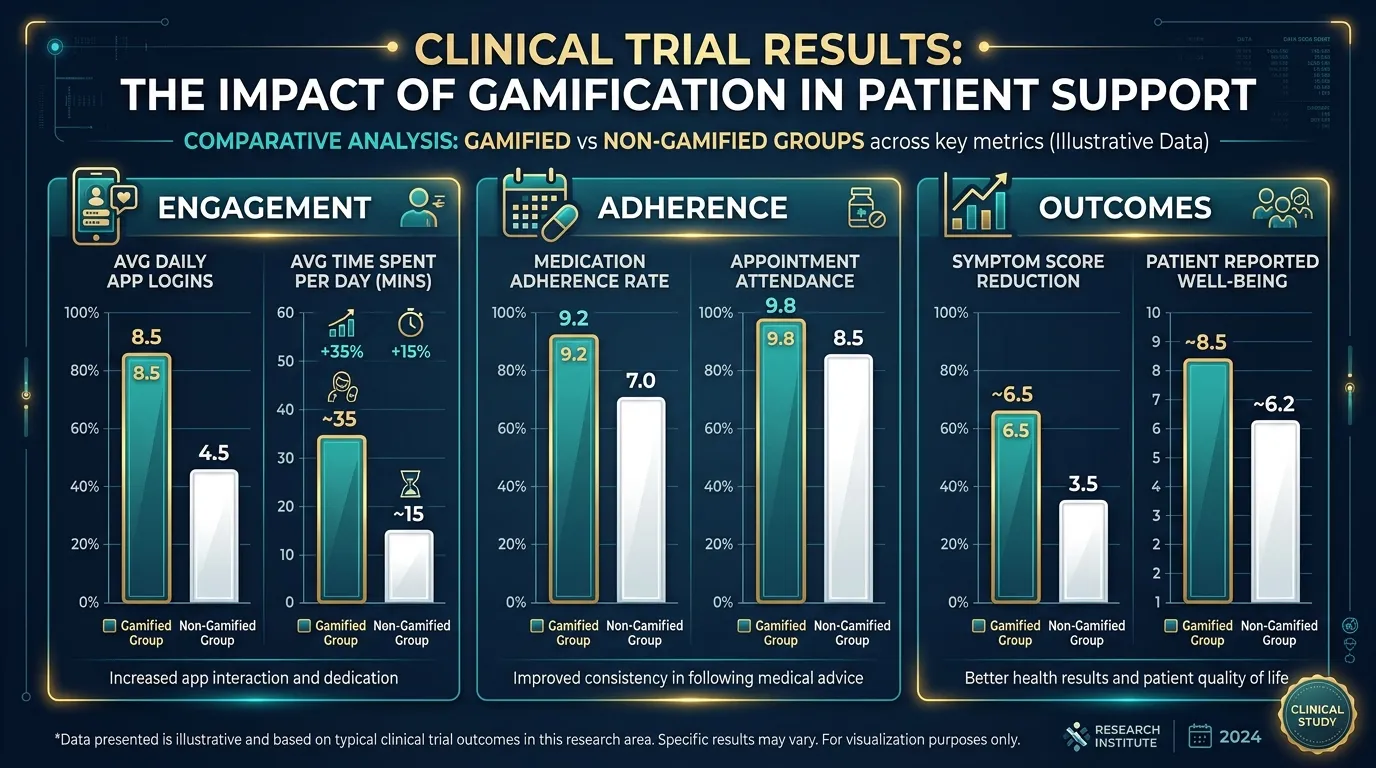
"Backed by science" is the most overused phrase in fitness. Every protein powder, recovery gadget, and Instagram influencer claims it. Here's what it actually looks like when you check the receipts.
We're talking randomized controlled trials — the gold standard of research — published in the most selective medical journals on the planet. Not blog posts. Not testimonials. Not "a study found." Actual clinical evidence with control groups and peer review.
And it all points in the same direction: gamification makes people move more.
The Numbers (No Hedging, Just Data)
Let's skip the buildup and hit you with the five stats that matter most:
- +2,183 steps/day — The MapTrek trial turned walking into a virtual race. Participants in the gamified group walked over two thousand additional steps daily compared to controls. (n=146)
- +1,384 steps/day — The ENGAGE trial used self-chosen goals and loss-framed points. Participants picked their own targets, then risked losing points if they didn't hit them. The result: nearly 1,400 extra steps every single day. (n=500, published in JAMA Cardiology)
- +920 steps/day — The STEP UP trial, published in JAMA Internal Medicine, tested three gamification approaches head-to-head. Competition beat collaboration and individual play. (n=602)
- 53% vs. 32% goal achievement — The BE FIT trial found that gamified participants were 66% more likely to hit their activity goals than the control group. (n=200)
- Hedges' g = 0.42 — Across a meta-analysis of 16 RCTs with 2,407 participants, gamification produced a moderate positive effect on physical activity. That translates to roughly 1,421 extra steps per day.
These aren't cherry-picked findings from obscure journals. They're from JAMA Internal Medicine, JAMA Cardiology, JAMA Network Open, and the American Heart Association's JAHA. This is where the most rigorous research in medicine gets published.
What Kinds of Gamification Work Best
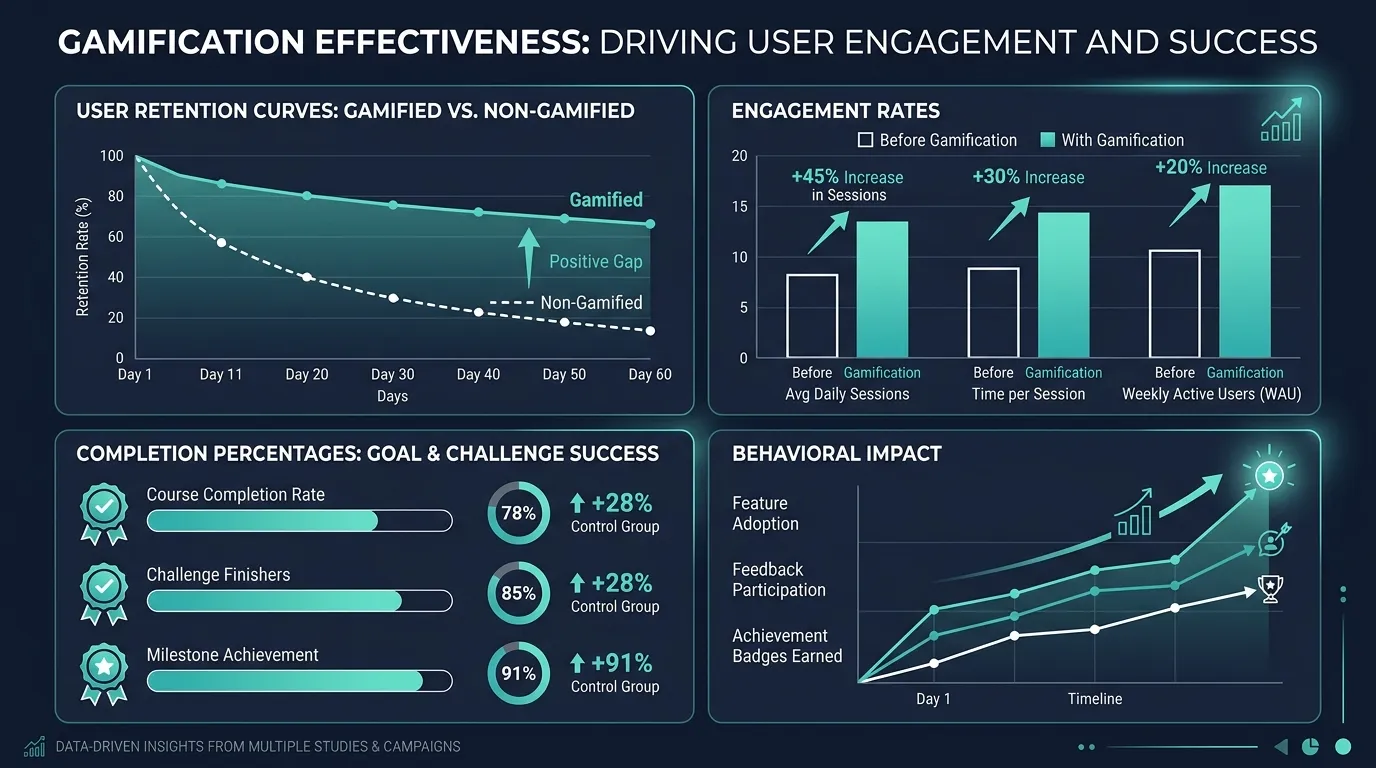
Not all game mechanics are created equal. The research is specific about what drives results:
Competition outperforms collaboration. The STEP UP trial tested this directly. Competition drove +920 steps/day. Collaboration? Lower. When you can see where you stand relative to other people, you push harder. Leaderboards work because humans are wired to care about rank.
Self-chosen goals beat assigned goals. The ENGAGE trial let participants pick their own step targets. When people choose their own bar, they're more invested in clearing it. Autonomy turns a task into a challenge you own.
Loss framing beats reward framing. Several of these trials used loss-framed incentives — you start with points and lose them if you miss your target. This leverages loss aversion, one of the strongest findings in behavioral economics. The threat of losing something you already have is more motivating than the promise of gaining something new.
Put those three together — competition, self-chosen goals, and loss-framed mechanics — and you have the recipe the clinical evidence supports.
See the science in action
FitCraft is built on the gamification mechanics proven in these clinical trials. Take the free 2-minute assessment to see how it works for you.
Take the Free Assessment Free · 2 minutes · No credit cardIt's Not Just Steps — It Lasts
The obvious follow-up question: does the effect disappear when the game stops?
No.
The ENGAGE trial tracked participants through a 12-week follow-up after the intervention ended. The increased activity levels held. Participants had built new habits during the gamified period, and those habits stuck.
The GAMEPAD trial (n=103) went one step further. Effects actually grew during the post-intervention period. Let that sink in — people were more active after the gamification ended than during it. The game mechanics had kickstarted a behavior pattern that became self-sustaining.
This is the critical distinction between gamification and simple rewards. A one-time incentive creates a one-time action. A well-designed gamification system rewires the habit loop itself. The game is the scaffolding. The habit is the building. Once the building stands on its own, the scaffolding can come down.
This Isn't Niche Research
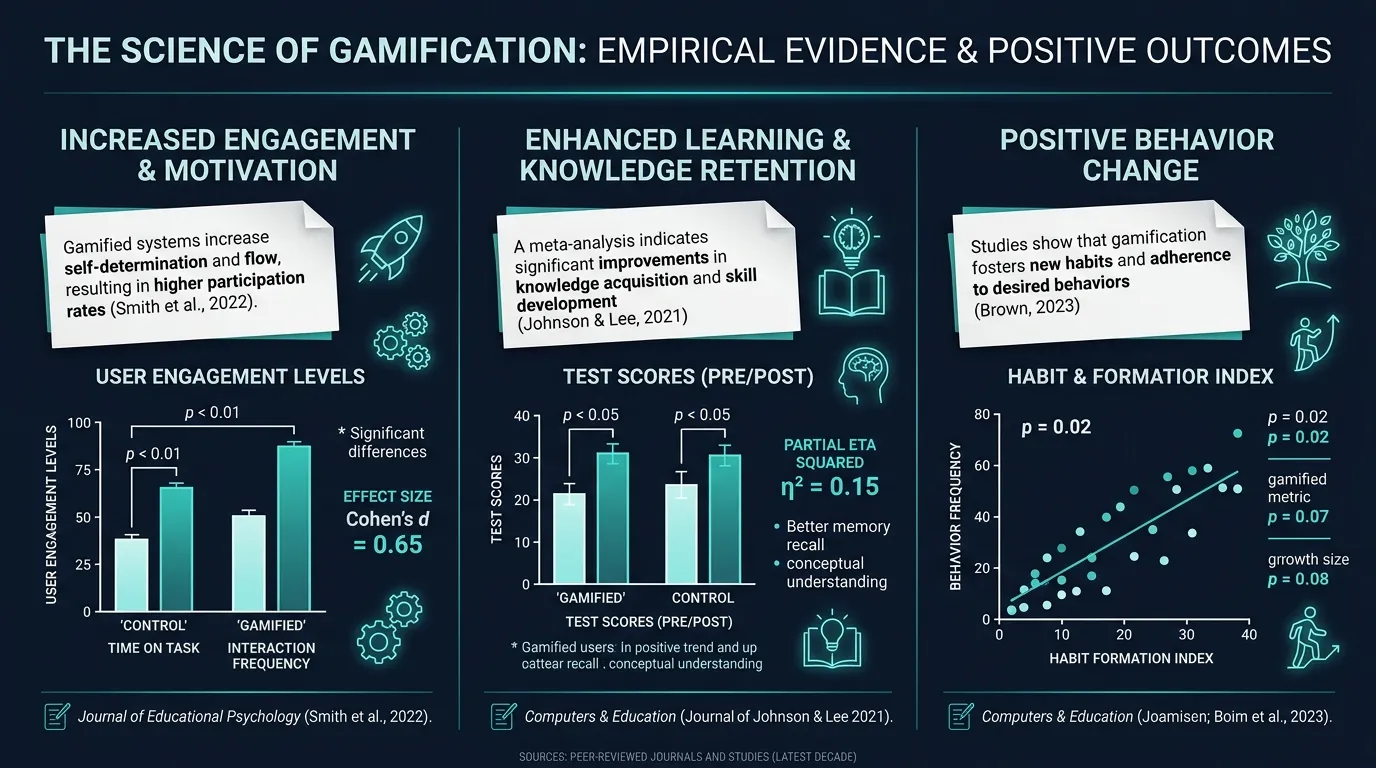
One of the most impressive things about this body of evidence is who it studied. These aren't trials run exclusively on college students in a lab (the usual criticism of psychology research). The populations are remarkably diverse:
- Cancer survivors — The ALLSTAR trial (n=150) found gamification drove +759 steps/day and +16 minutes of moderate-to-vigorous physical activity per week in cancer survivors. Published in JAMA Network Open.
- People with type 2 diabetes — Multiple trials have tested gamified step interventions in diabetic populations with positive results.
- Stroke patients — Gamified rehabilitation programs have been tested in post-stroke recovery.
- Postpartum women — Trials have studied gamification as a tool for returning to physical activity after pregnancy.
- Veterans — The VA system has funded gamified fitness research with veteran populations.
- Adults over 70 — This works for older adults, not just the 25-year-old gym crowd.
When a single intervention approach shows positive results across cancer survivors, stroke patients, new mothers, veterans, elderly adults, and the general population, that's not a trend. That's a signal.
And in 2024, a meta-regression published in eClinicalMedicine (a Lancet journal) confirmed the pattern at scale: apps that include gamification outperform apps that don't. Full stop. If you're deciding which one to actually download, we measured the leading gamified fitness apps against these same findings.
How FitCraft Applies All of This
FitCraft wasn't built on vibes. Every gamification feature maps directly to a finding from this research:
- XP leveling and progression — Progression mechanics drove strong engagement across multiple trials. FitCraft uses XP leveling and avatar progression to tap into that same mechanism.
- Personalized quests with self-chosen goals — ENGAGE showed self-chosen goals outperform assigned ones. FitCraft's AI coach Ty builds quests around your targets, not generic ones.
- Streak systems with loss framing — The loss-framed approaches in multiple trials produced the highest adherence. FitCraft's streak system and XP points use the same principle — you protect what you've earned.
- Progression and collectibles — Avatar leveling, collectible cards, and unlockable content create the layered reward ecosystem that keeps engagement high across multiple motivational pathways.
The difference between FitCraft and a standard fitness app isn't the exercises. It's the behavioral architecture around them. And that architecture is built on 15 clinical trials and 2,500+ participants worth of evidence.
Seeing it applied helps: FitCraft's gamified workout app shows what these findings look like once they are built into a real training plan.
Frequently Asked Questions
Does gamification actually work for fitness?
Yes. A meta-analysis of 16 randomized controlled trials with 2,407 participants found that gamified fitness interventions produced a moderate positive effect (Hedges' g = 0.42) and an average increase of roughly 1,421 additional steps per day. These studies were published in top-tier journals including JAMA Internal Medicine and JAMA Cardiology.
What kind of gamification works best for exercise?
Research shows that competition-based gamification and self-chosen goals produce the strongest results. The STEP UP trial found competition drove +920 steps/day, while the ENGAGE trial showed self-chosen goals drove +1,384 steps/day. Loss-framed incentives — where you risk losing points or streaks — also outperform reward-only approaches.
Do the effects of gamified fitness apps last long-term?
Yes. The ENGAGE trial showed that participants maintained increased activity levels through a 12-week follow-up after the intervention ended. The GAMEPAD trial found that effects actually grew during the post-intervention period, suggesting that gamification helps build lasting habits rather than temporary motivation.
Is gamified fitness only for young, healthy people?
No. The research spans remarkably diverse populations including cancer survivors, people with type 2 diabetes, stroke patients, postpartum women, veterans, and adults over 70. Gamification has shown positive results across all of these groups, making it a broadly applicable approach to increasing physical activity.
How does FitCraft use gamification science?
FitCraft builds directly on the mechanisms proven in clinical research: XP leveling and progression systems, self-chosen goals through personalized quests, loss-framed motivation through streak systems, and collectible cards with avatar progression. Every gamification feature maps back to a specific finding from the research.