You don't need a gym to get strong. That statement might sound like wishful thinking — something you'd see on an Instagram post from someone doing handstand push-ups on a cliff. But the peer-reviewed evidence backs it up, and it backs it up with specific numbers.
The question isn't whether bodyweight training works. It does. The real question is: what results can you actually expect, how long will they take, and what does the research say about the ceiling?
If you've been told you need barbells, dumbbells, or machines to build real muscle, this article will challenge that assumption with clinical data. And if you've been doing bodyweight workouts but wondering whether your results are "real" — the science has good news.
The Research: Can Bodyweight Training Build Muscle?
The traditional fitness industry has long positioned equipment-based training as the only path to serious muscle growth. But a growing body of research challenges that assumption directly. We put the two approaches side by side, including the point where bodyweight stops providing enough load to keep progressing, in our calisthenics vs weights guide.
Push-Ups vs. Bench Press: The Head-to-Head Trial
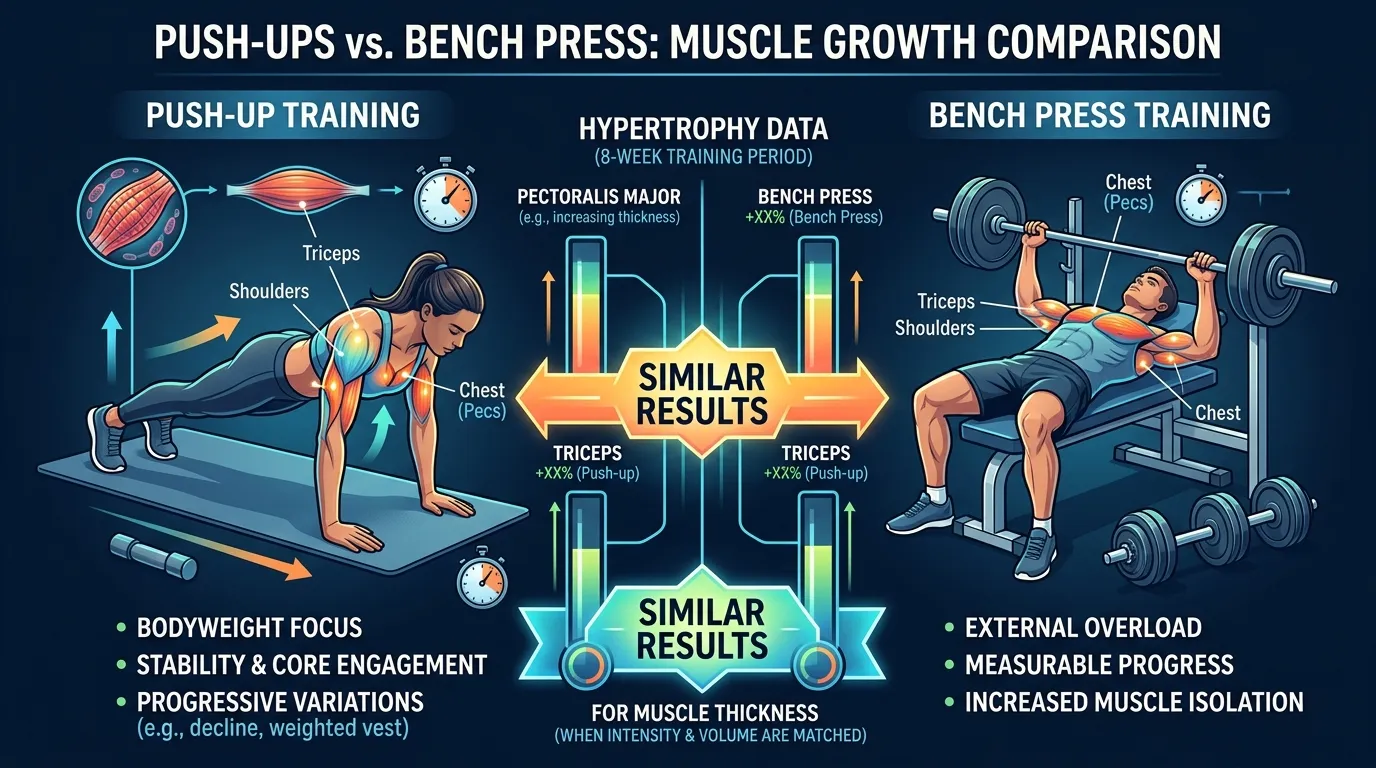
A 2017 randomized controlled trial by Kikuchi and Nakazato (PMC5812864) asked a simple question: if you match the load, do push-ups build as much muscle as bench press? The ladder that gets you from an incline to a clean floor rep, rung by rung, is laid out in our push up progression guide.
Eighteen men were randomly assigned to either a push-up group or a bench press group, training twice per week for 8 weeks. The push-up group used modified positions (such as kneeling) to match the load at approximately 40% of their one-repetition maximum — the same intensity used by the bench press group.
The results were nearly identical:
- Pectoralis major thickness: Similar increases in both groups
- Triceps thickness: Similar increases in both groups
- 1RM bench press strength: Both groups improved significantly
The only difference? Biceps thickness increased more in the bench press group — likely because the bench press involves a greater biceps contribution during the eccentric phase. But for the primary pushing muscles (chest and triceps), push-ups produced equivalent muscle growth to bench press training.
Progressive Calisthenic Push-Up Training
A 2018 study by Kotarsky and colleagues tested progressive calisthenic push-up training against traditional bench press in 23 moderately trained men over 4 weeks (3 sessions per week). Rather than matching loads, this study asked whether progressively harder push-up variations could produce comparable results to weight training.
Both groups showed significant increases in muscle strength. The push-up group actually showed significantly greater improvement in push-up progression, while bench press improvements were similar between groups. This study demonstrated that progressive bodyweight training — advancing from easier to harder variations — provides a viable alternative to adding weight plates.
The Low-Load Hypertrophy Meta-Analysis
The most comprehensive evidence comes from Schoenfeld and colleagues' 2017 systematic review and meta-analysis, published in the Journal of Strength and Conditioning Research. They analyzed 21 studies comparing low-load resistance training (60% of 1RM or less) against high-load training (above 60% of 1RM).
Their conclusion was unambiguous: muscle hypertrophy was similar between low-load and high-load conditions. The critical factor wasn't how heavy the weight was — it was whether sets were taken close to muscular failure.
This finding was reinforced by a 2020 meta-analysis (PMC7706639) specifically examining muscle fiber hypertrophy, which found no significant difference between low-load and high-load training for either Type I or Type II muscle fibers.
What does this mean for bodyweight training? There are multiple ways that you can achieve a similar result when it comes to fitness. If the exercise challenges you near the point of failure, the amount of hypertrophy you experience will be similar in many cases. It won't be exactly the same because the type of muscle fibers that adapt, and the specific pathway by which they adapt, differ a bit, but you'll see a roughly similar increase in muscle size. This is particularly true for someone who is newer to resistance training. People who are more advanced often require more resistance than their body can provide when trying to build muscle. But, for a beginner under the right circumstances, a set of 20 push-ups to failure results in a similar amount of total growth as a set of 8 bench presses to failure with heavy weight. Regardless, even in the situations where traditional resistance training with weights is more beneficial for you, you can still use bodyweight training as a tool to improve the amount of muscle you gain. Even if it's not at a similar rate or to a similar degree. Progress is still progress, and it's best to work with what you have, to make the most of your circumstance.
Cardiovascular Fitness: Bodyweight Training Delivers
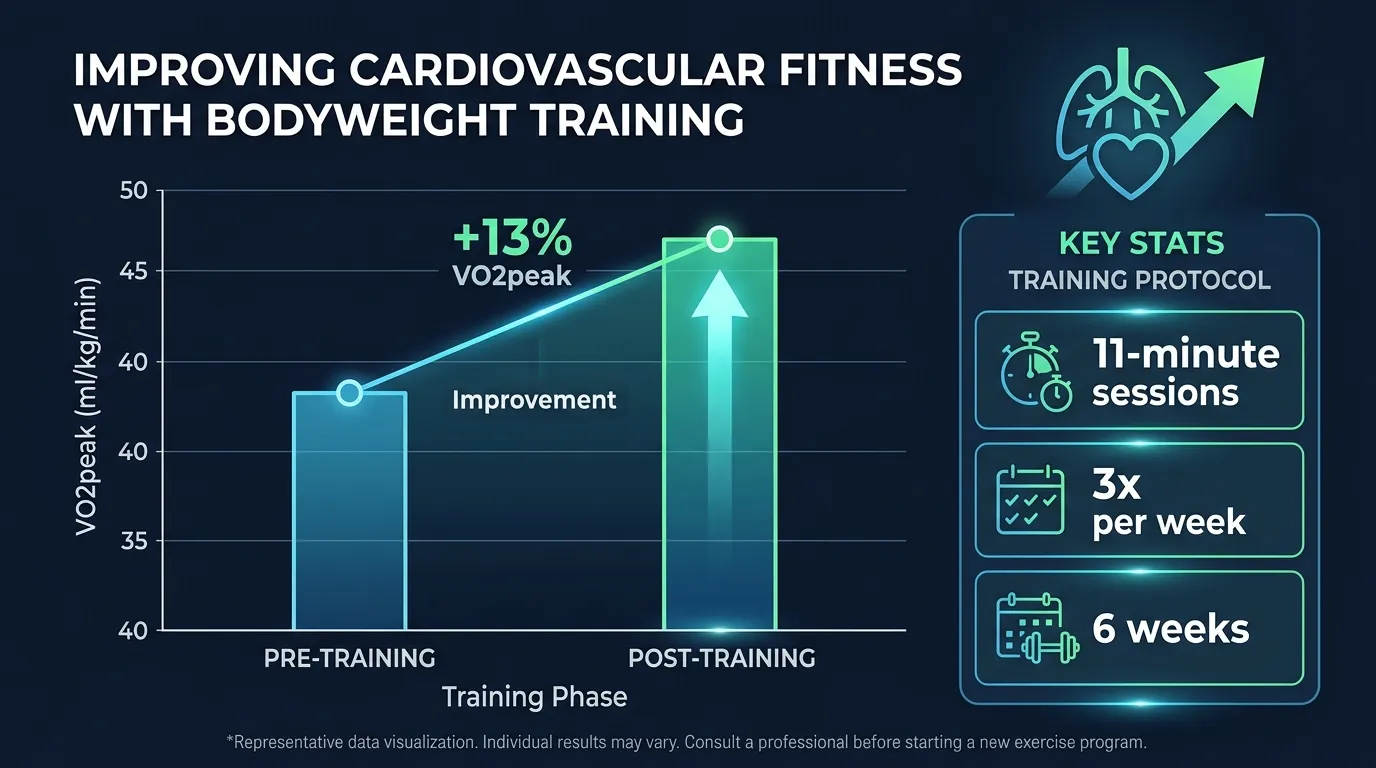
Bodyweight training isn't just about muscle. A 2021 study from McMaster University (PMC8136567) tested a modernized version of the classic 5BX (Five Basic Exercises) protocol — a bodyweight-only routine that takes just 11 minutes per session.
The protocol was straightforward: burpees, high knees, split squat jumps, high knees again, and squat jumps — each performed for 60 seconds at a self-selected "challenging" pace, with walking recovery between exercises. Participants trained 3 times per week for 6 weeks.
The results:
- VO₂peak was significantly higher in the training group compared to controls (34.2 vs 30.3 ml/kg/min, P=0.03) — approximately a 13% improvement
- Peak power output was also significantly higher (211 vs 191 watts, P=0.004)
- These improvements came from just 33 minutes of total weekly training time
The researchers concluded that simple bodyweight training, requiring minimal time commitment and no specialized equipment, can meaningfully enhance cardiorespiratory fitness in previously inactive adults. That's not a marginal result. A 13% improvement in VO₂peak from 11-minute sessions is clinically significant.
Fat Loss and Body Composition
A major overview of 12 systematic reviews and 149 studies (PMC8365736) examined the effects of exercise training on body composition in overweight and obese adults. The findings apply directly to bodyweight training:
- Exercise training produced significant fat loss ranging from 1.3 to 2.6 kg of fat mass
- Resistance training combined with caloric management was the most effective approach, reducing body fat percentage by an average of 3.8%
- Each additional 30 minutes per week of exercise was associated with 0.52 kg of body weight reduction and 0.37% decrease in body fat
Bodyweight exercises qualify as resistance training. When you do push-ups, squats, lunges, and planks, you are performing resistance training — the resistance simply comes from gravity acting on your body rather than from an external load. The metabolic and body composition benefits follow the same physiological pathways. For the pressing half of that in practice, our guide to a chest workout at home shows how to keep raising the load once body weight alone stops being hard.
Enjoying the article?
Start a new fitness routine today, written by me and coached by the AI I designed.
Take the Free Assessment Free · 2 minutes · No credit cardCommon Misconceptions
Misconception 1: "You can't build muscle without heavy weights"
This is the most persistent myth in fitness, and the research directly contradicts it. Schoenfeld's meta-analysis of 21 studies found equivalent hypertrophy between low-load and high-load training when exercises are performed to failure. Your muscles respond to mechanical tension and metabolic stress — not to the number printed on a dumbbell. A challenging set of archer push-ups creates as much tension in your chest as a set of bench presses.
Misconception 2: "Bodyweight exercises are only for beginners"
Bodyweight training has an almost unlimited progression ceiling. Once standard push-ups become easy, you progress to diamond push-ups, decline push-ups, archer push-ups, single-arm push-ups, planche progressions, and beyond. Once bodyweight squats are comfortable, you move to pistol squat progressions, shrimp squats, and plyometric variations. Elite gymnasts — among the most muscular athletes in any sport — train primarily with bodyweight. The ceiling is as high as you're willing to climb.
Misconception 3: "You need at least an hour for a real workout"
The 5BX bodyweight study (PMC8136567) produced significant cardiovascular improvements with 11-minute sessions, 3 times per week. That's 33 minutes per week total. While more training volume generally produces more results, the idea that anything under 60 minutes is "not a real workout" has no scientific basis. Short, intense bodyweight sessions produce measurable physiological adaptations.
How to Progress Without Equipment
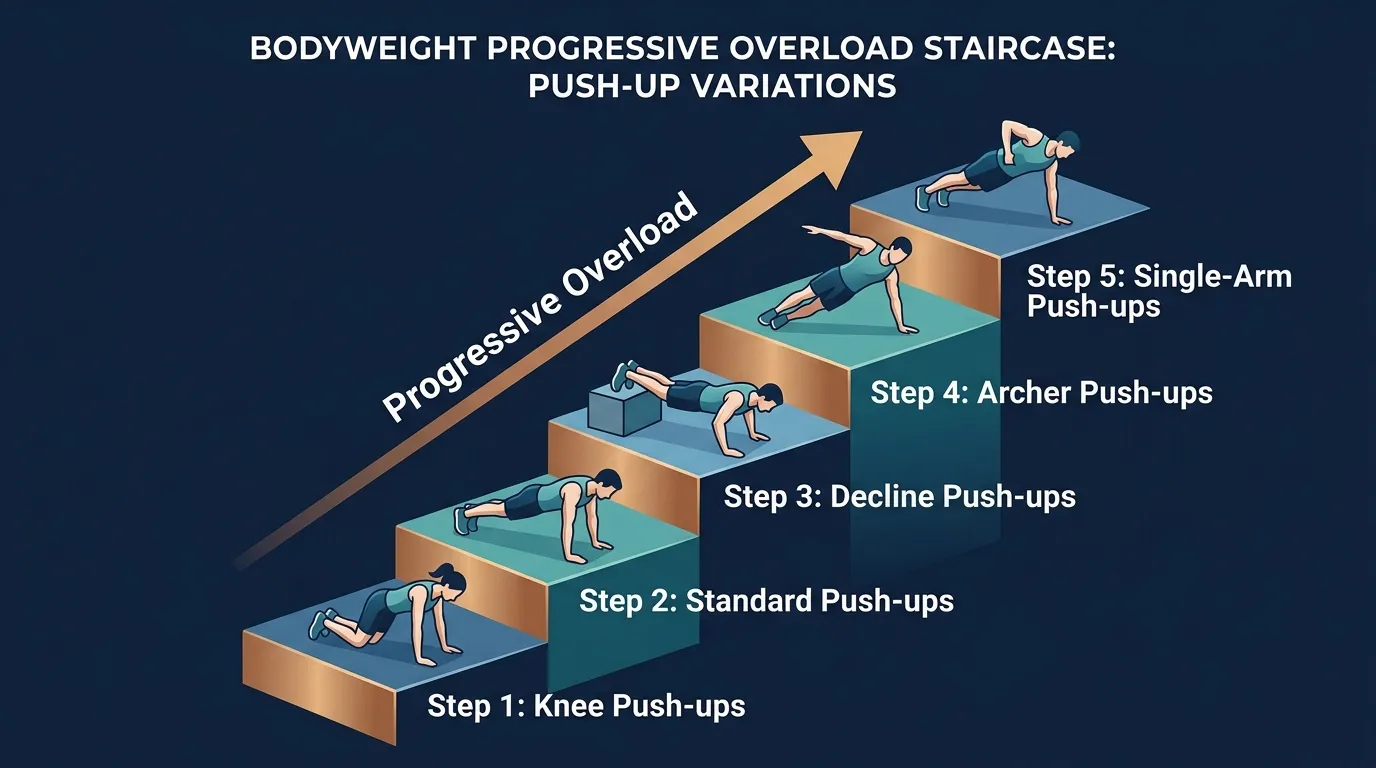
The key principle underlying all the positive research is progressive overload — systematically increasing the challenge over time. With weights, you add plates. With bodyweight, you have several progression strategies:
- Variation progression: Move from easier to harder exercise variations (knee push-ups → standard → decline → archer → single-arm)
- Volume progression: Add more reps or sets within the same time frame
- Tempo manipulation: Slow down the eccentric (lowering) phase to increase time under tension
- Range of motion: Increase depth or range (half squats → full squats → deep squats)
- Rest reduction: Shorter rest periods between sets increase metabolic stress
- Unilateral training: Single-leg or single-arm variations approximately double the load per limb
The research is clear: when these progression strategies are applied systematically, bodyweight training continues to produce hypertrophy and strength gains well beyond the beginner stage.
Where FitCraft Fits In
The research proves bodyweight training works. The challenge is doing it consistently and progressively — because that's where most people fail. You start strong, do push-ups for a week, run out of ideas for progression, get bored, and stop.
That's not a discipline problem. It's a design problem.
FitCraft offers bodyweight strength workouts alongside yoga, mobility, cardio, and dynamic movement — all designed to be done with no equipment. But the real difference isn't the exercises themselves. It's the system built around them:
- AI-powered progression: FitCraft's AI trainer adapts your workouts based on your progress, so you're always training at the right intensity — not too easy (no stimulus), not too hard (burnout risk)
- Interactive 3D exercise demos: Instead of static images or videos, FitCraft provides 3D models you can rotate with pinch-and-zoom camera control to see proper form from any angle
- Gamification that drives consistency: XP, leveling up, collectible cards, and calendar tracking with rewards — the research shows consistency matters more than intensity, and game mechanics are what keep you showing up past week 3
- Adaptive encouragement: The AI trainer provides personalized motivation that adapts to your patterns, not generic "You got this!" messages
The bodyweight training research consistently shows one thing: results come from progressive, consistent training performed near failure. FitCraft's entire design — from the AI progression to the streak system — is built to ensure you do exactly that, session after session, without needing to think about programming.
Mike, 23, put it simply: "The streak system got me hooked. I didn't want to break my chain." He became visibly stronger in 4 months using the app. The science says bodyweight training builds muscle. The question is whether you'll do it long enough to see the results. That's the problem FitCraft solves.
What the Research Suggests Going Forward
The evidence for bodyweight training effectiveness is strong, but it comes with important caveats worth acknowledging:
- Most studies use young, healthy populations. More research is needed on bodyweight training outcomes across age groups, fitness levels, and health conditions — though preliminary data in older adults is encouraging.
- Maximum strength development favors heavy loading. If your goal is to deadlift 500 pounds, bodyweight training alone won't get you there. For general strength, muscle building, and fitness, bodyweight training is sufficient for most people's goals.
- Progressive overload requires creativity. With weights, progression is simple: add more weight. With bodyweight, you need to understand variation progressions — or use a system that programs them for you.
- Consistency is the strongest predictor of results. The best training program is the one you actually do. If bodyweight training removes barriers (gym commute, equipment cost, scheduling constraints) that prevent you from exercising, the "inferior" modality becomes the superior choice for you.
The bottom line: bodyweight training produces real, measurable results in muscle growth, cardiovascular fitness, and body composition. The research doesn't suggest you need to choose between bodyweight and weights. It suggests you need to train consistently, progressively, and close to failure — and the modality that lets you do that most reliably is the best one for you.
References
- Kikuchi, N. & Nakazato, K. "Low-load bench press and push-up induce similar muscle hypertrophy and strength gain." Journal of Exercise Science & Fitness 15.2 (2017): 37-42. PMC5812864.
- Schoenfeld, B.J., Grgic, J., Ogborn, D. & Krieger, J.W. "Strength and Hypertrophy Adaptations Between Low- vs. High-Load Resistance Training: A Systematic Review and Meta-analysis." Journal of Strength and Conditioning Research 31.12 (2017): 3508-3523. PubMed 28834797.
- Archila LR, Bostad W, Joyner MJ, Gibala MJ. "Simple Bodyweight Training Improves Cardiorespiratory Fitness with Minimal Time Commitment: A Contemporary Application of the 5BX Approach." International Journal of Exercise Science 14.3 (2021): 93-105. PMC8136567.
- Grgic, J. et al. "The Effects of Low-Load Vs. High-Load Resistance Training on Muscle Fiber Hypertrophy: A Meta-Analysis." Journal of Human Kinetics 74 (2020): 51-58. PMC7706639.
- Kotarsky, C.J. et al. "Effect of Progressive Calisthenic Push-up Training on Muscle Strength and Thickness." Journal of Strength and Conditioning Research 32.3 (2018): 651-659. PubMed 29466268.
- Bellicha, A. et al. "Effect of exercise training on weight loss, body composition changes, and weight maintenance in adults with overweight or obesity: An overview of 12 systematic reviews and 149 studies." Obesity Reviews 22.4 (2021): e13256. PMC8365736.
Frequently Asked Questions
Can you build muscle with bodyweight exercises only?
Yes. A randomized controlled trial (PMC5812864) found that push-ups produced similar increases in pectoralis major and triceps muscle thickness as bench press training over 8 weeks. A meta-analysis of 21 studies (Schoenfeld et al., 2017) confirmed that muscle hypertrophy is similar between low-load and high-load resistance training when sets are performed to failure. Bodyweight exercises provide sufficient mechanical tension to stimulate muscle growth, especially in beginners and intermediates.
How long does it take to see results from bodyweight workouts?
Research suggests measurable improvements begin within 4-6 weeks of consistent training. A 6-week bodyweight training study (PMC8136567) found significant improvements in cardiorespiratory fitness (VO₂peak) with just 11-minute sessions three times per week. A 4-week progressive push-up study showed significant strength increases in trained men. Visible muscle changes typically become noticeable between weeks 6 and 12, depending on training consistency, nutrition, and starting fitness level.
Are bodyweight workouts as effective as weight training?
For muscle growth (hypertrophy), bodyweight training can be equally effective as weight training when exercises are performed to near-failure, according to multiple meta-analyses. For maximum strength development, weight training has an advantage because it allows precise load progression. For cardiovascular fitness, bodyweight circuits and high-repetition protocols can produce significant VO₂max improvements. The best approach depends on your specific goals.
What bodyweight exercises build the most muscle?
Research shows that compound bodyweight movements targeting large muscle groups produce the greatest hypertrophy stimulus. Push-up variations (standard, decline, archer) effectively target the chest, shoulders, and triceps. Squats and lunge variations target the quadriceps, glutes, and hamstrings. Pull-up variations (if available) are among the most effective upper-back and biceps builders. The key is progressive overload — advancing to harder variations as you get stronger.
Does FitCraft support bodyweight-only training?
Yes. FitCraft offers bodyweight strength workouts alongside yoga, mobility, cardio, and dynamic movement — all designed to be done with no equipment. The AI trainer adapts your workouts based on your progress, and interactive 3D exercise demos with pinch-and-zoom camera control show proper form for every movement. Gamification features like XP, leveling up, and collectible cards keep you consistent through the weeks where motivation typically fades.