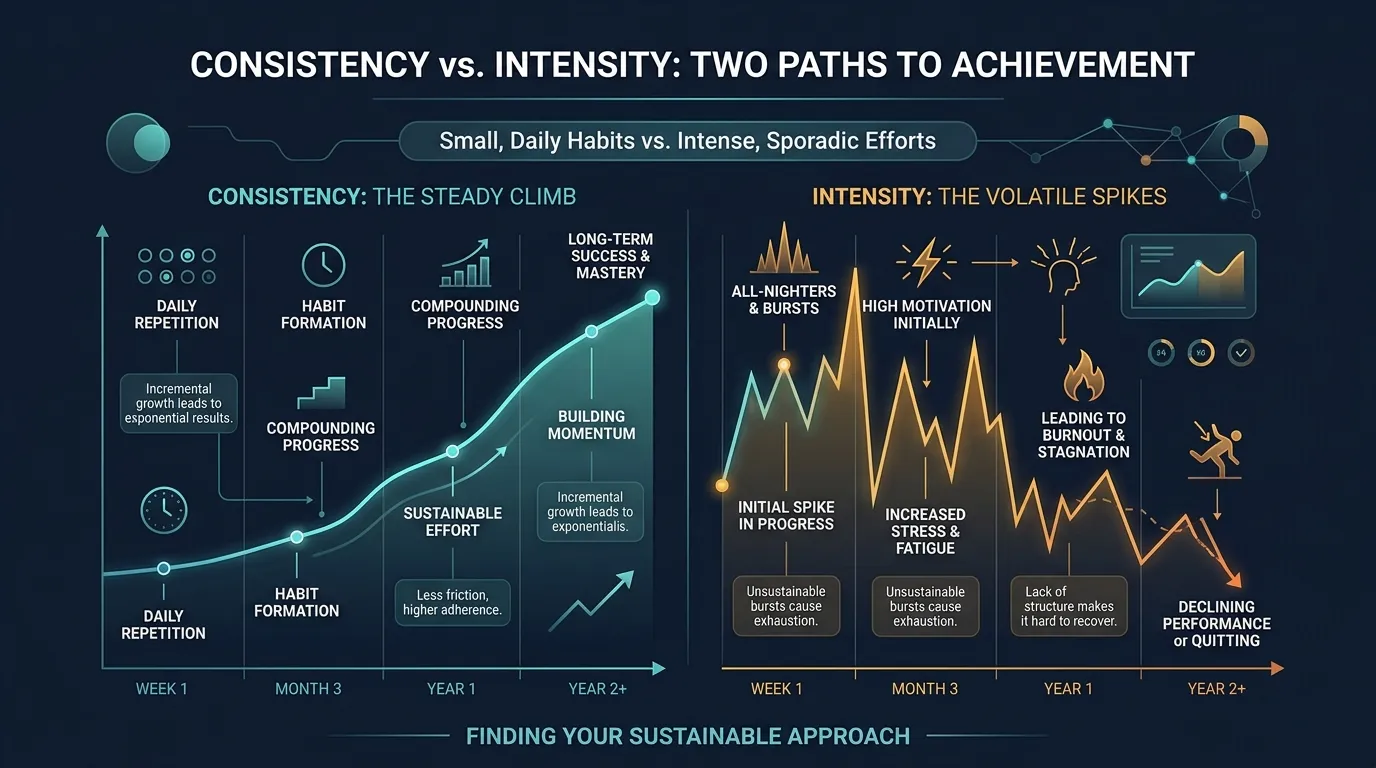
You've started before. Probably more than once. The first week felt great, the second week felt like work, and somewhere around week three you missed a Tuesday, then a Thursday, and then the whole thing quietly ended without you ever deciding to quit.
That pattern is so common it's almost a statistic. And the story you tell yourself afterward is usually some version of "I just don't have the discipline." That story is wrong, and it's expensive, because it sends you looking for more motivation when the actual failure was structural.
Here's the reframe that matters: consistency isn't a personality trait you either have or lack. It's an outcome produced by how a routine is designed. Change the design and the same person who quit three times becomes someone who trains for years. The research on exercise adherence is remarkably consistent about which design choices do the work.
When ADHD makes starting, waiting for a payoff, and tolerating repetition unusually expensive, the same principle needs a more specific design. Our ADHD workout guide maps those barriers to the structures that reduce them.
Why People Quit Working Out
Start with the numbers, because they're worse than most people assume and better than they feel.
A 2016 study in the Journal of Science and Medicine in Sport by Sperandei, Vieira and Reis tracked new fitness-center members in an unsupervised setting. 63% abandoned their activity before the third month, and fewer than 4% were still training continuously after 12 months. Those aren't people who lack character. That's what happens when a large group of ordinary humans meets a system that requires daily voluntary effort with no near-term payoff.
The same study found something more useful than the headline number. The members most likely to drop out were the ones driven mainly by extrinsic goals like weight loss, plus those with low prior activity and higher body mass. In other words, the people with the most to gain quit the most, because the reward they were chasing was months away and the cost was today.
That gap between immediate cost and delayed reward is the core mechanism. Four things widen it:
- The payoff is invisible for weeks. Neural adaptations come first and you can't see them. Visible change usually lags the effort by two to three months, which is exactly the window in which most people quit.
- The program was calibrated for a version of you who doesn't exist. Six days a week at maximum effort is a plan for someone with no job, no kids and no bad nights of sleep. When real life arrives, the plan has no reduced setting, so it breaks entirely.
- Every session requires a fresh decision. If working out is something you decide about each day, you'll lose that argument on the days you're tired, which are also the days that matter most.
- One missed day gets read as failure. This is the abstinence violation effect borrowed from relapse research. A person who has been perfect interprets a single slip as proof the whole attempt is over, which turns one missed Tuesday into a permanent stop. Our guide on what to do when you miss a workout unpacks that spiral in detail.
None of those are discipline problems. They're all design problems, and all four are fixable.
Consistency Beats Intensity, and the Research Isn't Close
Fitness culture rewards extremes. The hardest workouts get the most views, the most dramatic transformations get the most attention, and somewhere in that noise you absorbed the idea that a session which doesn't leave you wrecked doesn't count.
The evidence says the opposite. A 2019 systematic review and meta-analysis in the British Journal of Sports Medicine by Pedisic et al. pooled 14 studies covering 232,149 participants across 5.5 to 35 years of follow-up. Any amount of running, even once per week, below 8 km/h, for under 50 minutes, was associated with a 27% lower risk of all-cause mortality. More running wasn't dramatically better. Running at all was dramatically better than not running.
The same pattern shows up in strength work. Schoenfeld, Ogborn and Krieger (2016) found in Sports Medicine that training a muscle group two or more times per week produced significantly greater hypertrophy than training it once weekly, even when total training volume was equated. The variable that moved the outcome wasn't how hard a session was. It was how often you showed up.
Put those together and the practical conclusion is uncomfortable for gym culture: the biggest gap in results isn't between moderate exercisers and intense exercisers. It's between people who train consistently and people who don't.
The Minimum Effective Dose
Exercise science borrows a term from pharmacology: the minimum effective dose, meaning the smallest stimulus that still produces a meaningful adaptation. Your muscles don't need to be destroyed to grow. Your cardiovascular system doesn't need to be pushed to failure to improve. Both need a repeated signal that says this is important, adapt to it.
- Strength: as few as two sessions per week per muscle group at moderate intensity, roughly 60 to 80% of your one-rep max, produces meaningful gains. Training to failure on every set is optional and often counterproductive.
- Cardiovascular health: the World Health Organization recommends 150 minutes of moderate activity per week, about 30 minutes across five days. Even half that shows measurable benefit compared with being sedentary.
- Body composition: moderate resistance work plus light cardio, three to four times a week, outperforms intense daily training that ends in burnout and rebound.
The point of the minimum effective dose isn't to do less for its own sake. It's that a dose you can repeat every week for a year beats a dose you abandon in five weeks. And starting below your ceiling gives you somewhere to go when a hard week arrives, instead of a plan that only has one setting.
What Actually Predicts Sticking With It
Behavioral science has a decent map of what separates people who keep training from people who stop. Almost none of it is about wanting it more.
Repetition in a Stable Context
Habits form through repetition in a consistent setting, which is how a behavior migrates from something you decide to something you just do. Lally and colleagues (2010) tracked 96 people forming a new daily behavior and found automaticity took a median of 66 days, with a range of 18 to 254 days. Exercise sat at the slow end. The 21-day figure you've heard everywhere is folklore with no supporting data.
For exercise specifically, Kaushal and Rhodes (2015) followed 111 new gym members over 12 weeks in the Journal of Behavioral Medicine and found a usable threshold: roughly four sessions per week for six weeks was the minimum required for exercise to register as habitual. Below that frequency, the behavior stayed effortful and dependent on intention.
The practical read: frequency does more for habit formation than duration does. Four short sessions beat two long ones if the goal is to stop negotiating with yourself.
Friction, and Removing It
Every step between deciding to train and starting to train is a place where the plan can die. Driving 25 minutes to a gym is friction. Not knowing what today's workout is, is friction. Hunting for your shoes, your headphones and a clean shirt is friction.
Reducing friction sounds trivial. It isn't. Laying out clothes the night before, keeping a set of bands where you actually train, having tomorrow's session already written down, and shrinking the default session to something you can finish in twenty minutes all remove decisions from a moment when your decision-making is at its worst. Short workouts aren't a compromise here, they're a consistency tool.
Cue Design and Implementation Intentions
The single best-evidenced trick in behavior change is embarrassingly simple: decide in advance exactly when and where. Gollwitzer and Sheeran (2006) meta-analyzed 94 independent tests of implementation intentions and found a medium-to-large effect on goal attainment (d = 0.65). The format is "I will [behavior] at [time] in [location]."
"I will train more" isn't a plan. "I will do 25 minutes of strength work at 6:30 AM in the living room, Monday, Wednesday, Friday and Saturday" is. Anchoring the session to an existing routine, a technique usually called habit stacking, works for the same reason: the cue already fires reliably, so you're borrowing an existing trigger instead of building a new one. A fixed morning slot is the most protected time of day for most people, which is why building a morning workout habit tends to survive a chaotic week better than an evening plan.
Identity
There is a real difference between "I'm trying to work out more" and "I'm someone who trains." The second one doesn't require a decision on a bad day. Rhodes, Kaushal and Quinlan (2016) meta-analyzed 32 studies in Health Psychology Review and found exercise identity correlated with physical activity behavior at r = 0.44, one of the strongest single predictors in the literature.
Identity is built by evidence, not by affirmation. Every completed session is a vote. This is also why a short workout you finish is worth more than a long workout you skip: it casts the vote either way.
Find out what's really holding you back
FitCraft, our mobile fitness app, pairs you with an AI coach who builds you a personalized plan around your goals, schedule, and fitness level. Every FitCraft program is designed by Domenic Angelino, MPH (Brown University) and NSCA-CSCS, with research published in the Journal of Strength and Conditioning Research and Medicine & Science in Sports & Exercise.
Take the Free Assessment Free • 2 minutes • No credit card
Tracking, Streaks and Immediate Reward
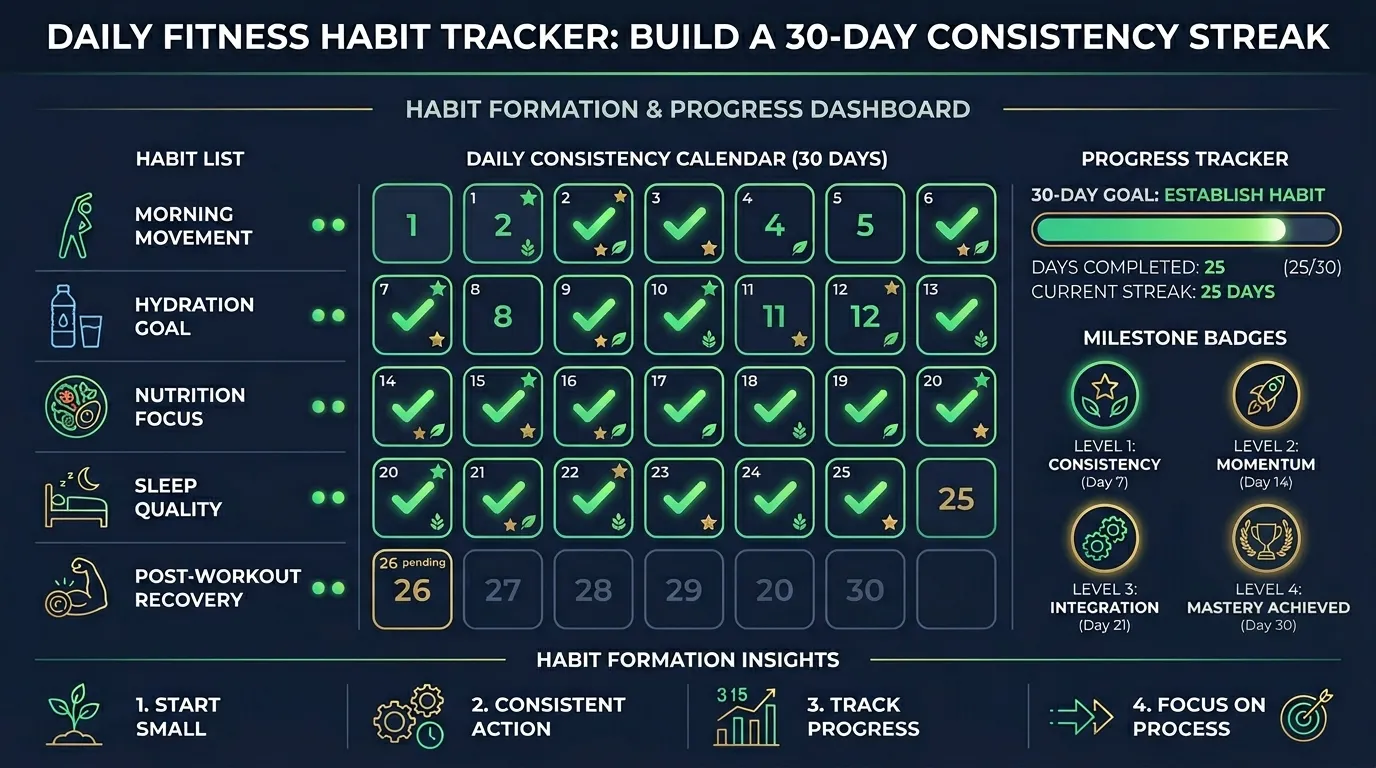
The reason exercise is hard to sustain is that the reward is delayed and the cost is now. Tracking systems work by manufacturing a reward that arrives today. A checked box, a logged session or an unbroken run of days gives the brain something it can register immediately.
The evidence here is real but modest, and worth stating honestly. A 2022 systematic review and meta-analysis in the Journal of Medical Internet Research by Mazeas et al. pooled randomized controlled trials of gamified physical activity interventions and found a small-to-moderate increase in physical activity (Hedges g = 0.42, 95% CI 0.14 to 0.69), and significantly more days of app usage in gamified conditions than non-gamified ones (113 days versus 81 days, p = 0.006). That 32-day gap is roughly the difference between quitting in month three and still being there when the habit sets.
The STEP UP trial (Patel et al., 2019) in JAMA Internal Medicine tested behaviorally designed gamification with social incentives in 602 adults and found meaningful step-count increases that persisted into a follow-up period after the intervention ended.
Streaks are the sharpest version of this and also the most double-edged. They work through loss aversion: once you have 30 days, skipping doesn't just cost a workout, it costs the 30 days. That same power is what makes a broken streak feel catastrophic, which is why how a streak system is designed matters more than whether one exists.
Social Accountability
Somebody expecting you is one of the most reliable adherence tools available, and it's underrated because it's unglamorous. Rackow, Scholz and Hornung (2015) ran an 8-week randomized study in the British Journal of Health Psychology where the intervention was simply finding a new exercise companion and training with them. Received emotional support predicted higher self-efficacy, more self-monitoring and better action planning, which are the mechanisms that actually carry behavior.
A training partner, a class with a roster, or a friend who gets a text after each session all do the same job: they convert a private promise into a public one.
Recovering From a Miss
Everyone misses. The people who stay consistent aren't the ones who never miss, they're the ones whose misses stay isolated.
The operating rule is never miss twice. One missed day is noise. Two in a row is the beginning of a new pattern, and by three the old pattern is gone. Lally's data supports the underlying claim: a single missed day didn't meaningfully damage habit formation. The streak in your head is far more fragile than the habit in your brain.
It helps to have a genuine minimum session defined in advance, something like ten minutes of bodyweight work, that counts as showing up. On a bad day you do the minimum instead of nothing, and the chain holds. The fresh start effect (Dai, Milkman & Riis, 2014) is the backup: if a chain does break, framing the restart as a new beginning rather than a continuation of failure measurably improves the odds of re-engaging.
A 4-Week Consistency Protocol
Here's the whole thing assembled into something you can start on Monday. The design goal for the first month isn't fitness. It's attendance. Progress comes after the pattern holds.
Week 1: Make It Too Small to Skip
- Pick four fixed slots and write them down with time and location. Four is the frequency threshold from Kaushal and Rhodes; fixed slots are the implementation intention.
- Cap every session at 20 minutes. Yes, even if you feel great. Especially if you feel great.
- Define your minimum session now: ten minutes of bodyweight work that counts as a completed day. You'll need it in week 3.
- Remove one piece of friction per slot. Clothes out the night before, workout written down in advance, equipment already where you train.
- Success this week is four checkmarks. Nothing else is being measured.
Week 2: Lock the Cue
- Keep the same four slots. Don't move them. The stable context is the mechanism, and moving it resets the clock.
- Attach each session to something that already happens reliably: after the morning coffee, straight after the school run, immediately after logging off.
- Start a visible record. Paper calendar, app, whiteboard, it doesn't matter. It needs to be something you see without looking for it.
- Tell one person your four slots. That's the cheapest version of social accountability and it costs you a single text.
- Still 20 minutes. Still four days. The restraint is the point.
Week 3: Survive the Dip
- This is the week most people quit. Novelty has worn off, results aren't visible yet, and the behavior isn't automatic. Expect it rather than being ambushed by it. Our guide to the week 3 motivation dip covers the mechanism.
- Apply never miss twice ruthlessly. If Tuesday goes, Wednesday is non-negotiable, even if it's the ten-minute minimum.
- Use the minimum session freely this week. A ten-minute day that happens beats a 45-minute day that doesn't.
- Don't add volume, don't change the program, don't switch apps. Changing the plan in week 3 feels productive and is almost always avoidance.
Week 4: Start Casting Votes for the Identity
- Add five minutes to two of the four sessions. That's the entire progression. Small enough that nothing breaks.
- Review the record. Sixteen sessions is the target; twelve or more means the pattern is holding and you should keep going unchanged.
- Change the language you use. "I train four days a week" instead of "I'm trying to get back into working out." Identity gets built from the evidence you just generated.
- Only after four weeks of held attendance should you touch the program itself: more days, longer sessions, or heavier loads, one variable at a time.
Run this and you finish week 6 at roughly 24 sessions, which is the neighborhood where Kaushal and Rhodes saw exercise start to feel automatic. You won't be in great shape at that point. You'll be someone who trains, which is the thing that produces great shape over the following year.
Where Apps Help, and Where They Don't
Being honest about this matters, because overselling the tool is part of why people churn through five apps in a year.
What a good app genuinely does:
- Removes the "what do I do today" decision. This is the biggest one. Decision fatigue kills more sessions than fatigue does.
- Supplies immediate feedback. Logging, streaks and progress views manufacture a same-day reward that exercise itself withholds for months.
- Keeps a record you can trust. Reviewing four weeks of completed sessions is how identity evidence accumulates where you can see it.
- Scales the session down instead of off. A program with a shorter option gives you a way to keep the chain alive on a bad day.
What no app can do:
- Manufacture a reason. If you don't have a reason to train that survives a bad week, notifications won't supply one.
- Fix a real time shortage. If you genuinely have 20 minutes, no app makes a 60-minute program fit. Choosing the smaller program is the fix.
- Replace a human expecting you. The Rackow findings were about a person, not a notification. A push alert isn't accountability, it's a reminder.
- Beat the effect sizes. Gamification produced g = 0.42 in the Mazeas meta-analysis. That's a real, useful nudge. It's not a transformation, and any app claiming otherwise is selling.
The right way to think about it: an app is scaffolding for the decision, not a substitute for one. If you want the side-by-side, we compared the options in the best fitness apps for consistency, and the motivation-focused breakdown covers how FitCraft approaches the weeks when motivation drops.
How FitCraft Approaches This
FitCraft was built around the observation that the problem is almost never bad programming. It's that people stop following good programming.
The design responses are the ones the research supports. The gamification layer gives each session an immediate outcome instead of a delayed one, through XP, leveling and collectible cards. Calendar tracking and calendar rewards create the visible record that turns completed sessions into evidence. Multi-week programs remove the daily "what do I do today" decision entirely. And you pick a 3D AI coach during onboarding, a character who demonstrates each movement on an interactive 3D model with pinch-and-zoom camera control and talks you through the session, so training at home has some of the structure of training with someone standing there. Workouts adapt as you progress, which keeps the difficulty in the range where showing up stays realistic.
None of that replaces the four-week protocol above. It's scaffolding for it.
As Matt, a FitCraft user, put it: "The real win is I actually want to work out now. That's never happened before."
Jim, 26, reported losing 24 lbs in 3 months, not through extreme intensity, but through consistent effort he kept up.
What to Expect
The honest timeline, so nothing catches you off guard.
In the first two weeks, changes are mostly neural. Your nervous system gets better at recruiting muscle you already have. You feel more coordinated and slightly stronger, and you look identical. Between weeks 4 and 8, structural change begins: muscle protein synthesis rises, tendons adapt, cardiovascular efficiency improves. By months 3 to 6, it becomes visible to other people. By month 12, it's simply what you do.
The catch is that stopping and restarting is expensive. Measurable detraining begins within one to three weeks of complete inactivity, and cardiovascular fitness declines faster than strength. The stop-start cycle means repeatedly rebuilding a foundation instead of building on one. That, not any single workout's intensity, is what separates a year of training from a year of trying.
The Bottom Line
The Takeaway
Staying consistent with working out is a design problem, and design problems have solutions. Pick four fixed slots, make each one small enough that a bad day can't cancel it, remove the friction between deciding and starting, track it somewhere you can see, and never miss twice.
Expect two to three months before it feels automatic, not 21 days. Expect week 3 to be the hardest. Expect the visible results to arrive well after the habit does, which is precisely why the habit has to be built on something other than results.
If you've quit three times, you don't need a harder program. You need a smaller one you will actually repeat, and a system that makes repeating it the path of least resistance.
Studies Referenced
- Sperandei, S., Vieira, M. C., & Reis, A. C. (2016). "Adherence to physical activity in an unsupervised setting: explanatory variables for high attrition rates among fitness center members." Journal of Science and Medicine in Sport, 19(11), 916-920. doi:10.1016/j.jsams.2015.12.522
- Lally, P., van Jaarsveld, C. H. M., Potts, H. W. W., & Wardle, J. (2010). "How are habits formed: Modelling habit formation in the real world." European Journal of Social Psychology, 40(6), 998-1009. doi:10.1002/ejsp.674
- Kaushal, N., & Rhodes, R. E. (2015). "Exercise habit formation in new gym members: a longitudinal study." Journal of Behavioral Medicine, 38(4), 652-663. doi:10.1007/s10865-015-9640-7
- Gollwitzer, P. M., & Sheeran, P. (2006). "Implementation intentions and goal achievement: A meta-analysis of effects and processes." Advances in Experimental Social Psychology, 38, 69-119. doi:10.1016/S0065-2601(06)38002-1
- Rhodes, R. E., Kaushal, N., & Quinlan, A. (2016). "Is physical activity a part of who I am? A review and meta-analysis of identity, schema and physical activity." Health Psychology Review, 10(2), 204-225. PMID 26805431
- Mazeas, A., Duclos, M., Pereira, B., & Chalabaev, A. (2022). "Evaluating the Effectiveness of Gamification on Physical Activity: Systematic Review and Meta-Analysis of Randomized Controlled Trials." Journal of Medical Internet Research, 24(1), e26779. doi:10.2196/26779
- Patel, M. S., Small, D. S., Harrison, J. D., et al. (2019). "Effectiveness of Behaviorally Designed Gamification Interventions With Social Incentives for Increasing Physical Activity Among Overweight and Obese Adults (STEP UP)." JAMA Internal Medicine, 179(12), 1624-1632. PMC6735420
- Rackow, P., Scholz, U., & Hornung, R. (2015). "Received social support and exercising: An intervention study to test the enabling hypothesis." British Journal of Health Psychology, 20(4), 763-776. doi:10.1111/bjhp.12139
- Pedisic, Z., Shrestha, N., Kovalchik, S., et al. (2019). "Is running associated with a lower risk of all-cause, cardiovascular and cancer mortality, and is the more the better? A systematic review and meta-analysis." British Journal of Sports Medicine, 54(15), 898-905. doi:10.1136/bjsports-2018-100493
- Schoenfeld, B. J., Ogborn, D., & Krieger, J. W. (2016). "Effects of Resistance Training Frequency on Measures of Muscle Hypertrophy: A Systematic Review and Meta-Analysis." Sports Medicine, 46(11), 1689-1697. doi:10.1007/s40279-016-0543-8
- Dai, H., Milkman, K. L., & Riis, J. (2014). "The Fresh Start Effect: Temporal Landmarks Motivate Aspirational Behavior." Management Science, 60(10), 2563-2582. doi:10.1287/mnsc.2014.1901
Frequently Asked Questions
How do I stay consistent with working out?
Stay consistent by lowering the difficulty of showing up rather than raising your discipline. The research points to five levers: repeat the workout in the same context so it becomes automatic, cut the friction between deciding and starting, pre-commit to a specific time and place, make the session short enough that a bad day cannot cancel it, and never miss twice in a row. Kaushal and Rhodes (2015) tracked 111 new gym members and found that roughly four sessions per week for six weeks was the threshold at which exercise started to feel automatic. Frequency of showing up matters more than how hard any single session is.
How long does it take for working out to become a habit?
There is no fixed number, but the best available estimate is a median of 66 days. Lally and colleagues (2010) tracked 96 people forming a new daily behavior and found automaticity took a median of 66 days, with a range of 18 to 254 days depending on the person and the difficulty of the behavior. Exercise sat at the slow end of that range. Kaushal and Rhodes (2015) found new gym members needed about four sessions per week for six weeks before exercise registered as habitual. Plan for two to three months of deliberate effort, not 21 days.
How many days a week should I work out to stay consistent?
Three to four sessions per week is the practical sweet spot for most people. It is frequent enough to build automaticity, since habit formation depends on repetition rather than session length, and sustainable enough to survive a busy week. Kaushal and Rhodes (2015) identified four bouts per week as the threshold associated with habit formation in new gym members. Schoenfeld and colleagues (2016) found that training a muscle group two or more times per week produced greater hypertrophy than once weekly even when total volume was matched. The best frequency is the one you can repeat for months.
What should I do if I miss a workout?
Do the next scheduled session and skip the guilt. A single missed workout has almost no physiological cost, since measurable detraining takes one to three weeks of complete inactivity. The real risk is the abstinence violation effect, where one slip gets read as total failure and triggers quitting. The practical rule is never miss twice: one missed day is noise, two in a row is the start of a new pattern. Lally and colleagues (2010) found that a single missed day did not meaningfully damage habit formation, which means the streak in your head is more fragile than the habit in your brain.
Do fitness apps actually help with workout consistency?
Some do, modestly, and mostly by adding structure and immediate feedback rather than motivation. A 2022 meta-analysis in the Journal of Medical Internet Research by Mazeas and colleagues found gamified interventions produced a small to moderate increase in physical activity (Hedges g = 0.42) and that gamified app users logged more days of use than non-gamified users (113 days versus 81 days). What apps cannot do is create meaning, handle a genuine time shortage, or replace the social accountability of another person expecting you. Treat an app as scaffolding for the decision, not a substitute for one.