You showed up. That matters more than you think.
Most people treat their first week of exercise like a test — something to survive before the "real" results start. But Week 1 isn't a warm-up. It's where the most dramatic internal changes happen. Your nervous system starts rewiring. Your cardiovascular system begins recalibrating. Your brain releases a cocktail of chemicals that, if you play it right, can become the foundation of a habit that lasts years.
The problem? Most people don't know any of this is happening. They feel sore, they feel uncertain, and they assume nothing is working. So they quit.
This guide breaks down exactly what's happening inside your body and mind during Days 1 through 7 — so you can recognize the progress you can't see in the mirror yet, and make decisions that carry you into Week 2 and beyond.
What's Happening in Your Body: The Physiology of Week 1
Your Brain Learns Before Your Muscles Grow
Here's something most fitness content won't tell you: the strength gains you experience in your first week have almost nothing to do with your muscles getting bigger. They're neural.
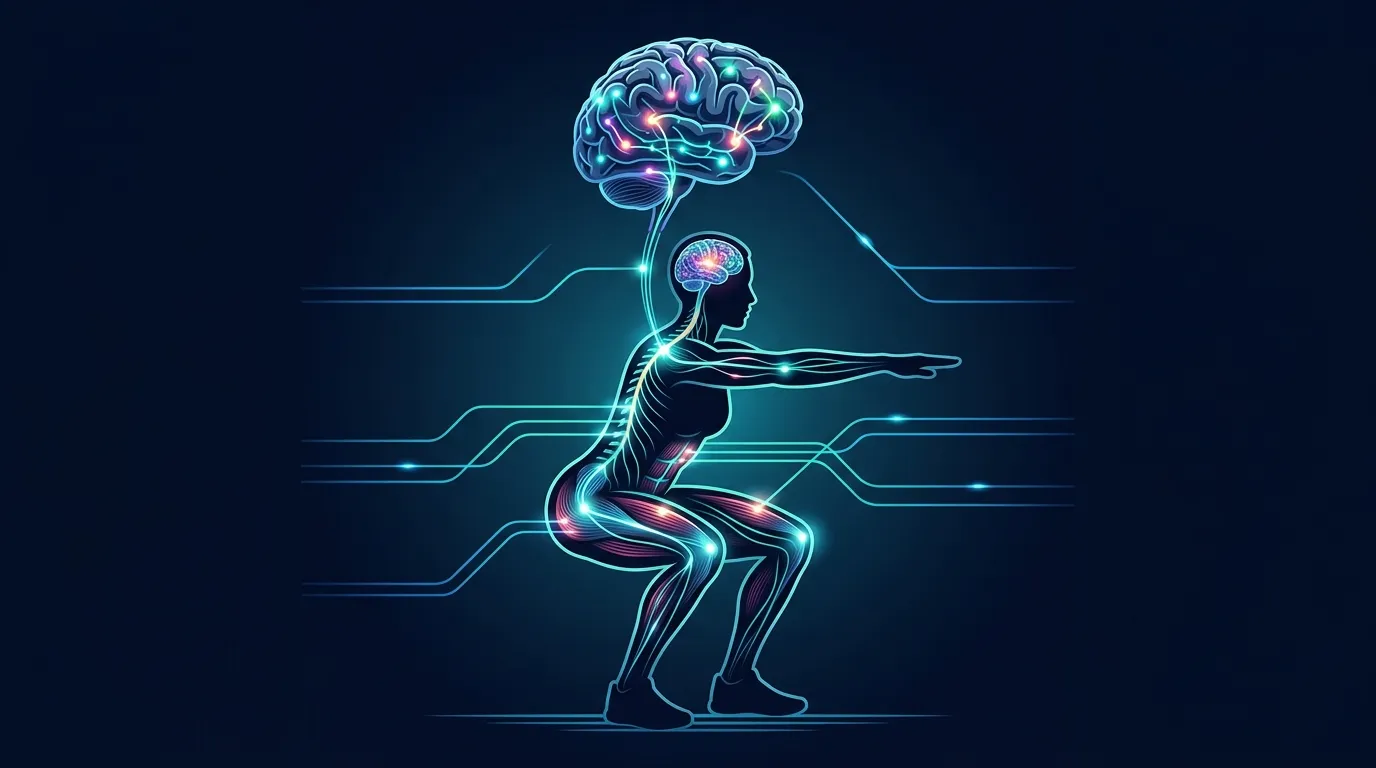
When you perform a movement for the first time — a squat, a push-up, a dumbbell row — your brain has to figure out which motor units to recruit, in what order, and how hard to fire them. This process is called neural adaptation, and it's the dominant mechanism behind early strength improvements.
A landmark study by Sale (1988), published in Neural Adaptation to Resistance Training, demonstrated that the initial strength gains during the first several weeks of a training program are primarily neural in origin. The nervous system becomes more efficient at activating muscle fibers, coordinating intermuscular timing, and reducing co-contraction of antagonist muscles — all before any measurable hypertrophy occurs. More recent research by Gabriel, Kamen, and Frost (2006) in Sports Medicine confirmed these findings, showing that motor unit recruitment and firing rate improvements can be detected within the very first training sessions.
What does this mean for you? Even though your muscles look the same on Day 7 as they did on Day 1, your nervous system is dramatically different. Movements that felt awkward and uncoordinated on Monday will feel smoother by Friday. That's not imagination — it's your brain literally getting better at controlling your body.
DOMS: Why You're So Sore (and Why That's Good)
Let's talk about the elephant in the room: you're sore. Maybe very sore. Maybe "I can't sit down on the toilet" sore.
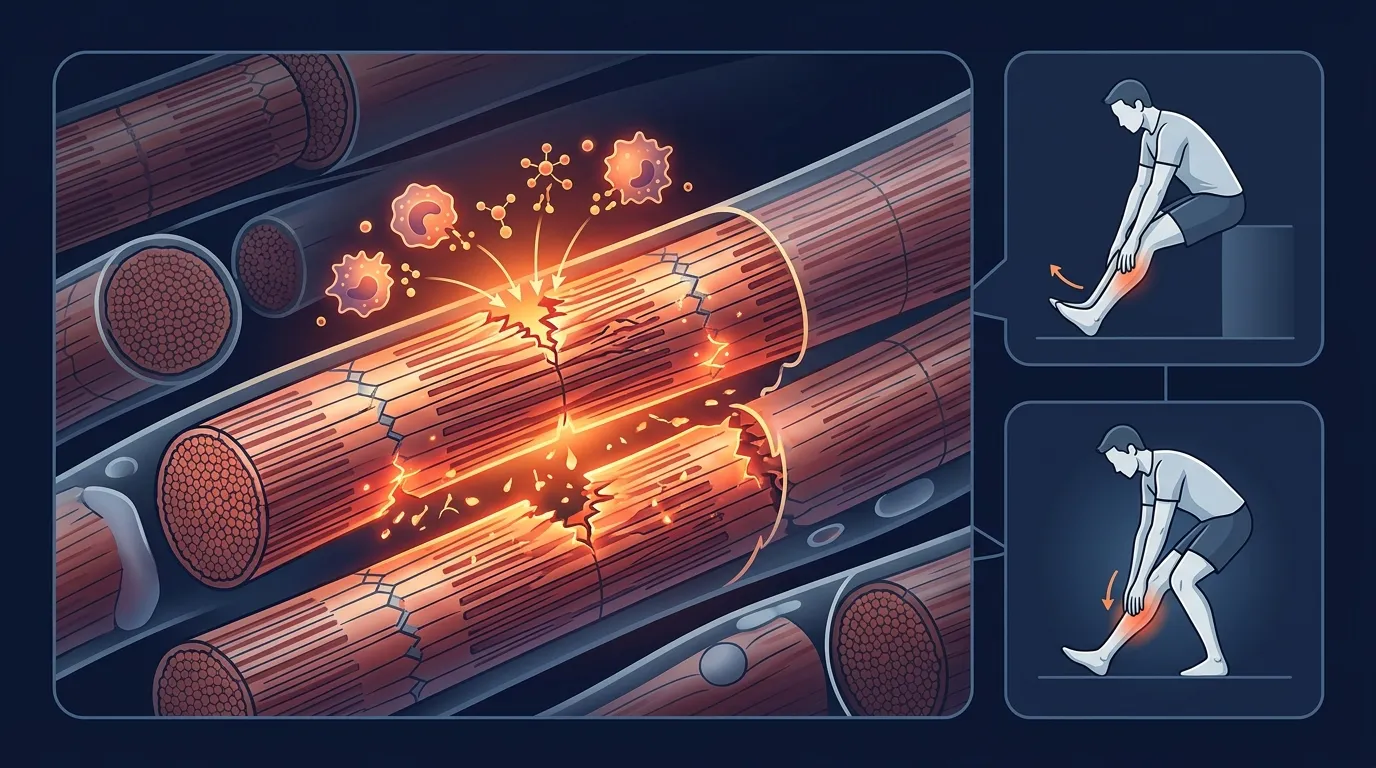
This is delayed onset muscle soreness (DOMS), and it typically peaks 24 to 72 hours after unfamiliar exercise. It's caused by microscopic damage to muscle fibers — specifically, eccentric contractions (the lowering phase of a movement) create small tears in the muscle tissue that trigger an inflammatory repair response.
Research by Cheung, Hume, and Maxwell (2003) in the Journal of Athletic Training established that DOMS is a normal physiological response to novel mechanical stress and is not indicative of injury. Their review of the literature confirmed that DOMS severity is highest during the initial exposure to a new exercise stimulus and progressively diminishes with repeated bouts — a phenomenon called the repeated bout effect.
Here's the reassuring part: the soreness you feel in Week 1 is the worst it will ever be for that movement pattern. Your body adapts rapidly. The same workout that leaves you hobbling on Day 3 will produce noticeably less soreness by the second time you do it. This isn't because you're doing less work — it's because your muscles have already begun developing protective adaptations at the cellular level.
The mistake most beginners make? They interpret DOMS as a sign they overdid it, and they skip their next session. In reality, light movement (active recovery) often reduces DOMS symptoms more effectively than complete rest.
Cardiovascular Changes: Subtle but Real
Your heart and lungs won't transform in seven days, but the process has started. During your first few sessions, your heart rate climbs higher than it will for the same effort level in a few weeks. Your body is inefficient — it's burning more energy, breathing harder, and recovering more slowly between sets or intervals.
By Day 5 or 6, many beginners notice a slight improvement in how quickly their heart rate recovers after exertion. This is your cardiovascular system beginning to adapt: improved stroke volume (more blood pumped per beat), better oxygen delivery to working muscles, and more efficient waste removal. These changes are small in Week 1, but they compound quickly.
Sleep: The Unexpected Early Win
One of the most underreported changes in Week 1 is sleep improvement. Physical exertion increases your body's need for deep sleep — the restorative phase where tissue repair, hormone release, and memory consolidation happen. Many beginners report falling asleep faster and waking up feeling more rested within the first 3 to 5 days of starting a program.
This isn't placebo. Exercise increases adenosine accumulation (the same chemical caffeine blocks), promotes body temperature regulation conducive to sleep onset, and reduces cortisol levels in the evening. If nothing else convinces you that Week 1 matters, the sleep improvement alone is worth protecting.
What's Happening in Your Mind: The Psychology of Week 1
The Novelty Dopamine Spike
You feel excited. Motivated. Maybe even fired up in a way you haven't felt about exercise in months — or years. That feeling is real, and it has a neurochemical basis: novelty-triggered dopamine release.
Your brain is wired to reward new experiences. When you start a new exercise program, the unfamiliarity itself generates dopamine — the neurotransmitter associated with motivation, anticipation, and reward-seeking behavior. This is why Day 1 feels electric. Everything is new: the movements, the environment, the sense of possibility.
Here's the problem: novelty wears off. By Weeks 2 and 3, the same routine that felt exciting becomes familiar. The dopamine signal weakens. And without a replacement source of motivation, most people interpret this as "losing interest" and quit. They think the problem is the workout. The problem is actually the reward system.
This is exactly why gamification works. When novelty-based motivation fades, game mechanics — streaks, progression, quests, rewards — provide a second dopamine pathway that doesn't depend on the exercise being new. It depends on the exercise being part of a system you're building.
Excitement Mixed with Intimidation
Most beginners in Week 1 exist in a psychological state that researchers call approach-avoidance conflict. You're drawn toward the goal (getting fit, feeling strong, looking better) while simultaneously repelled by the perceived barriers (not knowing what you're doing, feeling out of place, worrying about judgment).
This is completely normal. The intimidation you feel isn't weakness — it's your brain doing a risk assessment. "Is this environment safe? Do I belong here? Am I going to embarrass myself?" These questions are automatic, and everyone — even experienced gym-goers returning after time off — processes some version of them.
The people who push through Week 1 usually do so because something in their environment reduces the avoidance side of the equation. A clear plan reduces uncertainty. Early wins build confidence. Knowing exactly what to do when you show up eliminates the "standing around confused" scenario that makes people never come back.
The "Am I Doing This Right?" Loop
Perhaps the most common psychological experience in Week 1 is a persistent, low-grade anxiety that you're doing something wrong. Wrong form. Wrong exercises. Wrong intensity. Wrong program entirely.
This anxiety serves a purpose — it means you care about doing it well. But left unchecked, it becomes a reason to quit. "I'll stop until I figure out the right program" quickly becomes "I'll start again someday" which becomes "I guess I'm not a fitness person."
The antidote isn't perfection — it's guidance. Having a coach (human or AI) who tells you what to do, confirms you're on the right track, and adjusts when needed eliminates the cognitive load that makes beginners feel overwhelmed.
Start your Week 1 with the right plan
FitCraft's gamification system is specifically designed to get you through each stage. Your AI coach Ty calibrates your first week so you build momentum — not burnout.
Take the Free Assessment Free · 2 minutes · No credit card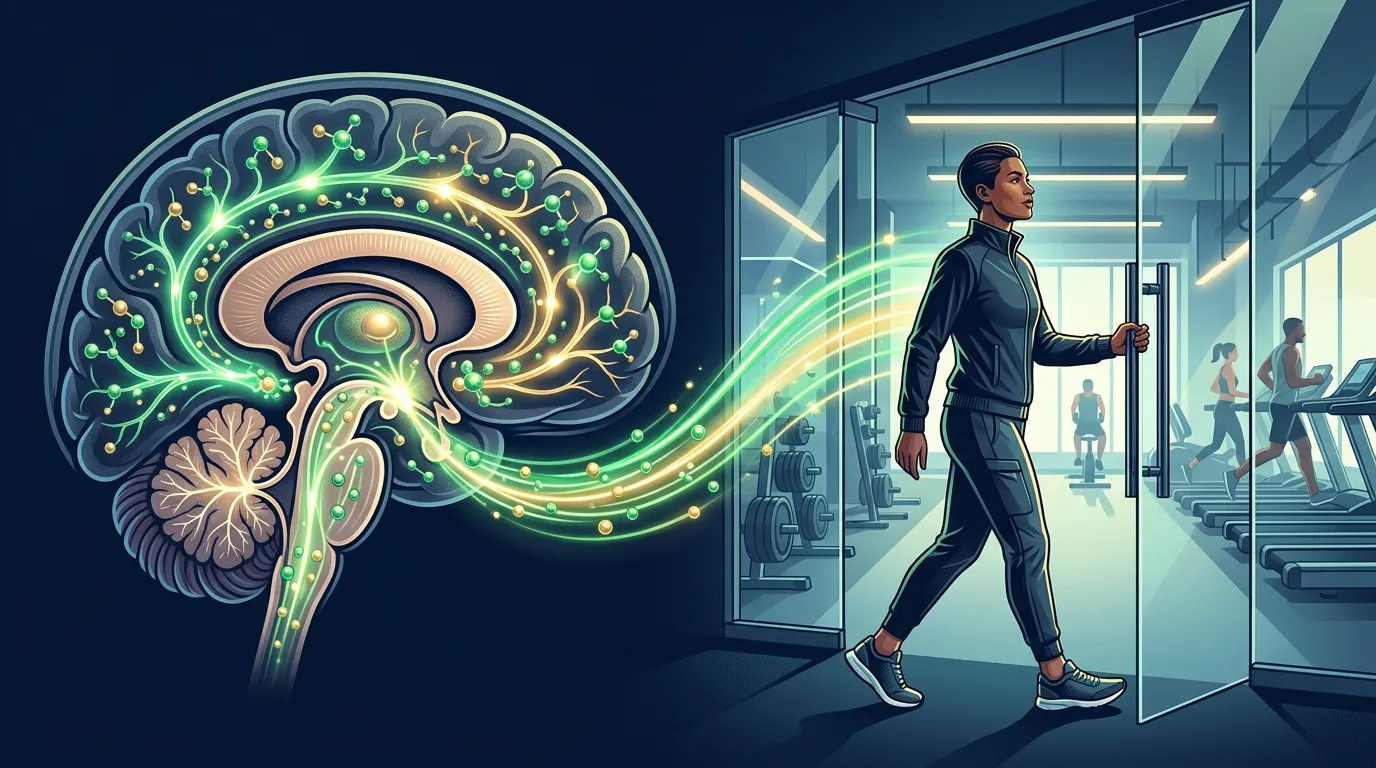
What Most People Feel in Week 1
If you're reading this during your first week, here's what you're probably experiencing — and why all of it is a sign that things are working:
Energized but sore. The endorphin boost after a session makes you feel genuinely good — maybe better than you've felt in a while. But the DOMS between sessions makes you wonder if you broke something. You didn't. The energy is your body rewarding the behavior. The soreness is your muscles adapting to handle it better next time.
Motivated but unsure. You want to keep going. You might even be surprised by how much you want to keep going. But there's a voice in the back of your head asking whether this enthusiasm will last, whether you picked the right program, whether you're doing enough — or too much. That voice isn't your enemy. It's just unfamiliarity talking.
Proud but quiet about it. You probably haven't told many people you started. That's smart — research on premature goal announcement suggests that telling people about your intentions can give you a false sense of accomplishment that reduces follow-through. Keep it to yourself for now. Let the results speak later.
Sleeping better. You might not even connect it to the exercise yet, but if you've been falling asleep faster or waking up less groggy, that's your body responding to physical exertion with deeper restorative sleep.
How FitCraft Is Designed for This Exact Stage
Week 1 is the highest-risk, highest-opportunity window in any fitness journey. The motivation is real but temporary. The body is adapting but signaling discomfort. The mind is engaged but uncertain. Everything about this stage is a contradiction — and most fitness apps treat it like any other week.
FitCraft doesn't.
Your first quest unlocks on Day 1. Instead of dropping you into a generic workout calendar, FitCraft gives you a specific, achievable mission from the moment you open the app. This eliminates the "what do I do?" paralysis that kills most beginners before they finish their first session. You have a quest. You complete it. You see progress immediately.
Your streak begins at Day 1. Streaks are one of the most powerful behavioral tools in gamification — and FitCraft starts counting from your very first session. By Day 3, you have a 3-day streak. By Day 5, you have something you don't want to break. This creates a psychological investment that carries you through the moments when motivation dips.
Your AI coach Ty calibrates your level. FitCraft's 32-step diagnostic assessment maps your fitness level, goals, equipment, schedule, and motivation patterns before you do a single rep. Ty doesn't give you a program designed for an average person — Ty gives you a program designed for you, right now, at this exact starting point. This eliminates the "am I doing this right?" anxiety because the answer is built into the system.
Early wins are designed into the first week. FitCraft's progression system is front-loaded with achievable milestones — your first completed workout, your first streak milestone, your first quest completion, your first collectible card. These aren't participation trophies. They're strategically placed dopamine hits that replace the novelty-based motivation before it fades. By the time the "new" wears off, you're hooked on the progression.
As Jim, 26, a FitCraft user, put it: "I kept telling myself I'd start Monday. FitCraft made me start on a Wednesday and I haven't stopped."
Making Week 1 Count: What the Science Says
Based on the research, here's what matters most in your first seven days:
Don't chase intensity — chase consistency. Your body needs recovery time to process the novel stimulus. Three to four sessions in Week 1 with rest days between them is more effective than seven consecutive days of pushing through soreness. The goal is to show up again, not to set records.
Move through soreness, don't sit through it. Active recovery — light walking, gentle stretching, easy movement — reduces DOMS symptoms more effectively than complete rest. Your instinct to lie on the couch is understandable, but counterproductive.
Prioritize sleep. Your body does its heaviest repair work during deep sleep. If you're training and not sleeping, you're tearing down without building back up. Aim for 7-9 hours per night, especially this week.
Accept the awkwardness. Every movement feels clumsy at first because your nervous system is still learning the patterns. This is the neural adaptation process at work. The awkwardness isn't a sign you're bad at exercise — it's a sign your brain is actively building new motor pathways. By Week 2, movements that felt foreign will start feeling familiar.
Don't wait for the "right" Monday. The biggest threat to your Week 1 isn't soreness or confusion — it's the belief that you need a perfect start. You don't. You need a start. Period. The neural adaptations, the cardiovascular improvements, the sleep benefits, the habit formation — all of it begins the moment you do your first session, regardless of what day it is.
What Comes Next
Week 1 is the spark. It's where your body begins adapting, your brain starts rewiring, and your identity as someone who exercises begins to take shape. But the spark doesn't sustain itself.
In Week 2, the novelty fades. The DOMS decreases but so does the excitement. This is where most people drop off — and where the systems you build in Week 1 either carry you forward or let you fall back.
The people who make it aren't more disciplined than you. They're not more motivated. They just have a system that makes showing up easier than not showing up. That's what gamification does. That's what an AI coach does. That's what FitCraft was built to do.
You've started. That's the hardest part. Now the question is: what's going to keep you going when the spark fades?
Frequently Asked Questions
Is it normal to be extremely sore in the first week of working out?
Yes. Delayed onset muscle soreness (DOMS) typically peaks 24-72 hours after your first sessions and is caused by microscopic damage to muscle fibers during unfamiliar movements. Research published in the Journal of Athletic Training confirms DOMS is a normal inflammatory response and not a sign of injury. It usually subsides within 5-7 days as your body adapts.
Will I see any results after just one week of exercise?
You won't see visible muscle growth after one week, but significant changes are happening beneath the surface. Your nervous system begins adapting within the first few sessions — a process called neural adaptation — which improves coordination and movement efficiency. You may also notice improved sleep quality, a mood boost from endorphin release, and slightly better cardiovascular recovery by day 7.
How many days should I work out in my first week?
For most beginners, 3-4 sessions in the first week is ideal. This allows recovery time between workouts, which is especially important when your body is experiencing DOMS for the first time. The goal in Week 1 isn't intensity — it's establishing the habit of showing up. FitCraft's AI coach Ty calibrates your first week around this principle.
Why do I feel so motivated in Week 1 but worried it won't last?
The burst of motivation you feel in Week 1 is driven by novelty-triggered dopamine — your brain rewards you for trying something new. This is real motivation, but it's temporary. Research shows this novelty effect fades by Weeks 2-3 unless replaced by habit-based reward systems. That's why FitCraft builds in streaks, quests, and progression mechanics from Day 1 — to create a second source of motivation before the first one fades.