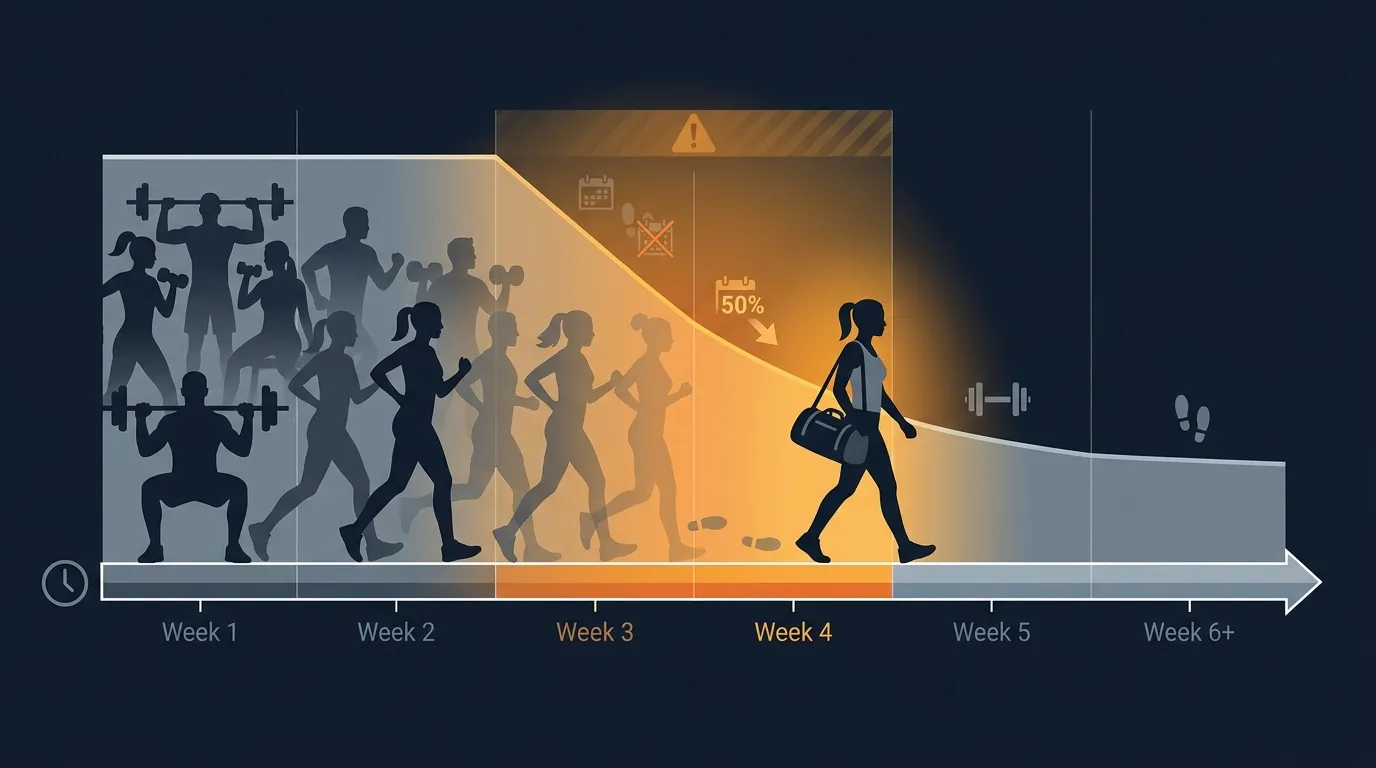
If you're reading this, there's a good chance you started working out two or three weeks ago. Maybe you downloaded an app, bought some equipment, joined a gym, or made a promise to yourself that this time would be different.
And for a while, it was. The first week felt great. New energy, new routine, that satisfying soreness that whispered this is working. Week two was still solid — you were building momentum, feeling proud of yourself.
But now? Something has shifted. The alarm goes off and you don't want to get up. The workout feels like a chore instead of an adventure. You're tired. You're busy. You start telling yourself stories: I'll start again Monday. One day off won't hurt. Maybe this just isn't for me.
You've hit The Dip.
And here's what you need to know: this is the single most predictable, most dangerous, and most survivable moment in any fitness journey. It happens to nearly everyone. It has nothing to do with your willpower, your discipline, or your character. It's biology. It's psychology. And if you understand what's happening — really understand it — you can get through it.
What's Happening in Your Body
Your body is doing something frustrating right now: it's adapting without showing you. Internally, real physiological changes are underway. Your cardiovascular system is becoming more efficient. Your muscles are building the neural pathways that make movements easier. Your mitochondria are multiplying, improving your cells' ability to produce energy.
But none of this is visible yet.
In the first one to two weeks of a new exercise program, the body responds with an acute stress response — inflammation, muscle soreness, elevated heart rate during workouts. These signals feel productive. They feel like evidence that something is changing. And in a sense, they are.
By week three, those acute signals fade. The delayed onset muscle soreness (DOMS) that made you walk funny after leg day? Your body has adapted to that stimulus. Your heart rate doesn't spike as dramatically. You're not as winded after a set. On the surface, this looks like progress — but it feels like nothing is happening.
Meanwhile, the visible results you're hoping for — muscle definition, weight loss, changes in the mirror — require a much longer timeline. A 2015 review published in Sports Medicine found that measurable changes in muscle hypertrophy typically require a minimum of 6-8 weeks of consistent resistance training, with visible changes often taking 8-12 weeks. Fat loss follows a similarly delayed trajectory — even when you're doing everything right, the first few weeks of exercise can temporarily mask fat loss through water retention and inflammation.
So you're stuck in a perceptual dead zone: the initial signals of progress have disappeared, and the real, visible results haven't arrived yet. Your body is changing. You just can't see it or feel it.
What's Happening in Your Brain
The physical dead zone is frustrating. But the psychological storm happening simultaneously is what actually kills most fitness routines.
Your novelty dopamine is gone. When you started your new workout routine, your brain released a surge of dopamine — not because of the exercise itself, but because of the novelty. A new app, a new plan, a new version of yourself. Neuroscience research shows that novel experiences trigger dopamine release in the mesolimbic pathway, the same reward circuit activated by social media notifications, video games, and unexpected good news. That chemical rush made the first week feel effortless. It made you want to work out.
By week three, the novelty is gone. Your brain has categorized this workout routine as "familiar," and the free dopamine stops flowing. The activity that felt exciting now feels ordinary. Without that neurochemical tailwind, every workout requires conscious effort — and conscious effort is exhausting.
Your habit hasn't formed yet. A landmark 2010 study by Phillippa Lally and colleagues at University College London tracked 96 participants as they tried to form new daily habits. The median time to reach 95% of maximum automaticity — the point where the behavior feels natural and requires minimal willpower — was 66 days. The range was enormous: 18 to 254 days. But the critical finding was this: automaticity climbs along a flattening curve, so at day 21 essentially nobody in the study had reached their plateau.
That means right now, at week three, you're in the worst possible position: the novelty reward has been fully depleted, but the automaticity reward — the ease that comes with a fully formed habit — is still weeks away. You're relying entirely on willpower. And willpower, as decades of psychology research have shown, is a depletable resource.
Life starts fighting back. The first two weeks of a new routine often benefit from what psychologists call the "honeymoon period" — you rearrange your schedule, say no to things, and prioritize the new behavior because it feels important and exciting. By week three, that protective bubble pops. Work deadlines pile up. Social commitments return. Sleep suffers. The excuses multiply because they're not really excuses — they're genuine competing demands on a finite resource: your energy.
And here's the cruelest part: your brain starts rationalizing quitting as the smart move. I gave it a fair shot. It's not working. I'll try something different later. This isn't laziness. It's your brain's energy conservation system doing exactly what evolution designed it to do — eliminate activities that cost energy without providing clear rewards.
The Valley of Disappointment
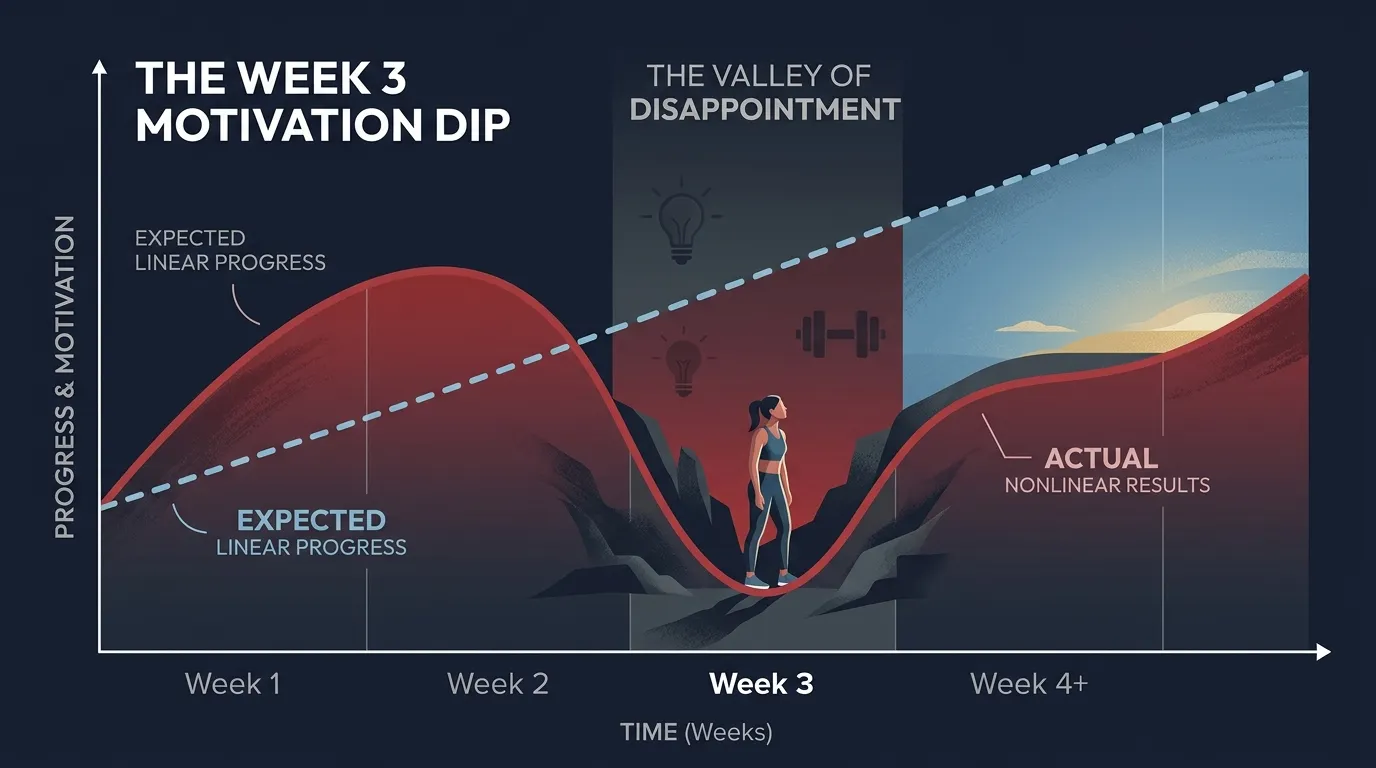
James Clear, in Atomic Habits, calls this the "valley of disappointment." It's the gap between what you expected to happen and what has actually happened so far.
When you start a new fitness routine, you unconsciously expect linear progress. Effort in, results out. Two weeks of hard work should equal two weeks of visible change. But that's not how adaptation works. Results are nonlinear. They lag behind effort, sometimes dramatically. You put in weeks of work before the compounding effects become visible.
The valley of disappointment is that painful stretch where effort and results haven't converged yet. You're doing the work but can't see the payoff. And every day in that valley, the temptation to quit grows stronger — because from where you're standing, it genuinely looks like what you're doing isn't working.
But it is. The people who emerge from the valley don't emerge because they were tougher or more disciplined. They emerge because they had something keeping them in the game long enough for the results to catch up.
The Statistics Are Brutal — and Predictable
You're not imagining this. The dropout data confirms exactly what you're feeling.
A widely cited 2003 study by Dishman and Buckworth examining exercise adherence patterns found that approximately 50% of people who start a new exercise program drop out within the first six months, with the steepest dropout rates occurring between weeks 2 and 6. A 2012 analysis published in the Journal of Clinical Psychology found similar patterns with New Year's fitness resolutions — the majority of abandonment clustered in the second and third weeks, well before any meaningful physical transformation could have occurred.
More recent data tells the same story. A 2019 study tracking gym attendance using electronic check-in data found that new members' visit frequency dropped by an average of 50% between the second and fourth week of membership. The researchers noted that this decline preceded any external barrier — it wasn't that people got injured or moved away. They simply stopped showing up.
The pattern is so consistent that researchers can predict it. If you're going to quit a workout program, the highest-probability window is exactly where you are right now: days 14 through 28. The dip isn't a random event. It's a predictable phase that nearly every exerciser passes through.
Which means it's also a solvable problem — if you have the right tools.
Why This Moment Is So Dangerous
The dip is uniquely dangerous because it attacks from every direction simultaneously.
And it arrives early for some people. If novelty is what has been carrying you, the week the novelty runs out is the week the whole thing is decided — which is why surviving week three is the central problem a fitness app for ADHD has to solve.
The emotional story is convincing. You feel unmotivated — and you interpret that feeling as information. If I don't want to do this, maybe I shouldn't. But the lack of motivation isn't a signal about the activity's value. It's a predictable neurochemical shift. The workout didn't change. Your dopamine response did.
The visible evidence supports quitting. You look in the mirror and don't see dramatic change. The scale hasn't moved much (or has moved in the wrong direction, which is common in early exercise due to water retention and muscle glycogen changes). From a pure evidence standpoint, it looks like what you're doing isn't working. But you're measuring the wrong timeline. Asking "has three weeks of exercise changed my body?" is like asking "has three weeks of saving changed my retirement account?" The answer is technically yes — but not in a way you can see yet.
Willpower is at its lowest. The Lally research suggests that the subjective effort required to perform a new behavior peaks in the early weeks and gradually decreases as automaticity develops. At week three, you're near maximum effort expenditure — every workout takes real mental energy to initiate. And you're doing this while also managing work, relationships, sleep, and the hundred other demands on your attention. Something has to give, and the newest, least-established habit is always the first to go.
There's no external accountability. Most people start their fitness journey alone. No coach checking in. No team expecting them at practice. No consequences for missing a day beyond a vague sense of guilt that fades quickly. In the absence of external accountability, the path of least resistance always wins — and the path of least resistance at week three is your couch.
How FitCraft Is Built for Exactly This Moment
We designed FitCraft knowing this moment would come. Not hoping it wouldn't — knowing it would. The dip isn't a bug in your fitness journey. It's a feature of human psychology. And the only reliable way to get through it is to replace the systems that have failed (motivation, willpower, discipline) with systems that work even when you don't feel like it.
Here's how FitCraft's gamification system specifically addresses the week-three crisis:
Your Streak Is Now 14-21 Days — and That Changes Everything
By week three, you've built a streak of two to three weeks. And behavioral economics tells us something powerful about streaks: loss aversion makes them exponentially harder to break the longer they get.
Kahneman and Tversky's prospect theory — one of the most replicated findings in behavioral science — demonstrates that the pain of losing something is roughly twice as powerful as the pleasure of gaining something equivalent. A 14-day streak isn't just a number. It's an investment you've made, a visible record of effort. Breaking it feels like throwing away two weeks of work.
This isn't a trick. It's a real psychological force working for you instead of against you. On the morning when your motivation is at zero and your bed is warm and your brain is listing every reason to skip, the streak reframes the decision. It's no longer "should I work out today?" It's "am I willing to destroy 14 days of progress?" That's a fundamentally different question — and it leads to a fundamentally different answer.
Quest Progression Creates Forward Pull
Motivation is a push force — it shoves you toward action. But push forces weaken over time. What you need at week three is a pull force — something drawing you forward.
FitCraft's quest system creates that pull. You're not just working out; you're progressing through a narrative. You have an active quest with a next milestone. You can see what's ahead. The 2017 BE FIT randomized controlled trial found that gamified exercise interventions with clear progression mechanics significantly improved physical activity levels compared to standard exercise programs — precisely because they created anticipatory engagement. You don't just exercise because you should. You exercise because you want to see what comes next.
Variable Rewards Keep Your Brain Engaged
Remember the novelty dopamine that disappeared? FitCraft's collectible card system replaces it with something more sustainable: variable rewards.
B.F. Skinner's research on reinforcement schedules — confirmed by decades of subsequent studies — showed that variable ratio reinforcement (rewards that come unpredictably) creates the strongest and most persistent behavioral engagement. It's the same principle behind every successful game you've ever played: you don't know exactly when the next reward is coming, so you keep playing.
FitCraft's collectible cards work on this principle. Complete a workout, and you might earn a new card. Or you might not. The unpredictability keeps your dopamine system engaged in a way that predictable rewards (like checking a box on a calendar) simply can't match. At week three, when your brain has habituated to the routine, variable rewards inject fresh neurochemical engagement without requiring novelty.
The AI Coach Adapts When It Senses Struggle
Most fitness apps are static — they give you a plan and leave you to execute it. If you're struggling at week three, they don't know and they don't care.
FitCraft's AI coach, Ty, is different. Built on a 32-step diagnostic assessment and ongoing behavioral data, Ty detects patterns that suggest you're entering the dip. Maybe your workout completion rate has dropped. Maybe you're starting sessions later in the day. Maybe you skipped a day for the first time. Ty responds — not with generic motivational quotes, but with targeted adjustments. A shorter workout on a hard day. A different exercise selection to reintroduce novelty. A reminder of how far you've come. The STEP UP trial (2019) demonstrated that adaptive interventions increased daily step counts by 637 to 920 steps depending on the study arm in sedentary adults — because the system met people where they were instead of where it wished they'd be.
This Is Where Gamification Earns Its Keep
Let's be honest: gamification sounds like a gimmick. Streaks and cards and quests — isn't that just window dressing on a workout app?
No. And week three is the proof.
When you have intrinsic motivation — when you genuinely want to work out — you don't need gamification. Week one is easy. Week two is manageable. The novelty carries you.
But week three strips all of that away. The novelty is gone. The intrinsic motivation is depleted. The results aren't visible. The habit isn't formed. You're standing in the valley of disappointment with nothing but willpower — and willpower isn't enough. It has never been enough. The research is unambiguous on this point: relying on willpower for sustained behavior change fails the majority of the time.
Gamification exists for exactly this moment. It provides external reward systems that bridge the gap between the death of novelty and the birth of habit. Streaks leverage loss aversion. Quests create forward pull. Variable rewards maintain dopamine engagement. Progression systems satisfy the need for visible progress when physical progress isn't yet apparent.
A 2022 systematic review published in the Journal of Medical Internet Research pooled 16 randomized controlled trials covering 2,407 participants and found a small-to-medium improvement in physical activity (Hedges g=0.42) compared with non-gamified approaches. The effect was strongest during weeks 2-8 — exactly the period when traditional motivation collapses.
This isn't about making exercise "fun" in a trivial sense. It's about engineering the behavioral architecture that keeps you in the game long enough for the real rewards — the physical changes, the energy, the confidence, the habit — to take hold.
Get through the dip with the right system
FitCraft's gamification is designed for exactly this moment — when motivation dies and you need something stronger than willpower.
Take the Free Assessment Free · 2 minutes · No credit card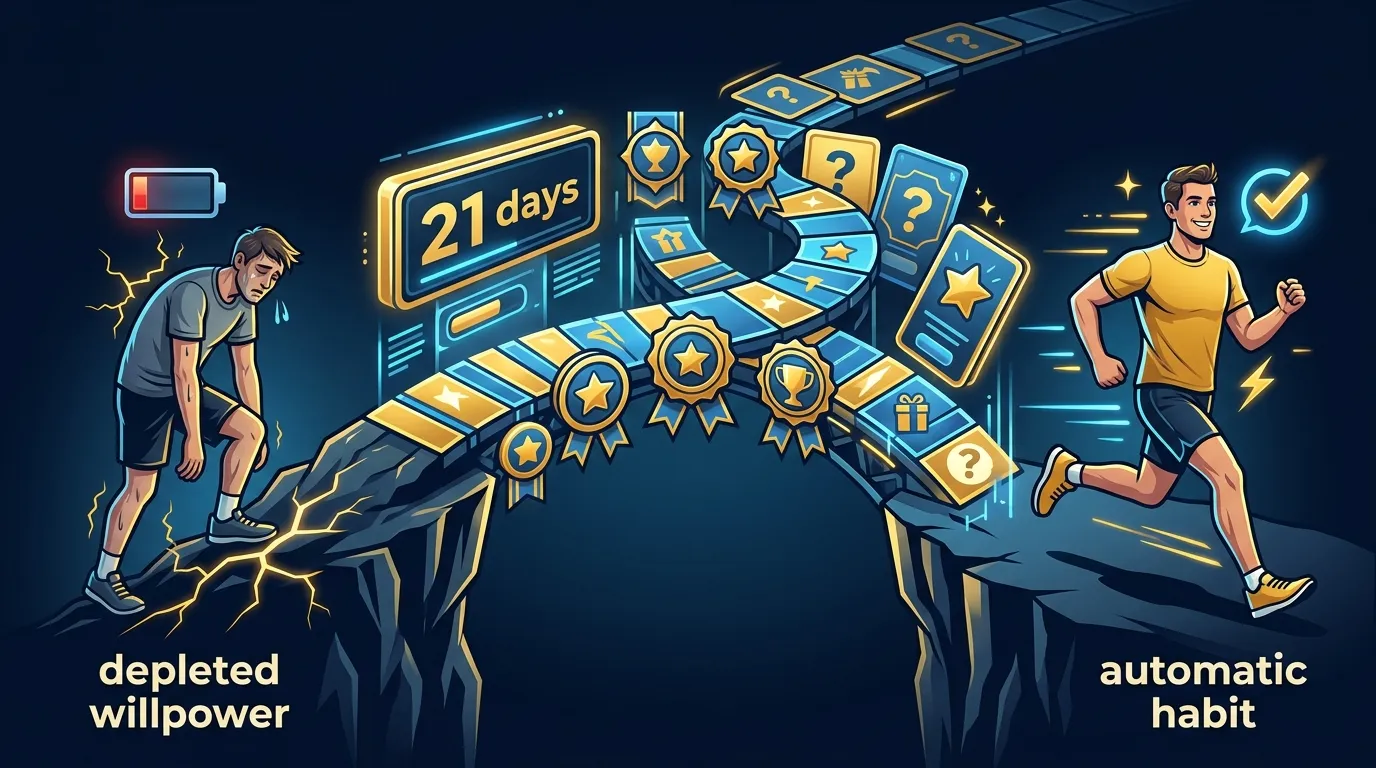
What People Who Survived the Dip Say
The dip feels permanent when you're in it. It helps to hear from people who made it to the other side.
Katie, a FitCraft user, described her experience: "I've tried everything. This is the first time I've stuck with something past two weeks. Around day 16, I almost quit — I just wasn't feeling it anymore. But my streak was at 16 days, and I couldn't bring myself to break it. I did a short workout just to keep it alive. And then the next day was easier. And the next. Now I don't even think about it — I just do it."
Mike, 23, had a similar turning point: "The streak system got me hooked. I didn't want to break my chain. There were days in week three where the only reason I worked out was because I didn't want to lose my streak. But that was enough. That got me to the gym. And once I was there, the workout was always fine. The hardest part was always just starting."
These stories aren't unusual. They're the pattern. The dip is real, the temptation to quit is overwhelming — and the people who get through it almost always point to a specific system or mechanism that kept them going when motivation couldn't.
The Other Side of the Dip
Here's what's waiting on the other side — and it's worth fighting for.
Weeks 4-6: The habit starts to solidify. The Lally research shows a significant acceleration in automaticity around this period. Workouts begin to feel less like a decision and more like something you just do. The mental resistance decreases noticeably.
Weeks 6-8: Physical changes become visible. The Sports Medicine review confirms that this is when hypertrophy and body composition changes start appearing in the mirror and on the scale. Friends and colleagues start commenting. The internal rewards — the ones that last — begin arriving.
Weeks 8-12: The identity shift. You stop being "someone who is trying to work out" and start being "someone who works out." This is the deepest and most permanent change — when exercise becomes part of who you are, not just something you do.
All of this is on the other side of the dip you're in right now. The only thing standing between where you are and where you want to be is the next 3-5 weeks of showing up. Not perfectly. Not enthusiastically. Just consistently.
A Practical Plan for Surviving This Week
You don't need to feel motivated. You need to take the next step. Here's how:
- Lower the bar dramatically. A 10-minute workout is infinitely better than a skipped workout. The goal right now isn't performance — it's continuity. Preserve the habit at all costs, even if the individual sessions are short.
- Stop waiting for motivation. Motivation follows action, not the other way around. The research on behavioral activation — originally developed for depression treatment — shows that action precedes the feeling, not the reverse. Put on your shoes. Start the warmup. The motivation will often follow once you're moving.
- Protect your streak. If you're using FitCraft, your streak is your most valuable asset right now. Do whatever it takes to keep it alive. Even a minimal session counts.
- Remove decisions. Decision fatigue is real and it compounds with every choice you make throughout the day. Lay out your workout clothes the night before. Schedule your workout at the same time every day. Eliminate every barrier between you and starting.
- Remember what you're actually fighting. You're not fighting laziness. You're fighting a predictable neurochemical shift that happens to nearly everyone. This isn't a character flaw — it's a phase. And phases end.
The Truth About Week 3
Here's the truth nobody tells you when you start a fitness journey: week 3 is supposed to be hard. Not hard in the way week 1 is hard (sore muscles, learning new movements). Hard in a deeper, more insidious way — the kind of hard where nothing hurts but nothing feels worth it either.
The people who build lasting fitness habits aren't the ones who never experience the dip. They're the ones who have a system that carries them through it. A streak they don't want to break. A quest they want to complete. A coach that notices when they're struggling. A reward system that gives their brain a reason to keep going when the body's silent progress isn't enough.
You've already done the hardest part: you started. You showed up for two weeks. You built a foundation. Don't let a predictable, temporary, completely normal neurochemical dip erase all of that.
The dip ends. The habit stays. But only if you stay in the game long enough to get there.
Frequently Asked Questions
Why do most people quit exercise after 2-3 weeks?
Most people quit exercise around weeks 2-4 because they hit the "valley of disappointment" — the novelty dopamine from starting has worn off, visible results haven't appeared yet, and the habit hasn't become automatic. Research by Lally et al. (2010) puts the median time to reach 95% of maximum automaticity at 66 days, with a range of 18 to 254 days, so at week 3 the habit is nowhere near established. Without external reward systems, willpower alone isn't enough to bridge this gap.
How long does it take to form an exercise habit?
According to a landmark study by Phillippa Lally and colleagues at University College London (2010), it takes an average of 66 days for a new behavior to become automatic — with a range of 18 to 254 days depending on the person and complexity of the behavior. Exercise habits tend toward the longer end of that range because they require more effort than simpler habits like drinking a glass of water.
What is the valley of disappointment in fitness?
The "valley of disappointment" is a concept popularized by James Clear in Atomic Habits. It describes the gap between your expected results and actual results in the early weeks of a new habit. You expect linear progress — effort in, results out — but real change is nonlinear. Results lag behind effort, creating a period where you feel like nothing is working. In fitness, this typically hits hardest during weeks 2-4, when the initial excitement has faded but visible physical changes haven't appeared yet.
How does gamification help people stick with exercise?
Gamification provides external reward systems that bridge the motivation gap between starting a new exercise routine and it becoming an automatic habit. A 2022 systematic review in the Journal of Medical Internet Research found that gamified fitness interventions produced a small-to-medium improvement in physical activity (Hedges g=0.42) against non-gamified controls. Key mechanics include streaks (loss aversion), variable rewards (unpredictable reinforcement), and progression systems (visible advancement). These replace depleted novelty dopamine with sustainable motivation until the habit takes hold.
What should I do if I've lost motivation to work out?
First, recognize that losing motivation around weeks 2-4 is completely normal — it happens to the vast majority of people. The key is not to rely on motivation at all. Instead, use systems: reduce friction (shorter workouts, less travel time), create accountability (streaks, social commitments), add external rewards (gamification, tracking progress), and lower the bar on bad days (even a 10-minute session preserves the habit). FitCraft's gamification system is specifically designed to carry you through this exact moment.