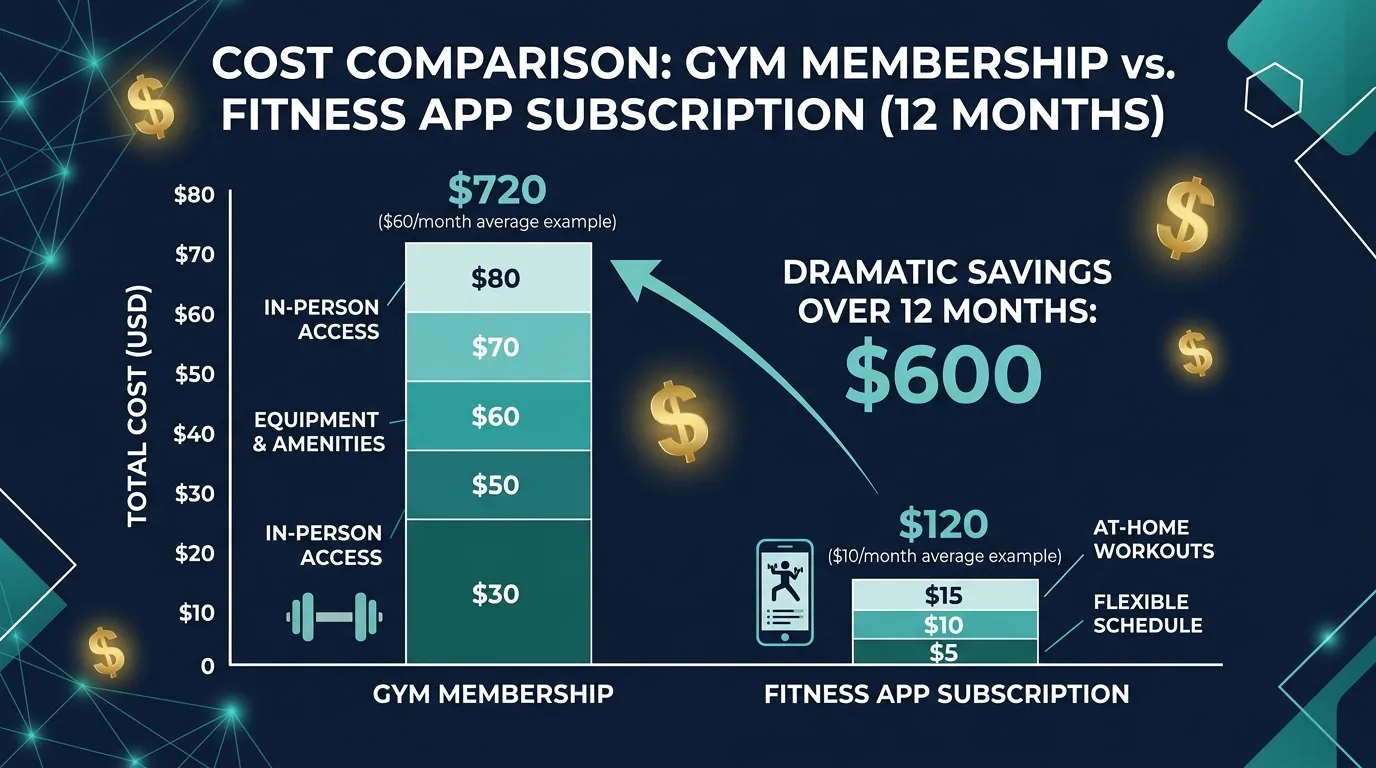
Here's a number that should make you uncomfortable: Americans spend over $35 billion per year on gym memberships. And roughly two-thirds of those memberships go effectively unused.
That's billions of dollars per year spent on a service that most people don't actually use. And the gyms know it. In fact, they depend on it. The entire gym business model is built on the assumption that most of their members won't show up.
So when you're deciding between a gym membership and a fitness app subscription, the question isn't just "which costs more?" It's "which one will I actually use?" — because a gym membership you don't use is infinitely more expensive than an affordable app you open every day.
Let's do the real math. If you have already ruled the gym out and just want the app numbers, our fitness app subscription pricing breakdown lists every tier, and whether a paid app is worth it is its own question.
The True Cost of a Gym Membership
The sticker price on a gym membership is almost never the full cost. Here's what you're actually paying:
Monthly Dues: $40-60/month (average)
According to the International Health, Racquet & Sportsclub Association (IHRSA), the average gym membership in the United States runs between $40 and $60 per month. Budget gyms like Planet Fitness start at $10-25/month, while mid-range options like LA Fitness, Anytime Fitness, or Gold's Gym typically fall in the $30-50 range. Premium facilities (Equinox, Lifetime Fitness, Barry's) can run $150-300+ per month.
Initiation Fees: $100-300
Most gyms charge a one-time enrollment or initiation fee. These fees are often negotiable — especially in January or during promotions — but they typically range from $100 to $300. Some premium gyms charge $500+.
Annual Maintenance Fees: $40-60/year
Many gyms charge an additional annual "maintenance" or "enhancement" fee, typically billed in a lump sum. This is effectively a hidden price increase that gets buried in the fine print of your contract.
Add-Ons That Add Up
Want to take classes? Some gyms charge extra. Need a locker? That's a rental fee. Towel service? Another charge. These individually small costs compound. A typical gym member who uses classes and amenities might pay $20-40/month on top of their base membership.
The Real First-Year Cost
For an average gym membership, the true first-year cost looks like this:
- Monthly dues: $50/month x 12 = $600
- Initiation fee: $200
- Annual maintenance fee: $50
- Total: $850/year
For a mid-range gym with moderate add-ons, you're looking at roughly $850-1,100 in year one. Subsequent years drop to $650-750 once the initiation fee is gone — assuming you don't let the contract auto-renew at a higher rate.
The Personal Trainer Premium
Here's where the costs get serious. A gym membership gives you access to equipment. It does not give you a program, coaching, accountability, or any guidance on what to actually do when you walk through the door.
For that, you need a personal trainer — or an AI fitness coach. And trainers are expensive.
Average personal trainer rates: $60-150 per session
Most sessions are 45-60 minutes. Most trainers recommend 2-3 sessions per week. Let's be conservative and assume 2 sessions per week at $80 each:
- Weekly cost: $160
- Monthly cost: $640
- Annual cost: $7,680
Gym membership + personal trainer = $8,500-9,000/year. And that's the budget scenario.
This is why only about 15% of gym members work with a personal trainer. It's not that people don't want guidance — it's that the cost is prohibitive for most households.
What Fitness Apps Actually Cost
Now let's look at the other side of the equation.
The fitness app market spans a wide range, but most premium apps fall between $10 and $30 per month:
- Budget apps (basic workout libraries): Free to $10/month
- Mid-range apps (guided programs, some personalization): $10-20/month
- Premium apps (AI coaching, full personalization, advanced features): $15-30/month
FitCraft sits in the affordable tier — a fraction of a typical gym membership. That includes AI-personalized programming from an Ivy League-trained exercise scientist, NSCA-certified strength coach, progressive overload tracking, gamification for accountability, and an AI coach named Ty who adapts your program in real-time.
For comparison:
- FitCraft: A fraction of gym costs
- Average gym membership: $650-850/year
- Gym + personal trainer: $8,500+/year
FitCraft costs less than what most people spend on coffee in a week.
The Number That Changes Everything: Utilization Rate
Here's the stat that the gym industry doesn't want you to think about: approximately 67% of gym memberships are unused or severely underused.
A widely cited study by Della Vigna and Malmendier (2006), published in the American Economic Review, found that gym members systematically overestimate their future attendance. Members paying monthly averaged just 4.3 visits per month — meaning their effective cost per visit far exceeded what a pay-per-visit rate would have cost. They would have been better off paying the per-visit rate.
The researchers also found that members who didn't use their memberships continued paying for an average of 2.3 months before canceling. That's money literally thrown away — often with a cancellation fee on top.
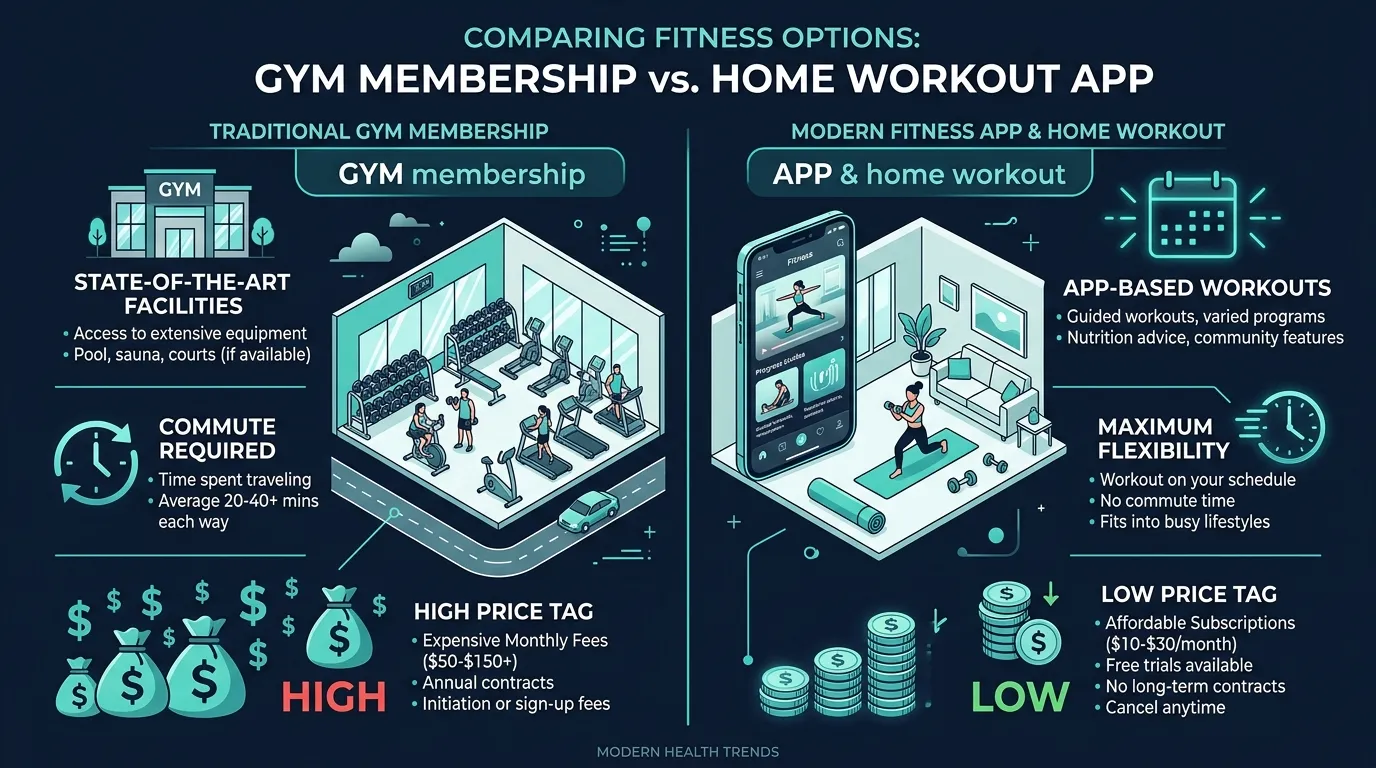
This isn't because people are irrational. It's because gyms have friction. You have to commute there. You have to change. You have to find equipment. You have to figure out what to do. Each of these small frictions adds resistance, and resistance kills consistency.
A 2019 study in Health Psychology found that perceived barriers — including travel time, scheduling conflicts, and lack of guidance — were the strongest predictors of exercise dropout among gym members (Rhodes et al., 2019). It's not about willpower. It's about logistics.
Fitness apps eliminate most of these barriers. No commute. No scheduling. No equipment confusion. Open the app, start the workout, done. The lower the friction, the higher the utilization — and the higher the utilization, the better the value.
The Real Cost-Per-Workout Comparison
Let's get brutally honest about cost per workout — because this is where the math gets uncomfortable.
Gym member who goes 3x per week (above average):
- $50/month / 12 workouts = $4.17 per workout
Gym member who goes 1x per week (closer to average):
- $50/month / 4 workouts = $12.50 per workout
Gym member who stops going after 2 months (majority):
- $50/month x 12 months (contract) / 16 total workouts = $37.50 per workout
FitCraft user who works out 4x per week:
- A FitCraft subscription divided across 16 workouts a month works out to just a few dollars per session.
FitCraft user who works out 3x per week:
- Even at 12 workouts a month, the per-session cost is a tiny fraction of any gym's drop-in fee.
Even if you're a consistent gym-goer, the cost per workout with an app is dramatically lower. And if you're in the majority who struggles with gym consistency, the gap becomes astronomical.
Ready to put this into practice?
Take the free FitCraft assessment and get a personalized plan based on behavioral science, not willpower.
Take the Free Assessment Free · 2 minutes · No credit cardThe Hidden Cost: Time
Money isn't the only cost. Time might be the bigger one.
The average gym visit — including getting there, changing, working out, showering, and getting back — takes about 90-120 minutes. The workout itself is typically 45-60 minutes. That means 30-60 minutes of every gym visit is just logistics.
Over a year, at 3 visits per week, that's 78-156 hours spent commuting to and from the gym. That's 3-6 full days of your life, just in transit.
A home workout with an app takes 30-60 minutes, with zero travel time. No packing a bag, no finding parking, no waiting for equipment. Over a year, the time savings are substantial — and for busy professionals or parents, that time difference is often the deciding factor in whether exercise happens at all.
When a Gym Membership Makes Sense
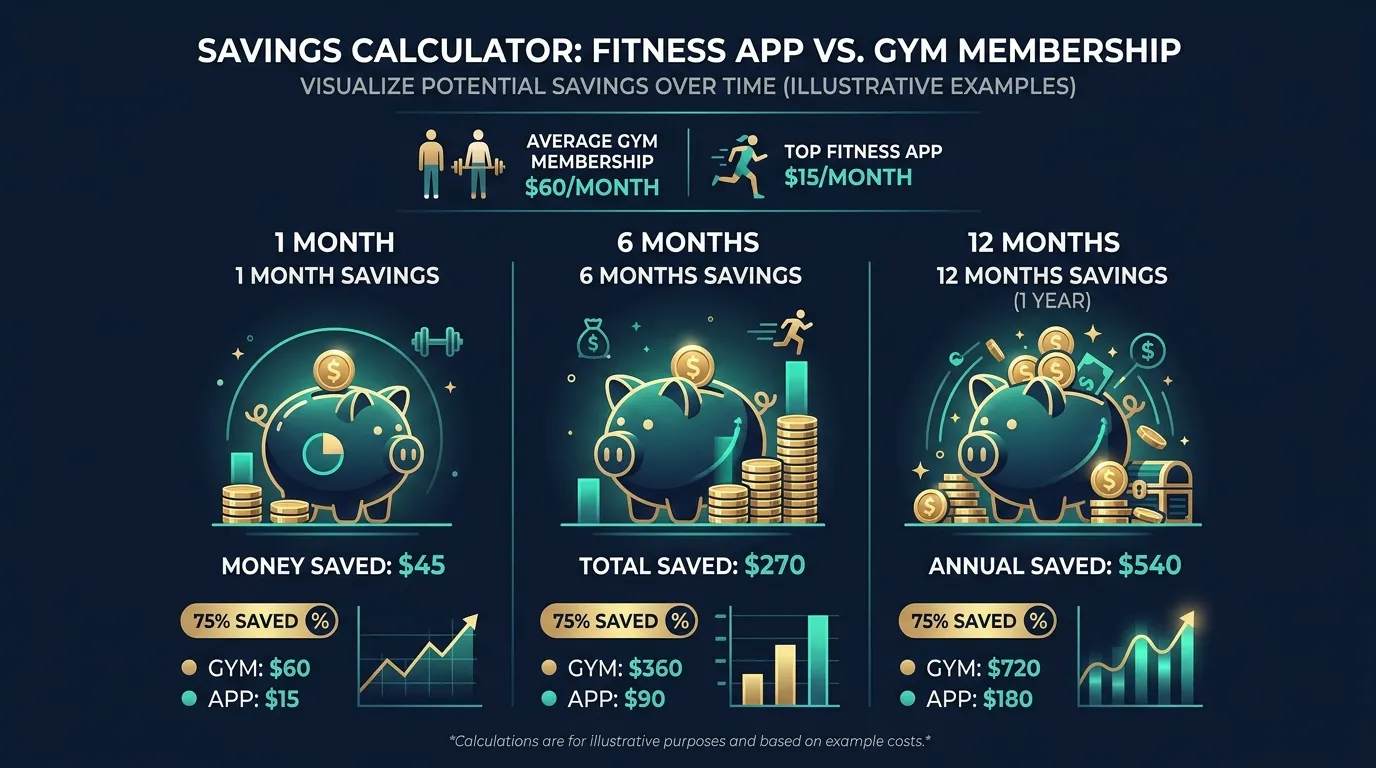
We're not anti-gym. Gyms offer real advantages that apps can't replicate:
- Heavy lifting. If your goals include heavy barbell work — powerlifting, Olympic lifting, heavy squats and deadlifts — you need a gym. No home setup under $5,000 can match a well-equipped gym for barbell training.
- Equipment variety. Cable machines, leg presses, specialized stations — gyms offer hundreds of pieces of equipment. If your program benefits from that variety, a gym membership provides access you can't easily replicate at home.
- Social environment. Some people train better with other people around. The energy of a gym, training partners, group classes — these are real motivators that an app can't fully replace.
- You actually go consistently. If you're in the minority who genuinely uses their membership 3+ times per week, year-round, the cost-per-use makes a gym membership reasonable — especially at budget gyms.
When an App Subscription Makes More Sense
For most people, though, the math and the behavioral science point in the same direction:
- You've struggled with gym consistency. If you've signed up and stopped going — once, twice, or ten times — the problem isn't willpower. It's friction. An app eliminates the barriers that keep you from showing up.
- You don't have 90+ minutes for fitness. If your window for exercise is 30-45 minutes, an app lets you use all of that time for the actual workout instead of splitting it between travel and training.
- You want programming and coaching, not just equipment access. A gym gives you equipment. An app like FitCraft gives you a program, an AI coach, progression tracking, and accountability — the things that actually produce results.
- You're cost-conscious. FitCraft costs less than a single day's parking at many downtown gyms. The value per dollar is objectively higher for most users.
As Barry, 42, a FitCraft user, said: "I spent $600 a year on a gym membership I used for three months. Now I use FitCraft and I haven't missed a week in six months. The gamification and the AI coaching make it a completely different experience. I actually use what I'm paying for."
The Bottom Line
The fitness industry has convinced us that the more we spend, the more committed we are. But commitment isn't measured in dollars — it's measured in consistency. And the most expensive gym in the world is worthless if you stop going in February.
Here's the real question to ask yourself: what option gives me the highest probability of still exercising six months from now?
If you're someone who thrives in a gym environment and has the schedule, budget, and track record to use it consistently — keep your membership. Maybe add an app for programming and tracking.
If you're someone who's tried the gym route and it hasn't stuck — not because you're lazy, but because the logistics and lack of guidance made it unsustainable — a well-designed fitness app might be the best investment. (Here's why most people quit and what to do about it.) you've ever made in your health. Especially one that costs less per month than a single protein shake.
Frequently Asked Questions
Is a gym membership worth it compared to a fitness app?
It depends on whether you'll actually use it. The average gym membership costs $40-60/month, but 67% of gym members rarely or never go, meaning most people pay $480-720/year for a facility they don't use. A fitness app at $10-20/month removes barriers like travel time and scheduling, which often leads to higher consistency. If you consistently go to the gym 3+ times per week, the membership is worth it. If you've struggled with consistency, an app may deliver better results per dollar.
How much does the average gym membership cost per year?
The average gym membership costs $40-60 per month ($480-720/year), plus initiation fees of $100-300 and annual maintenance fees of $40-60. The true first-year cost is often $620-1,080. Premium gyms can run $150-300+ per month. Budget options start around $10-25/month but offer limited equipment and no programming.
What percentage of gym members actually use their membership?
Studies show that approximately 67% of gym memberships go unused, members either never go or stop going within the first few months. A 2006 study in the American Economic Review found that gym members overestimate their future attendance by 70%, paying per-month when per-visit would be cheaper. Gyms oversell memberships because their business model depends on people not showing up.
Can you get good results with just a fitness app and no gym?
Yes. Research shows that bodyweight and minimal-equipment training can produce significant muscle and strength gains, especially for beginners and intermediates. A well-programmed app that applies progressive overload and adapts to your available equipment can deliver results comparable to gym training for most fitness goals. The key isn't where you train, it's whether your program includes progressive overload and whether you follow it consistently.
How much does FitCraft cost compared to a gym membership?
FitCraft offers a free assessment and subscription plans at a fraction of gym costs, visit getfitcraft.com for current pricing. That's significantly less than the average gym membership and includes AI-personalized programming, progressive overload tracking, gamification for accountability, and an AI coach. Adding a personal trainer to a gym membership ($60-150/session) makes the cost difference even more dramatic.