- Bones grow when you load them. Walking helps a little. Jumping, hopping, and progressive resistance work help a lot more.
- Tucker et al. (2015) had premenopausal women jump 10 to 20 times, twice daily. Sixteen weeks later, hip BMD was higher than the control group's. The whole protocol takes about a minute.
- The big-budget gym trial (LIFTMOR, 2018) used heavy lifts and box drops in postmenopausal women. Spine BMD rose 2.9 percent in 8 months. The home version trades intensity for frequency.
- Resistance bands aren't barbells, but the 2022 meta-analysis still found progressive band-based training improved hip and spine BMD modestly in older adults.
- Bone is slow tissue. Plan in months, not weeks. Consistency beats heroics every time.
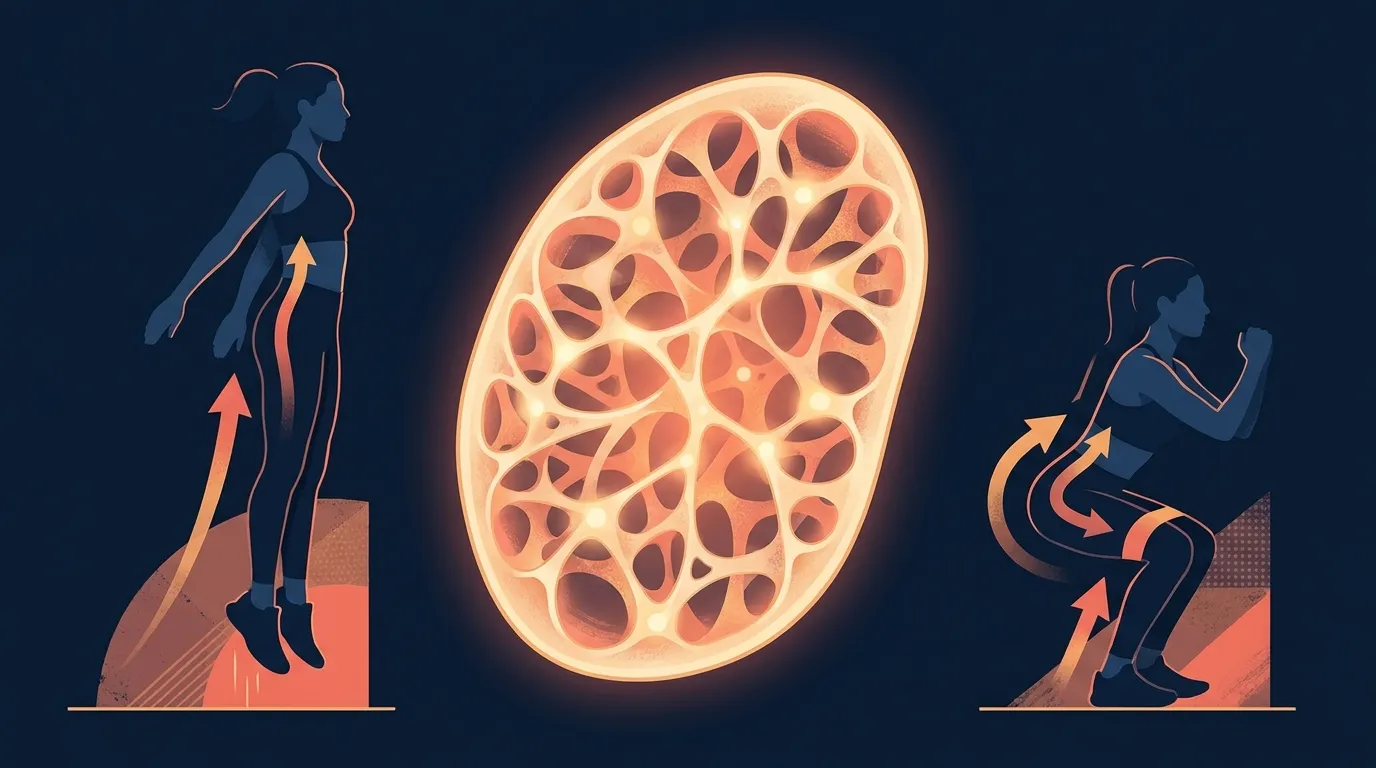
Most people find out their bones are thinning the same way. A DEXA scan shows osteopenia, or a wrist breaks from a fall that shouldn't have broken anything. The doctor mentions calcium, vitamin D, maybe a medication, and then says "weight-bearing exercise." That phrase usually gets translated as "walk more." Walking is good for almost everything, but for bones it's a maintenance dose at best.
The actual research on building bone is louder. Bones respond to mechanical stress. Big stress, applied with the right rest, signals the cells called osteoblasts to lay down new bone. Small, predictable stress (the kind walking provides) keeps what you've got but rarely adds much. So if your goal is to actually move the DEXA number, you need to do something your bones aren't already used to.
The good news. You can do most of it at home, in under 30 minutes a day, with no barbells. This article covers what the evidence actually supports, what to start with, who should be careful, and how to put it together into a weekly plan.
Why Bones Need a Reason to Stay Strong
Bone is constantly turning over. Osteoclasts break down old tissue. Osteoblasts build new tissue. The net direction depends on what you ask the skeleton to do. The principle goes back to a 19th-century surgeon named Julius Wolff, and it's now one of the most reliable rules in physiology: bone adapts to the loads placed on it.
Two kinds of load matter most. Impact, like landing from a jump, sends a fast, high-magnitude force through the skeleton. Heavy resistance, like loaded squats or hard banded rows, drives a slower but sustained pull on bone through the muscles attached to it. Walking, by comparison, peaks at roughly 1 to 1.5 times bodyweight at the hip. A small jump can hit 3 to 4 times bodyweight, briefly. That difference is the whole reason walking maintains bone and jumping can build it.
Why this matters more after 35
Peak bone mass arrives in your late 20s. From there, the trajectory is slow and downward, with a steeper slide for women through perimenopause as estrogen falls. Estrogen is a brake on bone resorption, so when it drops, the breakdown side of the bone equation gets louder. The good news is that load works at every age. The bad news is that the runway is shorter and the headwind is harder, so the dose has to be deliberate.
What the Big Trials Actually Showed
Two studies anchor the practical conversation. Read the rest of the literature with these as your reference points.
LIFTMOR (2018): the gym version
The LIFTMOR trial by Watson et al., published in the Journal of Bone and Mineral Research, randomized 101 postmenopausal women with low bone mass to either supervised high-intensity resistance and impact training (HiRIT) twice a week for 30 minutes, or a home-based low-intensity routine. After 8 months, the HiRIT group gained 2.9 percent in lumbar spine BMD. The control group lost 1.2 percent. Femoral neck BMD held steady in HiRIT and dropped in controls. Functional measures (back strength, leg strength, balance, height) all improved in HiRIT.
The catch. HiRIT used barbell deadlifts, overhead presses, squats, and supervised box drops at over 85 percent of one-rep max. So while LIFTMOR is the strongest signal we have that bone density can be moved in older women, the protocol itself isn't a home program. It's a coached gym program, and the authors were clear about that. What home training can borrow is the philosophy: load needs to be high enough to count, with rest between hard sessions.
Tucker et al. (2015): the home version
This one is the underrated workhorse of the bone-loading literature. Tucker, Strong, LeCheminant, and Bailey, in the American Journal of Health Promotion, randomized 60 premenopausal women to a control group, a "Jump 10" group, or a "Jump 20" group. The active groups jumped (a basic, two-foot vertical jump) the assigned number of times, twice a day, with 30 seconds of rest between each jump. They did this for 16 weeks. That's it.
Sixteen weeks later, both jump groups had higher hip BMD than the control group. The Jump 20 group beat the controls significantly. The Jump 10 group beat them marginally. The total time investment was tiny. A single session ran under a minute. The intervention was free, required no equipment, and worked.
The lesson isn't "jumping is magic." It's that the right kind of small, repeated, high-magnitude load (with rest between repetitions, so each jump arrives fresh) is enough to nudge the skeleton in the right direction.
What Works at Home, in Plain English
Stack these three categories. None of them alone is enough. Together they cover the bases that the gym trials cover.
1. Impact: the jumping piece
The Tucker dose is the easiest place to start. Twenty jumps a day, broken into two sessions of 10, with 30 seconds between each jump. If you can't jump (knee or ankle issues, balance trouble, recent fractures), substitute heel drops. Stand on the balls of your feet, lift your heels, then drop hard onto the floor. Aim for 50 heel drops a day, distributed across the day. Heel drops have been studied as a low-skill alternative for hip BMD and show meaningful effects in older populations. If knee pain is what rules jumping out, our roundup of the best low impact exercises for bad knees has more joint-friendly ways to keep loading the body.
Where you jump matters. Hardwood, tile, or a thin yoga mat over a hard floor delivers the load. Thick foam, plush carpet, or rubber gym mats absorb the very signal you're trying to send. The shoes that send the cleanest signal are the ones with thin, firm soles, or just bare feet on a clean hard surface.
2. Progressive resistance: the muscle pull on bone
Muscle yanks on bone every time it contracts. Stronger contractions yank harder. The 2022 systematic review by Massini et al. in Healthcare pulled together the resistance-training-and-BMD literature in older adults and found small but consistent gains at the hip and spine when programs progressed in difficulty over time. The exact tool didn't decide the outcome. The progression did.
At home, the practical menu looks like this:
- Squats and split squats, progressed by adding tempo, then a backpack of books, then a heavy resistance band. The hip and spine both load.
- Push-ups, on knees if needed, then on hands, then with feet on a chair. The wrist and the upper spine load.
- Banded rows, anchored in a door or under a foot. The mid-spine and the muscles that hold posture load.
- Calf raises, slow on the way up, hold, slow on the way down. The lower leg and tibia load.
- Single-leg balance work, eventually with a small banded resistance. Hip and ankle stability that translates to fewer falls.
Progress means you're choosing harder versions of these moves over months. If your set still ends with energy left in the tank, the bones aren't getting the message. The 2022 review's key word, repeated through the discussion, was progressive.
Ready to put this into practice?
Take the free FitCraft assessment and get a personalized plan based on behavioral science, not willpower. Free version available. Ty, our 3D AI coach, demonstrates every move and adapts the load as you get stronger.
Take the Free Assessment Free • 2 minutes • No credit card
3. Balance and posture: the fall-prevention piece
Most osteoporotic fractures happen because of a fall, not because the skeleton spontaneously snapped. So bone-density training without fall-prevention work misses half the point. Single-leg stands, slow lunges, and tai-chi-style weight shifts cost nothing, take five minutes, and meaningfully reduce fall rates in older adults. We dig deeper into the strength-and-aging picture in our piece on strength training after 60.
A Simple Weekly Template
Pull all of that into a week and it stops looking complicated.
Every day:
- Morning: 10 jumps (or 25 heel drops if jumping isn't an option), 30 seconds between each.
- Evening: another 10 jumps (or 25 heel drops).
- One minute of single-leg balance per side, while brushing your teeth.
Three days a week (Mon, Wed, Fri works well):
- Banded squats or split squats: 3 sets of 8 to 12, last set hard.
- Push-ups (the hardest version you can do with good form): 3 sets to 2 reps short of failure.
- Banded rows: 3 sets of 10 to 12.
- Slow calf raises: 2 sets of 12, with a pause at the top.
That's it. Total weekly time investment, including the daily jumps, is under two hours. The whole thing fits in a small living room. You'll feel the resistance work in your legs and back within a week. The bone changes take longer, which is why the next section matters.
Why You Won't See This for Months
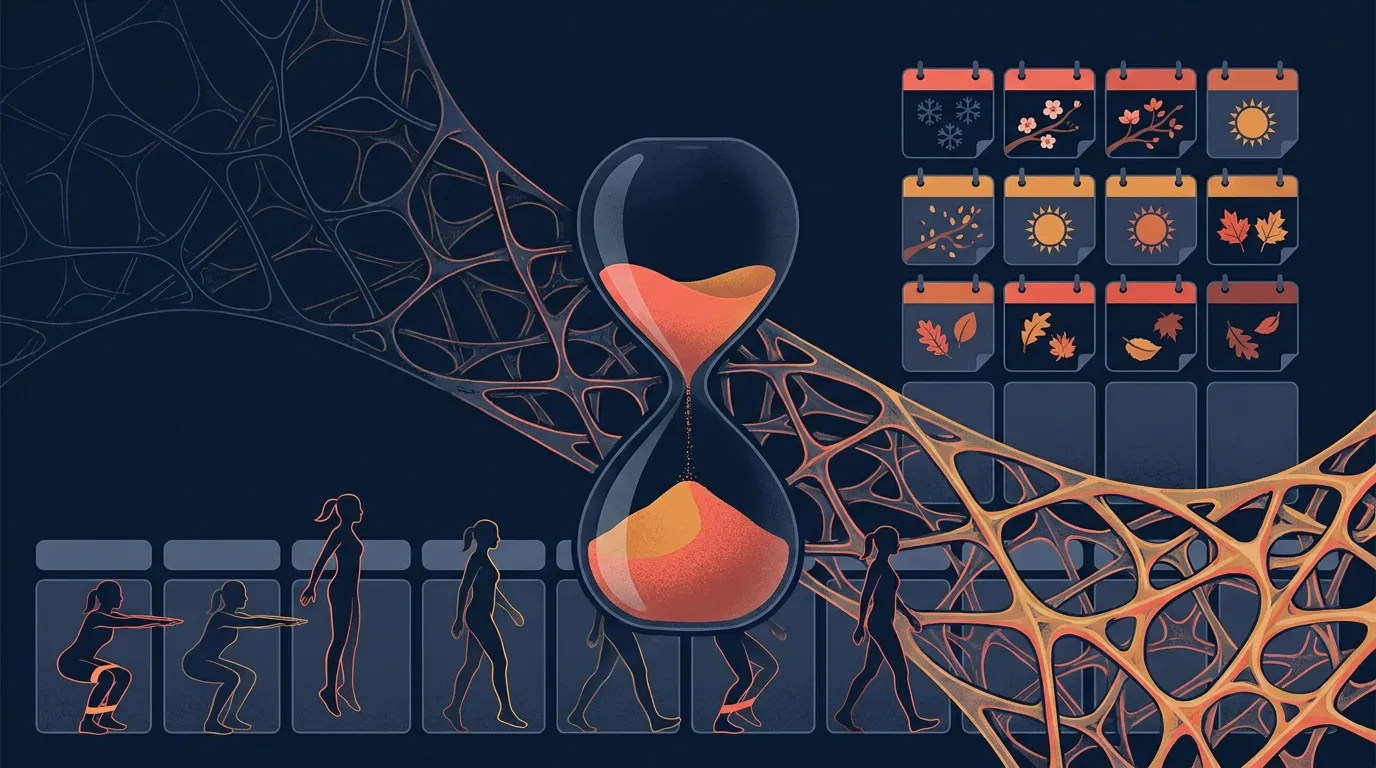
Here's the part that catches almost everyone off guard. Bone tissue remodels on the order of months, not weeks. The DEXA scan that detects a real change usually needs a 12-month interval to be confident the difference isn't measurement noise. So the first six months of any bone program have to run on faith and process, not feedback.
This is exactly the moment where most people quit. They start with conviction in January, can't see anything by March, and drift. The villain isn't the protocol. It's the gap between the work and the visible payoff. So the practical question stops being "what should I do?" and becomes "how do I keep doing it?" That's the part FitCraft is built for. Streaks, programs, and a 3D coach who walks you through each move turn a six-month slow burn into a daily routine that doesn't depend on motivation. We covered the underlying behavioral mechanic in our piece on streak psychology.
Who Should Be Careful
A few groups should adjust the protocol, not skip it. People with diagnosed osteoporosis (especially with vertebral fractures) shouldn't perform unsupervised forward-flexion movements (toe touches, sit-ups, deep crunches). The Bone Health and Osteoporosis Foundation has been clear on that point for two decades. People with knee or ankle injuries, balance disorders, or significant cardiovascular conditions need a clinician's input before starting impact work.
If you're not sure where you stand, get a DEXA scan. The number changes the conversation. T-score of -1 to -2.5 is osteopenia. Below -2.5 is osteoporosis. Both are loading-responsive. Both demand more care with form and progression than the average person needs.
What This Means for You
If your bones are healthy, the protocol above is a small, durable insurance policy. Twenty jumps a day plus three short resistance sessions a week buys you years of skeletal margin you'll be glad to have at 70. The cost is one minute of jumps and three short workouts. The return shows up on a scan a year from now and in the falls you won't have at 75.
If you're in perimenopause or already postmenopausal, the urgency goes up. The estrogen brake on bone loss has been released. Loading is one of the few non-pharmacological inputs with hard outcome data behind it. Pair it with adequate protein (we wrote about the leucine threshold for hitting your daily target without overthinking it) and, if relevant to your case, the conversation with your clinician about HRT and supplements.
If you've already been diagnosed with osteopenia or osteoporosis, the most important step is the slowest one. Talk to a physiotherapist who works with bone health before you add jumping, get a baseline DEXA so you have something to measure against, and progress carefully. The exercise still works. The path just runs through professional supervision for the first stretch.
And if you already train consistently and just want to make your home routine more bone-friendly, add the jumps in the morning, add a calf raise to the end of your push-up days, and move from machine-style isolation work to compound, multi-joint moves that pull on more of the skeleton at once. Progress the load each month. Trust the slow tissue to catch up.
Frequently Asked Questions
Can you really build bone density at home without weights?
Partly, yes. The gold-standard gym evidence (LIFTMOR, 2018) used heavy lifts that don't translate to a living room. But Tucker et al. (2015) showed premenopausal women added hip BMD by jumping 10 to 20 times, twice daily, for 16 weeks. High-impact work plus progressive bodyweight and resistance-band training preserves and modestly improves BMD when consistent over months.
How many jumps per day do I need for bone density?
The Tucker et al. (2015) trial in the American Journal of Health Promotion used 10 jumps twice a day, with 30 seconds rest between each jump, for the entry dose, and 20 jumps twice a day for the higher dose. Both improved hip BMD versus controls over 16 weeks. Land softly, on solid ground, away from carpet padding that absorbs the load you're trying to deliver.
Is jumping safe if I already have osteoporosis?
Not always. People with diagnosed osteoporosis or recent fragility fractures shouldn't start unsupervised high-impact work. The LIFTMOR protocol was supervised, with screening for cardiovascular and joint contraindications. If your DEXA shows osteoporosis, talk to a physiotherapist or your doctor first. Low-impact loading (heel drops, brisk walking, banded squats) is the safer entry point.
Do resistance bands really load bone the way weights do?
Bands aren't as bone-stimulating as heavy free weights, but they're not nothing. The 2022 Massini et al. meta-analysis in Healthcare found that progressive resistance training, including band-based protocols, produced small significant gains in lumbar spine and femoral neck BMD in older adults. The dose that matters is intensity progressed over time, not the tool's brand.
How long until my bone density actually changes?
Most controlled trials run 6 to 12 months before DEXA picks up a change. The LIFTMOR trial (Watson et al., 2018) saw spine BMD gains of 2.9 percent over 8 months. The Tucker jumping trial saw hip BMD gains over 16 weeks. Bone is slow tissue. Plan in seasons, not weeks, and judge progress by your training consistency, not the scan number, until the scan catches up.