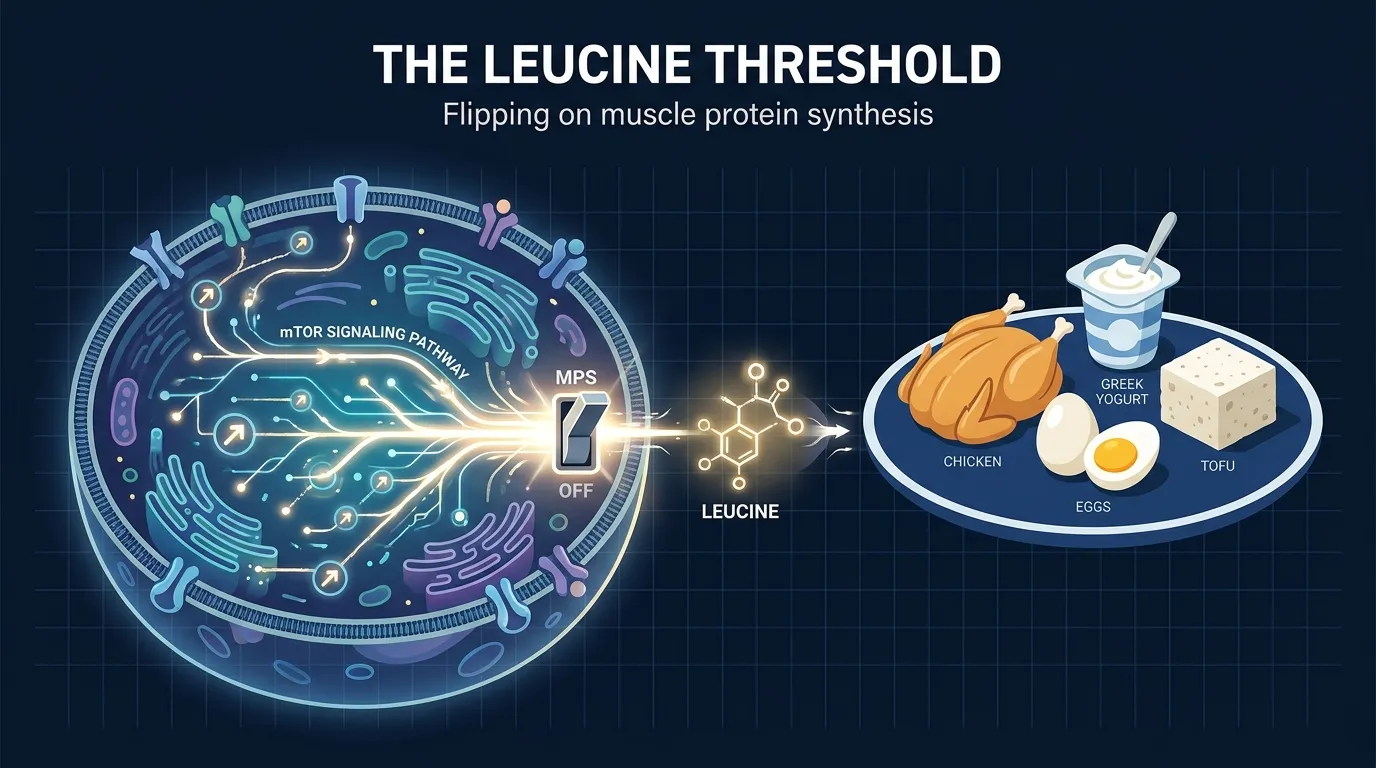
- The leucine threshold is the dose of leucine in a meal (about 2.5g for adults under 65, closer to 3g over 65) that fully turns on muscle protein synthesis. Below it, the response is weak. Above it, you plateau.
- In real food, that's roughly 25 to 35 grams of high-quality protein per meal. One palm-sized chicken breast. Two large eggs plus Greek yogurt. A properly dosed plant blend.
- Spreading protein across 3 to 4 meals beats stacking it in one. Each meal is its own MPS session. Skipping a meal skips a session.
- Older adults need a bigger leucine spike per meal. Anabolic resistance is real. Aim closer to 35 to 40 grams of protein and pair it with resistance training.
- Newer 2024 research argues the threshold isn't a hard line, just a useful planning tool. Total daily protein, around 1.6 grams per kilogram of body weight, still does most of the heavy lifting.
Open any 2026 fitness podcast and you'll hear it within five minutes. Three grams of leucine per meal. The leucine threshold. The "muscle full" effect. It's everywhere.
And it's confusing. Most people don't track leucine. Most people don't know how much is in a chicken breast. The advice gets compressed into "eat more protein," which is true but unhelpful. Or it gets blown up into a strict per-meal target that suddenly makes breakfast feel like math.
So let's slow down. This article walks through what the leucine threshold actually is, where the 2.5g number came from, what hits it on a normal plate, and why meal spacing turns out to matter more than the total most people are obsessing over. Every claim is linked to a real study so you can check.
What Muscle Protein Synthesis Actually Is
Your muscle is in a constant tug-of-war. Old protein gets broken down. New protein gets built. Whichever side wins over weeks and months decides whether you grow, stay flat, or shrink. The build side is muscle protein synthesis, or MPS. The breakdown side is muscle protein breakdown, or MPB. Net muscle = MPS minus MPB.
Two things crank MPS up. Resistance training is one. Eating protein is the other. Stack them, and MPS spikes for hours. Skip them, and MPS sits idle while breakdown chips away.
Where leucine fits in
Of the twenty amino acids in protein, one stands out as a signal. Leucine. It binds to a sensor inside muscle cells called mTORC1, and that sensor is what kicks the MPS machinery into gear. The other amino acids are bricks. Leucine is the foreman who shouts "build."
This is why a small dose of pure leucine can light up MPS in a lab study even when total protein is low. And it's why meals built around plant proteins, which carry less leucine per gram, sometimes need to be a bit larger to get the same response.
Where the 2.5g Threshold Came From
The number you keep hearing didn't fall out of a single paper. It emerged from a wave of dose-response studies in the late 2000s and 2010s, mostly tracing back to work by Stuart Phillips at McMaster and Kevin Tipton in the UK.
The classic paper is Moore et al. (2009) in the American Journal of Clinical Nutrition. They fed young men different doses of egg protein after resistance training, then measured MPS. The response climbed sharply up to about 20 grams of protein. Beyond that, it flattened. Twenty grams of egg protein contains roughly 1.7 to 2g of leucine, which placed the inflection point right around there.
Later work refined the picture. A 2021 systematic review by Zaromskyte et al. in Frontiers in Nutrition formally evaluated the "leucine trigger hypothesis" across young and older adults. Younger adults responded reliably once leucine in the meal hit roughly 2 to 2.5 grams. Older adults needed more, often closer to 3g, before MPS rose meaningfully.
So the rough rule that gets quoted on podcasts holds up reasonably well, with a real age-related caveat baked in.
What the threshold is not
It isn't a cliff. Below the number, MPS doesn't sit at zero. Above it, you don't double the response by piling on more leucine. Think of it as a dimmer switch with a sweet spot. Get into the sweet spot, and the lights are on. Going past it doesn't make the room brighter.
It also isn't fixed for life. Training status, age, recent meals, and total daily protein all shift where the threshold lands for any individual.
What 2.5 Grams of Leucine Looks Like on a Plate
Here's the part most people skip. Tracking leucine directly is annoying. So nutrition researchers translate the threshold into a more useful currency: high-quality protein per meal.
For an average healthy adult under 65, hitting roughly 2.5g of leucine usually takes around 25 to 30 grams of high-quality protein per meal. For adults over 65, push that up to 35 to 40 grams. That's it. That's the practical version of the rule.
Animal-based examples
These all land at or just over the threshold:
- 1 palm-sized chicken breast (about 100g cooked): roughly 30g protein, 2.4g leucine
- 1 can of tuna (about 140g): 30g protein, 2.5g leucine
- 1 cup of cottage cheese with 2 large eggs: 35g protein, 3g leucine
- 1 scoop of whey protein (about 25g): 25g protein, 2.5 to 2.7g leucine
- 200g Greek yogurt (5%) plus 1 scoop whey: 40g protein, 3.5g leucine
- 150g salmon, baked: 30g protein, 2.4g leucine
Plant-based examples
Plant proteins are leaner on leucine per gram, so meals usually need to run slightly bigger. From Goldman et al. (2024) in Sports, even rugby players hit performance-grade protein and leucine targets on fully plant-based diets, but the meals were planned, not casual:
- 1 block of firm tofu (200g) plus 1 cup of edamame: 35g protein, 2.7g leucine
- 1 scoop of soy protein isolate: 25g protein, 2g leucine (often blended with pea for completeness)
- 1 cup of cooked lentils plus 1 cup of cooked quinoa: 22g protein, 1.7g leucine (this one's just under)
- 1 scoop of pea-rice blend at 30g: 25g protein, 2.3 to 2.5g leucine
- 3 tbsp peanut butter, 1 cup soy milk, 1 banana: 22g protein, 1.7g leucine (also just under)
The pattern is clear. Concentrated plant protein sources (soy, properly blended pea-rice, seitan) clear the bar easily. Mixed plates of nuts, beans, and grains need a bit more volume or a powder topper to land above the threshold.
Meal Spacing Matters More Than People Realize
Here's the part that surprised me when I first read the literature carefully. Total daily protein is the foundation. Roughly 1.6g per kilogram of bodyweight is the well-established sweet spot for most active adults building muscle. But the way you spread that total across the day changes how much actual MPS you accumulate.
Schoenfeld and Aragon (2018) in the Journal of the International Society of Sports Nutrition reviewed this directly. Their recommendation: target roughly 0.4 grams of protein per kg of bodyweight at each of 3 to 4 meals. For a 75kg adult, that's 30 grams per meal, four times a day, totaling 120 grams. Each meal is its own MPS session. Hit four sessions, and you've stacked four chances for muscle to build.
The "muscle full" cap
Why does spacing matter? Because of a phenomenon researchers call "muscle full." After a protein-rich meal, MPS rises for 2 to 3 hours, then ramps back down even if amino acids are still circulating. Eating more protein at hour two doesn't extend the response. The cell has had its meal.
So one giant 80g protein dinner doesn't create a longer or bigger MPS spike than a 30g lunch and a 30g dinner would. It just creates one big spike, with the rest of the protein burned for energy or stored. Two spikes beat one.
This isn't an excuse to obsess over a perfect meal calendar. Hit your daily total, get protein into 3 to 4 separate meals, and you're well past the point of diminishing returns. The fanatical 6-meals-a-day school doesn't out-build the practical 3-to-4-meals school in head-to-head trials.
Protein helps. Showing up to train is what closes the loop.
Take the free FitCraft assessment and get a personalized plan with workouts you'll actually do. Free version available. Ty, our 3D AI coach, walks you through every move.
Take the Free Assessment Free • 2 minutes • No credit card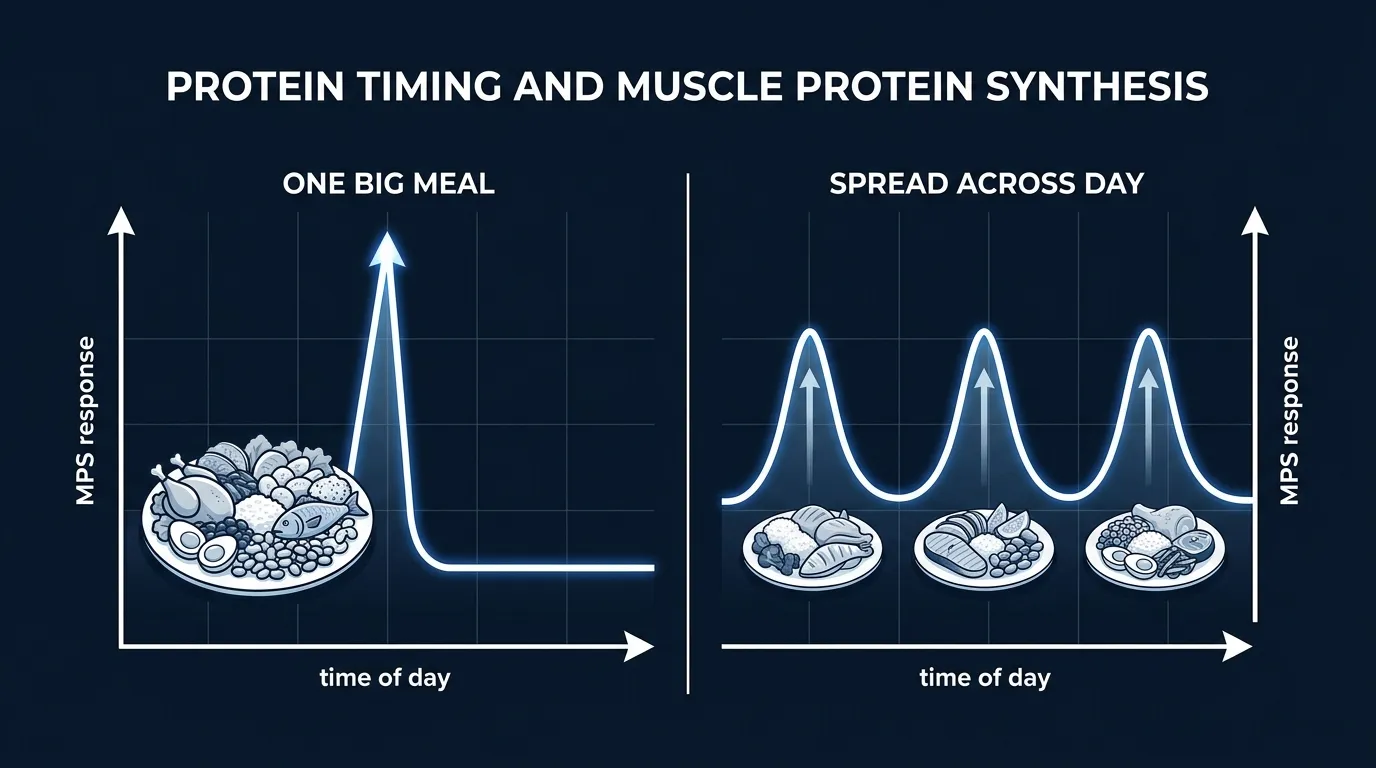
Anabolic Resistance: Why Older Adults Need More
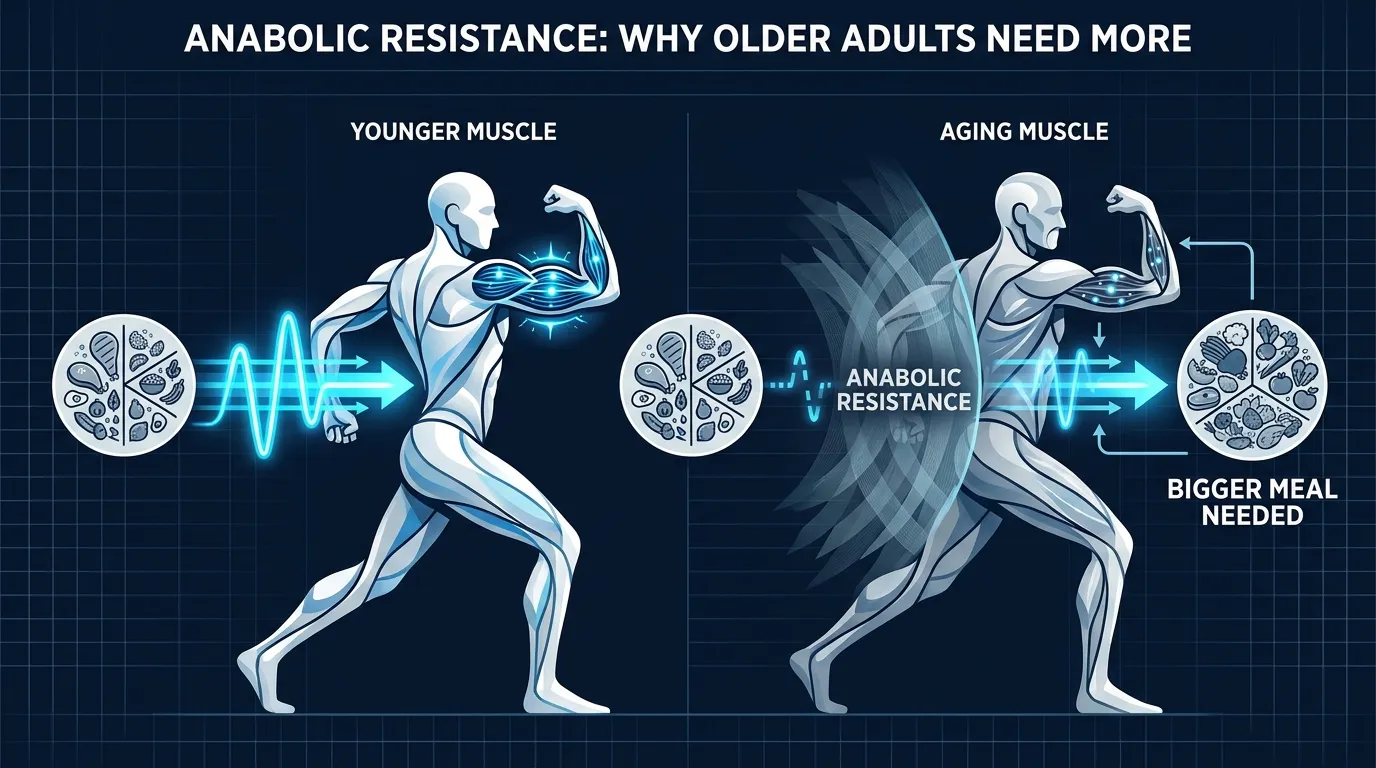
If you're over 50, the threshold conversation gets more important, not less. Aging muscle responds less aggressively to a given dose of protein. Researchers call this anabolic resistance. The same 25g of chicken that lit up MPS at age 30 produces a smaller spike at 70.
The fix isn't exotic. It's more leucine per meal, paired with resistance training. A dose-response analysis by Moore et al. (2015) in the Journals of Gerontology found that MPS plateaued after about 0.40 g of protein per kg of body mass in older men, against 0.24 g/kg in younger men. For an 80 kg older adult that is roughly 32g of high-quality protein in a sitting, close to double the younger requirement. Pair that with two to three resistance training sessions per week, and the data point in the same direction. Both inputs are needed. Protein alone doesn't reverse sarcopenia. Training alone leaves leucine on the table.
This is the same logic we walked through in our piece on fitness over 60. The principles don't change with age. The doses do.
The GLP-1 wrinkle
The conversation about meal-level protein has new weight in 2026 because of the GLP-1 wave. Semaglutide, tirzepatide, and the newer compounds suppress appetite hard. People eat smaller meals and skip more of them. Total daily protein drops without anyone meaning for it to drop. Lean mass loss follows.
If you're on a GLP-1, the meal-level rule becomes a non-negotiable. Whatever you eat needs to clear the leucine threshold, because you're eating less of it. We covered the protocol in detail in Ozempic and Exercise, and the meal math from this article plugs directly into that plan.
What the Newer 2024 Research Adds
The leucine threshold is a useful model. It's also being challenged at the edges. A 2024 paper in the American Journal of Clinical Nutrition argued that pure leucine content alone doesn't fully predict postprandial MPS. Total essential amino acids, the rate of digestion, and other amino acids like methionine and lysine all play supporting roles. The authors aren't saying leucine doesn't matter. They're saying it's not the only knob.
And a 2023 systematic review by Wilkinson et al. in Physiological Reports found a clear correlation between meal leucine dose and post-exercise MPS, but the relationship was less clean in non-trained adults. So the threshold seems to act more like a sharp lever in trained, recovering muscle and more like a soft gradient in everyday eating.
Practical takeaway: don't worship the 2.5g number. Plan around it. If your meals tend to land between 25 and 40g of mixed quality protein, you're inside the productive band. Going lower puts you in soft territory. Obsessing about 2.4 vs 2.6 isn't going to move your training.
What This Means for You
The simple version. Three to four protein-anchored meals a day. Each one in the 25 to 40 gram range, depending on age and training intensity. Mix of sources is fine. Whey, eggs, fish, chicken, Greek yogurt, tofu, soy. A scoop of protein powder counts as one meal's worth if breakfast or a snack would otherwise come up short.
The harder version. Most people don't have a protein problem at dinner. They have a protein problem at breakfast. A bowl of oatmeal with berries is a fine meal but barely nudges MPS. Adding 30g of Greek yogurt or a scoop of whey changes the day. So does a two-egg-plus-cottage-cheese plate. Lunch is the second weak spot. A salad with chicken on top often comes in at 15g of protein, half the threshold. Bulk it up.
None of this requires a kitchen scale or a tracking app. After a week of paying attention, you'll know which of your meals fall short and which are fine. The fix is small. Add a protein source at breakfast. Make lunch more chicken than greens. Don't skip a meal on a training day. That's the whole game.
And the protein only matters if you're actually training. Lifting, bodyweight strength work, anything that gives the muscle a reason to use the leucine signal. We built FitCraft for that part. Ty, our 3D AI coach, walks you into a workout that fits your day, demonstrates each exercise from any angle, and pulls you forward through streaks so consistency stops depending on willpower. The food side and the training side reinforce each other. Skip either one, and you're leaving most of the result on the table.
Frequently Asked Questions
What is the leucine threshold?
The leucine threshold is the dose of the amino acid leucine in a single meal that fully activates muscle protein synthesis (MPS). For most adults under 65, that's around 2.5 grams of leucine. For adults over 65, the number drifts up toward 3 grams because of anabolic resistance. Below the threshold, MPS responds weakly. Above it, the response plateaus.
How much protein per meal is enough?
For most adults, 25 to 35 grams of high-quality protein per meal puts you at or above the 2.5g leucine threshold. Older adults trend toward 35 to 40 grams. Plant-based eaters need a bit more total protein per meal to hit the same leucine load, since plant proteins generally carry less leucine per gram than animal sources.
Should I spread protein across the day or stack it in one meal?
Spread it. The Schoenfeld and Aragon 2018 review in the Journal of the International Society of Sports Nutrition recommends roughly 0.4 grams of protein per kilogram of body weight at each of 3 to 4 meals. That hits the leucine threshold each time, which means more total MPS sessions per day than dumping all your protein into dinner.
Do older adults need more leucine?
Yes. Anabolic resistance, the dulled MPS response that comes with age, means older muscle needs a bigger leucine spike to flip on. Reviews suggest 3 to 4g of leucine per meal (about 35 to 40g of protein) for adults over 65, paired with resistance training. Both inputs matter. Protein without training won't reverse sarcopenia.
Is the leucine threshold real or a myth?
It's a useful model that the science is still refining. A 2024 paper in the American Journal of Clinical Nutrition argued that pure leucine content alone doesn't fully predict MPS rates, and that total essential amino acids matter too. The threshold is a planning tool, not a hard biological line. Total daily protein still does most of the work.