- Across GLP-1 trials, roughly 25-40% of total weight lost is lean body mass. In STEP-1, lean mass dropped 9.7%; in SURMOUNT-1 with tirzepatide, about 25% of weight loss was lean tissue.
- Resistance training 2-3 times per week (60-90 minutes total) is the single most effective intervention for preserving muscle while on Ozempic, Wegovy, Mounjaro, or Zepbound.
- Protein intake of 1.2-2.0 g/kg per day, spread across the day, mitigates muscle loss. A 2025 ENDO presentation found that GLP-1 patients eating less protein lost more lean mass.
- A 2025 case series documented two patients who gained 2.5-5.8% lean tissue on GLP-1s by combining 3-5 days of resistance training with 1.6-2.3 g/kg protein. The protocol works.
- Bodyweight, dumbbells, and resistance bands are enough. You don't need a gym, and FitCraft's home programs are built around exactly this kind of accessible resistance work.
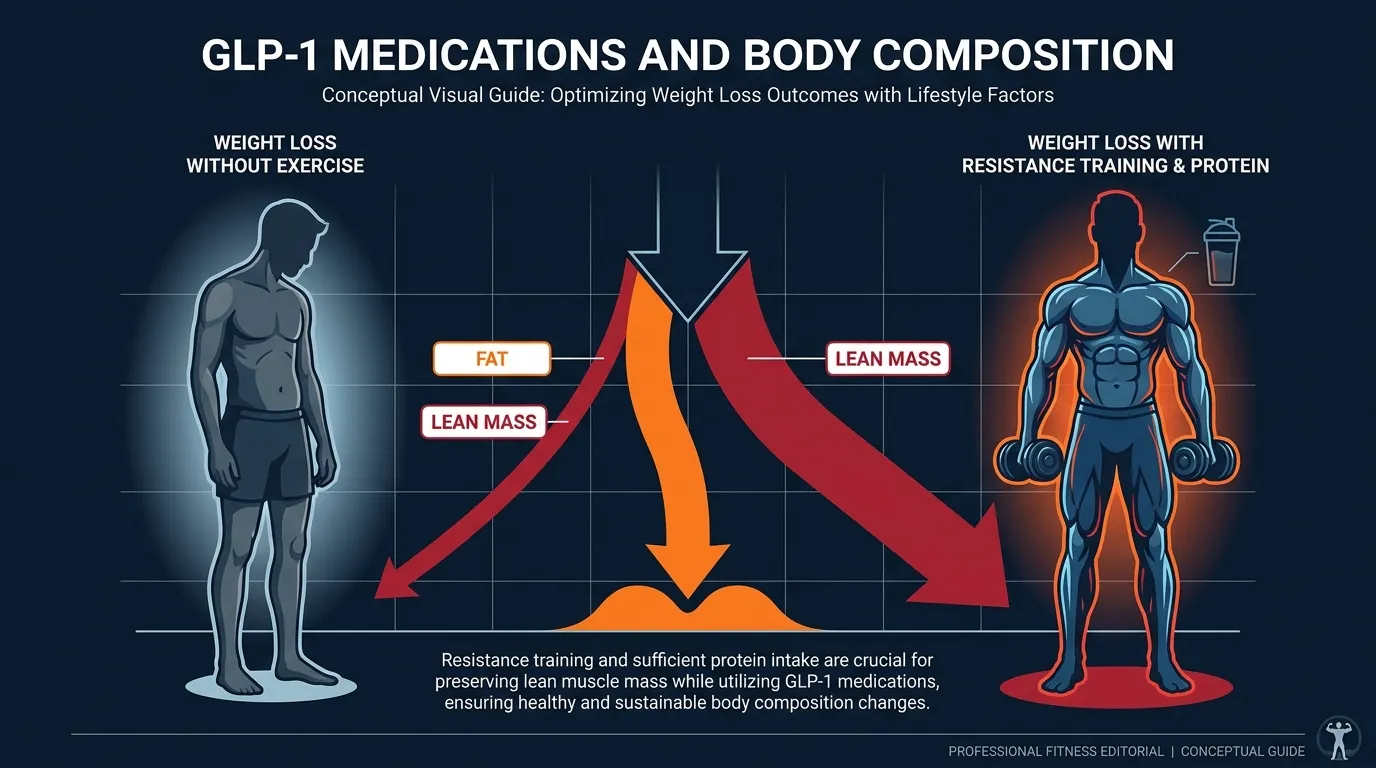
You started a GLP-1 to lose weight. The scale is moving. So is your muscle, and probably faster than you think.
Across the major trials of semaglutide (Ozempic, Wegovy) and tirzepatide (Mounjaro, Zepbound), roughly 25-40% of the total weight people lose comes from lean body mass. Not just fat. Real muscle. Strength, posture, metabolism, fall risk, the things that matter when you're 50 or 60 or 70 and trying to age well. Codella et al. (2025), in a Frontiers narrative review, put a number on it: in STEP-1 with semaglutide, lean mass dropped about 9.7% while fat mass fell 19.3%. In SURMOUNT-1 with tirzepatide, roughly 25% of total weight loss over 72 weeks was lean tissue.
Here's the part nobody on the patient side is hearing clearly: that loss isn't inevitable. Resistance training and protein flip the math. This article walks through what the 2025 research actually shows, the protocol that protects your muscle, and the consistency problem that quietly sabotages most people once their appetite goes quiet and motivation flattens out.
What GLP-1s Actually Do to Your Body Composition
GLP-1 receptor agonists work by mimicking a gut hormone that signals fullness, slows gastric emptying, and reduces food intake. The weight loss is real. So is the side effect that gets less airtime: when you eat dramatically less and don't change anything else, your body breaks down both fat and lean tissue. Muscle is metabolically expensive. The body is happy to let some of it go.
The numbers, from the trials themselves
The 2025 ACE-Certified review on GLP-1s and lean mass cites a 2022 meta-analysis finding GLP-1 users typically lose 25-40% of their weight loss from lean mass. A separate Mendelian randomization analysis of over 800,000 individuals (University of Hong Kong) found that for every 1-unit BMI reduction tied to GLP-1 mimicry, fat mass dropped about 7.9 kg and lean mass about 6.4 kg.
Read that again. For every kilogram of fat lost, almost a kilogram of lean tissue went with it.
The SEMALEAN study (Alissou et al.), which followed 115 patients on semaglutide 2.4 mg, told a more nuanced story: with adequate nutritional support, fat mass fell substantially while lean mass held up better than expected. The mediator wasn't the drug. It was what the patients did around the drug.
Why the loss matters more than the percentage suggests
People often shrug at "25-40% lean mass." It sounds like the same ratio you'd lose from any diet. The catch: GLP-1 patients lose more total weight. So the absolute amount of muscle lost is larger.
And muscle isn't just an aesthetic concern. It's the largest organ system involved in glucose disposal. It's a buffer against frailty, falls, and the metabolic ceiling that makes weight regain so common after the medication stops. Codella et al. (2025) were direct: long-term weight maintenance is significantly more successful when exercise is included, since stopping GLP-1 therapy without it tends to trigger weight regain inside a year.
What the 2025 Research Says About Protecting Muscle
Three new pieces of evidence from 2025 changed the conversation. They all point in the same direction.
The case series that proved muscle gain is possible
In late 2025, Tinsley and Nadolsky published a case series in SAGE Open Medical Case Reports following three patients on semaglutide or tirzepatide who paired the medication with structured exercise and high protein. The body composition results were striking:
- Case 1: Lost 33% of body weight. Lean tissue made up only 8.7% of the loss, far below the 26-40% trial average.
- Case 2: Lost 26.8% of body weight while increasing lean tissue by 2.5%.
- Case 3: Lost 13.2% of body weight while increasing lean tissue by 5.8%.
The intervention all three shared: 4-7 days per week of intentional exercise, 3-5 of those days dedicated to resistance training, and protein intake of 1.6-2.3 g/kg of fat-free mass. So a 70 kg person with roughly 50 kg of fat-free mass would target 80-115 grams of protein per day.
One small case series isn't proof. But it lines up with everything else the literature has shown about protein and resistance training during energy restriction. The mechanisms are well established. The drug doesn't override them.
The Mass General protein study
At ENDO 2025 in San Francisco, Dr. Melanie Haines and colleagues from Massachusetts General Hospital and Harvard Medical School presented findings from 40 adults with obesity, 23 on semaglutide and 17 in a diet/lifestyle program. They tracked body composition and protein intake over three months.
The result, in the team's own words: among semaglutide patients, lower protein intake correlated with greater muscle loss. And greater muscle loss was associated with smaller improvements in HbA1c. So the muscle wasn't just cosmetic. It was metabolic. Older adults and women showed the highest risk for muscle loss, and protein was the modifiable variable that softened it.
The Frontiers review's exercise prescription
The Codella et al. (2025) review went further and laid out a phased exercise prescription that lines up with what the broader sports-medicine community recommends for older adults losing weight:
- Phase 1 (build a base): 150 minutes of moderate aerobic activity per week, or 75 minutes of vigorous activity. Walk, cycle, swim, dance. Anything that gets your heart rate up.
- Phase 2 (preserve muscle and bone): 2-3 resistance training sessions per week, totaling 60-90 minutes. Compound movements: squats, hinges, presses, pulls.
- Phase 3 (maintenance): 30-60 minutes daily of aerobic plus 2-3 resistance sessions per week. Forever, basically.
Notice what's not on that list. Hours of grueling cardio. CrossFit-style brutality. Anything that requires a barbell or a gym membership. The protocol is conservative, sustainable, and almost entirely doable at home with a pair of dumbbells, resistance bands, or just your bodyweight.
Ready to put this into practice?
Take the free FitCraft assessment and get a personalized resistance-training plan built around your goals, schedule, and equipment. Designed to keep you consistent, not exhausted.
Take the Free Assessment Free • 2 minutes • No credit card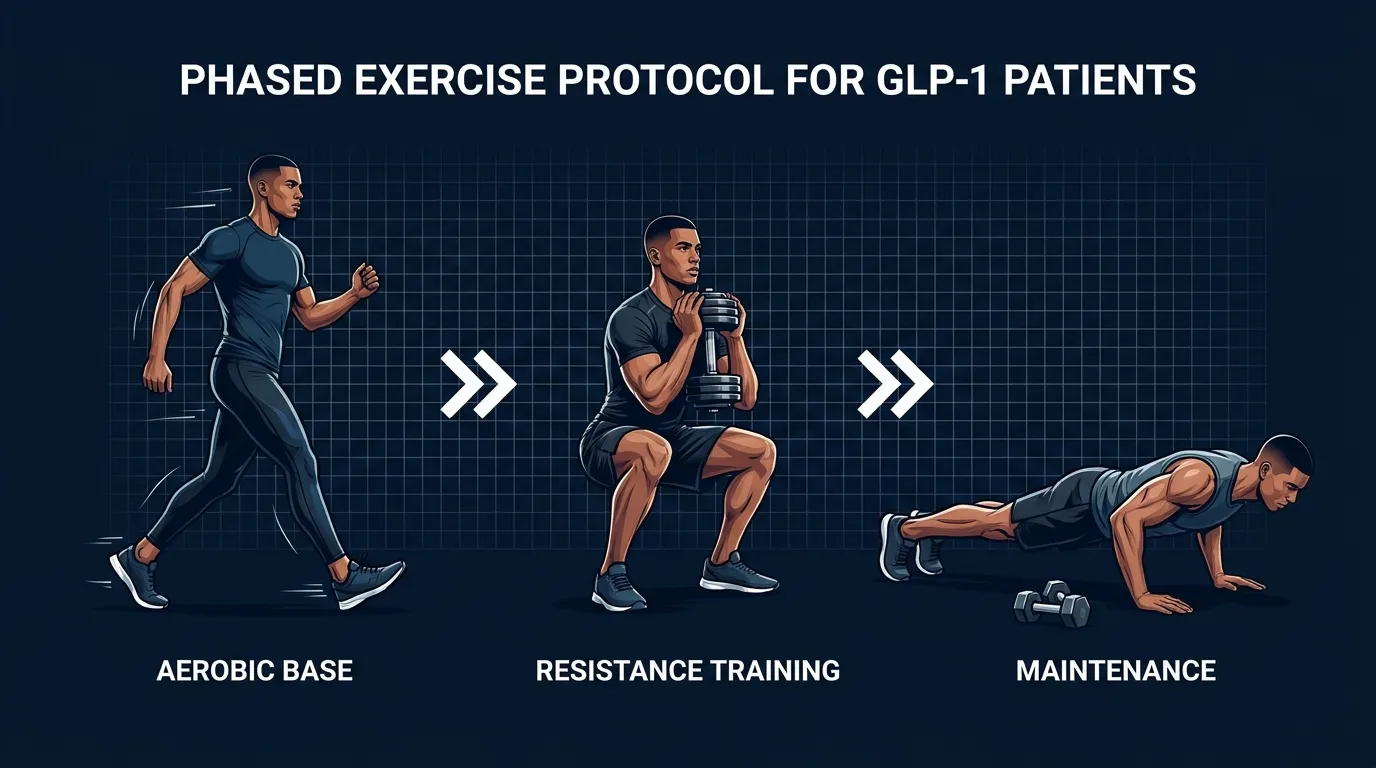
The Resistance Training Protocol That Actually Works on a GLP-1
If you take one thing from this article, take this part. Skip cardio. Cardio is great for your heart, your sleep, your mood. It will not protect your muscle. Resistance training will.
What "resistance training" actually means
Loading your muscles against meaningful resistance, hard enough that you couldn't do many more reps. That's the whole concept. The mechanism is the same whether the resistance comes from a barbell or a banded squat or a slow-tempo push-up. Muscle responds to load and effort, not to specific equipment.
For most people on a GLP-1, especially those new to lifting, three movement categories cover almost everything that matters:
- Lower-body push: squats, split squats, step-ups, leg press
- Lower-body pull (hinge): deadlifts, Romanian deadlifts, glute bridges, single-leg deadlifts
- Upper-body push and pull: push-ups, dumbbell rows, shoulder presses, banded pulls
You don't need to do all of them every session. Two sessions a week of full-body resistance work, with two to three exercises per category, will cover the muscle-protection job for almost anyone on a GLP-1.
The dose-response sweet spot
Both Codella et al. (2025) and the ACE-Certified review converge on a similar weekly volume: 2-3 sessions, 60-90 total minutes. That's a beginner-friendly target. It works. The point is consistency over months, not heroism on any single day.
Sets and reps that hit the muscle-preservation goal:
- Sets per exercise: 2-4
- Reps per set: 6-15, taken close to failure (2-3 reps in reserve)
- Rest between sets: 60-120 seconds
- Progressive overload: add a rep, a set, or a touch more load each week or two
If that sounds boring, good. Boring is what works. The flashier the program, the harder it is to stick to past week three.
Protein: The Other Half of the Equation
Resistance training is the signal. Protein is the building material. Without enough of it, the muscle-protection signal doesn't have anything to act on.
How much protein
The mainstream guideline for GLP-1 patients lands between 1.2 and 2.0 grams per kilogram of body weight per day. The Tinsley & Nadolsky (2025) case series went a step higher (1.6-2.3 g/kg of fat-free mass) for patients actively trying to gain or hold lean tissue. Two practical anchors:
- If you're a 70 kg (154 lb) adult: aim for 84-140 g of protein per day
- If you're a 90 kg (198 lb) adult: aim for 108-180 g per day
The exact number matters less than the floor. Don't drop below ~1.2 g/kg. Older adults and women, the groups most at risk per the Haines et al. ENDO 2025 findings, should target the higher end.
The hard part: actually eating it
Here's where GLP-1s sabotage their own users. Appetite suppression is the entire point of the medication. So protein, the food group that takes the longest to chew, fills you up the fastest, and triggers the most satiety, becomes the hardest macronutrient to hit. People skip it without noticing.
A few strategies that work:
- Front-load. Eat the protein first at every meal, before carbs or fats fill the bag.
- Spread it out. Three to four meals with 25-30 g each beats one giant chicken breast at dinner. Muscle protein synthesis caps per meal, so distribution matters.
- Use shakes when food fails. A whey or plant-protein shake delivers 25 g in a glass when solid food sounds awful. This is a tool, not a moral failure.
- Anchor on Greek yogurt, cottage cheese, eggs, lean meat, fish, tofu, tempeh, edamame. These pack protein density per calorie far better than processed snacks.
The Hidden Problem: Exercise Anhedonia on GLP-1s
This is the part of the conversation almost no clinician brings up.
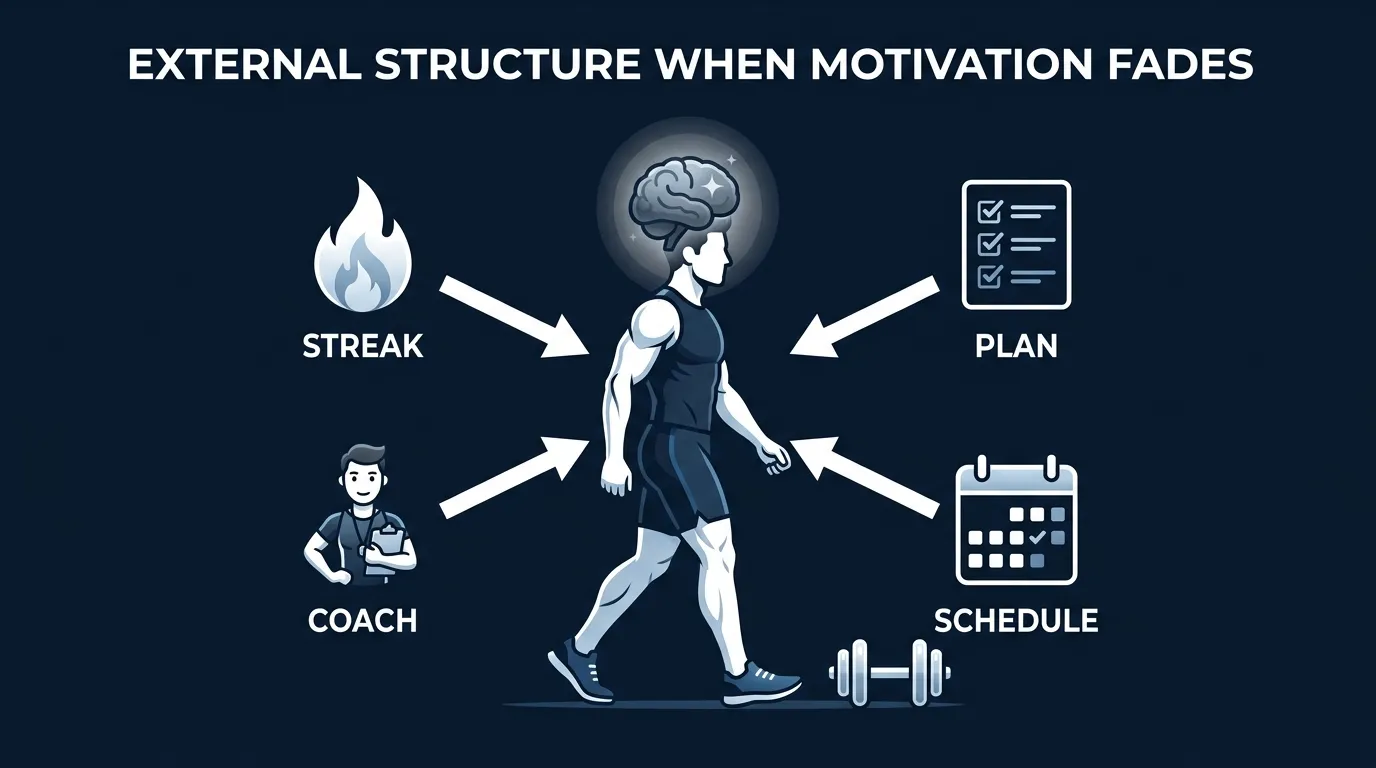
GLP-1 medications act on dopamine reward circuits, not just appetite. The same mechanism that quiets food cravings can blunt the felt reward from other activities. Exercise included. Some users describe a strange flatness around training. The motivation just isn't there. Workouts that used to feel energizing feel like a chore.
It's not laziness. It's pharmacology. And the standard advice ("just push through, you'll feel better after") often doesn't land, because the post-workout endorphin rush itself is muted.
Why willpower-based plans fail here, specifically
Most fitness apps and trainers assume you'll be intrinsically motivated to show up. They give you a workout and hope you do it. That model collapses when the felt reward goes quiet. You don't quit because you're weak. You quit because the brain's "this was worth it" signal got dialed down.
The fix is structural. External cues. Streaks. A coach checking in. A program that decides what you're doing today so you don't have to negotiate with yourself at 6 a.m. Research on gamification in fitness shows that adding external motivation structures produces a small-to-medium improvement in physical activity compared with self-directed exercise alone. We looked at which apps actually build in that kind of structure in our roundup of the best fitness apps for GLP-1 users.
This is exactly the moment FitCraft was built for. Ty (the AI coach) tells you what today's workout is, demonstrates each move in 3D, and pulls you forward through streaks and quests. The streak effect bypasses the dampened internal reward and substitutes an external one. You're not relying on motivation that isn't there. You're relying on a system that doesn't need it.
Putting It All Together: Your First 4 Weeks
Here's a plain-English starter protocol for someone on a GLP-1 who wants to protect their muscle. Talk to your doctor, especially if you have cardiovascular concerns or are new to resistance training, but the structure below maps directly onto the Codella et al. (2025) phased recommendations.
Week 1-2: Build the habit, not the load
- Resistance: 2 sessions per week, 30 minutes each. Full-body bodyweight or light dumbbells. Examples: squats, glute bridges, push-ups (or wall push-ups), bent-over rows with bands or light dumbbells.
- Aerobic: 20-30 minute walks, 3-4 days per week. Brisk enough to break a light sweat.
- Protein: Aim for the lower bound (1.2 g/kg). Start tracking just at breakfast and lunch to build the pattern.
Week 3-4: Add load and a third session
- Resistance: 3 sessions per week. Same movement patterns, slightly more reps or slightly heavier weight. Add tempo: 3 seconds down, 1 second up.
- Aerobic: 30-40 minute walks or low-intensity cardio, 4 days per week. Hit ~150 min/week total.
- Protein: Push toward 1.4-1.6 g/kg. Add a shake on training days if dinner appetite tanks.
Month 2 and beyond
Hold the structure. Add load every 2-3 weeks. Track sets, reps, and weights so you can see the line going up even when the scale moves slowly. Body composition tells the real story here, not bodyweight alone, since you're trading fat for muscle, not just shedding total mass.
If you have a smart scale or DXA access, recheck body composition at month 3. The data is your motivation cue when the felt reward is muted.
What This Means for You
Ozempic, Wegovy, Mounjaro, and Zepbound are powerful medications. They are also blunt instruments. They reduce intake. They don't care whether the weight you lose is fat or muscle. That part is on you, and on the structure you build around the drug.
The good news: the protocol is simple. Lift twice or three times a week. Hit 1.2-2.0 g/kg of protein. Walk most days. Build a system that handles consistency for you, since your internal motivation may be muted by the medication itself. Do that for six months and your scale will keep moving while your strength holds, your posture holds, and you walk away from the medication someday with a body that's leaner and more functional, not just lighter.
That's the goal. A leaner version of you that you can actually live in for the next 30 years. Not a smaller, weaker shadow of the person you were before.
Frequently Asked Questions
Does Ozempic cause muscle loss?
Yes. Across the major GLP-1 trials, roughly 25-40% of total weight lost on semaglutide (Ozempic, Wegovy) or tirzepatide (Mounjaro, Zepbound) comes from lean body mass. In STEP-1, lean mass dropped about 9.7% while fat mass fell 19.3%. The proportion is similar to non-medication weight loss, but the absolute amount tends to be larger because GLP-1 patients lose more total weight.
What kind of exercise should I do on a GLP-1?
Two to three resistance training sessions per week, totaling 60-90 minutes, plus 150 minutes of moderate aerobic activity (or 75 minutes vigorous). The resistance work is the part that actually preserves muscle. Aerobic work alone won't do it. Bodyweight exercises, dumbbells, or resistance bands all qualify if the load is challenging enough.
How much protein should you eat on Ozempic?
Most guidelines for GLP-1 patients land between 1.2 and 2.0 grams of protein per kilogram of body weight per day. A 2025 Mass General study presented at ENDO found that semaglutide patients eating less protein lost more muscle. Spread it across 3-4 meals with at least 25-30 grams each, since appetite suppression makes hitting the daily total surprisingly hard.
Can you build muscle while on Ozempic or Wegovy?
It's harder, but a 2025 case series in SAGE Open Medical Case Reports documented two patients who actually gained 2.5% and 5.8% lean tissue while losing weight on semaglutide or tirzepatide. The protocol: 4-7 days of intentional exercise per week, 3-5 days of resistance training, and protein intake of 1.6-2.3 g/kg of fat-free mass. Without that combination, lean tissue tends to drift down.
Why do people on GLP-1s feel less motivated to exercise?
GLP-1 medications act on dopamine reward circuits in the brain. The same mechanism that quiets food cravings can blunt the felt reward from other activities, including exercise. Some users report a flattened drive to train. The fix isn't more willpower. It's external structure, like a coach, a streak system, or a friend, that takes the decision off the table on days the internal motivation isn't there.