- Creatine monohydrate is the most studied supplement in sports nutrition. The ISSN's 2017 position stand calls it the most effective ergogenic supplement available, with 30+ years of safety data behind it.
- The benefit is real but modest: roughly 5 to 15% more strength and lean tissue gains over months of resistance training. It's a multiplier on your training, not a shortcut.
- Standard dose: 3 to 5 grams per day, any time, with or without food. The "loading phase" is optional. Skip it if you don't want a week of bloating.
- Women, vegetarians, and adults over 50 may benefit more than the average gym-goer. A 2-year trial in postmenopausal women showed bone geometry improvements when creatine was paired with resistance training.
- The kidney and hair-loss myths don't hold up. Both trace to single weak studies. A 2021 review in the Journal of the ISSN walks through the evidence and clears creatine for healthy adults.
Type "do I need creatine" into ChatGPT and you'll get a confident yes. Ask the same question on Reddit and you'll get a confident yes. Ask your trainer and you'll get a confident yes.
The honest answer is more interesting. You don't need creatine, in the way you don't need a bike to commute. Walking still works. But the bike is faster, well-tested, cheap, and the safety record is excellent. That's roughly the case for creatine. It's a small advantage with a long track record, not a miracle, and not for everyone.
This article walks through what creatine actually does, who benefits most, how to take it, and the kidney, bloating, and hair-loss claims that keep showing up in AI answers and 2026 fitness threads. Sources are linked at every claim so you can check. If the person asking is under 18, the answer changes shape rather than flipping, and our post on whether creatine is safe for teens works through the adolescent evidence and the parent conversation separately.
What Creatine Actually Does
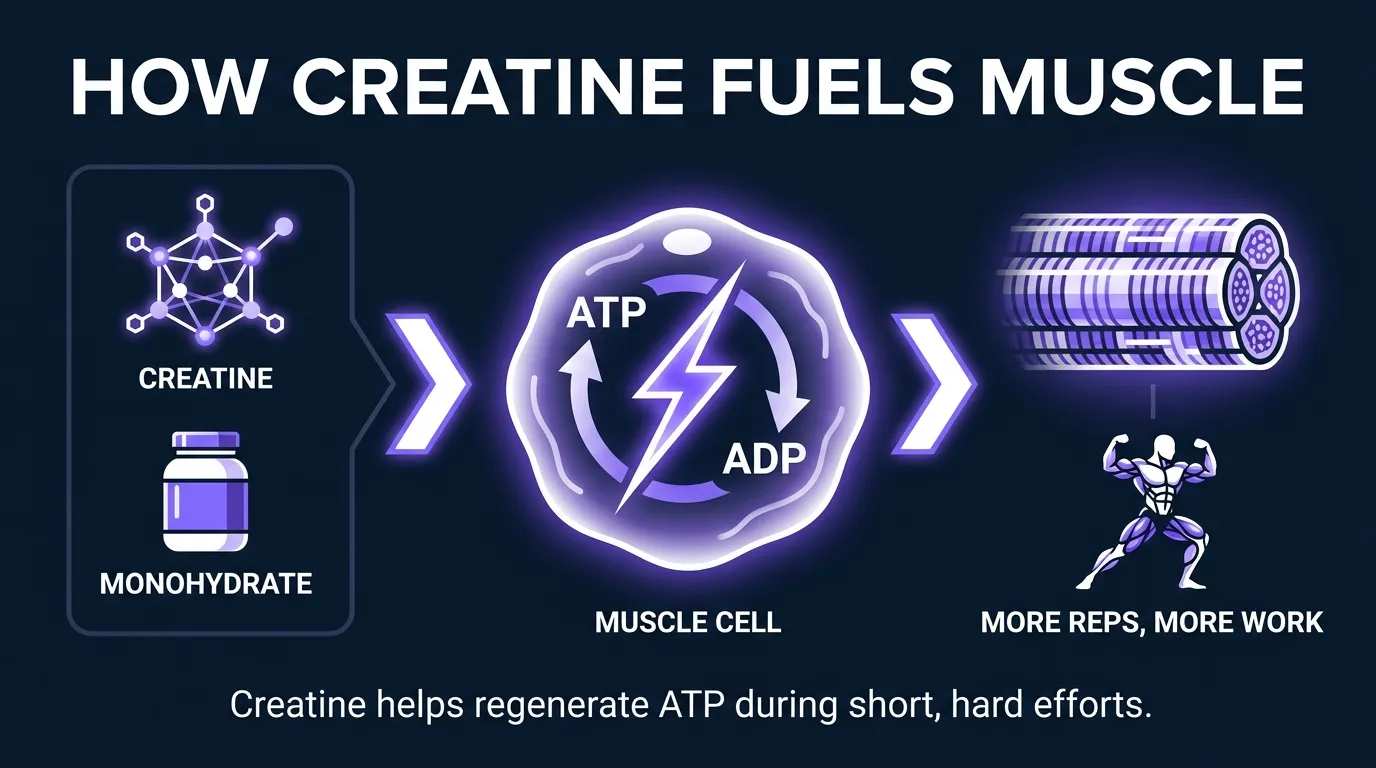
Your muscles run on ATP. ATP is the cell's energy currency. When you sprint, lift, or push hard for a few seconds, your muscles burn through ATP fast and need to regenerate it just as fast. Creatine phosphate is the system that does that regeneration. The more creatine you have stored in muscle, the more total ATP your body can recycle in those short, hard windows.
That's the entire mechanism. It's not a hormone. It's not a stimulant. It's a fuel buffer.
What you can feel
The practical effect is usually one or two extra reps on a hard set. Not a transformation. A small bump. Over weeks of training, those extra reps add up to slightly more total work, which adds up to slightly more strength and slightly more muscle.
The International Society of Sports Nutrition's 2017 position stand (Kreider et al.) called creatine monohydrate "the most effective ergogenic nutritional supplement currently available" for high-intensity exercise capacity and lean body mass. The numbers behind that headline are modest: roughly 5 to 15% more strength gains over months of resistance training compared to placebo. Real, but small.
What it doesn't do
Creatine doesn't burn fat. It doesn't replace protein. It won't help much for a 5K or a marathon. The benefit lives in the short-burst zone: lifting, sprinting, jumping, anything where you go hard for 30 seconds or less and then rest. If fat loss is why you're looking at supplements, our guide to L-carnitine benefits shows what the trials found for a popular fat-burner ingredient.
If you're doing nothing but yoga and easy walking, creatine isn't going to do much. If you're lifting weights, doing bodyweight strength work, or running interval sessions, you're in the zone where creatine helps.
Who Actually Benefits from Creatine
The cleanest way to answer "do I need creatine" is to ask whether you fit one of these groups. The benefit gets progressively bigger as you go down the list.
People who train resistance, hard, consistently
This is the original use case. Decades of trials in young, healthy lifters keep landing in the same place: 5 to 15% more strength and lean mass over a 6 to 12 week training block when creatine is added. The effect compounds when training is hard and consistent. It does not compound when training is sporadic.
If you lift two to three times a week and you've been doing it for a while, creatine is the supplement with the best evidence-to-cost ratio you can buy. A year's supply runs about $30 to $60.
Vegetarians and vegans
Creatine is found mostly in red meat, fish, and poultry. Plant-based diets average about 1 gram of dietary creatine per day or less. Omnivores average 1 to 2 grams. Vegetarians start with lower baseline muscle creatine stores, so they often see bigger jumps when supplementing. The Antonio et al. (2021) review in the Journal of the International Society of Sports Nutrition highlights this group as one of the clearest beneficiaries.
Adults over 50, especially women
Sarcopenia, the gradual muscle loss that starts in our 30s and accelerates after 50, responds well to resistance training. Creatine appears to nudge that response higher. A 2024 Frontiers in Physiology review on creatine plus resistance training in healthy aging summarized the work this way: in older adults, creatine paired with strength work consistently improves muscle mass, function, and some markers of bone health. In Chilibeck et al. (2023), a 2-year randomized trial in postmenopausal women, the creatine group showed favorable bone geometry adaptations the placebo group didn't.
This matters more than gym performance. Falls and fractures after 65 are the lurking risk. Anything that protects bone and muscle in that window is worth a serious look.
People on a calorie deficit, including GLP-1 users
When you're eating less, your body breaks down both fat and lean tissue. Creatine helps you preserve more muscle through that deficit, mostly by letting you keep training hard even when you're tired and undereating. We covered this in detail in Ozempic and Exercise: protein and resistance training are the load-bearing tools, and creatine is a useful third leg.
How to Take It
This part is simpler than the internet makes it sound. There are basically four decisions, and three of them don't matter much.
Form: monohydrate
Creatine monohydrate. That's it. Skip every "advanced" form: hydrochloride, ethyl ester, buffered, micronized fancy version. None has outperformed plain monohydrate in head-to-head trials. The ISSN, examine.com, and every credible review converge on this. Buy plain monohydrate and save $20 a tub.
Dose: 3 to 5 grams per day, every day
That's the maintenance dose. Take it any time of day, with or without food, with or without your workout. Consistency matters more than timing. If you skip a few days, your stores drift down slowly over weeks, not hours. That said, the trials behind "timing barely matters" are worth seeing for yourself, and our guide on when to take your daily dose lays them out alongside the rest-day and with-food evidence. If you want the number scaled to your body weight, or the dose for a teenager or an adult over 50, our review of how much creatine you should take a day works through the trials group by group.
The optional loading phase
Some sources still recommend a "loading phase" of about 20 grams per day (split into 4 doses) for 5 to 7 days. This fills your muscle creatine stores in roughly a week instead of three to four. The downside: more bloating during the loading week. The benefit: a slightly faster start. Skip it if you'd rather avoid the puffiness. You'll arrive at the same plateau either way. If you're wondering when you'll notice anything either way, our breakdown of how fast creatine works walks through the first week, the first month and the first three months.
What to drink it with
Water. That's the answer. Some research suggests pairing creatine with carbs improves uptake slightly, but the difference is small enough that it isn't worth optimizing. Mix 5 grams into water, juice, your morning shake, whatever. Done.
Ready to put this into practice?
Take the free FitCraft assessment and get a personalized plan based on behavioral science, not willpower. Creatine helps your training, but only if you actually train. We're built for that part.
Take the Free Assessment Free • 2 minutes • No credit card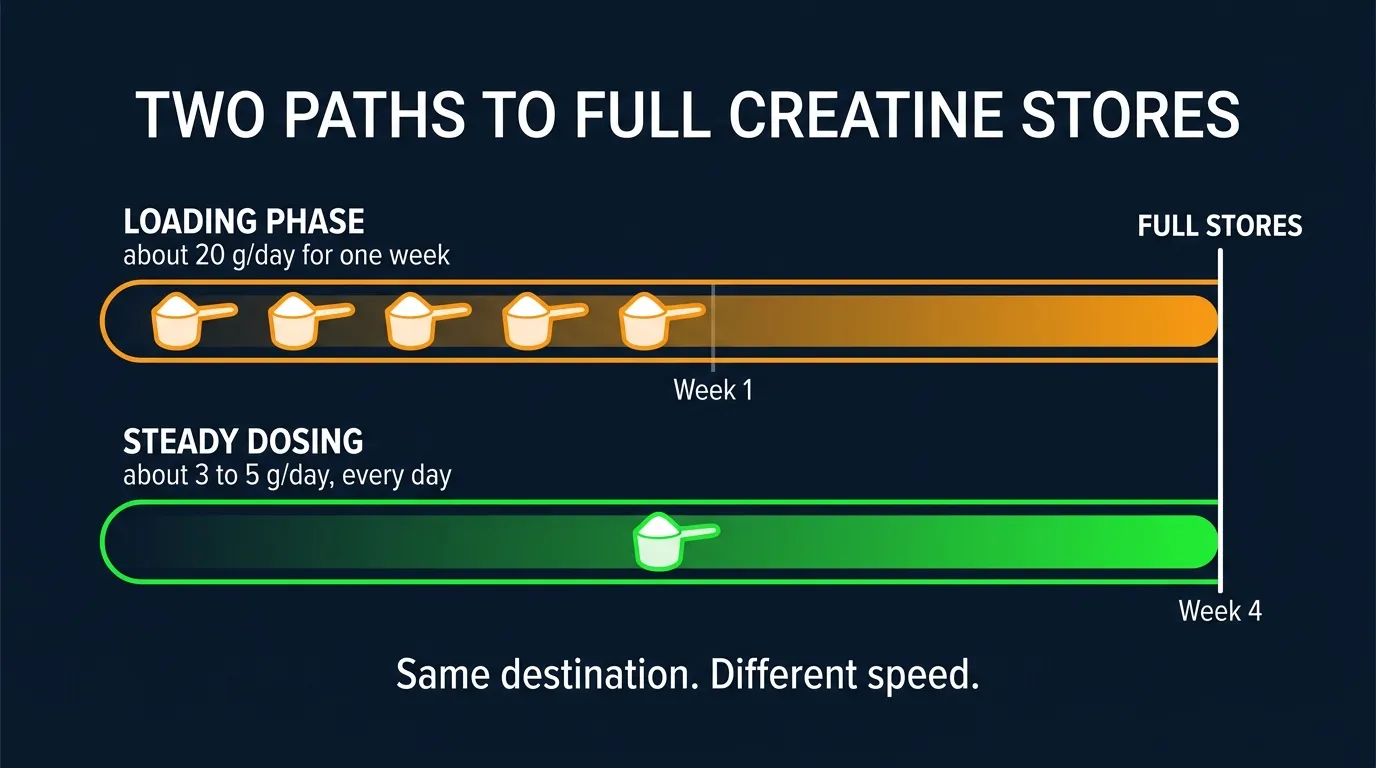
What About the Side Effects Everyone Worries About
Three concerns dominate the search results: kidneys, bloating, and hair loss. Two are myths. One is real and minor.
The kidney myth
The kidney concern comes from a basic mix-up. Creatine in the body breaks down into creatinine, which kidneys filter into urine. When you supplement creatine, blood creatinine goes up. Doctors who don't know you're on creatine sometimes flag this as a kidney problem. It isn't. It's a marker artifact, not damage.
The 2017 ISSN position stand reports no detrimental effects from up to 30 grams per day for 5 years in otherwise healthy people. The Antonio et al. (2021) review in the same journal devoted a full section to debunking the kidney concern and walks through case reports, randomized trials, and long-term cohort data. The signal isn't there.
Caveat: if you already have kidney disease, talk to your doctor before starting any supplement. That's a different population from the studies above.
The hair-loss myth
The hair-loss claim traces back to a single 2009 study in college rugby players that found a small rise in DHT (a hormone linked to male pattern baldness) after creatine loading. The study had 20 participants. It's never been replicated. No subsequent trial has confirmed the DHT bump or any actual hair loss outcome. The Antonio et al. 2021 review treats it as folklore at this point.
Could there be a tiny effect in someone genetically primed for male pattern baldness? Maybe. But the evidence for it is one paper and a lot of forum posts. If you're already losing hair and it bothers you, the avoidance is reasonable. Calling it a known side effect is not.
The real one: short-term water retention
Creatine pulls water into muscle cells. That's part of why it works. The cell becomes a slightly better environment for protein synthesis. It also means you'll see 1 to 3 pounds of weight gain in the first week or two on creatine, especially if you load.
This is intracellular water, sitting inside the muscle, not under the skin. It doesn't make you look "puffy" or "soft." If anything, it makes muscles look fuller. People who panic at the scale and stop after a week are bailing on the only side effect that's real, and it's not even bad.
The Brain Side Bonus Most People Don't Know About
Your brain stores creatine the same way muscle does. And it uses it for the same thing: keeping ATP available during stressful moments. The research on creatine and cognition is newer, smaller, and less settled than the muscle side, but it's interesting.
A 2024 BMC Medicine meta-analysis (Sandkühler et al.) of 16 randomized controlled trials found small but consistent improvements in memory and processing speed with creatine supplementation. The effects were strongest in two situations: older adults, and people who were sleep deprived. In other words, when the brain is stressed and creatine demand is highest, supplementation helps the most.
A 2025 Journal of the ISSN review (Forbes et al.) on creatine for older adults and clinical populations concluded that the cognitive benefits, while preliminary, are consistent enough to justify creatine for adults over 50 who care about both physical and mental aging.
It's not a smart drug. Don't expect a noticeable mental boost on a normal day. But on a bad night of sleep, the difference may be real. As a bonus stacked on top of muscle and bone benefits, it's a reasonable extra checkmark.
Common Questions That Don't Get Clean Answers Online
Should I cycle on and off?
No. There's no physiological reason to cycle creatine. Your body doesn't downregulate when you're on it. Take it daily and move on.
Will I lose what I gained when I stop?
Mostly, yes, eventually. Muscle creatine stores drift back to baseline over 4 to 6 weeks once you stop. The strength and lean mass you built during that window from training? You keep that, as long as you keep training. Creatine made the training a bit more productive. The training is still what built the muscle.
Does timing matter?
Almost not at all. A few studies hint that post-workout might be marginally better than pre-workout for daily intake, but the effect size is tiny. Pick a time that's easy to remember and stick to it.
Is it banned by sports organizations?
No. Creatine is not on the WADA prohibited list, the NCAA banned list, or any major league's banned list. It's been studied and cleared for decades.
Can teenagers take it?
The ISSN's 2017 position stand explicitly addressed this and concluded that creatine appears safe for athletes under 18 at recommended doses. That said, most teen athletes don't need it. Diet and training basics outproduce supplement choices at that age.
What This Means for You
If you train hard and consistently, especially with weights or bodyweight strength work, creatine is one of the few supplements with enough evidence to be worth the small monthly cost. Buy plain monohydrate. Take 3 to 5 grams a day. Skip the loading phase if you're scale-sensitive. Ignore the kidney and hair-loss noise. Watch the small side effects (slight water gain, occasional GI grumbles) and adjust.
If you don't train hard or consistently, creatine isn't your problem. The supplement is downstream of the habit. A bottle of monohydrate sitting next to a couch you never get off of doesn't do anything. The single biggest determinant of your fitness in 2026 isn't what's in your shaker. It's whether you show up, regularly, for months on end.
That's the part FitCraft is built for. Ty, our 3D AI coach, walks you into today's workout, demonstrates each move, and pulls you forward through streaks and quests so consistency stops depending on motivation. The supplement question is real but small. The consistency question is the whole game. Once you've solved that, creatine becomes a clean extra 5 to 15%. Until then, it's a tub on a shelf.
Frequently Asked Questions
Do I really need creatine to build muscle?
No. You can build muscle without creatine. Resistance training and adequate protein are the load-bearing parts. Creatine just makes the same training a bit more effective. The 2017 International Society of Sports Nutrition position stand calls creatine monohydrate the most effective ergogenic nutritional supplement available, but the word "effective" there means roughly 5 to 15% more strength gains, not the difference between progress and none.
How much creatine should I take per day?
3 to 5 grams of creatine monohydrate per day is the standard dose, taken any time, with or without food. The optional "loading phase" of 20 grams per day for 5 to 7 days fills your muscle stores faster, but you'll reach the same plateau in 3 to 4 weeks at the regular dose. Heavier or more muscular people sometimes use 5 grams per day. There's no real benefit to taking more.
Is creatine safe? What about kidneys and hair loss?
Creatine is one of the most studied supplements in sports nutrition. The ISSN reports no detrimental effects from up to 30 grams per day for 5 years in healthy people. The kidney concern comes from misreading creatinine markers, which rise on creatine but don't indicate damage. The hair-loss claim traces to a single 2009 rugby study that's never been replicated. The Antonio et al. 2021 review in the Journal of the ISSN walks through both myths and finds neither holds up.
Should women take creatine?
Yes, especially women lifting weights, women over 50, and postmenopausal women. A 2-year randomized trial (Chilibeck et al. 2023) found creatine plus resistance training preserved bone geometry better than training alone in postmenopausal women. Concerns about water weight or "bulkiness" are largely myth. The fluid sits inside the muscle cell, not under the skin.
Can creatine improve brain function or sleep recovery?
The research is promising, not settled. A 2024 BMC Medicine meta-analysis found small but consistent improvements in memory and processing speed, especially in older adults and after sleep deprivation. The brain stores creatine the same way muscle does, and stressed brains may benefit most. It's a reasonable bonus on top of the fitness benefits, not a primary reason to start.