Here's something most people don't realize: after age 30, you lose roughly 3–8% of your muscle mass per decade. After 60, that rate accelerates. Strength declines even faster — up to 3% per year after age 60 (Volpi et al., 2004). This isn't a minor inconvenience. It's the difference between living independently at 80 and needing help getting off the toilet. And the good news is that strength training isn't the only tool: research on minimum effective exercise dose shows that even 15 minutes of daily activity produces significant mortality reduction, so the barrier to starting is lower than most people think.
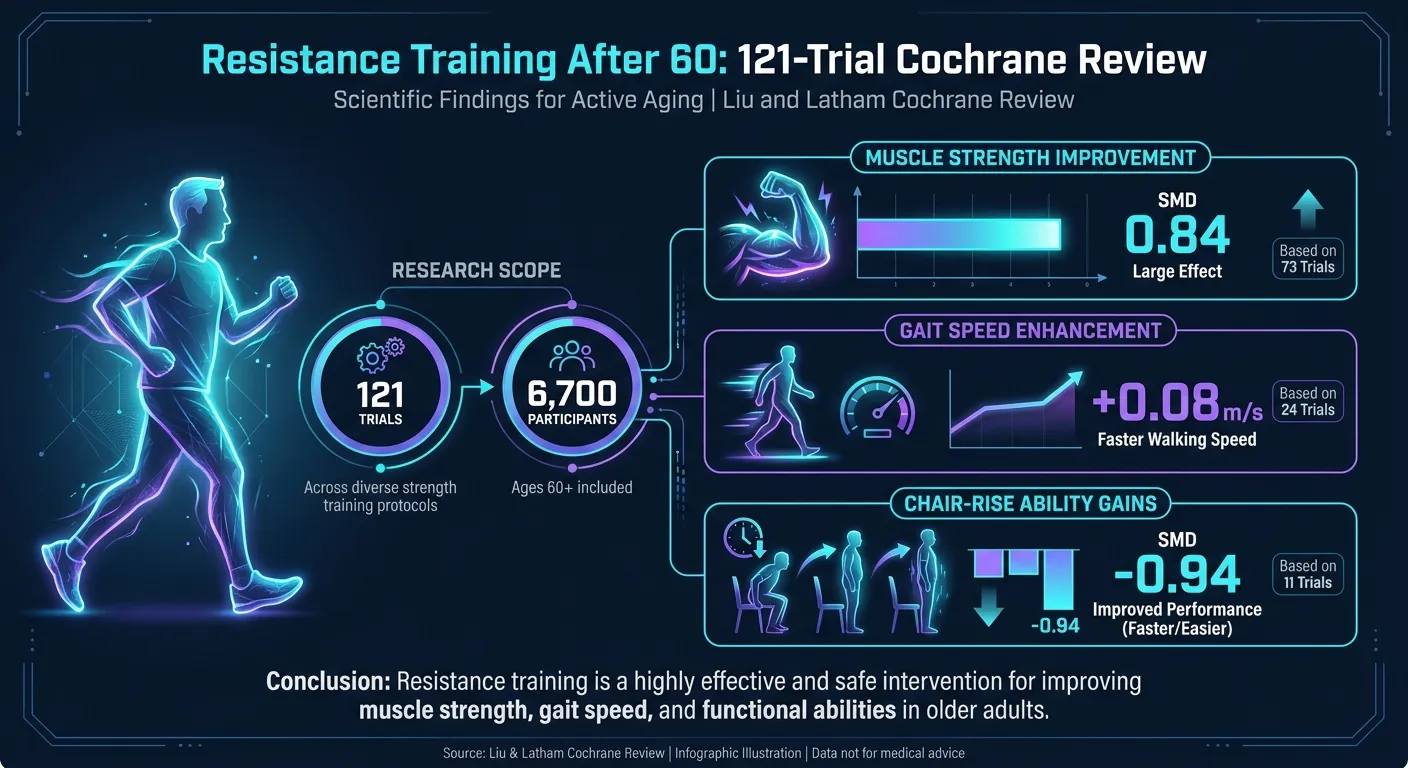
If you're reading this and thinking "it's too late for me" — the research says you're wrong. Conclusively, across 121 randomized controlled trials and 6,700 participants. Not wishful thinking. Not a single small study. A Cochrane systematic review — the gold standard of medical evidence.
Let's look at what they found.
The Research: What 121 Trials Actually Show
In 2009, researchers Liu and Latham published a landmark Cochrane review examining every available randomized controlled trial on progressive resistance training (PRT) for adults aged 60 and older. Progressive resistance training means exercises where you work against resistance — your own bodyweight, dumbbells, resistance bands — and gradually increase the challenge as you get stronger.
They found 121 qualifying trials with 6,700 participants total. Here's what the data showed.
Strength Gains: Large and Consistent
Across 73 trials and 3,059 participants, PRT produced a large positive effect on muscle strength (standardized mean difference of 0.84). To put that in context: a standardized effect size above 0.8 is considered "large" in research. This wasn't a marginal improvement. Older adults who did progressive resistance training got meaningfully, measurably stronger.
And this wasn't just lab-coat stuff. Stronger muscles translate directly to daily life — carrying groceries, climbing stairs, picking up grandchildren. The kind of strength that keeps you independent.
Walking Speed: Faster and Steadier
Twenty-four trials with 1,179 participants measured gait speed — how fast and confidently someone walks. PRT improved gait speed by 0.08 meters per second. That might sound small. It isn't.
In geriatric medicine, a change of 0.05 m/s in gait speed is considered clinically meaningful. It's associated with reduced mortality risk and longer independent living. The improvement from resistance training was nearly double that threshold.
Slower gait speed is one of the strongest predictors of nursing home admission and mortality in older adults. Improving it isn't vanity — it's survival.
Getting Out of a Chair: The Functional Test That Matters Most
Here's the finding that should get everyone's attention. Across 11 trials and 384 participants, PRT showed a moderate-to-large effect on the ability to rise from a chair (SMD −0.94).
The chair-rise test is one of the most important functional assessments in geriatric medicine. It predicts falls, disability, and loss of independence. If you can't get out of a chair without using your arms, your risk of falls and functional decline goes up substantially. Resistance training directly addressed this.
Pain Reduction: An Unexpected Bonus
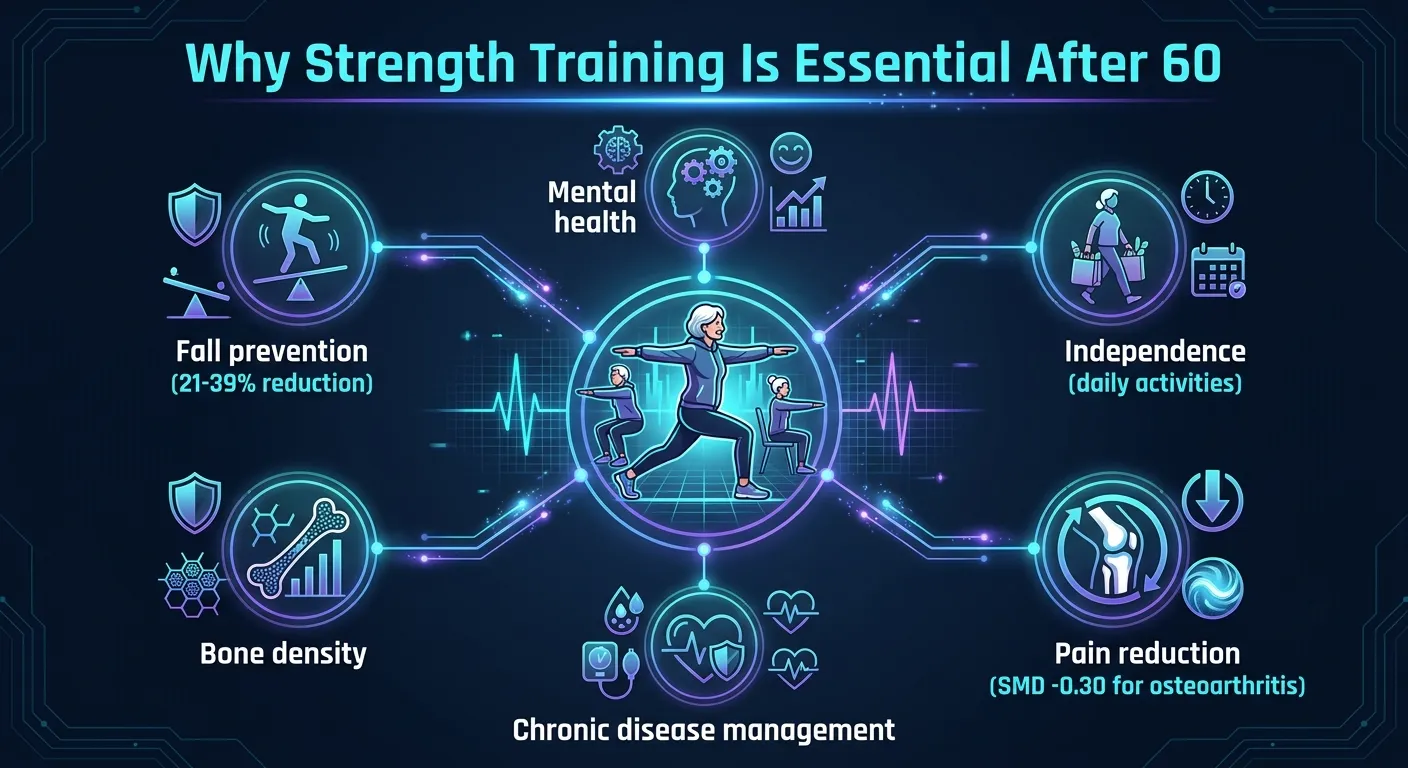
Six trials with 503 participants who had osteoarthritis found that PRT reduced pain (SMD −0.30). That's notable because many people over 60 avoid exercise specifically because of joint pain — and the evidence shows that the right kind of strength training actually makes it better, not worse.
Safety: Rare Serious Events
One of the biggest concerns people have about strength training after 60 is injury. The Cochrane review addressed this directly: most adverse events were minor musculoskeletal complaints like muscle soreness. Serious adverse events were rare, and none appeared to be directly related to the exercise programs.
That's across 121 trials and 6,700 people. The evidence for safety is extensive.
Important note: If you're over 60 and considering starting a resistance training program, please consult your physician first — especially if you have heart disease, uncontrolled blood pressure, diabetes, or have had joint replacements. The research shows PRT is safe for most older adults, but your doctor knows your specific medical history.
Why This Matters: The Cost of Doing Nothing
Muscle loss after 60 isn't just about looking different. It cascades.
- Falls: Reduced muscle strength is one of the primary risk factors for falls in older adults. A 2021 systematic review found that exercise — particularly strength and balance training — can reduce fall rates by 21–39% in community-dwelling older adults.
- Loss of independence: When you can't get off the couch, climb stairs, or carry a bag of groceries, your world shrinks. Research consistently links muscle weakness to nursing home admission.
- Chronic disease: Sarcopenia (age-related muscle loss) is associated with insulin resistance, reduced bone density, increased cardiovascular risk, and poorer outcomes after surgery or hospitalization.
- Mental health: Loss of physical function is strongly correlated with depression in older adults. When your body can't do what it used to, it affects more than your muscles.
The philosophical problem here is real: it's wrong that so many people over 60 accept physical decline as inevitable when the evidence shows it's largely preventable. Nobody should lose their independence because they didn't know that two sessions a week with dumbbells could change the trajectory.
What the NSCA Recommends (And Why It's Simpler Than You Think)
The National Strength and Conditioning Association's 2019 position statement (Fragala et al.) reviewed the full body of evidence and issued clear recommendations for older adults:
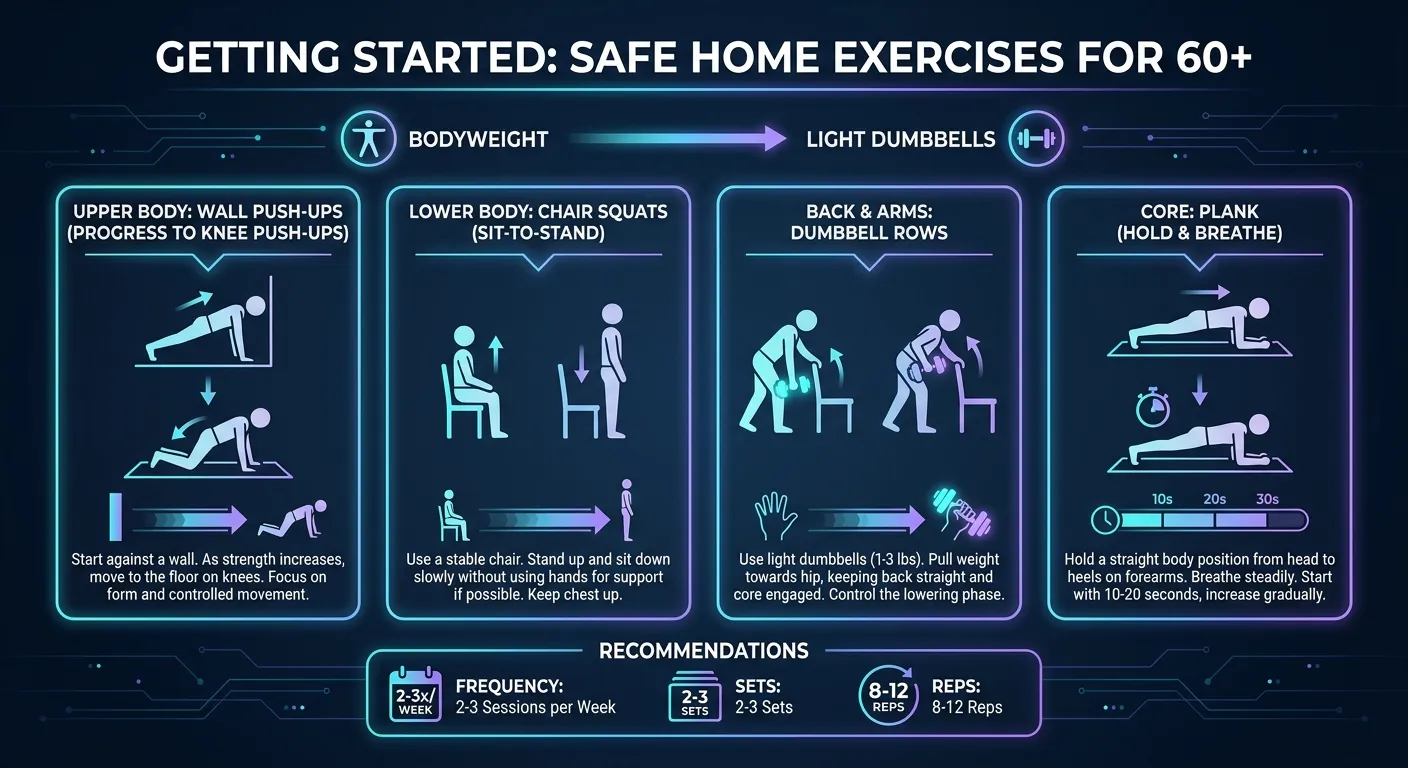
- Frequency: 2–3 sessions per week
- Volume: 2–3 sets of 8–12 repetitions per major muscle group
- Rest: About 2 minutes between sets
- Progression: Gradually increase resistance as strength improves
That's it. No daily two-hour gym sessions. No complicated periodization. Two to three times a week, working your major muscle groups, progressively challenging yourself. Most sessions can be done in 20–30 minutes.
The NSCA's conclusion is worth quoting directly: resistance training is "a powerful intervention to combat the loss of muscle strength and muscle mass, physiological vulnerability, and their debilitating consequences on physical functioning, mobility, independence, chronic disease management, psychological well-being, quality of life, and healthy life expectancy."
That's not a fitness influencer talking. That's the largest strength and conditioning research organization in the world.
Enjoying the article?
Start a new fitness routine today, written by me and coached by the AI I designed.
Take the Free Assessment Free • 2 minutes • No credit cardCommon Misconceptions About Strength Training After 60
If you've been telling yourself one of these, you're not alone. But the research disagrees.
Misconception: "I'm too old to build muscle"
You're not. The Cochrane review included participants well into their 80s and 90s. The effect on strength was large and consistent regardless of age within the 60+ population. Yes, a 75-year-old won't build muscle at the same rate as a 25-year-old. But they will build muscle. They will get stronger. And that strength directly translates to independence, reduced fall risk, and better quality of life.
Research shows that even adults in their 90s respond to resistance training with measurable strength gains. Your muscles don't have an expiration date.
Misconception: "Strength training is dangerous for older adults"
The Cochrane review examined safety data across 121 trials and 6,700 participants. Serious adverse events were rare and not directly attributable to the exercise programs. The minor issues — mostly temporary muscle soreness — are the same ones people of any age experience when starting a new program.
Here's the irony: not strength training is the dangerous choice. Weak muscles lead to falls, falls lead to hip fractures, and hip fractures in adults over 65 carry a mortality rate that would shock most people. Sitting on the couch isn't the safe option. It's the risky one.
Misconception: "You need a gym and heavy weights"
The research supports bodyweight exercises and light resistance as effective interventions for older adults. What matters is progressive overload — gradually increasing the challenge over time. You can do this at home with bodyweight exercises, resistance bands, or a pair of dumbbells. A wall push-up progressing to a knee push-up progressing to a full push-up is progressive resistance training. Sitting to standing from a chair, eventually while holding a weight, is progressive resistance training.
You don't need a squat rack. You need a plan that adapts to your ability and challenges you a little more each week.
How to Start (Without Overdoing It)
If you haven't been doing structured exercise, here's what the evidence suggests:
- Start with 2 days per week. This is enough to produce significant strength gains according to the research. You can add a third day after 4–6 weeks if you want.
- Focus on major movement patterns: Squats (or chair sits), push-ups (or wall push-ups), rows, and core work. These cover the muscle groups that matter most for daily function.
- Prioritize form over load. Bodyweight is a perfectly good starting resistance. Master the movement before adding weight.
- Progress gradually. The "progressive" part is what makes resistance training work. Add a rep, add a set, slow down the movement, or add light resistance when the current level feels manageable.
- Rest between sets. Two minutes is the standard recommendation. There's no prize for rushing.
- Expect some soreness. Mild muscle soreness 24–48 hours after training is normal and not a sign of injury. Sharp pain during an exercise is different — stop and reassess.
The hardest part isn't the exercises. It's doing them consistently. That's where most people — at any age — struggle.
The Consistency Problem (And How Design Solves It)
You've probably heard this before: the best exercise program is the one you actually do. The research backs that up completely. The Cochrane review found improvements across many different program designs — the common thread was that participants actually completed the training.
But here's the thing. Knowing you should strength train and actually doing it three times a week for months on end are very different problems. Willpower fades. Motivation is unreliable. Life gets in the way. That's not a character flaw — it's a well-documented pattern that affects people at every age.
Research on gamification and exercise adherence shows that programs incorporating variable rewards, visible progress tracking, and adaptive difficulty maintain engagement far longer than static programs. A 2022 meta-analysis in the Journal of Medical Internet Research found that gamified fitness interventions produced significantly more physical activity than standard approaches across 16 RCTs and 2,407 participants.
For older adults specifically, this matters enormously. If you start a strength program and quit after three weeks, you don't get the benefits the research describes. The programs in the Cochrane review typically lasted 8–24 weeks. You need something that keeps you coming back.
How FitCraft Applies This Research
FitCraft was designed by Domenic Angelino, an Ivy League-trained exercise scientist (MS Kinesiology, MPH from Brown University, NSCA-CSCS certified) who studied this literature extensively. The app applies the principles validated in the research above.
- Ty, your 3D AI personal trainer, builds workouts personalized to your current fitness level. If you're starting from zero, Ty starts there too. No judgment, no pressure to keep up with a class of 25-year-olds.
- Bodyweight and dumbbell programming — exactly the modalities supported by the research for older adults. No gym, no heavy barbells, no intimidating equipment. Just effective exercises you can do at home.
- Progressive adaptation — the "progressive" part of progressive resistance training. FitCraft's AI adjusts your program as you improve, ensuring you're always training at the right challenge level. This is precisely what the NSCA recommends.
- 3D exercise demonstrations — pinch and zoom to see proper form from any angle. This matters more for older adults, where poor form carries higher injury risk.
- Gamification for consistency — XP, leveling up, and streak tracking use the same behavioral mechanics that research shows maintain long-term engagement. Because the best program is the one you actually stick with.
- Free version available — full access to adaptive workouts, no credit card required. Try it before you commit to anything.
We're not claiming FitCraft has been tested in a clinical trial on adults over 60 specifically — it hasn't. What we're saying is that every design decision maps to peer-reviewed research on what works for this population: progressive resistance, adaptive difficulty, bodyweight and dumbbell exercises, and systems that keep people consistent.
What the Research Can't Tell Us (Yet)
Honesty matters here. The evidence is strong, but it has limits.
- Most trials were 8–24 weeks. We have strong data on short-to-medium-term effects. Long-term data (2+ years of consistent resistance training in older adults) comes mostly from observational studies, not RCTs.
- Study participants are motivated. People who sign up for exercise trials are more committed than average. Real-world adherence rates are likely lower.
- Program variety is wide. The 121 trials used many different protocols. The review confirms that PRT works broadly, but it can't tell you which specific program is optimal for you.
- Individual variation matters. Pre-existing conditions, medication effects, prior injury history, and baseline fitness all influence how you'll respond. The research shows population-level effects — your individual experience may differ.
None of this undermines the core finding. Across 121 trials and 6,700 participants, resistance training made older adults stronger, faster on their feet, and better able to function independently. The effect sizes were large and consistent. The safety profile was excellent.
The question isn't whether strength training works for people over 60. That's settled. The question is whether you'll actually do it consistently — and that's a design problem, not a willpower problem.
References
- Liu CJ, Latham NK. "Progressive resistance strength training for improving physical function in older adults." Cochrane Database of Systematic Reviews. 2009;(3):CD002759. doi:10.1002/14651858.CD002759.pub2
- Fragala MS, Cadore EL, Dorgo S, et al. "Resistance Training for Older Adults: Position Statement From the National Strength and Conditioning Association." Journal of Strength and Conditioning Research. 2019;33(8):2019-2052. doi:10.1519/JSC.0000000000003230
- Claudino JG, Afonso J, Sarvestan J, et al. "Strength Training to Prevent Falls in Older Adults: A Systematic Review with Meta-Analysis of Randomized Controlled Trials." Journal of Clinical Medicine. 2021;10(14):3184. doi:10.3390/jcm10143184
- Sherrington C, Fairhall NJ, Wallbank GK, et al. "Exercise for preventing falls in older people living in the community." Cochrane Database of Systematic Reviews. 2019;(1):CD012424. doi:10.1002/14651858.CD012424.pub2
- Volpi E, Nazemi R, Fujita S. "Muscle tissue changes with aging." Current Opinion in Clinical Nutrition and Metabolic Care. 2004;7(4):405-410. doi:10.1097/01.mco.0000134362.76653.b2
Frequently Asked Questions
Is it safe to start strength training after 60?
Yes, for the vast majority of older adults. The Liu & Latham Cochrane review of 121 trials found that serious adverse events were rare and none appeared directly related to the exercise programs. The NSCA's 2019 position statement explicitly recommends resistance training for older adults 2–3 times per week. That said, anyone over 60 should consult their physician before starting a new exercise program, especially if they have heart disease, uncontrolled blood pressure, or joint replacements.
How often should someone over 60 strength train?
Research supports 2–3 sessions per week for older adults. The Cochrane review found that most effective programs used this frequency at moderate to high intensity. The NSCA recommends working up to 2–3 sets of 8–12 repetitions per major muscle group per session, with 2 minutes of rest between sets. Consistency matters more than intensity — even two sessions per week produces significant strength gains.
Can strength training reverse age-related muscle loss?
Partially, yes. While you can't fully reverse decades of muscle loss, research consistently shows that progressive resistance training produces significant increases in muscle strength and physical function even in adults over 60. The Cochrane review found a large positive effect on strength (SMD 0.84) across 73 trials. The NSCA states that resistance training is a powerful intervention to combat the loss of muscle strength and mass associated with aging.
Do you need heavy weights to build strength after 60?
No. Bodyweight exercises and light dumbbells are effective for building strength in older adults. Research shows that low-load resistance training produces meaningful muscle and strength adaptations when exercises are performed with appropriate effort. What matters is progressive overload — gradually increasing the challenge over time — not starting heavy. FitCraft's AI coach designs bodyweight and dumbbell programs that scale progressively based on your ability.
Does FitCraft work for people over 60?
Yes. FitCraft's AI coach Ty builds personalized workout plans using bodyweight exercises and dumbbells — no gym required. The app adapts difficulty to your current fitness level and progresses at your pace, which is exactly what the research recommends for older adults. The free version includes full access to adaptive workouts, 3D exercise demonstrations for proper form, and gamification features that help you stay consistent.