Here's what most people believe about exercise: you need at least 30 minutes, ideally 60, several times a week, and it should be hard enough that you're sweating and out of breath. Anything less is basically a waste of time.
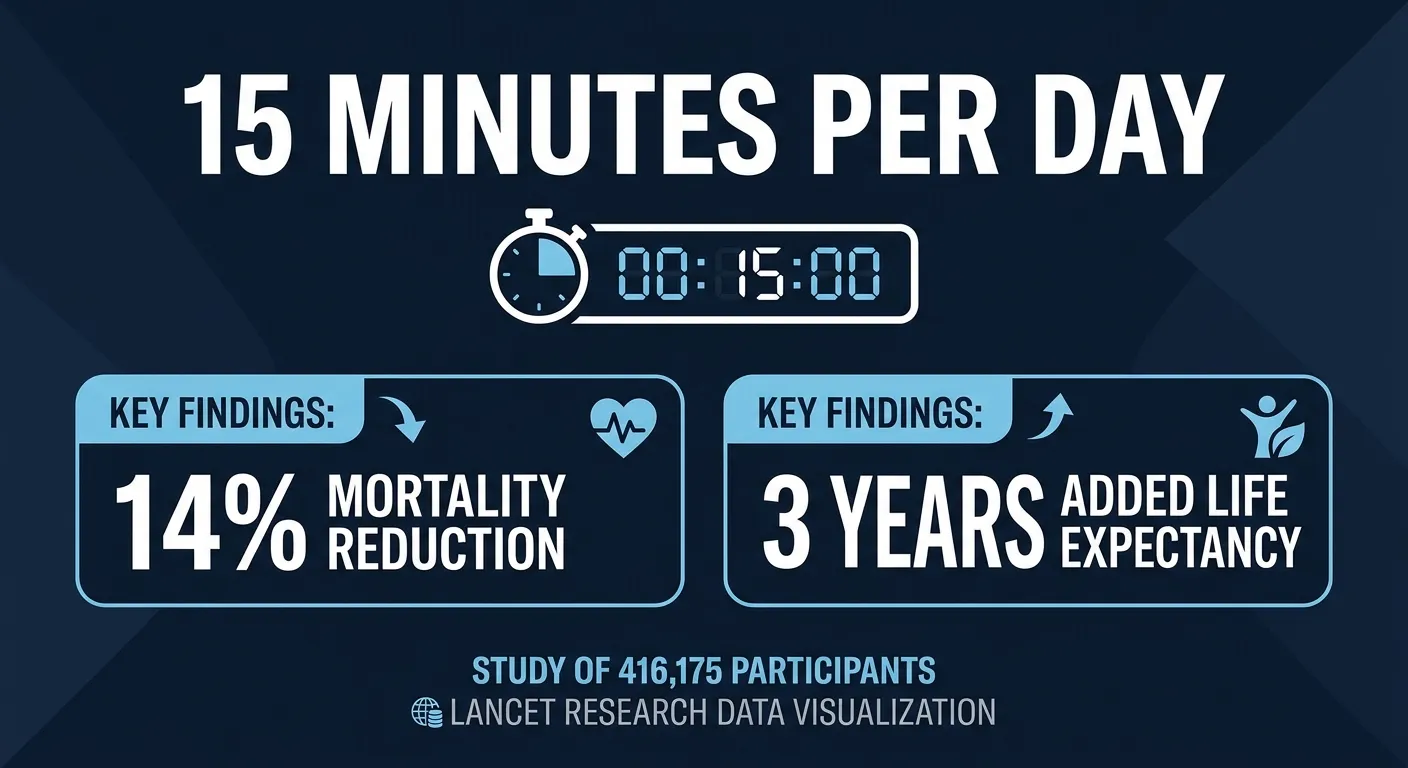
That belief is wrong. And a massive study published in The Lancet proved it in a way that's difficult to argue with , 416,175 participants, 8 years of follow-up, and results that shifted how exercise scientists think about the minimum amount of physical activity needed to actually improve health.
If you've ever felt like exercise is an all-or-nothing proposition, like 15 minutes "doesn't count". This article is going to change your mind. And honestly, it might change your entire relationship with working out.
The Study: What Wen et al. Actually Found
Let's get into the details, because the numbers here are genuinely remarkable.
Study Design and Scale
Between 1996 and 2008, Chi Pang Wen and colleagues at the National Health Research Institutes in Taiwan enrolled 416,175 adults (199,265 men and 216,910 women) through a standard medical screening program. Participants reported their weekly exercise habits via questionnaire and were sorted into five categories: inactive, low activity, medium, high, and very high activity.
The researchers then tracked mortality outcomes over an average of 8.05 years. What makes this study particularly powerful is its sheer scale , over 400,000 participants gives you statistical power that smaller trials simply can't match. And because it was a prospective cohort (following people forward in time), it avoids many of the recall biases that plague retrospective studies.
The 15-Minute Finding
The "low-volume" activity group exercised for an average of 92 minutes per week , roughly 15 minutes per day. That's it. A brisk walk around the block. A short bodyweight circuit. Nothing heroic.
Compared to the inactive group, these 15-minute-a-day exercisers had:
- 14% lower risk of all-cause mortality (hazard ratio 0.86, 95% CI 0.81-0.91)
- 10% lower risk of cancer mortality
- 3 additional years of life expectancy
Read that again. Fifteen minutes a day. Three more years alive. That's one of the most favorable cost-benefit ratios in all of medicine.
The Dose-Response Curve
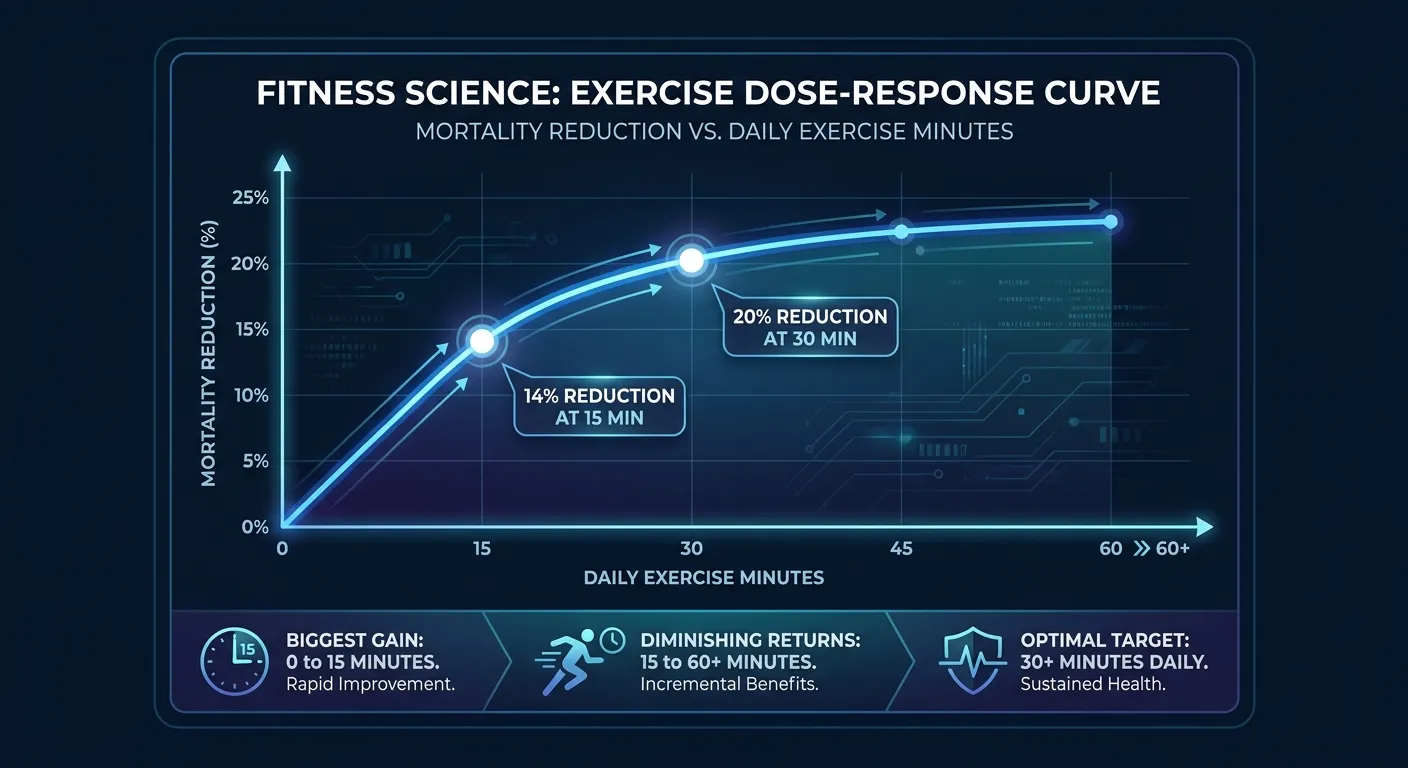
Here's where the study gets even more interesting. The benefits didn't stop at 15 minutes. They kept climbing. Every additional 15 minutes of daily exercise beyond the baseline reduced all-cause mortality by another 4% and all-cancer mortality by an additional 1%.
But the relationship was curvilinear, not linear. The biggest jump in benefit came at the very bottom , going from zero to 15 minutes per day. The difference between 15 and 30 minutes was real but smaller. Between 30 and 45? Smaller still. The curve flattens as you do more.
This is a critical insight: the greatest return on investment comes from the first minutes of exercise, not the last. If you're currently doing nothing, starting a 15-minute daily habit gives you more health benefit per minute than an already-fit person gets from adding another hour to their routine.
Why This Matters More Than You Think
The Wen study didn't exist in a vacuum. It landed in the middle of a growing body of research that was quietly rewriting the rules about how much exercise humans actually need.
The Global Inactivity Problem
A year after Wen's paper, I-Min Lee and colleagues published a complementary analysis in The Lancet (Lee et al., 2012) estimating that physical inactivity causes 9% of premature mortality worldwide , more than 5.3 million deaths per year. Inactivity contributes to 6% of coronary heart disease, 7% of type 2 diabetes, and 10% of both breast and colon cancer globally.
Here's the uncomfortable math: if those 5.3 million people had done nothing more than walk briskly for 15 minutes a day, the Wen data suggests a significant portion of those deaths could have been prevented. Not with gym memberships. Not with personal trainers. Not with elaborate meal plans. Just 15 minutes.
What the WHO Guidelines Actually Say
The World Health Organization's 2020 physical activity guidelines recommend 150-300 minutes of moderate-intensity aerobic activity per week for adults (Bull et al., 2020). That's 21-43 minutes per day. The Wen study's 15-minute minimum falls below this threshold.
But here's what most people miss: the WHO guidelines explicitly state that "some physical activity is better than none." The 150-minute target is the optimal recommendation, not a minimum cutoff below which exercise has zero value. The Wen study proved that point with data from over 400,000 people.
Think of it this way: the WHO recommendation is the gold standard. But the Wen study showed that the bronze standard , 15 minutes a day , still beats doing nothing by a country mile.
Confirmed by Later Research
In 2019, Ulf Ekelund and colleagues published a systematic review and meta-analysis in the BMJ using accelerometer data (not self-reported, which matters) from 36,383 adults. Their findings aligned with Wen's: the dose-response curve between physical activity and mortality was steepest at the low end. Even light-intensity activity , well below the threshold most people consider "real exercise" , was associated with significantly lower mortality risk (Ekelund et al., 2019).
A pooled analysis of six large cohort studies in JAMA Internal Medicine (Arem et al., 2015) involving 661,137 adults similarly found that people who exercised below the WHO minimum (less than 150 minutes/week) still had a 20% lower mortality risk than those who were completely inactive. Maximum risk reduction occurred around 3-5 times the minimum recommendation, but the curve showed clear diminishing returns well before that point.
What "Minimum Effective Dose" Actually Means for You
Let's be practical about this. Because if you're someone who's been stuck in the "I don't have time for exercise" loop, the Wen study is directly relevant to your life.
It's Not About the Perfect Workout
Fitness culture has a perfectionism problem. Instagram is full of 60-minute workout routines, 5 AM gym sessions, and athletes with 6-day-per-week training splits. That's great for those people. But the research says something different about what most humans need for health (not bodybuilding, not marathon running , health).
Fifteen minutes of moderate-intensity activity. Daily. That's the minimum effective dose. A brisk walk counts. A bodyweight circuit in your living room counts. Playing actively with your kids counts. You don't need special equipment, a gym membership, or a complicated program.
Consistency Beats Intensity , Every Time
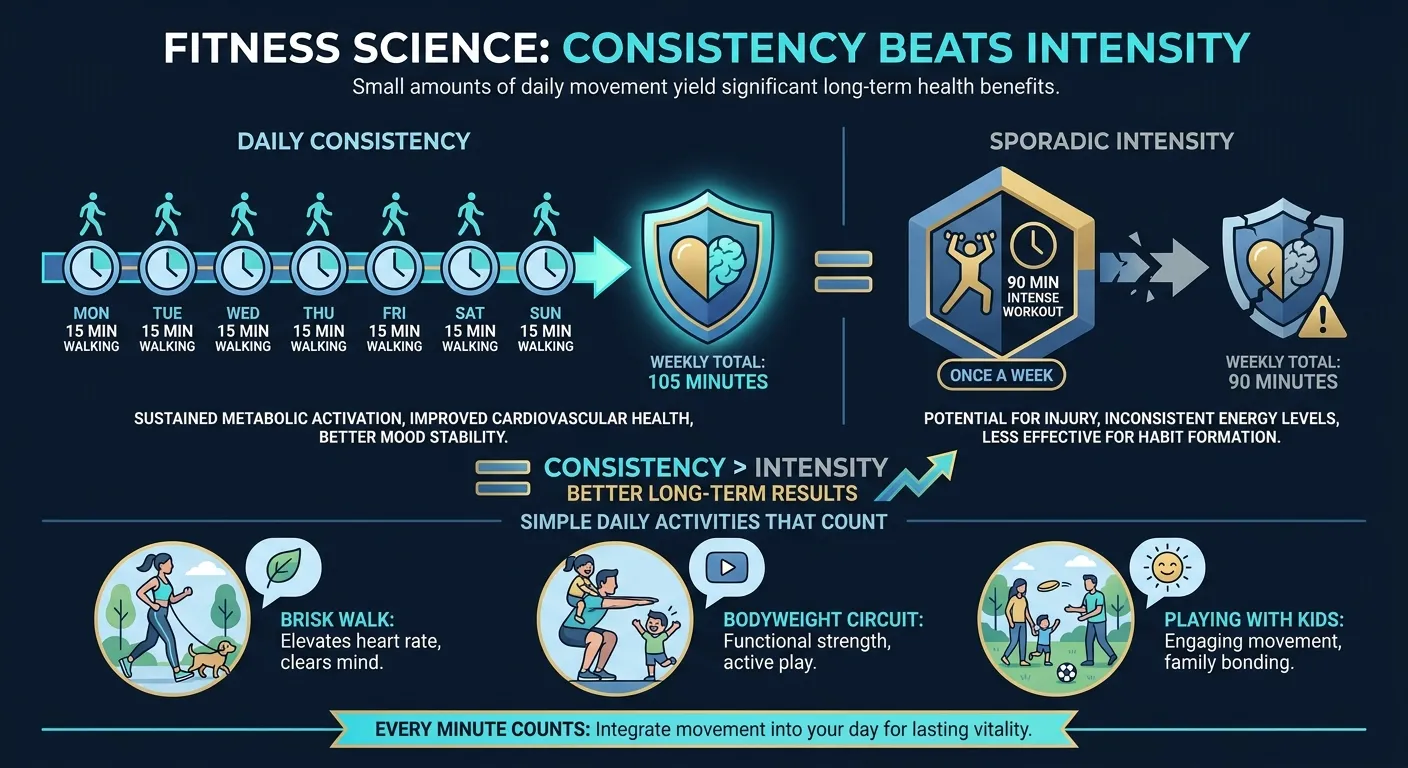
Here's what the dose-response data really reveals when you look at it through a practical lens: a person who walks briskly for 15 minutes every single day will have better health outcomes than someone who crushes a 90-minute gym session on Monday and then does nothing for the rest of the week.
The math works because the benefits of exercise are driven more by consistent daily activity than by occasional intense effort. Your body responds to regular stimuli. A 15-minute daily walk tells your cardiovascular system, your metabolic pathways, and your inflammatory response systems "we're active, keep adapting." A once-a-week marathon session tells them "something weird happened on Tuesday."
This is one of the most important findings in modern exercise science: the best exercise program is the one you'll actually do consistently. And the research shows that shorter, sustainable sessions produce better long-term health outcomes than ambitious programs that lead to burnout and quitting.
Enjoying the article?
Start a new fitness routine today, written by me and coached by the AI I designed.
Take the Free Assessment Free • 2 minutes • No credit cardCommon Misconceptions About Exercise Duration
The Wen study, and the body of research supporting it , directly contradicts several beliefs that are deeply embedded in fitness culture. Let's address the big ones.
Misconception 1: "If I can't do 30 minutes, there's no point"
This is probably the most damaging myth in fitness. It stops people from doing anything at all. The data is unambiguous: 15 minutes of moderate activity provides a 14% mortality reduction. That's not trivial. That's a clinically significant effect backed by one of the largest exercise studies ever published. "Something is better than nothing" isn't just a feel-good platitude , it's a statement supported by cohort data from 416,175 people.
Misconception 2: "Light exercise doesn't really count"
The Ekelund 2019 meta-analysis specifically measured light-intensity activity via accelerometers and found significant mortality reductions even at activity levels most people wouldn't call "exercise." Walking at a normal pace. Gardening. Light housework. These activities don't raise your heart rate much, but they still shift you away from the "inactive" category, and that shift is where the biggest health gains live.
Research on bodyweight workout effectiveness supports this too. You don't need heavy weights or extreme cardio to trigger meaningful physiological adaptations. Your body responds to movement. Period.
Misconception 3: "You need to exercise most days of the week for it to matter"
While daily exercise produced the strongest results in the Wen study, other research shows that "weekend warriors" , people who concentrate their weekly activity into 1-2 sessions , still get substantial health benefits. The Arem et al. (2015) pooled analysis found mortality reductions even among people exercising below the WHO minimum. Frequency matters, but total weekly volume matters more.
That said, the research on exercise engagement consistently shows that daily habits are easier to maintain than sporadic ones. Doing a small amount every day builds the neurological pathways that make exercise feel automatic. A 15-minute daily habit is psychologically easier to sustain than a 90-minute twice-weekly one, and it produces comparable or better health outcomes.
The Dose-Response Reality: How Much Is Enough?
Let's put the full picture together. Based on the Wen study and its supporting research, here's what the dose-response curve looks like in practical terms:
- 0 minutes/day (inactive): Baseline mortality risk. This is where 5.3 million preventable deaths per year come from (Lee et al., 2012).
- 15 minutes/day (~90 min/week): 14% mortality reduction, 3 years added life expectancy. The minimum effective dose (Wen et al., 2011).
- 30 minutes/day (~150 min/week): Approximately 20% mortality reduction. Meets the WHO minimum recommendation. Roughly where the dose-response curve begins to flatten noticeably.
- 45-60 minutes/day: Continued but diminishing returns. The Arem et al. (2015) analysis found maximum risk reduction around 3-5x the minimum WHO recommendation, with no additional benefit (and no harm) above that level.
The pattern is clear and consistent across multiple large studies: the marginal health return per minute of exercise is highest at the lowest doses. Your first 15 minutes buy you more life than any subsequent 15 minutes. This doesn't mean more exercise is bad. It isn't. But it does mean that the barrier to "enough" exercise is far lower than most people believe.
What This Means for People Who've Given Up
If you've quit a fitness program before, and statistically, most people reading this have. The Wen study carries a message worth hearing.
You didn't fail because you weren't disciplined enough. You probably failed because the program demanded too much, too soon, and when you couldn't meet those demands consistently, you felt like a failure and stopped entirely. That's not a character flaw. That's a design problem.
The research says you can start with 15 minutes. Not as a compromise. Not as a stepping stone to "real" workouts. Fifteen minutes is a real workout. It produces real, measurable health benefits backed by some of the most robust epidemiological evidence in exercise science.
And here's what tends to happen: people who start with 15 minutes and stick with it for a few weeks often find themselves naturally doing more. Not because they're forcing it, but because consistent movement changes how your body feels. You have more energy. Your mood improves. The dopamine response to exercise starts reinforcing the behavior. One day you realize you've been going for 25 minutes and didn't even notice.
That's the real power of the minimum effective dose. It's not a ceiling. It's a door.
How FitCraft Applies This Research
FitCraft was built around the principle that consistency matters more than intensity, and the Wen study is one of the reasons why.
- Workouts start short and build gradually , Ty, FitCraft's 3D AI personal trainer, builds sessions that match your current fitness level and available time. If you've got 15 minutes, you get a complete, effective 15-minute workout. Not a rushed version of a longer one.
- Daily consistency is rewarded , FitCraft's gamification system (XP, streaks, collectible cards) is designed to reinforce the daily habit that the research shows produces the best health outcomes. The psychology behind streaks makes your 15-minute commitment feel worth protecting.
- Progressive overload is automatic , As you get more consistent, Ty gradually increases workout duration and intensity based on your actual progress. You don't have to guess when to do more. The AI adapts.
- Programs designed by a credentialed exercise scientist , Every FitCraft program is built by Domenic Angelino (MS, MPH, CSCS), whose approach to program design is informed by the dose-response literature discussed in this article.
FitCraft's free version includes everything you need to start a consistent 15-minute daily habit. No credit card required. No complicated setup. Just take the 2-minute assessment and Ty builds your first plan.
Honest Limitations of the Research
The Wen study is impressive, but no single study should be treated as gospel. Here's what the research doesn't tell us , because intellectual honesty matters more than selling a narrative.
Self-Reported Data
The Wen study relied on self-reported exercise habits via questionnaire. People tend to overestimate their physical activity. The Ekelund 2019 meta-analysis addressed this by using accelerometer data and found similar dose-response patterns, which strengthens confidence in the Wen findings, but the original study's measurement method is a real limitation.
Observational, Not Experimental
This was a prospective cohort study, not a randomized controlled trial. That means it can show association between exercise and reduced mortality, but it can't definitively prove causation. It's possible that people who exercise 15 minutes a day differ from inactive people in other ways (diet, stress levels, socioeconomic status) that also affect mortality. The researchers controlled for multiple confounders, but residual confounding is always possible in observational research.
Population-Specific
The study cohort was entirely Taiwanese. While the dose-response patterns align with research conducted in Western populations (Arem et al., 2015; Ekelund et al., 2019), the specific mortality estimates may not translate perfectly across all ethnic groups and healthcare systems.
Health vs. Fitness Goals
The Wen study measured mortality and life expectancy. Not muscle growth, athletic performance, or body composition change. If your goal is to build significant muscle mass, run a marathon, or achieve a specific physique, 15 minutes a day is not sufficient. The minimum effective dose for health is different from the minimum effective dose for performance. This article is about the former.
References
- Wen CP, Wai JPM, Tsai MK, et al. "Minimum amount of physical activity for reduced mortality and extended life expectancy: a prospective cohort study." The Lancet 378.9798 (2011): 1244-1253. doi:10.1016/S0140-6736(11)60749-6
- Lee I-M, Shiroma EJ, Lobelo F, et al. "Effect of physical inactivity on major non-communicable diseases worldwide: an analysis of burden of disease and life expectancy." The Lancet 380.9838 (2012): 219-229. doi:10.1016/S0140-6736(12)61031-9
- Bull FC, Al-Ansari SS, Biddle S, et al. "World Health Organization 2020 guidelines on physical activity and sedentary behaviour." British Journal of Sports Medicine 54.24 (2020): 1451-1462. doi:10.1136/bjsports-2020-102955
- Ekelund U, Tarp J, Steene-Johannessen J, et al. "Dose-response associations between accelerometry measured physical activity and sedentary time and all cause mortality: systematic review and harmonised meta-analysis." BMJ 366 (2019): l4570. doi:10.1136/bmj.l4570
- Arem H, Moore SC, Patel A, et al. "Leisure time physical activity and mortality: a detailed pooled analysis of the dose-response relationship." JAMA Internal Medicine 175.6 (2015): 959-967. doi:10.1001/jamainternmed.2015.0533
Frequently Asked Questions
Is 15 minutes of exercise a day really enough to improve health?
Yes, according to a landmark Lancet study of 416,175 people. Wen et al. (2011) found that just 15 minutes per day of moderate-intensity exercise reduced all-cause mortality by 14% and extended life expectancy by 3 years compared to being inactive. This is below the WHO's recommended 150 minutes per week, but the health benefits are statistically significant and clinically meaningful.
What is the minimum effective dose of exercise?
Research suggests the minimum effective dose of exercise is approximately 15 minutes per day (about 90 minutes per week) of moderate-intensity activity like brisk walking. The Wen et al. (2011) Lancet study found this amount reduced mortality risk by 14%. Every additional 15 minutes of daily exercise beyond this minimum further reduced all-cause mortality by 4%, showing a clear dose-response relationship.
How many minutes of exercise per week does the WHO recommend?
The WHO 2020 guidelines recommend 150-300 minutes of moderate-intensity aerobic activity per week, or 75-150 minutes of vigorous-intensity activity. However, the WHO also emphasizes that "some physical activity is better than none," which aligns with research showing significant health benefits begin at volumes well below the full recommendation.
Does short daily exercise reduce cancer risk?
Yes. The Wen et al. (2011) study found that 15 minutes of daily exercise was associated with a 10% reduction in cancer mortality. Each additional 15 minutes reduced all-cancer mortality by a further 1%. A separate Lancet analysis by Lee et al. (2012) found physical inactivity contributes to 10% of breast cancer and 10% of colon cancer cases worldwide.
Does FitCraft offer short workouts for beginners?
Yes. FitCraft's free version includes workouts as short as 10-15 minutes, designed by exercise scientist Domenic Angelino (MS, MPH, CSCS). The AI coach Ty personalizes workout length to your schedule and fitness level, making it easy to start with the minimum effective dose and build from there as consistency develops.