Medical disclaimer: This article is for informational purposes only and does not constitute medical advice. Perimenopause affects every woman differently. Always consult your healthcare provider before beginning a new exercise program, especially if you have existing health conditions or are managing symptoms with medication.
Something has shifted. The workouts you've done for years, the routines that used to leave you energized and progressing, now leave you wrecked for two days. Or produce results that seem to have stalled entirely. Maybe the scale won't move. Maybe recovery is taking longer than it used to. Maybe you're doing everything right and still feel like something is working against you.
You're not imagining it. And it's not a motivation problem. If you're in your late 30s to early 50s, perimenopause may be the explanation. Understanding what's actually happening in your body changes everything about how you should be training.
The frustration you feel isn't weakness. It's your body sending a clear signal: the old approach isn't the right approach anymore. So exercise differently. The research on how to do that is clearer than most people realize.
What Perimenopause Actually Does to Your Body
Perimenopause begins when your ovaries start producing less estrogen, typically anywhere from 4 to 10 years before your final menstrual period. During this transition, estrogen levels fluctuate wildly before declining. That fluctuation is responsible for most of what you're experiencing.
From an exercise science perspective, the key changes are:
Accelerated Muscle Loss
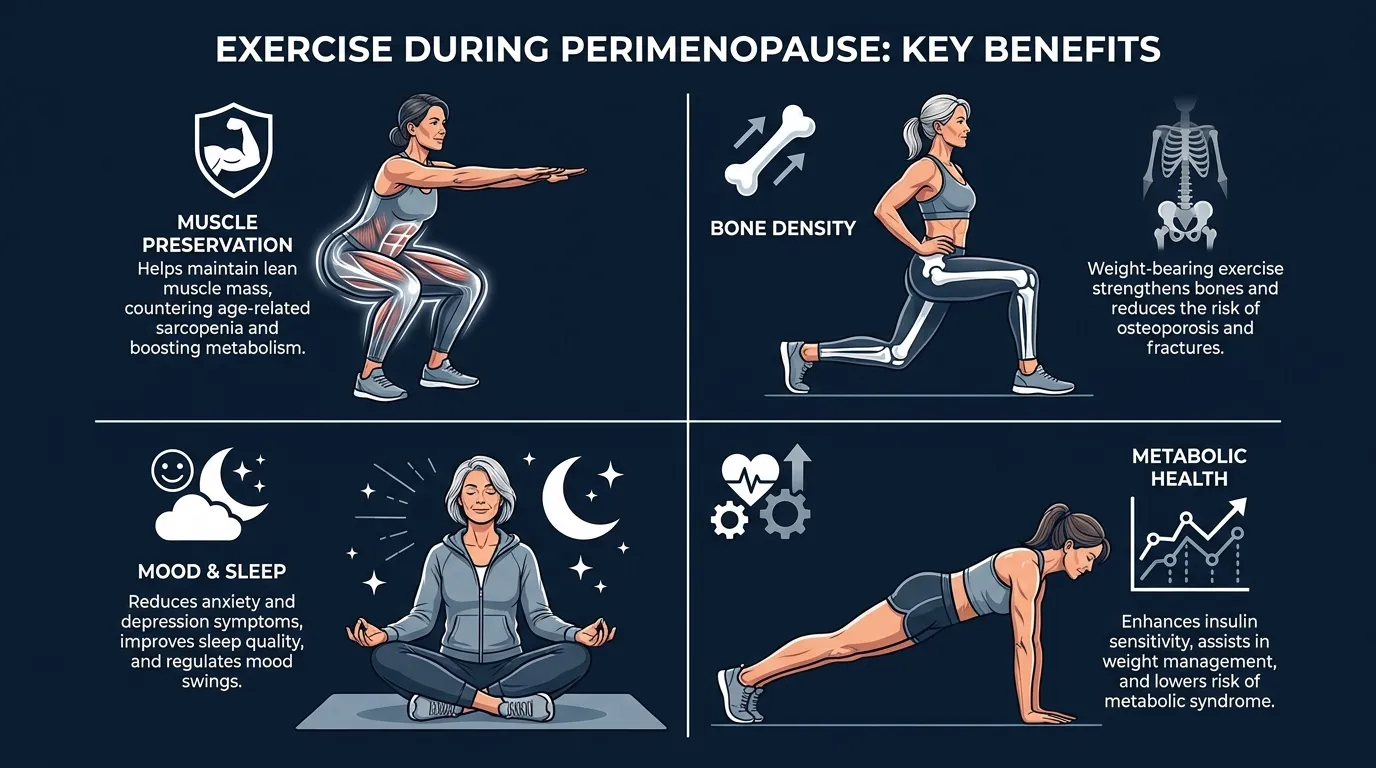
Estrogen plays an underappreciated role in muscle protein synthesis. As estrogen declines, the anabolic signaling that helps you build and maintain muscle weakens. Adults lose 3–8% of muscle mass per decade after age 30 under normal conditions. Perimenopause accelerates this process. Without targeted resistance training, women in perimenopause can lose muscle at nearly double the background rate.
Why does this matter for exercise? Muscle tissue is your metabolic engine. Less muscle means fewer calories burned at rest, harder fat loss, and workouts that feel harder for the same output. It's not your imagination. Your engine is smaller than it was.
Bone Density Decline
Estrogen is critical for bone maintenance. As estrogen falls during perimenopause, bone resorption outpaces bone formation. Women can lose up to 20% of their bone density in the 5–7 years around menopause. This dramatically increases long-term osteoporosis and fracture risk.
The intervention that works: weight-bearing and resistance exercise. Impact loading and resistance training both stimulate bone formation. They work best when started during perimenopause, before the steepest bone loss window arrives.
Fat Redistribution
Declining estrogen shifts fat storage from the hips and thighs toward the abdomen. This visceral fat accumulation is hormonally driven, not purely a result of diet or inactivity. It's also the type of fat most strongly associated with metabolic and cardiovascular risk. Exercise, particularly high-intensity interval training (HIIT) and resistance training, is the most effective behavioral intervention for visceral fat.
Sleep Disruption
Hot flashes and night sweats fragment sleep. Poor sleep impairs cortisol regulation, increases hunger hormones (ghrelin), and dramatically reduces your capacity for effort and recovery. If your workouts have felt harder lately, sleep quality is often a hidden factor. And exercise itself is one of the most effective interventions for improving perimenopausal sleep.
Recovery Slowdown
Estrogen has anti-inflammatory properties. Lower estrogen means slower recovery from exercise-induced muscle damage. The soreness you feel after a workout lasts longer. Training with the same frequency and intensity you used a decade ago will leave you chronically under-recovered. The fix is strategic. Don't stop exercising; just program smarter.
The Research: What Exercise Does (And Doesn't Do) in Perimenopause
The evidence base on exercise and perimenopause has grown substantially in the last five years. Here's what it actually says:
Strength Training Reduces Perimenopause Symptoms
A 2023 systematic review published in the Journal of Clinical Medicine (Berin et al., PMC9864448) analyzed strength training interventions in perimenopausal and menopausal women. The review found that resistance exercise consistently improved:
- Muscle strength and functional capacity
- Bone mineral density
- Body composition (reduced fat mass, preserved lean mass)
- Hormonal and metabolic markers
- Self-reported symptom severity, including hot flashes and sleep quality
The effect on hot flashes is modest and inconsistent across individuals. But the benefits for muscle, bone, and metabolic health are robust and well-replicated.
Resistance Training Changes Body Composition Even During the Transition
A 2023 controlled trial (Javed et al., PMC10559623) followed middle-aged women through a 20-week resistance training program, comparing perimenopausal and postmenopausal participants. Key finding: resistance training significantly altered body composition in both groups, reducing fat mass and preserving lean mass, even in the absence of dietary changes. The perimenopausal group showed greater responsiveness, suggesting early intervention matters.
Group-Based Programs with Accountability Work Best
A 2025 pilot trial (Dieli-Conwright et al., PMC12336402) tested a group-based physical activity program for pre- and perimenopausal women delivered via Zoom. Despite delivery barriers and a low-active starting population, the intervention demonstrated high feasibility and preliminary efficacy for both physical activity and strength outcomes. The motivational component, delivered alongside the physical training, was identified as a key driver of adherence.
This aligns with what behavioral science has consistently shown: external accountability structures work better than internal motivation alone, particularly during life transitions when self-regulation resources are depleted.
What Most People Try (And Why It Backfires)
The most common response to the plateau and fatigue of perimenopause is to train more intensely. More cardio, fewer rest days, stricter dieting. It's intuitive, and it's almost exactly backwards.
More Cardio, Fewer Results
Chronic steady-state cardio in the absence of resistance training accelerates the muscle loss that estrogen decline has already begun. You get fitter cardiovascularly while becoming metabolically less efficient. The scale doesn't move, and you feel exhausted. This is the experience so many women in perimenopause describe: working harder than ever and getting further behind. That gap between the scale and the mirror has been measured directly, and our breakdown of menopause belly explains why your weight can sit still for years while fat quietly relocates to your middle.
Cardio has real benefits and belongs in your program. But it is not sufficient on its own, and excessive cardio without resistance training actively makes the hormonal picture worse.
Caloric Restriction Without Protein Focus
Cutting calories aggressively during perimenopause, without prioritizing protein, accelerates muscle loss. Your body, already receiving less anabolic signal from declining estrogen, turns to muscle tissue for fuel when calories are severely restricted. The result: lower lean mass, lower metabolic rate, and a body that's harder to change going forward.
High-Intensity Without Adequate Recovery
High-intensity training is effective during perimenopause, but only when recovery is respected. Training hard every day without recovery days produces chronically elevated cortisol, which further disrupts hormonal balance, worsens sleep, and creates a state where your body is constantly breaking down rather than rebuilding.
This isn't a discipline problem. Traditional fitness culture rewards grinding. Your physiology has different needs right now. Recovery is training.
Find out what's really holding you back
FitCraft's diagnostic assessment identifies your specific consistency patterns (the real reasons behind the quitting cycle) and builds a plan that adapts as your body changes.
Take the Free Assessment Free • 2 minutes • No credit cardWhat Actually Works: The Evidence-Based Approach
The research points clearly toward a specific combination of training types, frequencies, and principles for perimenopause. Here's what to do:
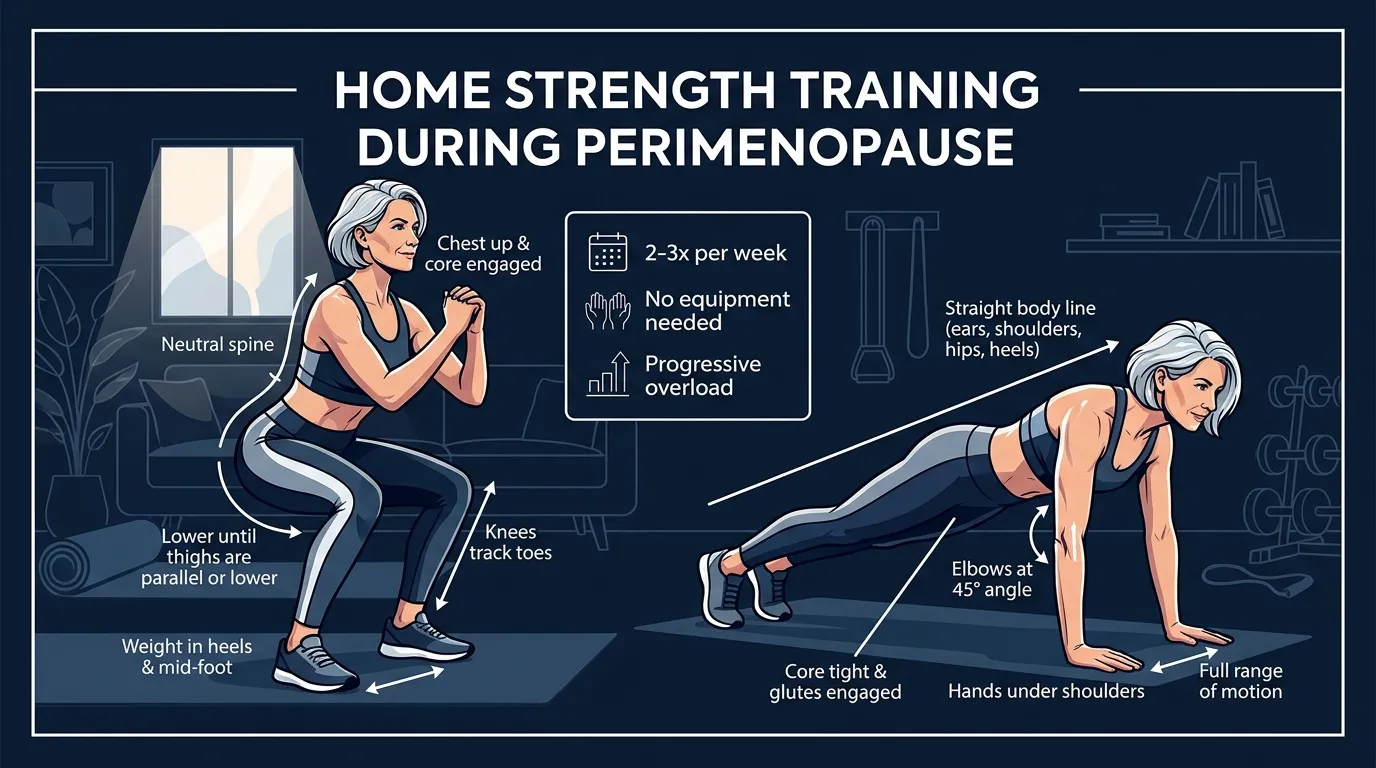
Resistance Training: 2-3 Days Per Week
This is the non-negotiable foundation. The American College of Sports Medicine recommends strength training 2-3 days per week for middle-aged and older adults, and the perimenopause-specific research strongly supports this as the minimum effective dose for preserving muscle and bone.
You do not need a gym. The bodyweight exercises that are effective for perimenopause include:
- Squats: load the quads, glutes, and hips; weight-bearing for bone health
- Push-ups: upper body pressing strength, chest and tricep development
- Glute bridges: posterior chain, hip stability, lower back support
- Rear lunges: single-leg strength and balance, essential for fall prevention as bone density declines
- Inverted rows: pulling strength, upper back, posture correction
- Dead bugs: deep core stability, protects the spine during the postural changes common in perimenopause
Progressive overload matters. As exercises become easier, increase difficulty: slow the tempo, add pauses at the bottom position, progress to more challenging variations. The mechanical stimulus (the signal to your bones and muscles that they're needed) must stay challenging to remain effective.
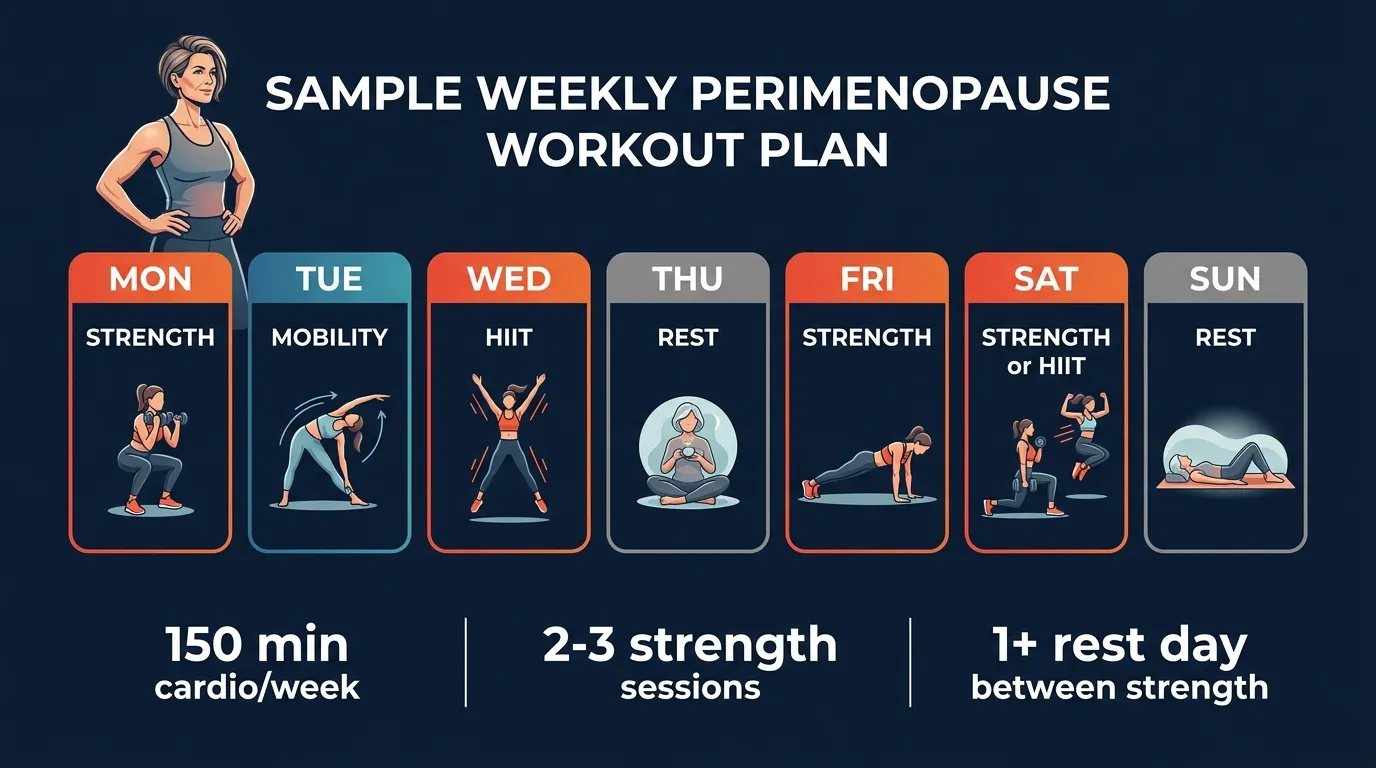
HIIT: 1-2 Sessions Per Week
High-intensity interval training, done 1-2 times per week, provides cardiovascular benefits, improves insulin sensitivity, and targets visceral fat more effectively than steady-state cardio. Research from meta-analyses of HIIT in perimenopausal women shows meaningful benefits for fat loss and cardiometabolic markers.
A simple protocol: 20 minutes of alternating 30 seconds of high effort (jumping jacks, high knees, burpees) with 60 seconds of active rest. Done twice per week alongside resistance training, this combination covers the major physiological concerns of perimenopause without the overtraining risk of daily high-intensity work.
Mobility and Recovery: Non-Negotiable
Joint mobility and flexibility tend to decline in perimenopause, partly due to lower estrogen's effect on connective tissue. Add 10-15 minutes of mobility work on rest days (cat-cow stretches, downward dog, hip flexor stretches) to maintain range of motion and reduce injury risk.
Recovery days aren't optional. They're where adaptation happens. A 2-3 day strength program requires at least one full rest day between sessions. On those days, light walking, yoga, or mobility work supports recovery without impeding it.
Protein Prioritization
Exercise produces the stimulus; protein provides the building material. During perimenopause, anabolic resistance (your muscles' reduced sensitivity to protein) means you need more protein than you did in your 30s to achieve the same muscle-building effect. Current evidence supports 1.2–1.6g of protein per kilogram of bodyweight daily for active women in their 40s and 50s. Spread your intake across meals for optimal muscle protein synthesis.
Consistency as the Primary Variable
The research is consistent on this point: the best exercise program for perimenopause is the one you actually do. Women who maintain consistent exercise habits throughout the perimenopausal transition (even moderate habits) have significantly better outcomes for weight, bone density, mood, and cardiovascular risk than women who exercise sporadically at high intensity. If an app is how you keep the habit, our roundup of the best fitness apps for women ranks the options on consistency as much as content.
Showing up three days per week for two years beats a perfect program you quit in six weeks. The research on gamification in fitness (BE FIT trial, STEP UP trial, and the 2025 pilot from Dieli-Conwright et al.) shows that external accountability structures like streaks, social support, and adaptive feedback are the most effective tools for building this kind of sustained adherence in populations facing real barriers to consistency.
How to Get Started Today
You don't need a gym membership, expensive equipment, or an hour blocked out every day. Here's how to build a perimenopause fitness practice from zero:
Week 1: Establish the Foundation
Start with two sessions this week. Each session: 15-20 minutes of bodyweight resistance. Choose 4-5 exercises from the list above and perform 2-3 sets of 10-12 repetitions each. Rest 60-90 seconds between sets. Don't train to failure. The goal this week is to establish the habit pattern, not to exhaust yourself.
Add a 20-minute walk on off days. Research consistently shows that 8,000-10,000 steps per day provides meaningful cardiovascular and metabolic benefits. And walking is weight-bearing, which counts for bone health.
Weeks 2-4: Add Consistency
Graduate to three resistance sessions per week. Add one HIIT session (20 minutes). Focus on technique. Slow, controlled reps produce better muscle stimulus and lower injury risk than fast, sloppy ones. Aim for 8 hours of sleep; poor sleep is the hidden variable that derails most perimenopause fitness programs before they get started.
Month 2 Onward: Progressive Challenge
Increase exercise difficulty rather than volume. Progress your squats to Bulgarian split squats. Progress push-ups to pike push-ups or diamond push-ups. Track your workouts. Seeing your numbers improve is one of the most powerful consistency motivators available, and it's the core mechanism behind FitCraft's AI coaching system.
What to Expect (The Real Timeline)
Week 1 will feel uncomfortable and unfamiliar. That's normal and expected. The research-backed timeline for perimenopause fitness looks like this:
- 2-4 weeks: Sleep quality begins to improve with consistent exercise. Energy improves modestly.
- 6-8 weeks: Strength improvements become measurable. Body composition changes begin (though they may not be visible on the scale, since muscle gain and fat loss can cancel each other out while your body is meaningfully improving).
- 3-4 months: Meaningful lean mass preservation, reduced symptom severity for many women, established habit. This is where the research shows the clearest outcomes.
- 6+ months: Bone density maintenance effects, sustained cardiometabolic improvements, significantly reduced long-term health risk.
The 6-8 week window is where most programs fall apart. This is when the initial motivation fades, results aren't yet visible, and life events (travel, illness, stress) create gaps in the routine. The science of habit loops is clear on this: the systems and accountability structures you have in place at week 6-8 determine whether exercise becomes a lasting behavior or another attempt that didn't stick.
The Bottom Line
Perimenopause changes how your body responds to exercise. But it doesn't make exercise less important. It makes it more important. The women who navigate this transition best aren't the ones who train hardest. They're the ones who train consistently, with a program that respects the hormonal reality of this life stage.
Resistance training 2-3 days per week. HIIT 1-2 days. Adequate protein. Recovery taken seriously. And an accountability system that keeps you showing up on the days when motivation isn't enough.
"After my second kid, I needed something stupidly simple. FitCraft fit into my life, not the other way around. Down 22 lbs in four months and I actually look forward to my sessions now."
— Stacy, 41
You're not too old. You're not broken. You just need an approach designed for where your body actually is, not where it was ten years ago. That's not a discipline problem. It's a design problem.
Frequently Asked Questions
What type of exercise is best during perimenopause?
Resistance training is the most evidence-backed exercise type for perimenopause. A 2023 systematic review (Berin et al., PMC9864448) found that strength exercises reduce multiple symptoms including hot flashes, sleep disruption, and mood instability. HIIT 1-2 times per week adds cardiovascular and fat-loss benefits. Both can be done at home with bodyweight exercises.
Why is exercise harder during perimenopause?
Declining estrogen reduces muscle protein synthesis, slows recovery, and shifts fat distribution toward the abdomen. Workouts that produced clear results in your 30s produce less visible results in your 40s. You're not doing something wrong; your hormonal environment has changed. Training smarter, not harder, is the correct adaptation.
How often should I exercise during perimenopause?
Research supports strength training 2-3 times per week, with at least one rest day between sessions, combined with 150 minutes of moderate-intensity cardio weekly. A 2023 controlled trial (PMC10559623) showed significant body composition improvements in perimenopausal women over 20 weeks at this frequency. Recovery between sessions matters more than it did in your 20s.
Can bodyweight exercises preserve muscle mass during perimenopause?
Yes. Bodyweight resistance exercises (squats, push-ups, lunges, glute bridges) provide sufficient mechanical stimulus to slow sarcopenia when performed consistently and with progressive overload. The key is progressive challenge: as exercises become easier, increase difficulty through tempo, range of motion, or more demanding variations.
Does exercise reduce hot flashes during perimenopause?
Evidence is generally positive for resistance and aerobic training reducing hot flash severity over time, with effects appearing after several weeks of consistent training. The 2023 systematic review by Berin et al. found strength training improved multiple menopause symptoms. Individual responses vary, and consistency matters more than intensity for this benefit.