Cat cow is the simplest exercise on this site. It's also one of the most universally useful. Two positions, back and forth, coordinated with your breathing. That's it. No weight, no equipment, no complicated form cues. And yet it shows up in physical therapy clinics, yoga studios, CrossFit warm-ups, and pro sports training facilities. Why? Because your spine needs to move through its full range of motion regularly, and most people's spines don't.
If you sit at a desk, drive a car, or look at a phone (so, everyone), your spine spends most of the day stuck in a mild flexion. It doesn't extend. It doesn't articulate segment by segment. And over time, that stiffness accumulates. A 2017 study in the Journal of Physical Therapy Science confirmed what physical therapists have known for years: spinal mobilization exercises like cat cow reduce pain and improve function in people with chronic low back issues (Park et al., 2017).
So while cat cow won't build muscle or burn calories, it does something that arguably matters more for most people. It keeps your spine healthy and moving well. And it feels really good. Especially first thing in the morning when everything is stiff.
Quick Facts: Cat Cow
- Equipment needed: None (yoga mat optional)
- Difficulty: Beginner
- Modality: Dynamic mobility / Stretching
- Body region: Spine, core, shoulders
- FitCraft quest category: Mobility
Areas Stretched & Mobilized
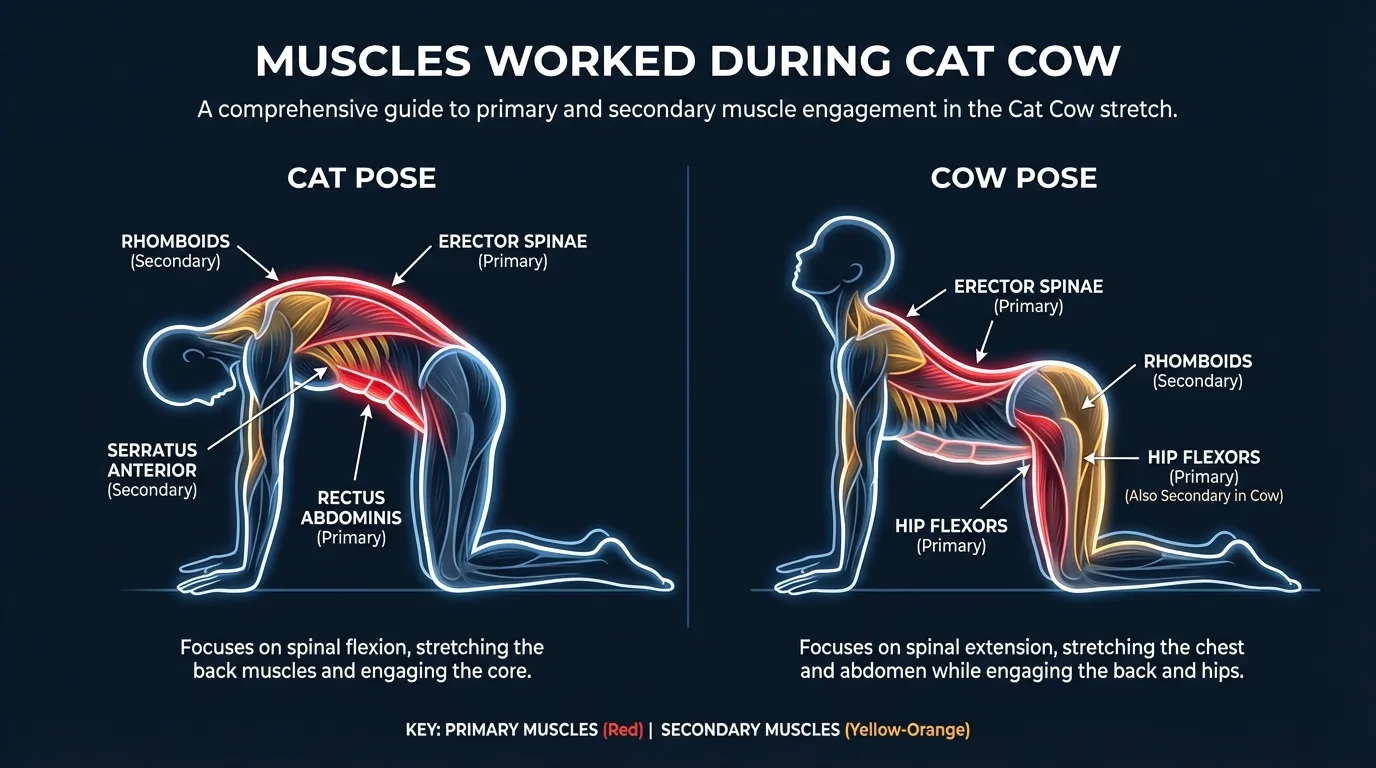
Primary areas mobilized: the entire spinal column from the cervical (neck) through the thoracic (mid-back) into the lumbar (lower back) and sacrum. The erector spinae group (the long muscles running parallel to your spine) shortens concentrically during cow and lengthens eccentrically during cat. The rectus abdominis does the opposite, contracting concentrically during cat and lengthening during cow. Both sides of the trunk get a full active-range cycle every rep.
Secondary areas worked: the serratus anterior, rhomboids, and lower trapezius assist with scapular protraction (cat) and retraction (cow), giving the shoulder blades a gentle mobility cycle alongside the spine. The hip flexors (psoas, iliacus) lengthen during cow as the pelvis tips anteriorly, and the glutes briefly contract during cat as the pelvis tucks posteriorly. The wrists and forearms hold the supporting tabletop position throughout, giving them a mild loaded stretch.
Stabilizers: stretching and mobility drills usually don't require active stabilization, but cat cow is dynamic, so the deep core (transverse abdominis), the glutes, and the shoulder girdle (especially serratus anterior pressing the floor away in cat) work isometrically to keep the tabletop frame stable while the spine articulates. This light bracing is what keeps the movement spine-driven instead of collapsing into the shoulders or hips.
Mechanism (why this works for spinal health): the spinal discs are avascular, meaning they don't have direct blood supply. They get their nutrients through a process called imbibition, which works like a sponge: compression squeezes fluid out, decompression draws fresh fluid in. Cat cow alternates compression and decompression across each segment of the spine, which is why it tends to feel especially good first thing in the morning (when discs are most hydrated and stiff) and after long stretches of static posture. The 2017 study cited above (Park et al., 2017) demonstrated functional benefits in chronic low back pain patients; the proposed mechanism is improved joint lubrication, reduced muscle guarding, and increased local blood flow to the paraspinal muscles.
How to Do Cat Cow (Step-by-Step)
- Start in tabletop. Hands directly under your shoulders, knees directly under your hips. Spread your fingers wide, press your palms flat. Your spine starts in a neutral position. Think about a glass of water balanced on your lower back.
- Inhale into cow. As you breathe in, drop your belly toward the floor. Lift your tailbone toward the ceiling. Your chest opens forward and your shoulder blades draw together on your back. Let your gaze drift gently upward or forward. This is the extension (cow) phase. It should feel like a gentle stretch across your abs and chest.
- Exhale into cat. As you breathe out, round your spine toward the ceiling. Tuck your tailbone under, pull your belly button toward your spine, and let your head drop between your arms. Press the floor away with your hands so your upper back gets extra rounding. This is the flexion (cat) phase. You should feel a stretch along your entire back.
- Flow back and forth. Keep alternating. Inhale, cow. Exhale, cat. 8 to 12 reps. Move slowly. The transition between the two should be smooth. Think of each vertebra moving one at a time like a wave traveling up and down your spine. If you're just flopping between two positions, you're going too fast.
- Return to neutral. After your last rep, come back to a flat tabletop position. Your spine should feel warmer and more mobile than when you started. If it doesn't, do another round. Cat cow is one of those rare exercises where more is almost always better.
Coach Ty's cue: "Inhale equals extension. Exhale equals flexion. If your breath is random, you're missing half the benefit."
Ty's segmental cue: "Start the movement at your tailbone and let it travel up through your lower back, mid-back, upper back, and finally your head. Like a wave. Flopping between two positions skips the whole point."
Ty's arm cue: "Keep your elbows locked but not hyperextended. Your arms are pillars. The spine does all the work."
Get this exercise in a personalized workout
FitCraft, our mobile fitness app, uses its AI coach Ty to program mobility work like this into your plan at the right volume and intensity, based on your level, goals, and equipment. Ty was designed and trained by Domenic Angelino, MPH (Brown University) and NSCA-CSCS, with research published in the Journal of Strength and Conditioning Research and Medicine & Science in Sports & Exercise.
Take the Free Assessment Free · 2 minutes · No credit card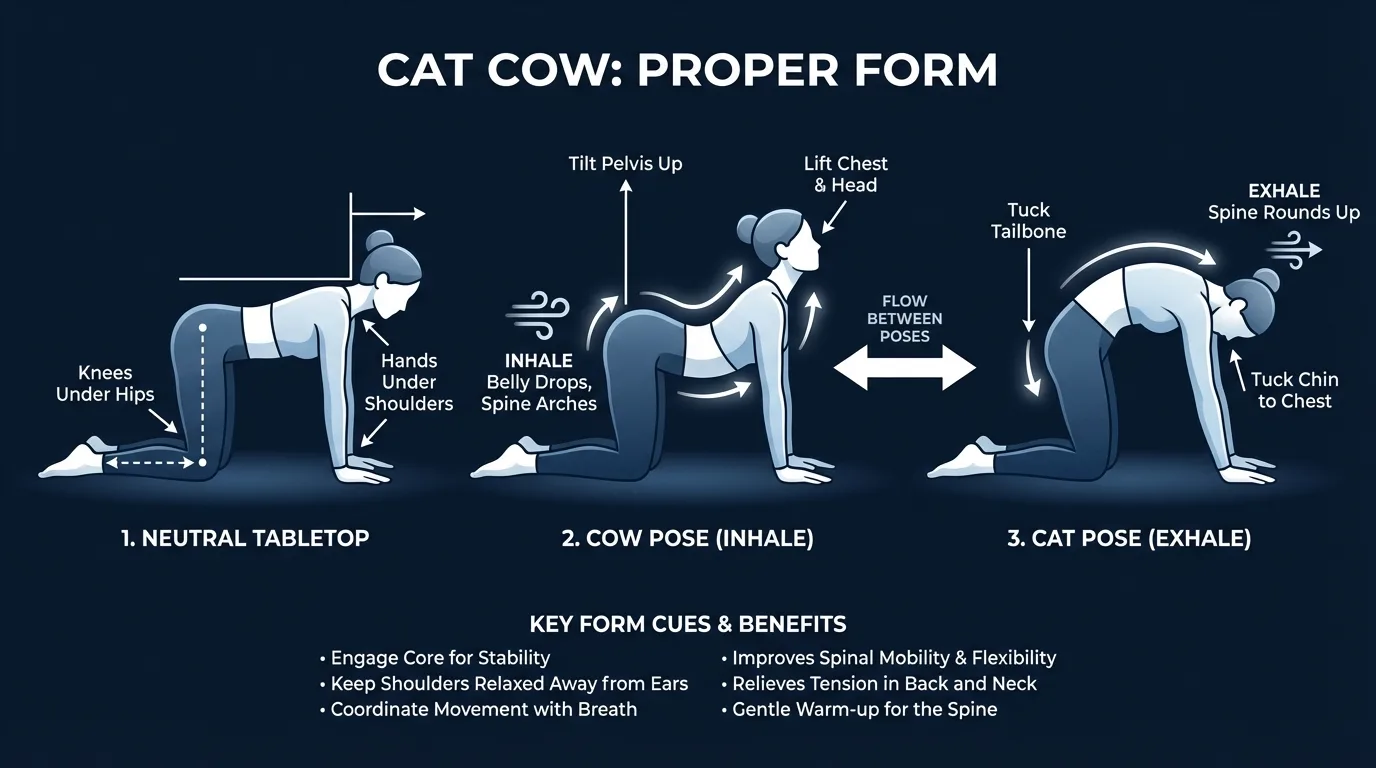
Common Mistakes to Avoid
It's hard to hurt yourself with cat cow. But it's easy to waste the exercise by doing it mindlessly. These are the mistakes that turn a spinal mobility exercise into rocking on all fours.
- Moving too fast. This is the big one. Cat cow is not a speed drill. People crank through 10 reps in 15 seconds and wonder why their back still feels stiff. Each transition should take a full breath cycle. That means roughly 3 to 4 seconds per position. If you're going faster than that, you're not mobilizing your spine. You're bouncing.
- Only moving the neck. Watch someone do cat cow and you'll often see their lower and mid-back barely moving while their head bobs up and down. The movement needs to travel through the entire spine. If your lower back doesn't round in cat and arch in cow, it isn't participating. Think about initiating from the tailbone, not the head.
- Hands too far forward. When your hands creep forward past your shoulders, you end up loading your shoulders instead of positioning yourself for pure spinal movement. Hands under shoulders, knees under hips. Check this at the start of every set.
- Holding your breath. Sounds silly, but it happens all the time. People concentrate so hard on the movement that they forget to breathe. And since the breath is what drives the movement quality, holding it removes the most important part of the exercise. Inhale, cow. Exhale, cat. Every single rep.
- Cranking into deep range on rep one. Cold spines don't appreciate being yanked to end-range. The first 3 to 4 reps should be gentle. Reps 5 to 12 can go deeper as the joints warm up and the surrounding muscles relax.
Variations and Progressions
Seated Cat Cow (Beginner / Office-Friendly)
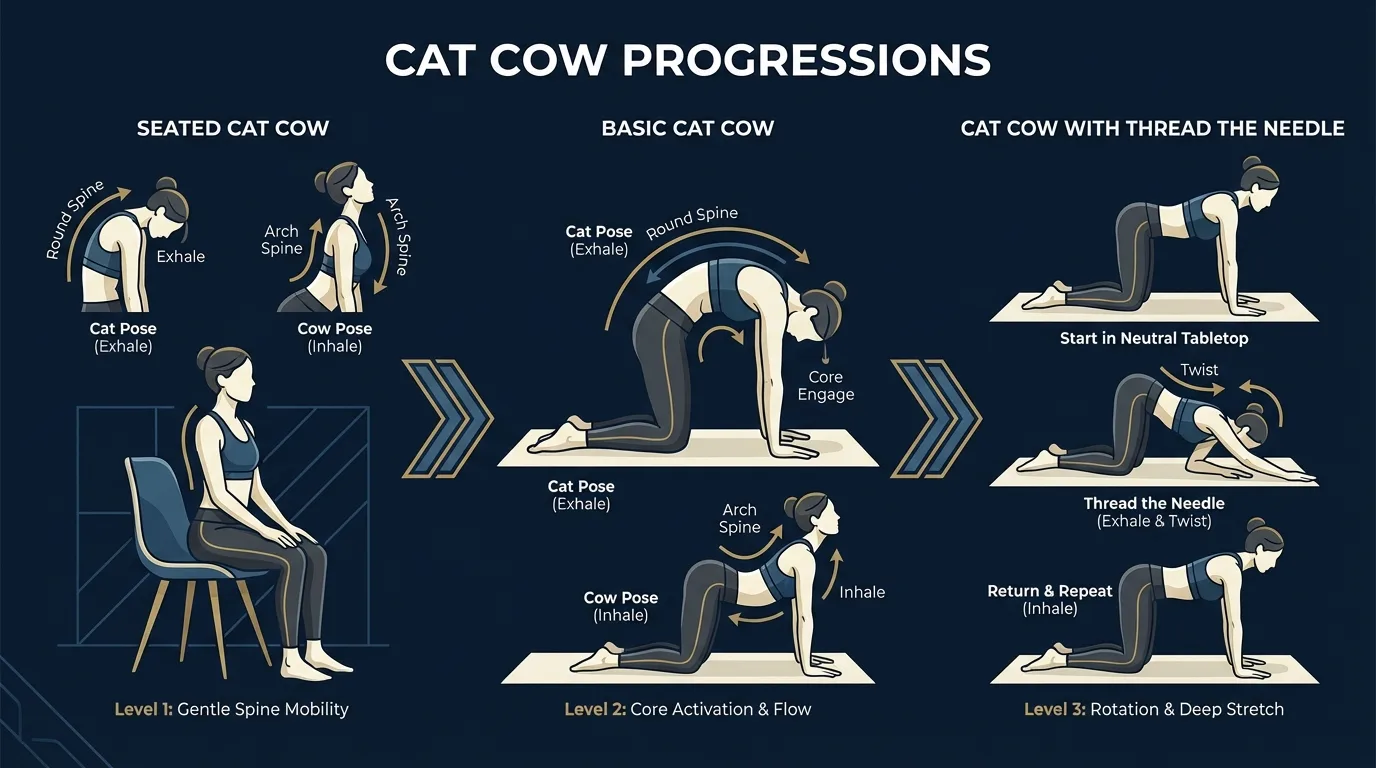
Can't get on the floor? Do it sitting. Sit at the edge of your chair, feet flat on the floor. Place your hands on your knees. Inhale and arch your back (cow), lifting your chest. Exhale and round your spine (cat), tucking your chin. Same movement, same breath pattern, no mat required. This is the best desk break exercise that exists. Do it every hour.
Cat Cow with Thread the Needle (Intermediate)
After each cat-cow cycle, add a thoracic rotation. From tabletop, reach your right arm under your left arm and thread it through to the other side, letting your right shoulder drop toward the mat. Then open back up, reaching your right arm to the ceiling. Alternate sides. This adds rotational mobility to the flexion and extension you're already getting. Your mid-back will thank you.
Cat Cow with Leg Extension (Intermediate)
During the cow phase, extend one leg straight back behind you. During cat, draw that knee toward your chest. Alternate legs. This adds a hip mobility and core stability component to the basic movement. Think of it as cat cow plus a slow-motion mountain climber. It's more work than it sounds.
Standing Cat Cow (Hinge Variation)
Stand with feet hip-width apart, hands on your thighs just above your knees, hips hinged back slightly so your torso is at about 45 degrees. Same breath pattern: inhale, arch and lift the chest; exhale, round and tuck the chin. Useful when you're at a standing desk, on a hike, or warming up at a trailhead with no floor available.
When to Avoid or Modify Cat Cow
Cat cow is one of the safest exercises in any program. It's used in post-surgical rehab protocols, prenatal yoga classes, and geriatric mobility groups for a reason. But a few specific conditions still call for modification or temporary substitution. Always consult a qualified healthcare provider or physical therapist before starting or returning to any exercise program, especially if any of the following apply.
- Acute disc herniation or active sciatica. Aggressive spinal flexion can compress the anterior portion of the disc and worsen a posterior herniation. If you have a recent or known disc injury, skip the cat (flexion) phase and work only the cow (extension) and neutral positions, often called the "press-up" or McKenzie extension approach. Clear it with a spine specialist before progressing to full cat cow.
- Wrist pain or carpal tunnel. Tabletop loads the wrist at roughly 90 degrees of extension. If that aggravates your wrists, drop to forearms (sphinx-style tabletop), use push-up handles, or stick with the seated chair version, which keeps the wrists neutral. The wrist stretch can also help pre-condition the wrists for tabletop work.
- Knee pain in the kneeling position. If kneeling on the floor is painful (patellofemoral pain, meniscus irritation, or arthritic knees), use a folded blanket or thick mat under the knees, or switch to the seated or standing variation. Kneeling discomfort shouldn't keep you from doing the spinal mobility work.
- Late-pregnancy (third trimester). Cat cow itself is generally safe and often recommended throughout pregnancy. The caveat: as the belly grows, the cow (extension) phase can feel uncomfortable or cause round-ligament strain. Stay in a gentler range and avoid forcing deep extension. The cat phase remains useful for relieving low-back compression. Consult your obstetrician or a prenatal-trained PT for individual guidance.
- Recent abdominal or spinal surgery. Get clearance from your surgeon before doing any spinal flexion or extension work. Most post-operative protocols start with neutral-spine work (deadbugs, bird-dogs) before introducing spinal articulation drills like cat cow.
- Hypermobility (Ehlers-Danlos, joint hypermobility spectrum disorder). If your spine already moves more than average, the goal isn't more range but better control. Work the movement in a small, controlled range and add gentle isometric holds at the end of each position rather than pushing depth. A PT with hypermobility experience can program appropriate parameters.
Related Exercises
If cat cow is part of your routine, these movements complement or extend the same spinal-health pattern:
- Stability counterpart to mobility: Bird Dog starts from the same tabletop position but trains the opposite quality: maintaining a neutral spine while extending opposite arm and leg. The classic pair is cat cow first (mobilize) then bird dog (stabilize).
- Spinal extension specialist: Cobra Pose isolates the extension half of cat cow from a prone position. Useful when you specifically need more thoracic and lumbar extension (most desk workers do).
- Rotational complement: Spinal Twist and Quadruped Thread the Needle add the rotational plane that cat cow's sagittal-only movement misses. Pair all three for a full 3D spinal warm-up.
- Anti-extension core foundation: Deadbugs and Deadbug Partial teach the deep core to resist extension, which is the bracing pattern that keeps a sagging plank or anterior pelvic tilt from creeping into your standing posture.
- Yoga progression: Downward Dog uses the same shoulder-press-the-floor pattern at a steeper angle, adding hamstring and calf stretch on top of the shoulder and spinal work.
How to Program Cat Cow
Cat cow programming is different from resistance training. Mobility work prioritizes hold time, breath quality, and consistency over weeks rather than sets and reps for strength. The American College of Sports Medicine (ACSM) Position Stand on resistance training notes that mobility and flexibility work can be performed daily, with intensity rather than volume as the primary progression lever (Ratamess et al., 2009).
| Level | Reps × Hold | Sets | Frequency |
|---|---|---|---|
| Beginner (gentle range, light tension) | 6–10 × 2-3 sec each position | 1–2 | 5–7 sessions/week |
| Intermediate (working into resistance) | 8–12 × 3-4 sec each position | 2–3 | 5–7 sessions/week |
| Advanced (deeper range, active engagement) | 10–15 × 4-5 sec, optional 15-30 sec end-range hold | 2–4 | Daily, often multiple times |
Where in your workout: Cat cow is ideal at the start of any session as part of a 5 to 10 minute dynamic warm-up. It pairs naturally with hip and shoulder mobility drills before strength or running work. Avoid long static holds at end-range right before max-effort strength or power training; instead, do the movement dynamically as a joint primer. Cat cow also works as a standalone movement break during long sitting bouts (1 to 2 sets of 8 reps every hour) or as a 5-minute morning routine.
Form floor over rep targets: if you're moving so fast that the segmental wave disappears, slow down even if it means fewer reps. The point isn't to hit 12 reps. The point is to mobilize each vertebra. Six clean reps beat 15 sloppy ones, every time.
How FitCraft Programs This Exercise
Knowing how to do cat cow is step one. Knowing when to do it, how often, and which variation fits your situation is where most people get stuck.
FitCraft's AI coach Ty handles that. During your personalized diagnostic assessment, Ty maps your fitness level, goals, mobility needs, and available equipment. Then Ty builds a personalized program that includes cat cow at the right point in your warm-up, paired with complementary mobility work.
As you progress, Ty adjusts the variation and volume to match your level. The seated version becomes the floor version. The floor version gets paired with thread-the-needle for rotational mobility. Frequency adapts to your training load. Ty's 3D demonstrations show the segmental wave motion from a side angle, which makes the "one vertebra at a time" concept click much faster than written descriptions.
Frequently Asked Questions
Can I do cat cow if I have lower back pain?
Cat cow is one of the most commonly recommended exercises for mild lower back stiffness and non-specific back pain because it gently mobilizes the spine through both flexion and extension without external load. A 2017 study in the Journal of Physical Therapy Science (Park et al., 2017) found that spinal mobilization exercises like cat cow reduced pain and improved functional disability in patients with chronic low back pain. That said, if you have a diagnosed disc herniation, active sciatica, or pain that sharpens during the movement, stop and consult a physical therapist before continuing. Pain that worsens during the exercise is a signal, not a stretch to push through.
What muscles does cat cow work?
Cat cow dynamically mobilizes the erector spinae, rectus abdominis, and the muscles along the entire spinal column. The cow phase activates the back extensors and stretches the abdominals. The cat phase activates the abdominals and stretches the back extensors. Assisting structures include the serratus anterior, rhomboids, and hip flexors, all of which support the segmental wave pattern. It's primarily a mobility exercise rather than a strength exercise.
How many cat cow stretches should I do?
8 to 12 reps (one full cat plus one full cow equals one rep) is standard. For warm-ups, 2 sets of 10 works great. For a quick desk break, even 5 to 6 slow reps can meaningfully reduce stiffness. The key is moving slowly enough that each vertebra participates.
Can I do cat cow every day?
Yes. Cat cow is one of the few exercises universally recommended for daily practice. It's low-intensity, minimal injury risk when performed in a comfortable range, and the benefits accumulate with consistency. Many physical therapists recommend doing it first thing in the morning, when the spinal discs are most hydrated and stiff, and after prolonged sitting.
What's the difference between cat cow and bird dog?
Cat cow is a spinal mobility exercise that moves through flexion and extension. Bird dog is a core stability exercise that challenges you to maintain a neutral spine while extending opposite arm and leg. They start from the same tabletop position but serve different purposes: mobility versus stability. Both are excellent for spinal health, and they pair well together. Cat cow first to mobilize, then bird dog to stabilize.