The Bulgarian split squat is the exercise people love to hate. One foot on a bench behind you, dumbbells at your sides, your front leg doing almost all the work. It's awkward the first few times. Your balance is off. Your back leg cramps. And somewhere around rep six you start questioning your life choices. Worth every uncomfortable second. No other dumbbell exercise builds single-leg strength and glute mass quite like this one.
Research by Mackey and Riemann (2021) compared the Bulgarian split squat to the back squat and found something that surprised a lot of coaches. The Bulgarian version is a hip-dominant movement, and its hip extension demands often exceed those of traditional back squats at comparable loads. More glute work, less spinal compression, and the ability to train each leg independently. Your strong side can't cover for your weak side anymore.
If you've mastered the standard split squat, this is the natural next step. And if you've been doing Bulgarians but your knees hurt or you can't feel it in the right muscles, this guide will fix that.
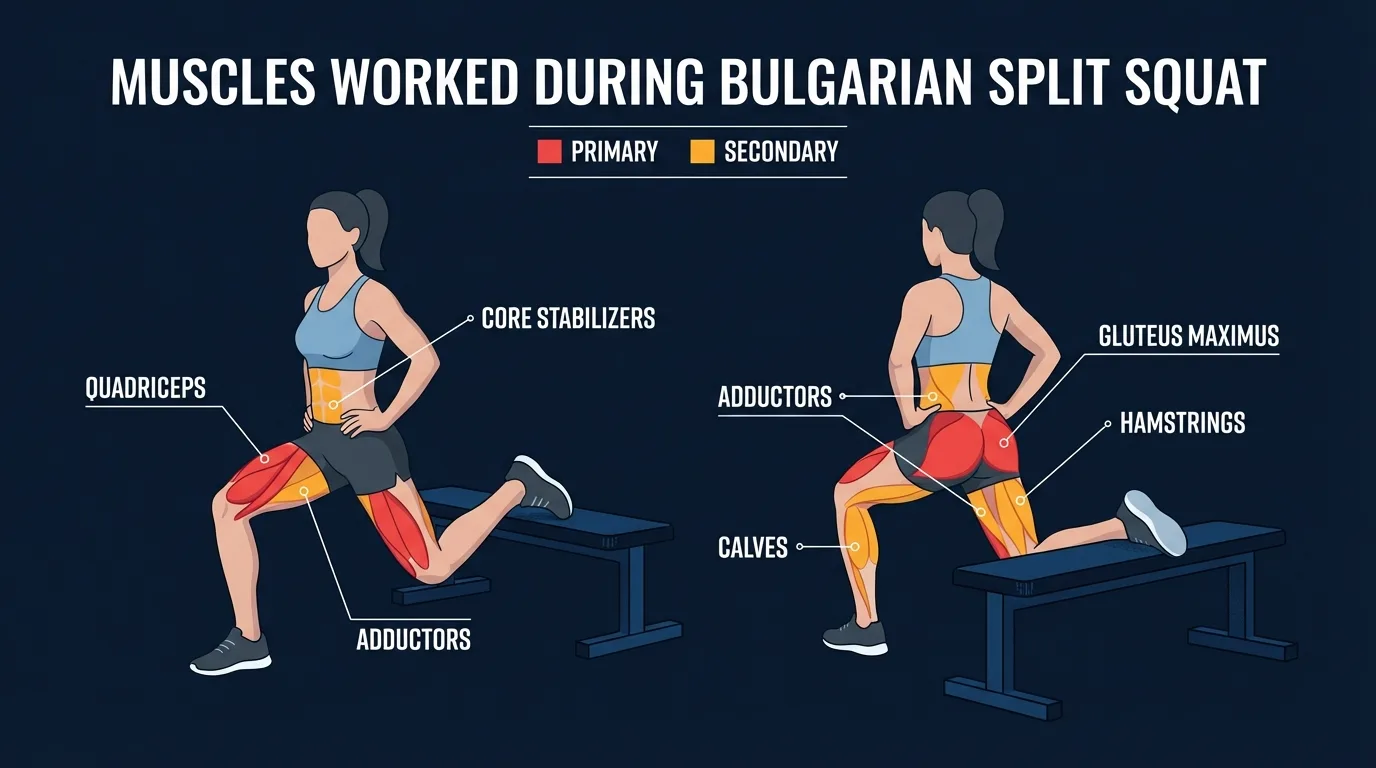
Muscles Worked
Primary movers are the quadriceps (vastus lateralis, vastus medialis, vastus intermedius, and rectus femoris) and gluteus maximus of the front leg. The quads extend the knee concentrically as you drive up out of the bottom position and absorb the load eccentrically on the way down. The gluteus maximus drives hip extension to bring the torso back to vertical, working through a longer range than it sees in a bilateral squat because the rear-foot elevation lets the front-leg hip drop deeper.
Secondary movers are the hamstrings, adductors (especially the adductor magnus, which doubles as a hip extender at depth), and the calves. The hamstrings co-contract with the quads to stabilize the knee and assist hip extension. The adductors get meaningful work because the long-stride stance recruits them as both hip extenders and stabilizers, which is why people often feel inner-thigh soreness after a heavy session. The calves work isometrically to stabilize the front ankle as you press through the heel and midfoot.
Stabilizers are the gluteus medius and minimus of the front leg (preventing the knee from caving inward), the deep core including the transverse abdominis and obliques (keeping the pelvis level and the torso from twisting), the erector spinae (maintaining a neutral spine under load), and the foot intrinsics of the front foot (driving balance through the tripod of the heel, big-toe ball, and pinky-toe ball). The rear-leg hip flexors stretch passively at the bottom and stabilize the trailing leg.
Evidence. Mackey and Riemann (2021) compared joint-level biomechanics of the Bulgarian split squat and the bilateral back squat at matched relative loads. They found the Bulgarian split squat produced significantly greater hip extension moments and lower knee extension moments than the back squat, classifying it as a hip-dominant movement. The practical translation: per leg, you're loading the glutes harder than you would in a back squat at the same relative effort, while reducing the share of work the quads do and avoiding axial spinal compression. That's why coaches use Bulgarians as a glute-bias compound and as a knee-friendlier squat alternative when spinal loading needs to come down.
Quick Facts
Quick Facts: Bulgarian Split Squat
- Equipment needed: Knee-height bench, chair, or step (14 to 18 inches); pair of dumbbells optional (bodyweight works for beginners)
- Difficulty: Intermediate to Expert (bodyweight to deficit-loaded variations)
- Modality: Compound, unilateral, squat pattern
- Body region: Lower body (quad and glute dominant, hip-extension biased)
- FitCraft quest category: Strength: Single-Leg Power
How to Do a Bulgarian Split Squat (Step-by-Step)
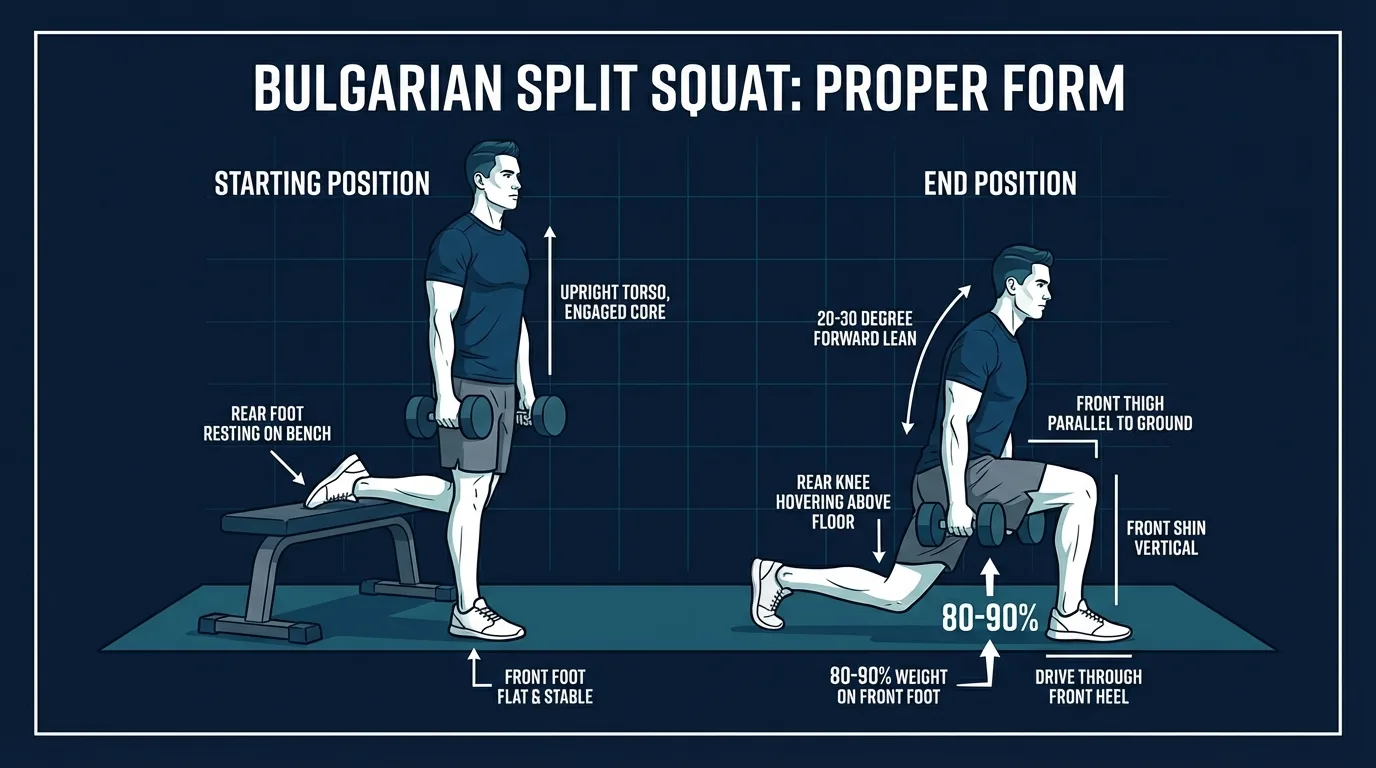
- Set up the bench. Stand about two feet in front of a bench, chair, or step that's roughly knee height (14 to 18 inches). Face away from it. If you're using dumbbells, pick them up before getting into position. Trying to grab weights while your foot is already on the bench is a recipe for face-planting.
Coach Ty's cue: "Set your stance before you touch the bench. Front foot two shoe-lengths forward. Then place the rear foot. Reverse order and you'll spend the first three reps adjusting."
- Place your rear foot. Reach one foot back and place the top of your foot (laces down) on the bench. Some people prefer the ball of the foot. Either works, but laces-down tends to be more comfortable on the knee. Your front foot should be far enough forward that when you lower down, your knee stays over your ankle.
- Find your balance. Here's where most people rush. Take a second. Actually take a second. Get 80 to 90 percent of your weight on the front foot. Stand tall with a slight forward lean, about 20 to 30 degrees. Arms hanging with dumbbells at your sides (or hands on hips if bodyweight). Keep your feet hip-width apart. Train tracks, not tightrope.
Coach Ty's cue: "Spread your toes and press all five into the floor. This activates your foot's stabilizers and locks in balance immediately. Small thing, big effect."
- Lower under control. Bend your front knee and drop your hips straight down toward the floor. Think elevator. Lower until your front thigh is at or just below parallel, and your rear knee is hovering an inch or two above the ground. Keep your torso stable. No twisting, no leaning to one side. Take 2 to 3 seconds on the descent. The slow eccentric is where most of the muscle-building stimulus happens.
Coach Ty's cue: "Drop the hip, not the chest. If your chest is folding toward your front knee, the weight's too heavy or your core isn't braced."
- Drive up through the front heel. Press through the heel and midfoot of your front leg to push back up. Squeeze your glute hard at the top. Inhale on the way down, exhale as you drive up. Complete all reps on one side, then switch legs.
Coach Ty's cue: "If you feel your rear quad burning more than your front glute, you're pushing off the back foot. Lighten the back foot. It should feel like it could float."
Common Mistakes to Avoid
The Bulgarian split squat has a steeper learning curve than most leg exercises. These are the mistakes that make it feel worse than it should:
- Bench too high. When the bench is above knee height, your rear hip flexor gets overstretched and your pelvis tilts forward. That puts your lower back in a bad spot and takes tension off the muscles you're actually trying to work. Standard gym bench height (about 17 inches) is ideal. A couch or bed is usually too tall.
- Front foot too close to the bench. This forces your front knee into excessive forward travel, loading the patellar tendon instead of the quad and glute. At the bottom position your front shin should be roughly vertical. If your knee is way past your toes, step forward.
- Pushing off the back foot. Your back leg shouldn't be doing real work. If it is, you're basically doing a split squat with extra steps instead of an elevated unilateral squat. Put 80 to 90 percent of the load on the front foot.
- Leaning too far forward. A slight forward lean is good. Folding at the waist like a hinge is not. If your chest is dropping toward your front knee, either the weight's too heavy or your core isn't engaged. Brace your abs before each rep.
- Hips rotating open. Both hips should face straight ahead throughout the movement. If one hip rotates open or your torso twists, it usually means your front-leg glute medius is weak. Drop the weight, slow the tempo, and cue both hip points forward.
- Rushing the setup. People grab their dumbbells, throw a foot on the bench, and immediately start repping. Then they wonder why their balance is off and nothing feels right. Spend 5 seconds getting your stance dialed in. Check your foot width. Feel your weight distribution. Then go.
Get this exercise in a personalized workout
FitCraft, our mobile fitness app, uses its AI coach Ty to program compound strength exercises like this into your plan at the right volume and intensity, based on your level, goals, and equipment. Ty was designed and trained by Domenic Angelino, MPH (Brown University) and NSCA-CSCS, with research published in the Journal of Strength and Conditioning Research and Medicine & Science in Sports & Exercise.
Take the Free Assessment Free · 2 minutes · No credit cardVariations and Progressions
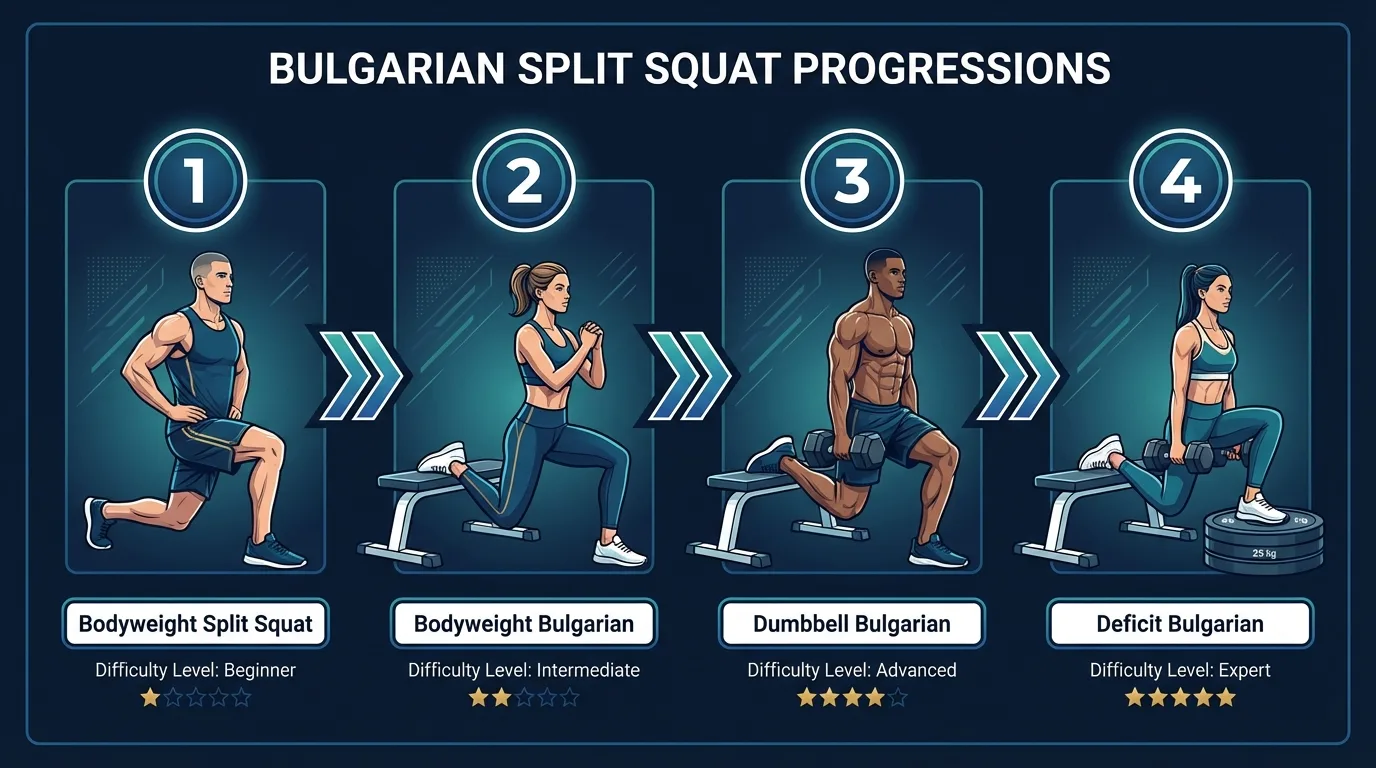
Bodyweight Bulgarian Split Squat (Starting Point)
No dumbbells, hands on hips or arms out front for balance. This is where everyone should start, even experienced lifters. Master balance and the movement pattern before adding load. Once you can do 3 sets of 12 per leg with a controlled 2-second descent and no wobbling, you're ready for weight.
Dumbbell Bulgarian Split Squat (Intermediate to Expert)
Hold a dumbbell in each hand at your sides. Start light, 10 to 15 pounds per hand, and progress by 5 pounds when you can complete all sets cleanly. This is the most common variation and the one you'll spend the most time with. Something people don't expect: the dumbbells act as a slight counterbalance, so some lifters find their stability improves compared to bodyweight.
Goblet Bulgarian Split Squat (Intermediate)
Hold a single dumbbell or kettlebell at chest height, cupped in both hands. The front-loaded weight shifts more demand to your core and anterior chain. Good option if you only have one dumbbell or want extra core challenge.
Deficit Bulgarian Split Squat (Expert)
Place your front foot on a low plate or step (2 to 4 inches). This increases the range of motion at the bottom, loading your glutes through a deeper stretch. Fair warning: only attempt this if you have full control of the standard version. The deeper range demands serious hip mobility and stability.
Coming From Standard Split Squats?
If you've been doing standard split squats and want to progress, the Bulgarian version is the natural next step. The elevated rear foot increases hip range of motion and demands more from your stabilizers. Expect to use less weight than your flat split squat for the first few weeks while your balance catches up.
Gym alternative
This guide covers the dumbbell version. If you have gym access, you can perform the Bulgarian split squat with a barbell racked across the upper back. The pattern is identical, but the barbell increases axial spinal loading and reduces the counterbalancing effect that dumbbells provide at the sides. Most home and hybrid lifters get more out of the dumbbell version.
When to Avoid or Modify the Bulgarian Split Squat
The Bulgarian split squat is safe for most healthy adults, but a few conditions warrant modification. Always consult your physician or physical therapist before starting any new exercise program, especially if any of the following applies to you:
- Recent knee, hip, or ankle surgery or injury. The unilateral load and deep range expose the front leg's joints to forces a healing structure may not tolerate. Get clearance from your surgeon or PT, and rebuild with standard split squats first.
- Patellofemoral pain or anterior knee pain. If your front knee hurts during or after the movement, check that the front foot is far enough forward (shin near-vertical at the bottom), drop the load, and limit depth to pain-free range. If pain persists, swap to bodyweight squats or sumo squats until you can see a clinician.
- Significant balance or vestibular issues. The narrow stance and elevated rear foot make this an unforgiving balance exercise. Hold a wall or rail for the dumbbell version, or substitute split squats until balance improves.
- Acute lower-back pain or known disc pathology. Although Bulgarians load the spine less than bilateral barbell squats, the dumbbell hold and forward lean still demand a braced trunk. Drop to bodyweight or pause the movement entirely, build a foundation with deadbugs and bird-dogs, then return when pain is gone.
- Pregnancy, especially second and third trimester. The balance demand grows as your center of mass shifts. Hold a wall or rail, reduce or eliminate the dumbbell load, and avoid the deficit variation. Substitute with supported split squats if balance becomes unreliable.
- First 6 to 8 weeks postpartum or active diastasis recti. The bracing demand under dumbbell load increases intra-abdominal pressure. Restore deep-core function with deadbugs and bird-dogs first, then return to bodyweight Bulgarians before adding load.
- Uncontrolled hypertension or known cardiovascular disease. Bracing under heavy dumbbells spikes intra-arterial pressure. Use lighter loads, exhale on the way up to avoid Valsalva, and follow your cardiologist's exercise guidance.
Related Exercises
- Same movement pattern (squat): Squats, Sumo squats, Split squats. Bilateral and unilateral squat variations that share the knee-and-hip extension pattern.
- Easier unilateral regression: Split squats. Same single-leg pattern with both feet on the floor, easier to balance, lower hip range of motion.
- Dynamic unilateral alternative: Rear lunges. Stepping movement that hits similar muscles with an added coordination component.
- Hinge pattern pairing: Romanian deadlift, Single-leg deadlift. Posterior-chain dominant lifts that balance the quad-and-glute bias of Bulgarians in a complete lower-body session.
- Core foundation for spinal bracing: Deadbugs, Bird-dogs, Forearm planks. Prerequisite core work that makes the loaded trunk-bracing demand of Bulgarians more sustainable.
How to Program the Bulgarian Split Squat
Programming follows the Ratamess et al., 2009 ACSM Position Stand on Progression Models in Resistance Training. Because the Bulgarian split squat is unilateral and creates real muscle damage from the deep stretch at the bottom, the volume per leg matters more than chasing absolute load. Build balance and form before adding weight.
| Level | Sets × Reps (per leg) | Rest between sets | Frequency |
|---|---|---|---|
| Beginner | 2-3 × 8-12 (bodyweight) | 60-90 seconds | 2 sessions/week |
| Intermediate | 3 × 10-12 (light to moderate dumbbells) | 90-120 seconds | 2 sessions/week |
| Advanced | 3-4 × 6-10 (moderate to heavy dumbbells) | 120-180 seconds | 2-3 sessions/week |
Where in your workout. Early. First or second exercise in your lower-body session, while you're fresh and your balance is sharp. Balance-demanding lifts performed after fatigue accumulate form breakdown fast, and form breakdown on this movement means the wrong muscles take the load. Pair Bulgarians with a hinge pattern (Romanian deadlift, single-leg deadlift) in the same session for a complete lower-body workout.
Form floor over rep targets. If the last rep of a set isn't as clean as the first, end the set. Hitting the rep target with sloppy reps trains the wrong patterns and risks the knee. Better to stop at 8 clean reps than push to 12 with three garbage reps at the end.
FitCraft's AI coach Ty programs left and right legs separately based on your assessment. If one leg is weaker (one almost always is), Ty adjusts the volume so you close that gap over time. The 3D demonstrations show foot placement, lean angle, and depth targets, which matter a lot with this particular exercise.
Frequently Asked Questions
What muscles does the Bulgarian split squat work?
The Bulgarian split squat primarily targets the quadriceps and gluteus maximus of the front leg. Secondary muscles include the hamstrings, adductors, calves, and core stabilizers. Research by Mackey and Riemann (2021) found it's a hip-dominant movement that often produces greater hip extension demands than bilateral back squats at comparable loads.
How heavy should dumbbells be for Bulgarian split squats?
Start with bodyweight only until you can do 3 sets of 10 reps per leg with solid balance. Then begin with light dumbbells, 10 to 15 pounds each. Progress by 5-pound increments when you complete all sets without form breakdown. Most intermediate lifters end up working in the 25 to 40 pound per hand range.
Is the Bulgarian split squat better than regular squats?
Honestly, neither is objectively better. They serve different purposes. Bulgarian split squats expose and correct imbalances, place less compressive force on the spine, and create higher hip extension demands per leg. Back squats let you handle heavier absolute loads and more total-body stress. A solid program typically includes both.
How high should the bench be?
Roughly knee height, about 14 to 18 inches. Too high and your rear hip flexor gets overstretched, pulling your pelvis into anterior tilt. Too low and you lose the range-of-motion advantage over a standard split squat. A standard gym bench or sturdy dining chair works well for most people.
Can I do Bulgarian split squats with knee pain?
Front-knee pain usually means your front foot is too close to the bench (shin angle too forward), the load is too heavy, or you have an underlying patellofemoral issue. Step the front foot forward so the shin is roughly vertical at the bottom, drop the dumbbells and rebuild with bodyweight, and limit depth to pain-free range. Back-knee pain usually comes from too much weight on the rear foot or a bench that is too high. The back foot should bear only 10 to 20 percent of your weight, acting as a kickstand. If pain persists despite these corrections, consult a physical therapist before continuing.