The split squat looks like a lunge frozen in place. One foot forward, one foot back, both feet stay planted, and the front leg does most of the work.
That planted stance is the point. You get the single-leg strength and imbalance-revealing benefits of a lunge without the extra coordination of stepping forward or backward every rep. It is easier to learn, easier to slow down, and easier to load once your balance catches up.
The catch is weight distribution. If the back leg starts pushing hard, the movement turns into a two-leg bounce. Keep the back foot quiet, drive through the front heel and midfoot, and the exercise becomes a clean quad-and-glute builder.
Quick Facts: Split Squats
- Equipment needed: None for bodyweight; dumbbells optional for loading
- Difficulty: Beginner with support to Advanced with dumbbells or rear-foot elevation
- Modality: Strength, unilateral, squat pattern
- Body region: Lower body (quad and glute dominant)
- FitCraft quest category: Strength
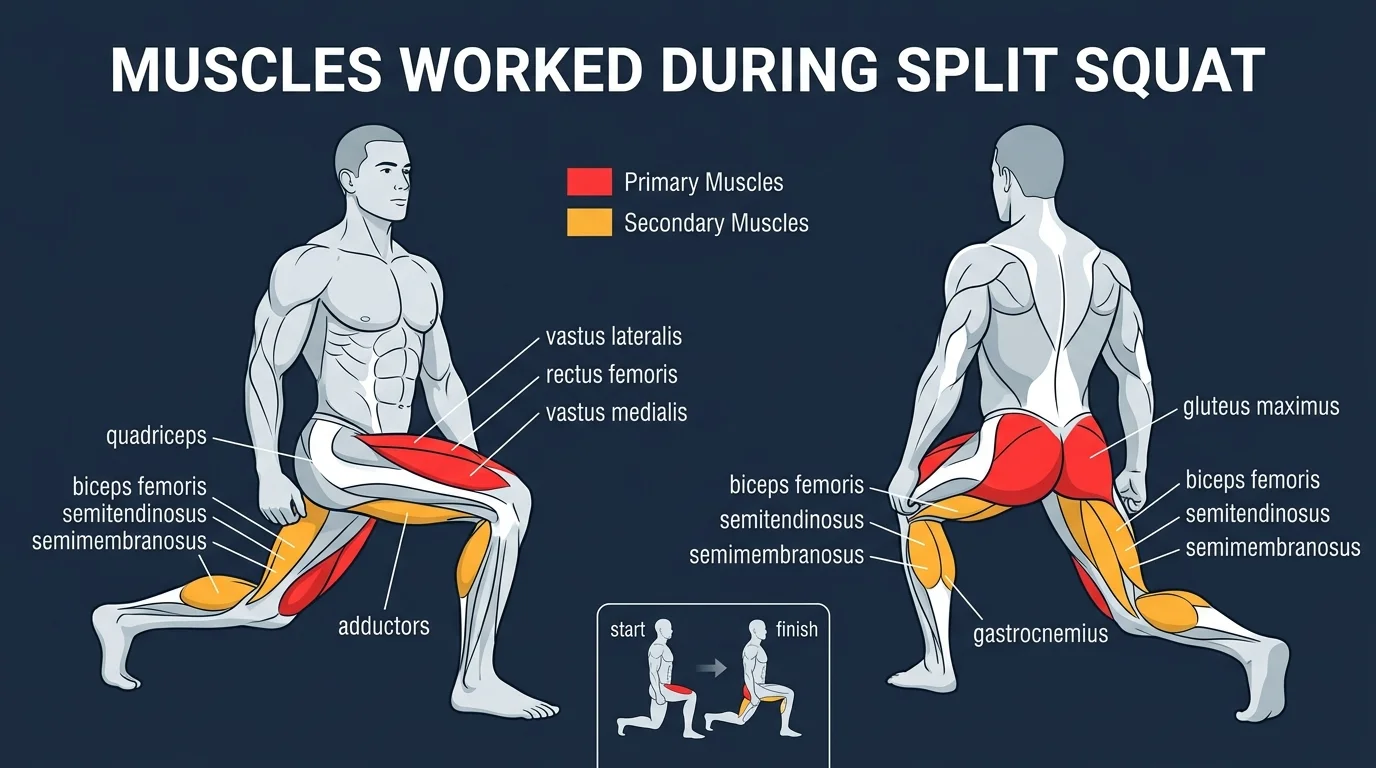
Muscles Worked
Primary movers are the quadriceps and gluteus maximus of the front leg. The quads extend the knee as you drive up from the bottom and control knee flexion on the descent. The gluteus maximus extends the hip, especially when you keep a slight forward torso lean and press through the heel and midfoot.
Secondary movers are the hamstrings, adductors, and calves. The hamstrings help control the knee and assist hip extension. The adductor magnus contributes to hip extension from the lower position. The gastrocnemius and soleus stabilize the front ankle while the body moves vertically over the planted foot.
Stabilizers are the gluteus medius and minimus of the front hip, the deep core, obliques, erector spinae, and the small muscles of the foot. They keep the pelvis level, stop the front knee from caving inward, and prevent the torso from twisting as one leg carries most of the load.
Evidence. Kipp et al. (2022) modeled muscle forces during squats, split squats, and step-ups across added loads from 0 to 75 percent of body mass. They found load-dependent increases in gluteus maximus, vastus lateralis, vastus medialis, vastus intermedius, hamstring, soleus, and gastrocnemius forces during split squats. In several of those muscles, the load response was more pronounced in split squats and step-ups than in bilateral squats. Chen et al. (2023) also found that step length changes hip, knee, ankle, and lower-limb EMG demands during split squats, with longer steps increasing hip-extensor activation.
How to Do a Split Squat (Step-by-Step)
- Set your stance. Stand tall, then step one foot forward about two to three feet. Keep the feet hip-width apart, as if they are on train tracks. Both toes point forward.
Coach Ty's cue: "Train tracks, not tightrope. Give your hips room and balance gets easier immediately."
- Load the front leg. Shift about 80 percent of your weight into the front heel and midfoot. The back foot stays planted, but it should feel like a kickstand. It helps you balance. It does not drive the rep.
Coach Ty's cue: "If your back foot could almost lift off the floor, you are in the right place."
- Brace and descend. Brace your abs, keep a slight forward lean, and bend both knees as your hips drop straight down. The front knee tracks over the middle toes. The back knee lowers toward the floor.
Coach Ty's cue: "Drop the hip straight down. If the whole body drifts forward, reset your stance."
- Pause near the bottom. Lower until the back knee hovers just above the floor, or stop earlier if that is your pain-free range. Pause for a beat. No bounce.
Coach Ty's cue: "Own the bottom. A quiet pause tells you the muscles are doing the work."
- Drive up through the front foot. Press through the heel and midfoot of the front leg to stand tall again. Exhale as you rise. Finish all reps on one side, then switch legs.
Coach Ty's cue: "Front heel heavy, back foot light. That is the whole exercise."
Get this exercise in a personalized workout
FitCraft, our mobile fitness app, uses its AI coach Ty to program compound strength exercises like this into your plan at the right volume and intensity, based on your level, goals, and equipment. Ty was designed and trained by Domenic Angelino, MPH (Brown University) and NSCA-CSCS, with research published in the Journal of Strength and Conditioning Research and Medicine & Science in Sports & Exercise.
Take the Free Assessment Free · 2 minutes · No credit card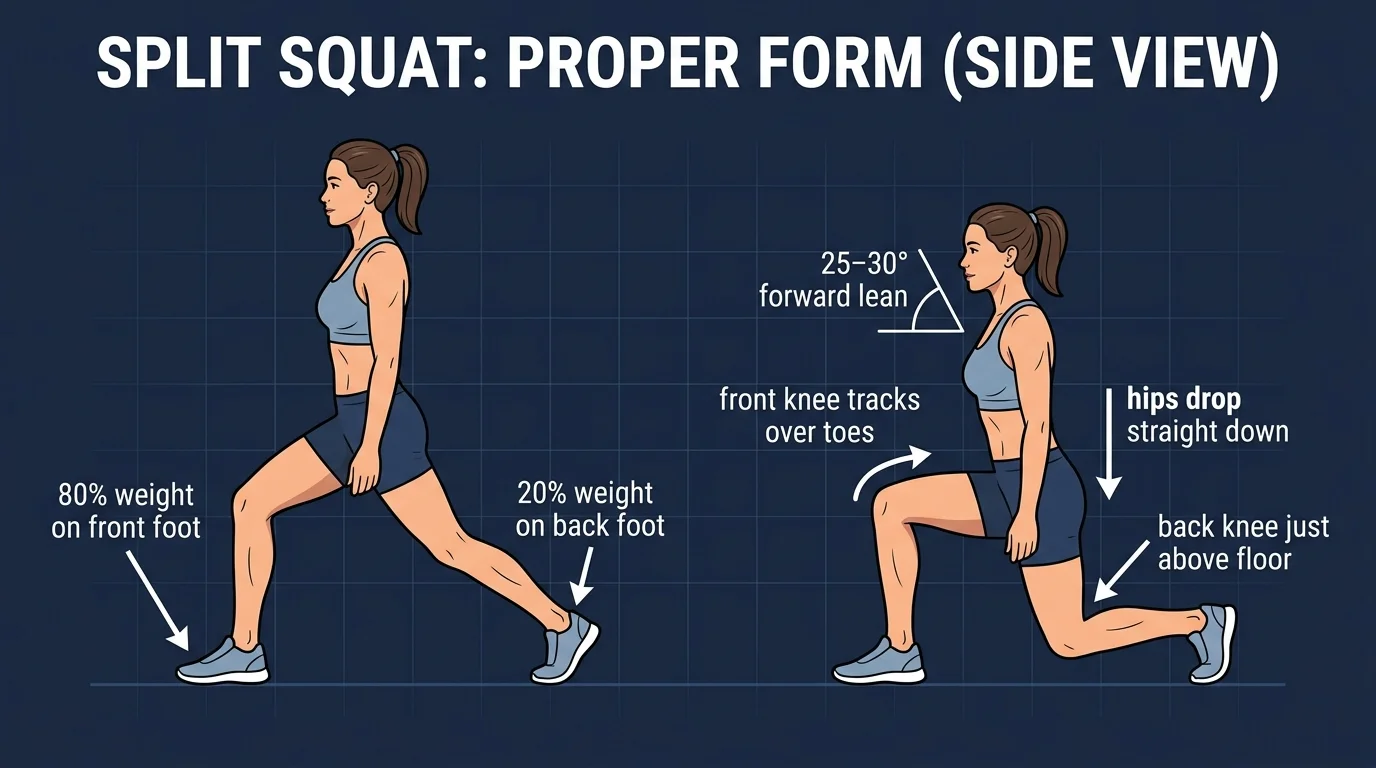
Common Mistakes to Avoid
Small setup errors change the split squat fast. These are the form breakdowns to fix first.
- Pushing off the back foot. If the rear leg is driving the ascent, the front leg loses the training stimulus. Shift more weight forward and think of the back foot as a balance point.
- Standing on a tightrope. Putting both feet in one narrow line turns the exercise into a balance test. Keep hip-width space between the feet so the pelvis has a stable base.
- Letting the front knee cave inward. Knee collapse usually means the hip is losing control. Spread the floor with the front foot, keep the kneecap tracking over the middle toes, and reduce depth until the line is clean.
- Drifting forward instead of dropping down. When the hips travel forward, knee stress goes up and the glutes contribute less. Think elevator: the hips descend vertically, then rise vertically.
- Rushing the bottom position. Bouncing out of the bottom hides weakness and steals tension from the muscles. Use a 2-second descent and a short pause before standing.
- Using a stance that is too long or too short. A short stance can overload the front knee. A very long stance can tug hard on the rear hip flexor and shift the movement away from clean knee-and-hip extension. At the bottom, the front shin should be close to vertical or only slightly angled forward.
Split Squat Variations: Regressions and Progressions
Supported Split Squat (Beginner Regression)
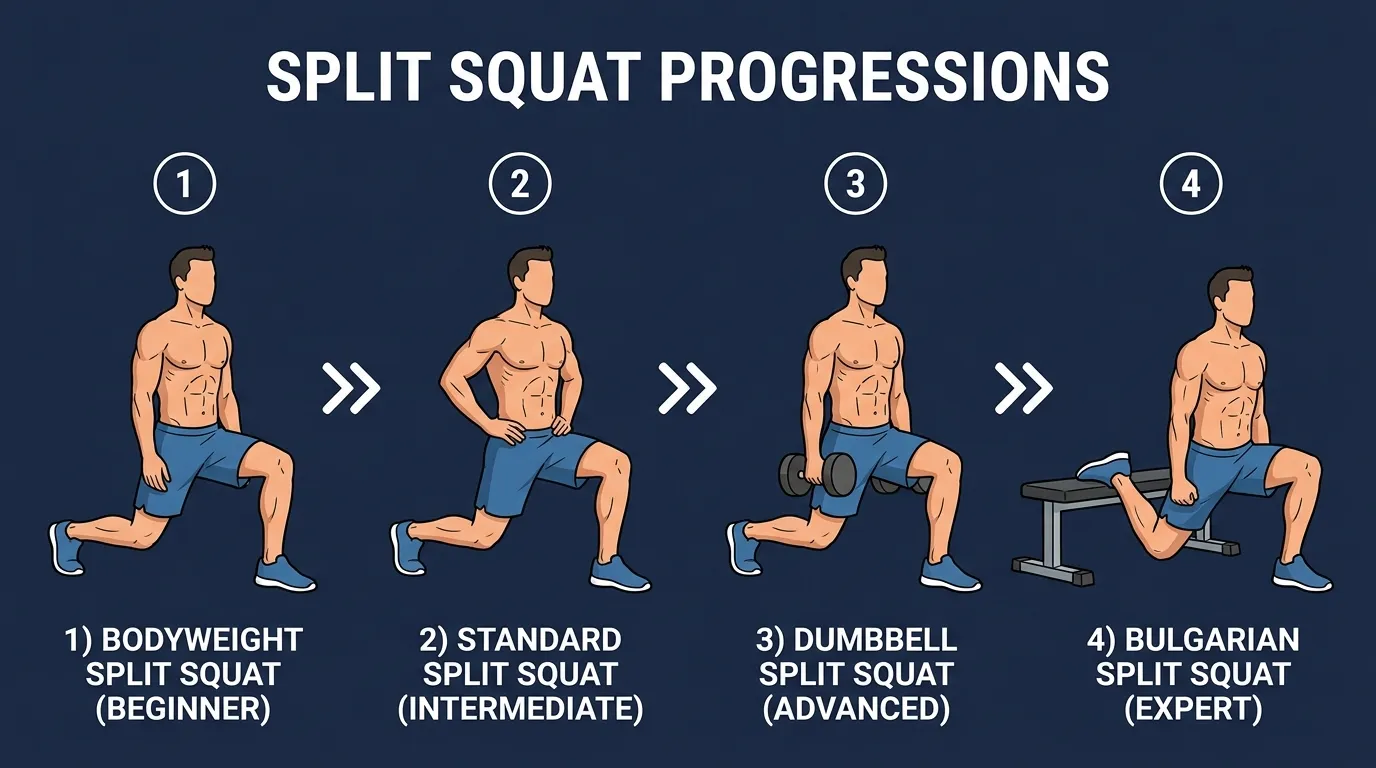
Hold a wall, countertop, or rail lightly with one hand. Keep the same stance and range, but remove enough balance demand that you can control the front knee. This is the best starting point if you wobble or cannot reach depth without twisting.
Bodyweight Split Squat (Standard)
This is the version described above. No equipment, both feet on the floor, front leg doing most of the work. Own 2 to 3 sets of 10 to 12 clean reps per leg before adding load.
Dumbbell Split Squat (Loaded Progression)
Hold a dumbbell in each hand at your sides. Start light, usually 5 to 15 pounds per hand, and keep the same front-foot pressure. The dumbbells should add load without changing your depth, knee line, or torso angle.
Bulgarian Split Squat (Advanced Progression)
Elevate the rear foot on a bench or step. This increases hip range of motion and balance demand, so it hits the front-leg glutes and stabilizers harder. Earn it after the flat split squat feels controlled.
Rear Lunge (Dynamic Alternative)
Step backward into the split stance each rep, then return to standing. Rear lunges use similar muscles with more coordination and rhythm. They are a good bridge between planted split squats and walking or forward lunges.
When to Avoid or Modify Split Squats
Split squats are safe for most healthy adults, but a few conditions call for modification or a different entry point. Always consult your physician or physical therapist before starting any new exercise program, especially if any of the following applies to you:
- Recent knee, hip, ankle, or spine injury or surgery. The unilateral load can expose irritated joints quickly. Use supported squats, shallow range, or glute bridges until you have clearance and pain-free control.
- Patellofemoral or anterior knee pain. Keep the stance slightly longer, reduce depth, slow the descent, and make sure the front knee tracks over the middle toes. If knee pain persists, swap to sumo squats or supported partial squats while you get assessed.
- Balance or vestibular issues. Use a wall, rail, or countertop for support. If that still feels unstable, build lower-body strength with squats and glute bridges before returning.
- Acute lower-back pain or difficulty bracing. Bodyweight split squats create less spinal load than heavy bilateral squats, but the torso still has to stay braced. Rebuild trunk control with deadbugs, bird-dogs, and forearm planks.
- Pregnancy or early postpartum return. Balance, pelvic pressure, and bracing demands change quickly. Use support, reduce depth, avoid heavy dumbbells, and get clinical guidance if you are pregnant, within the first 6 to 8 weeks postpartum, or have active diastasis recti.
- Uncontrolled hypertension or known cardiovascular disease. Heavy dumbbells and breath-holding can spike blood pressure. Use bodyweight or light loads, exhale on the way up, and follow your clinician's exercise guidance.
Related Exercises
- Same movement pattern (squat): Squats, Sumo squats, and Bulgarian split squats train the same knee-and-hip extension pattern with different stance and stability demands.
- Loaded squat progression: Goblet squats teach an upright loaded squat with a dumbbell held at the chest.
- Dynamic unilateral alternative: Rear lunges train the same front-leg muscles while adding a step-back coordination demand.
- Hinge pattern pairing: Romanian deadlift and Single-leg deadlift balance the quad-heavy split squat with more posterior-chain work.
- Glute accessory: Glute bridges train hip extension without the balance demand, useful when split squats feel unstable.
- Core foundation for bracing: Deadbugs, Bird-dogs, and Forearm planks build the trunk control that keeps the pelvis level.
How to Program Split Squats
Programming follows the Ratamess et al., 2009 ACSM Position Stand on Progression Models in Resistance Training. Split squats are unilateral, so count volume per leg and keep enough rest to repeat clean reps on both sides.
| Level | Sets × Reps | Rest between sets | Frequency |
|---|---|---|---|
| Beginner | 2-3 × 6-10 (supported or bodyweight) | 90-120 seconds | 2-3 sessions/week |
| Intermediate | 3-4 × 8-12 (bodyweight or light dumbbells) | 120-180 seconds | 2-4 sessions/week |
| Advanced | 3-5 × 6-10 (dumbbells or Bulgarian progression) | 180-300 seconds | 3-5 sessions/week |
Where in your workout. Put split squats first or second in a lower-body session while balance and coordination are fresh. Pair them with a hinge such as a Romanian deadlift or single-leg deadlift so the session trains both squat and hip-hinge patterns.
Form floor over rep targets. Stop a set when the front knee caves inward, the back foot starts pushing hard, or depth changes from rep to rep. Clean reps build the pattern. Sloppy reps teach your body how to leak force.
FitCraft's AI coach Ty can place split squat variations inside a broader lower-body program based on your assessment, equipment, and consistency. The goal is simple: the right variation, the right volume, and enough recovery for both legs to progress.
Frequently Asked Questions
What muscles do split squats work?
Split squats primarily train the quadriceps and gluteus maximus of the front leg. The hamstrings, adductors, calves, gluteus medius, and trunk stabilizers assist by controlling the hip, knee, ankle, and pelvis through each rep.
How many split squats should a beginner do?
Start with 2 to 3 sets of 6 to 10 controlled reps per leg, 2 or 3 times per week. Use a wall or rail for balance if needed, and stop each set when knee tracking or depth control breaks down.
What is the difference between a split squat and a lunge?
In a split squat, both feet stay planted in the same stance for the whole set. In a lunge, you step into or out of the stance each rep. Split squats remove the stepping piece, so they are usually easier to control and better for focused single-leg strength.
Are split squats good for building glutes?
Yes. Split squats train the gluteus maximus hard because the front hip moves through flexion on the descent and hip extension on the way up. A slightly longer stance and controlled depth usually shift more work toward the glutes while the quadriceps still contribute.
Can I do split squats with knee pain?
Use a shorter pain-free range, hold a wall or rail, slow the descent, and keep the front knee tracking over the middle toes. If pain is sharp, worsening, or present after the session, stop split squats and use easier options like supported squats or glute bridges until a physical therapist clears you.