
Let's start with something most fitness app companies won't tell you: a free fitness app might be all you need.
If you're someone who already exercises regularly, knows proper form, can self-program progressive overload, and just needs a basic timer or rep counter, there are excellent free workout apps that do exactly that. You don't need to spend a dollar.
But here's where it gets interesting. The average 30-day retention rate for health and fitness apps is just 27.2% (Business of Apps, 2026). That means nearly three out of four people who download a fitness app stop using it within a month. And the vast majority of those abandoned apps? They're free ones.
So the real question isn't "is premium worth the money?" It's "is premium worth it for the way I actually use fitness apps?" That's a different question, and a more honest one. Let's dig into what the research says.
What Free Fitness Apps Actually Give You
Free fitness apps have gotten genuinely good. The best ones offer:
- Workout libraries: hundreds or thousands of exercises with video demonstrations
- Basic tracking: log sets, reps, and weight for strength training
- Timer functions: interval timers, rest timers, and workout clocks
- Generic programs: pre-built workout plans (usually one-size-fits-all)
- Community features: some offer forums or social feeds
For a self-directed exerciser, this is genuinely useful. If you know how to structure a program, understand progressive overload, and can hold yourself accountable without external motivation, a free app is a perfectly valid tool.
The limitations of free
Where free apps fall short is in everything beyond content delivery. A library of exercises isn't a program, the same way a dictionary isn't a novel. Knowing what exercises exist and knowing which ones you should do today, in what order, at what intensity, with what progression are fundamentally different things.
A content analysis published in Health Education and Behavior scored 127 iPhone health and fitness apps against an established instrument for the behavior-change theory built into them. Scores were low across the board, from 1 to 28 on a 100-point scale, but higher-priced apps scored significantly higher than cheaper ones (Cowan et al., 2013).
Free apps give you the ingredients. Paid apps give you the recipe and adjust it every day based on how the last meal turned out.
What Paid Apps Add to the Equation
Paid fitness apps vary widely. Some just remove ads and unlock the same generic content. That's not worth paying for. But the best paid apps offer fundamentally different capabilities:
AI-driven personalization
This is the biggest differentiator. A good paid app doesn't just give you workouts. It builds your specific program based on your goals, fitness level, available equipment, schedule, and how your body responds over time. Research suggests AI-driven personalization can increase retention rates by up to 50% compared to generic programming (Business of Apps, 2026).
FitCraft's AI coach Ty, for example, adjusts your workouts in real-time. If you're struggling with a movement, Ty modifies it. If you're progressing faster than expected, Ty increases the challenge. It's the difference between following a YouTube video and having a trainer watching you, except the trainer works 24/7 and costs less than a single training session.

Gamification and accountability systems
This is where the science of gamification in fitness gets compelling. A 2022 systematic review in JMIR mHealth and uHealth analyzed gamified fitness interventions and found that gamification significantly improved physical activity participation compared to non-gamified alternatives (Xu et al., 2022). Importantly, the effects persisted beyond the initial novelty period. This wasn't just people playing with a new toy.
Gamification features like streaks, leveling systems, collectible rewards, and progress visualization work because they tap into the same psychological loops that make games engaging. They create small, frequent wins that build momentum. And momentum is the antidote to the quitting cycle.
Most free apps don't include meaningful gamification. It's expensive to build and maintain, which is exactly why it tends to live behind a paywall.
Progressive overload tracking
Progressive overload, meaning gradually increasing the demands on your body, is the single most important principle in exercise science. Without it, you plateau. With it, you keep getting results.
Free apps let you log your workouts. Paid apps track your progression and tell you when to increase weight, reps, or difficulty. That's the difference between recording what happened and being told what to do next.
The Consistency Question
Here's the part that matters most, and it's the part most "free vs paid" comparisons skip entirely.
The best app is the one you actually use. A free app used five days a week beats a paid app abandoned after two weeks. Obviously. But the data tells a more nuanced story than "just pick whichever you'll stick with."
Subscription-based fitness apps show 30% higher engagement rates than free alternatives (Business of Apps, 2026). Part of this is selection bias: people who pay are more invested. But part of it is design. Paid apps can invest in the features that drive consistency: adaptive difficulty, personalized scheduling, streak systems, and coaching feedback.
A 2015 study in the Journal of Medical Internet Research found that mobile fitness apps increased leisure-time exercise activity, with self-efficacy as a key mediating factor (Litman et al., 2015). In other words, apps that make you feel capable through personalized difficulty, achievable goals, and positive feedback are the ones that keep you moving. And those features require investment to build.
Research from the science behind fitness apps confirms this pattern: the apps that work best aren't the ones with the most content. They're the ones with the best systems for keeping you engaged over time.
Ready to put this into practice?
Take the free FitCraft assessment and get a personalized plan based on behavioral science, not willpower.
Take the Free Assessment Free • 2 minutes • No credit cardWhen Free Is the Right Call
Let's be specific about when you should save your money:
- You're already consistent. If you've been exercising regularly for 6+ months and your biggest challenge is just tracking reps, a free app is fine. You've already solved the hardest problem.
- You're knowledgeable about programming. If you understand periodization, progressive overload, and exercise selection, and you enjoy planning your own workouts, you don't need an AI to do it for you.
- You're exploring. If you're just getting started and want to try different types of exercise before committing to anything, free apps are a great low-risk way to experiment.
- Budget is genuinely tight. Fitness shouldn't be gated by income. A free app plus bodyweight exercises is infinitely better than no exercise because you can't afford a subscription.
None of these scenarios are failures. They're practical decisions made by people who know themselves.
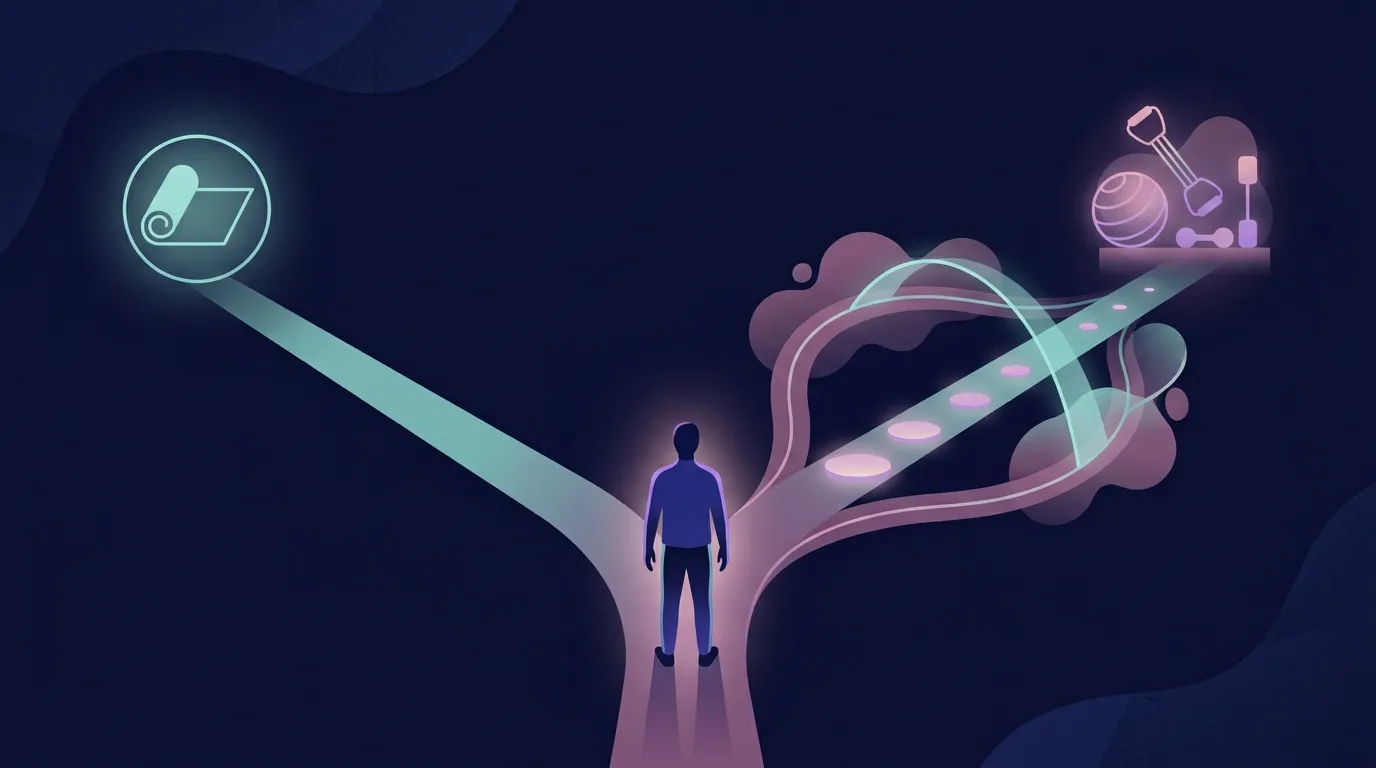
When Paying for Premium Makes Sense
And here's when the investment pays for itself:
- You've tried free apps and quit them. If your phone is a graveyard of abandoned fitness apps, the problem isn't willpower. It's that those apps didn't solve the consistency problem. That's a design problem, not a character flaw.
- You don't know what to do. If you open a workout app and feel overwhelmed by choices, you need a program, not a library. AI-personalized programming removes the decision fatigue that kills motivation.
- You need external accountability. Some people thrive on internal motivation. Many don't. If you're in the second group, features like streak systems, daily challenges, and coaching feedback aren't luxury extras. They're the core product.
- You've hit a plateau. Free apps can't tell you why you stopped making progress. A paid app with progressive overload tracking and adaptive programming can.
As Matt, a FitCraft user, put it: "The real win is I actually want to work out now. That's never happened before." For Matt, the difference wasn't getting access to more exercises. It was getting an app that made consistency feel automatic instead of relying on motivation.
Is the Price Really the Barrier?
Most premium fitness apps cost between $10 and $30 per month. FitCraft has a free version, so you can start without paying anything, with a subscription available for the full experience. For the tier-by-tier numbers on every major app, see our fitness app subscription pricing breakdown.
Here's how that compares to the alternatives:
- Personal trainer: $60-150 per session, 2-3x per week = $480-1,800/month
- Gym membership: $40-60/month plus hidden fees (and 67% of members don't use it)
- Premium fitness app: $5-30/month with no hidden fees, no commute, no scheduling friction
- Free fitness app: $0, genuinely a valid option if it works for you
For personalized, AI-coached sessions with progressive overload and gamification, even a modest subscription price delivers extraordinary value per workout. But only if you use it.
And that's the honest pivot point. An app you use every day is a steal. An app you abandon after two weeks is money wasted. The question isn't what the app costs. It's whether the app is designed to keep you coming back.
What This Means for You
Here's the honest take, stripped of marketing language.
If you're already exercising consistently, you probably don't need to pay for a fitness app. Seriously. Save your money, use a free tracker, and keep doing what's working.
But if you're in the majority, if you've downloaded fitness apps before and stopped using them, if you start workout programs and drift away after a few weeks, if you know what to do but can't seem to keep doing it, then the question changes. You're not paying for workouts. You're paying for a system that solves the consistency problem. And if that system works, the cost is trivial compared to the value of actually being fit.
Programs designed by Domenic Angelino, an Ivy League-trained, NSCA-certified exercise scientist whose work has been featured in TIME, Newsweek, Forbes, and Women's Health, are built into an app with a 3D AI coach named Ty who adapts to you in real-time. If that's the thing that finally makes exercise stick, FitCraft's subscription is the best money you'll spend.
But don't take our word for it. FitCraft has a free version. Try it. If it works for you, keep going. If free is enough, that's a win too.
Frequently Asked Questions
Are free fitness apps as effective as paid ones?
Free fitness apps can be effective for self-motivated people who already know what they're doing. Research shows that paid and free apps include similar numbers of behavior change techniques on average. However, paid apps are more likely to offer AI-driven personalization, adaptive programming, and accountability features like gamification, which studies show can increase retention by up to 50%. If you struggle with consistency, the personalization and engagement features in paid apps often make the difference.
What do you get with a paid fitness app that you don't get for free?
Paid fitness apps typically offer AI-personalized workout programming, progressive overload tracking, adaptive difficulty, gamification systems (streaks, rewards, leveling), and coaching feedback. Free apps usually provide generic workout libraries and basic tracking. The biggest difference is personalization: a paid app adjusts to your fitness level, goals, schedule, and available equipment, while a free app gives everyone the same workouts.
How much do fitness app subscriptions cost?
Most fitness app subscriptions range from $10 to $30 per month, with annual plans offering significant discounts. Many apps, including FitCraft, offer robust free versions so you can try before committing. Compared to a personal trainer at $60-150 per session, even premium fitness apps are a fraction of the cost.
Is it worth paying for a fitness app if I keep quitting?
If you keep quitting free apps, paying for the right app might actually save you money in the long run. A 2022 JMIR systematic review found that gamified fitness interventions significantly improved exercise adherence compared to non-gamified alternatives. The key is choosing a paid app that specifically addresses consistency through features like AI coaching, gamification, and adaptive programming, rather than just offering more workouts.
Does FitCraft have a free version?
Yes. FitCraft offers a free version that includes access to Ty, the 3D AI coach, along with personalized workout recommendations and basic gamification features. A subscription unlocks the full gamification system, advanced AI personalization, and additional coaching features. You can start with the free version and upgrade if you want the full experience.