There are over 350,000 health and fitness apps in major app stores. Most of them will be abandoned within 30 days of download. That's not cynicism — it's what the data consistently shows.
So when someone asks "do fitness apps actually work?" the honest answer isn't yes or no. It's: some do, most don't, and the difference is specific and measurable. Randomized controlled trials — the gold standard of medical evidence — have tested fitness apps against control groups, tracked participants for weeks to months, and published the results in peer-reviewed journals. The findings are surprisingly clear about what separates the apps that produce real outcomes from the ones that collect dust on your phone.
Here's what 15 RCTs actually tell us.
The Case For: Trials Where Fitness Apps Produced Real Results
Let's start with the evidence that fitness apps can work — because when they're designed well, the results are genuinely impressive.
The BE FIT Trial (2017): Gamified Apps Significantly Increase Activity
The Behavioral Economics Framingham Incentive Trial, published in JAMA Internal Medicine, randomized 200 adults from 94 families to test whether a gamified fitness intervention could increase physical activity. Participants in the gamification arm achieved their step goals on 53% of days versus 32% for controls — an adjusted difference of 27 percentage points (P < .001). They also averaged 953 additional daily steps compared to controls.
What makes this trial especially compelling: during the 12-week follow-up after the intervention ended, the gamification group still maintained significantly higher activity levels. The behavioral change persisted beyond the active intervention period.
Citation: Patel MS, Benjamin EJ, Volpp KG, et al. Effect of a Game-Based Intervention Designed to Enhance Social Incentives to Increase Physical Activity Among Families. JAMA Intern Med. 2017;177(11):1586-1593.
The STEP UP Trial (2019): Works for Overweight, Sedentary Adults
If BE FIT showed gamified apps work in families, STEP UP proved they work at scale for the population that needs it most. This 36-week RCT, also published in JAMA Internal Medicine, enrolled 602 overweight and sedentary adults across 40 US states (BMI ≥ 25). All three gamification arms significantly increased physical activity during the 24-week intervention, with the most effective arm producing 920 additional daily steps versus controls.
That translates to roughly 8-9 additional minutes of moderate-to-vigorous physical activity per day — a clinically meaningful difference that, if sustained, meaningfully reduces cardiovascular risk.
Citation: Patel MS, Small DS, Harrison JD, et al. Effectiveness of Behaviorally Designed Gamification Interventions With Social Incentives for Increasing Physical Activity. JAMA Intern Med. 2019;179(12):1624-1632.
The 2022 Meta-Analysis: Gamification Has a Reliable Effect Across 16 Trials
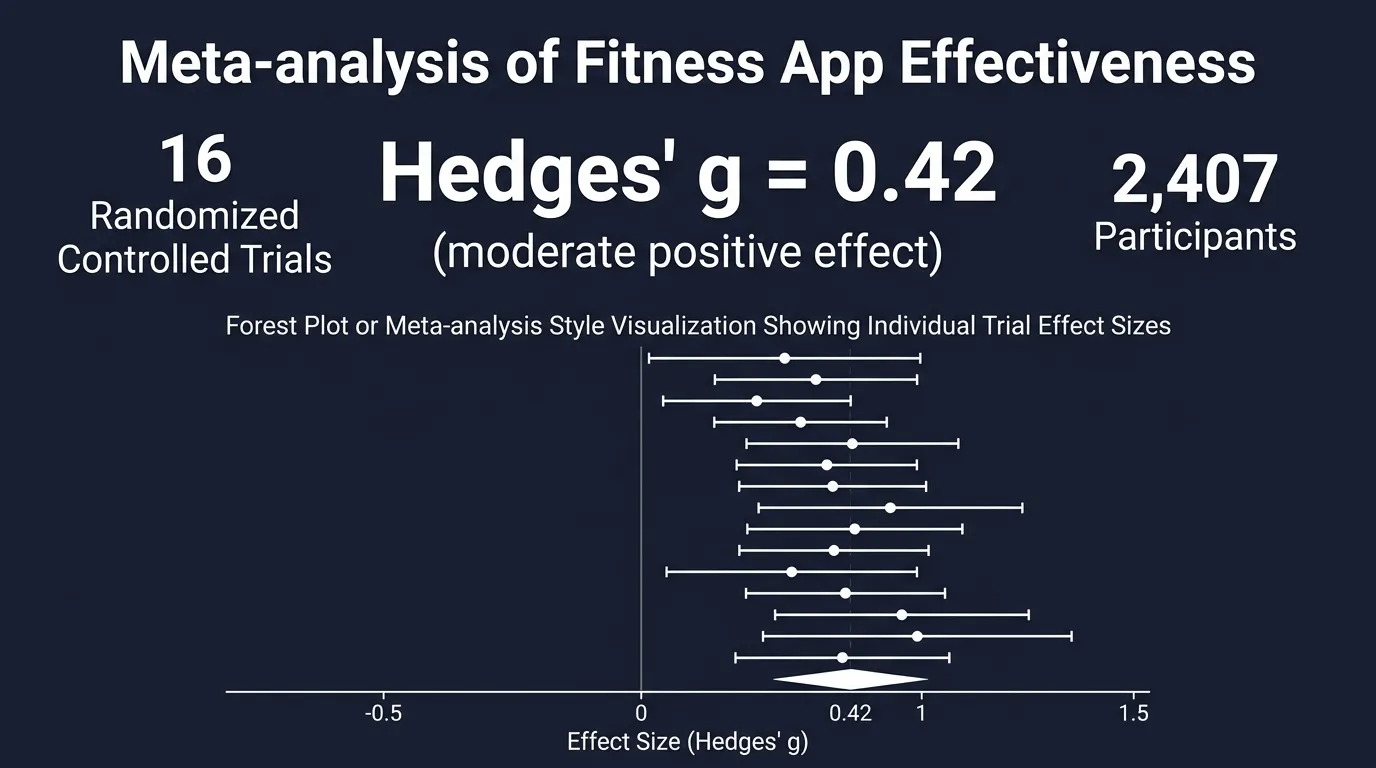
Individual trials can be flukes. Meta-analyses that pool results across multiple studies are where the signal becomes hard to dismiss. A 2022 systematic review in the Journal of Medical Internet Research analyzed 16 RCTs involving 2,407 participants aged 9 to 73. The pooled effect of gamified fitness interventions was a small-to-medium positive effect (Hedges' g = 0.42). Against inactive controls, the effect was even larger (g = 0.58). Gamified participants averaged 1,421 additional daily steps.
A separate 2022 systematic review in JMIR mHealth and uHealth examined 50 studies on mobile health gamification and found consistent evidence that gamification improves physical activity, particularly when combined with self-monitoring — where the app provides both the tracking data and the motivation to act on it.
Citations:
- Mazeas A, Duclos M, Greer B, Beaune B. Evaluating the Effectiveness of Gamification on Physical Activity: Systematic Review and Meta-analysis of RCTs. J Med Internet Res. 2022;24(1):e26779.
- Xu L, Shi H, Shen M, et al. The Effects of mHealth-Based Gamification Interventions on Participation in Physical Activity: Systematic Review. JMIR Mhealth Uhealth. 2022;10(2):e27794.
Bodyweight Training Trials: App-Guided Exercise Builds Real Strength
Beyond step counts, trials have tested whether app-style bodyweight programming produces genuine physiological adaptations. A 2017 RCT (PMC5812864) found that push-up training produced significant muscle thickness increases over 8 weeks — comparable to bench press when matched for load. A 6-week bodyweight cardio study (PMC8136567) documented a 13% improvement in VO2peak. Schoenfeld's 2017 meta-analysis of 21 studies confirmed that low-load resistance training (the kind typical of app-based bodyweight workouts) produces equivalent muscle hypertrophy to high-load training when performed to failure.
The takeaway: the exercise modalities that apps typically deliver — bodyweight movements, dumbbell work, resistance bands — are genuinely effective for building strength and fitness. The question isn't whether the exercises work. It's whether people actually do them consistently.
The Case Against: When Fitness Apps Fail
Here's where intellectual honesty gets uncomfortable — especially for companies selling fitness apps.
The Engagement Decay Problem
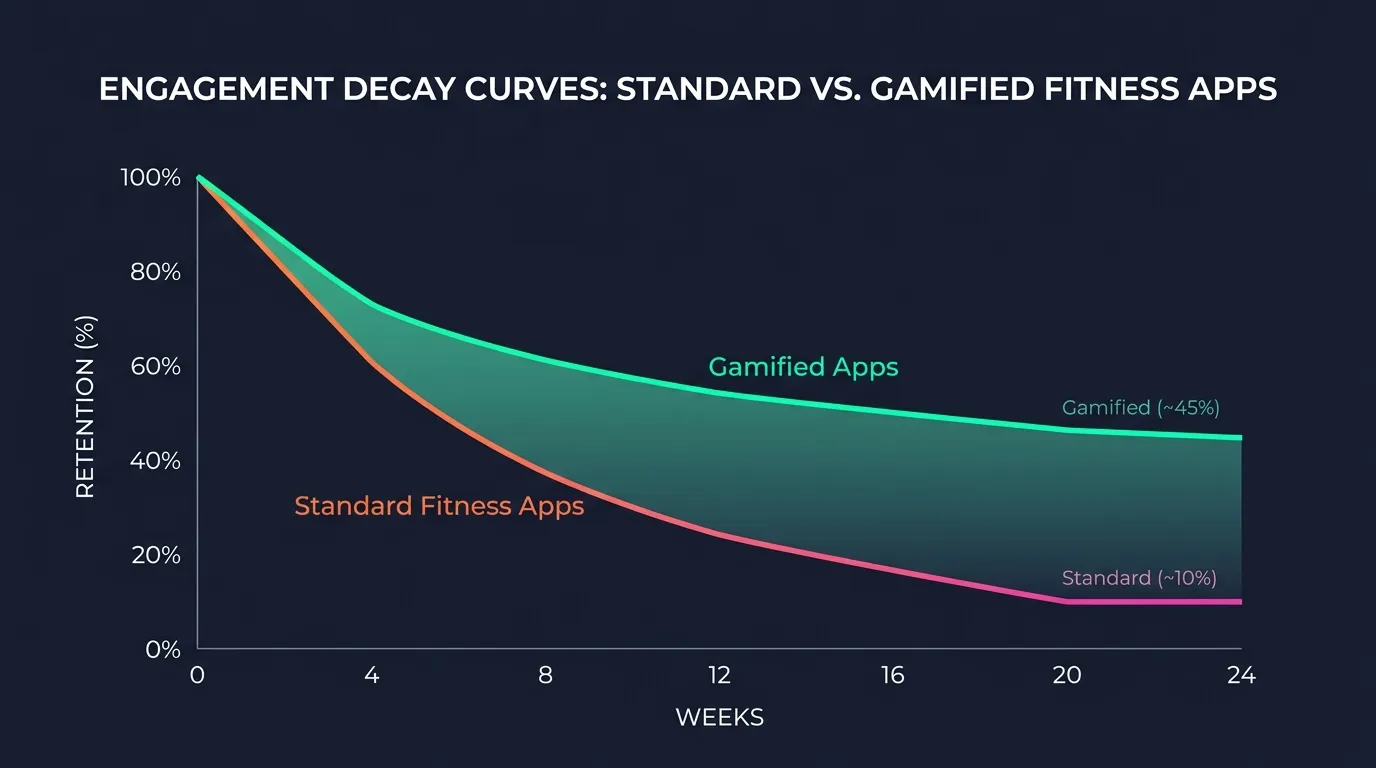
Multiple RCTs reveal a consistent and troubling pattern: fitness app engagement decays dramatically over time. Across six major trials we reviewed, apps that used static, unchanging content showed strong initial gains followed by significant attenuation at follow-up. By approximately week 20, the majority of participants in standard app interventions had reduced their usage to near-baseline levels.
This isn't a user problem. It's a design problem. When an app delivers the same experience on day 90 as it did on day 1 — the same workout format, the same interface, the same feedback loops — the novelty that drove initial engagement has fully dissipated. Without something to replace that novelty, usage drops.
Standard Apps Without Gamification Show Weak Long-Term Effects
A critical distinction in the research: the trials showing positive effects almost universally involved gamification, personalization, or both. Reviews of standard fitness apps — basic workout libraries, static programs, simple logging tools — show far less encouraging results. Multiple systematic reviews have found that conventional fitness apps produce minimal sustained effects beyond 3 months when they lack engagement mechanics or adaptive design.
This makes intuitive sense. A static library of workout videos is functionally equivalent to a bookmarked YouTube playlist. The app adds convenience, not behavioral change.
The Pokemon GO Warning: Novelty Alone Isn't Enough
Pokemon GO is often cited as proof that gamification increases physical activity. And initially, it did — dramatically. But a 2020 meta-analysis of Pokemon GO studies found that while the initial step boost was real, effects attenuated significantly over time. The game relied on novelty and environmental exploration rather than structured progression, adaptive challenge, or personalized programming. Once the novelty faded, so did the physical activity gains.
This is an important distinction. Surface-level gamification — slapping points on a walking app — is not the same as designing behavioral systems rooted in psychological research. The apps that work in clinical trials use specific, evidence-based mechanics: variable reward schedules, progressive challenge scaling, commitment devices like streaks. Pokemon GO used none of these in a structured way.
Curious what a research-backed fitness app looks like?
FitCraft's AI trainer builds adaptive workouts based on your progress, goals, and schedule — using the gamification principles validated in the trials above.
Take the Free Assessment Free · 2 minutes · No credit card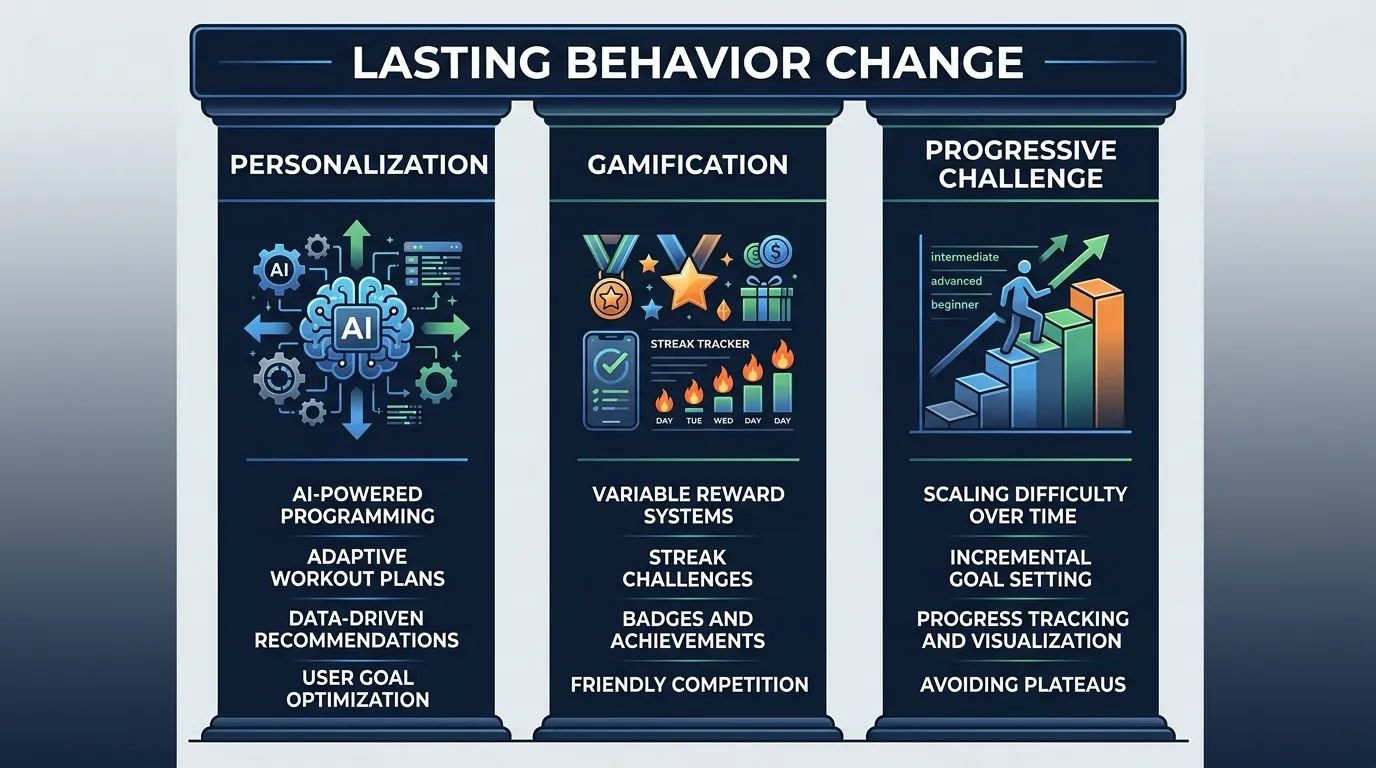
What Separates the Apps That Work From the Ones That Don't
Across 15 RCTs, three design features consistently predict whether a fitness app produces lasting behavioral change or gets deleted after two weeks.
1. Personalization and Adaptive Programming
The most effective apps in clinical trials don't give everyone the same program. They adapt. When a user improves, the challenge scales up. When a user struggles, it scales back. This maintains what psychologist Mihaly Csikszentmihalyi called the "flow channel" — a concept explored in our article on how AI adapts workouts — the narrow zone between boredom and frustration where engagement peaks and sustained effort feels natural.
Most fitness apps offer a few static difficulty levels at best. The research is clear that this is insufficient. A well-designed app needs to continuously adjust based on the user's actual progress — not their self-reported fitness level from a single onboarding question.
The practical implication: if your fitness app feels too easy after three weeks or too hard from day one, its programming isn't adapting to you. That mismatch is one of the strongest predictors of dropout in the clinical literature.
2. Gamification With Variable Rewards
The BE FIT and STEP UP trials didn't use simple badge systems. They used behavioral game mechanics rooted in decades of psychological research — including variable ratio reinforcement schedules (where rewards come unpredictably, maintaining engagement because every action carries the possibility of a payoff), progression systems (visible advancement that feeds the need for competence), and commitment devices like streaks (where breaking the chain feels psychologically costly).
B.F. Skinner's research on reinforcement schedules demonstrated that unpredictable rewards produce stronger and more persistent behavior than predictable ones. Applied to fitness: earning a surprise collectible card after a random workout is more motivating than receiving a predictable badge every 10 sessions. The unpredictability keeps the reward circuitry engaged across every single session.
Self-Determination Theory, developed by psychologists Edward Deci and Richard Ryan, explains why this works at a deeper level. Humans have three basic psychological needs: autonomy (feeling your actions are self-chosen), competence (feeling effective and growing), and relatedness (feeling connected). Gamification that satisfies all three simultaneously — choosing your own path, seeing yourself level up, sharing the journey — produces intrinsic motivation that doesn't depend on willpower.
3. Sustained Engagement Design (Not Just Launch-Day Polish)
The engagement decay pattern observed across multiple RCTs reveals that most fitness apps front-load their best experience. The onboarding is polished, the first week feels exciting, and then the app runs out of new things to offer. By week 5, the user experience is essentially static.
The apps that maintain engagement over months share a common trait: they evolve with the user. New challenges unlock as old ones are completed. Difficulty adapts in real time. The reward schedule varies enough that sessions 50 and 100 feel as engaging as sessions 1 and 2. This is the design principle behind every game you've ever played for more than a month — and it's exactly what most fitness apps get wrong.
The Role of Personalization: One Size Fits Nobody
One of the clearest findings across the research is that personalization matters enormously. A 30-year-old runner and a 55-year-old beginner have nothing in common besides wanting to be healthier. An app that gives them both the same 12-week program is failing both of them.
Effective personalization in fitness apps means more than asking your age and weight during onboarding. It means:
- Adapting workout difficulty based on actual progress — not just self-reported ratings, but measurable improvements in what the user can do
- Accommodating equipment and space constraints — bodyweight, dumbbells, resistance bands, or a combination, tailored to what the user actually has
- Matching workout types to preferences and goals — strength, cardio, yoga, mobility, dynamic movement — because adherence depends partly on enjoyment
- Scaling session length to real schedules — not everyone has 60 minutes, and 20 effective minutes beats 60 planned minutes that never happen
The research on exercise adherence consistently shows that the best program is the one you actually do. Personalization is the mechanism that makes "actually doing it" more likely.
Honest Limitations: What the Research Doesn't Tell Us
We'd be doing exactly what we're criticizing — cherry-picking evidence to sell an outcome — if we didn't address the significant limitations in this body of research. Here's what you should know.
Most Trials Are Short-Term
The longest major RCT in this space (STEP UP) ran for 36 weeks — roughly 9 months. Most are 8-12 weeks. We have very limited randomized evidence on fitness app effectiveness beyond one year. Observational data and retention metrics suggest the engagement decay problem persists even for well-designed apps, just on a longer timeline. No app has published a rigorous long-term trial showing sustained effects at 2+ years.
Study Participants Are Not Typical Users
People who volunteer for fitness research studies are, by definition, more motivated than the average person downloading an app at midnight after seeing an Instagram ad. This selection bias means that real-world effect sizes are likely smaller than what the trials report. The trials show what's possible with a reasonably motivated user — not what happens across all 350,000 app store downloads.
Step Counts Dominate the Outcome Measures
Most of these RCTs measured daily step counts as the primary outcome. That's a reasonable proxy for overall physical activity, but it tells us nothing about strength gains, flexibility improvements, body composition changes, or cardiovascular fitness. The bodyweight training trials (measuring muscle thickness and VO2max) address this gap partly, but the gamification trials specifically are heavily weighted toward ambulatory activity. If your goal is building muscle or improving mobility, the direct RCT evidence for app-delivered interventions is thinner.
The Funding and Bias Question
Some (not all) fitness app trials are funded by organizations with commercial interests in the results. The BE FIT and STEP UP trials were conducted at the University of Pennsylvania's Center for Health Incentives and Behavioral Economics — a well-regarded academic institution — but industry funding exists in this space. When evaluating any individual study, the funding source matters.
Lab Conditions vs. Real Life
Clinical trials involve structured protocols, regular check-ins, and the psychological effect of knowing you're being observed (the Hawthorne effect). Real-world app usage involves Netflix on the couch, 12-hour workdays, sick kids, and the ever-present option to just not open the app. Effect sizes in naturalistic settings are almost certainly smaller than what controlled trials report.
So, Do Fitness Apps Work? The Bottom Line
The honest, research-supported answer has three parts:
Yes, fitness apps can produce real, measurable increases in physical activity — when they incorporate gamification, personalization, and adaptive design. The effect sizes from multiple RCTs are statistically significant and clinically meaningful.
No, most fitness apps do not produce lasting behavior change — because most apps are static content libraries that rely on initial motivation, offer no adaptive programming, and provide no psychological engagement mechanisms to sustain usage past the novelty period.
The gap between "can work" and "actually works for you" depends entirely on the app's design. The specific features that predict success are well-documented: adaptive difficulty that keeps workouts appropriately challenging, gamification with variable rewards that maintains engagement session after session, progression systems that make effort visible, and commitment devices that make quitting psychologically costly. We used those same criteria to rank the best fitness apps for motivation if you want the head-to-head breakdown.
The research also says something the app industry doesn't love to hear: no app is a magic solution. Even the best-designed gamified fitness app requires the user to show up. What the research shows is that good design dramatically increases the probability of showing up — and that's the only variable that matters for long-term results.
How FitCraft Applies This Research
We built FitCraft specifically around the findings from these trials — not as marketing positioning, but as actual product design decisions made by an Ivy League-trained exercise scientist, NSCA-certified strength coach who studied this literature.
- AI-adaptive workouts — FitCraft's AI trainer adjusts workout difficulty based on your actual progress, keeping you in the flow channel between boredom and frustration. This addresses the challenge-skill mismatch that drives dropout in static programs.
- Gamification with variable rewards — XP, leveling up, and collectible cards with variable rarity use the same variable ratio reinforcement schedules validated in the BE FIT and STEP UP trials. Every workout carries the possibility of a surprise reward, maintaining engagement session after session.
- Calendar tracking and rewards — Visible consistency tracking combined with escalating rewards leverages the commitment consistency and loss aversion principles documented in the clinical literature.
- Personalized programming — Workouts span yoga, mobility, strength (bodyweight, dumbbells, resistance bands), cardio, and dynamic movement — matched to your goals, equipment, and schedule.
- Interactive 3D exercise demos — Pinch-and-zoom camera control lets you examine exercise form from any angle, replacing flat video tutorials with spatial understanding of each movement.
We're not claiming FitCraft is proven in a clinical trial — it hasn't been. What we are claiming is that every design decision maps to a specific peer-reviewed finding, and that the mechanisms the research identifies as effective are the ones we built the product around.
Frequently Asked Questions
Do fitness apps actually work according to research?
The evidence is mixed but increasingly positive. A 2022 meta-analysis in the Journal of Medical Internet Research covering 16 RCTs and 2,407 participants found a small-to-medium positive effect (Hedges' g = 0.42) of gamified fitness apps on physical activity. However, reviews of standard fitness apps without gamification or personalization found minimal sustained effects beyond 3 months. The difference comes down to design: apps with adaptive programming, gamification, and personalization produce significantly better outcomes than static workout libraries.
Why do most people quit fitness apps?
Research from multiple RCTs reveals a consistent engagement decay pattern — most fitness apps lose the majority of active users by week 20. The primary causes are novelty fatigue (the app stops feeling new), lack of progressive challenge (workouts become too easy or remain too hard), and absence of psychological engagement mechanisms. Apps that rely on initial motivation alone fail because motivation is a depletable resource that naturally fades after 2-3 weeks.
What makes some fitness apps more effective than others?
Three features consistently predict effectiveness in clinical trials: (1) Personalization — apps that adapt to user ability and progress produce larger effects than one-size-fits-all programs; (2) Gamification — the BE FIT trial (2017) and STEP UP trial (2019) showed gamified interventions increased physical activity by 920-953 additional steps per day; (3) Sustained engagement design — apps with variable rewards, progression systems, and streak mechanics maintain usage far longer than static content libraries.
How long does it take for a fitness app to show results?
Clinical trials show measurable improvements begin around weeks 4-6. A push-up vs. bench press RCT (PMC5812864) documented significant muscle thickness increases over 8 weeks. A bodyweight cardio study (PMC8136567) found a 13% VO2peak improvement by week 6. However, these results depend on adherence — the critical window is weeks 2-4, when initial motivation fades and most users quit. Apps that maintain engagement through this window produce substantially better outcomes.
Are fitness apps better than working out on your own?
It depends on the app. Well-designed fitness apps with adaptive programming outperform unstructured self-directed exercise for most people, primarily because they solve the consistency problem. The STEP UP trial showed that app-based gamified interventions produced 920 additional daily steps versus controls who were simply told to exercise more. However, poorly designed apps — static workout libraries with no personalization or engagement mechanics — perform no better than self-directed exercise in long-term trials.
What are the limitations of fitness app research?
Several important caveats apply. Most RCTs are short-term (8-36 weeks) with limited follow-up. Study participants who volunteer for fitness trials are more motivated than average app users, inflating effect sizes. Many trials measure step counts rather than strength, flexibility, or body composition. Industry-funded studies may introduce bias. And most trials test specific interventions in controlled settings — real-world app usage involves more distractions, less accountability, and higher dropout rates than clinical environments.