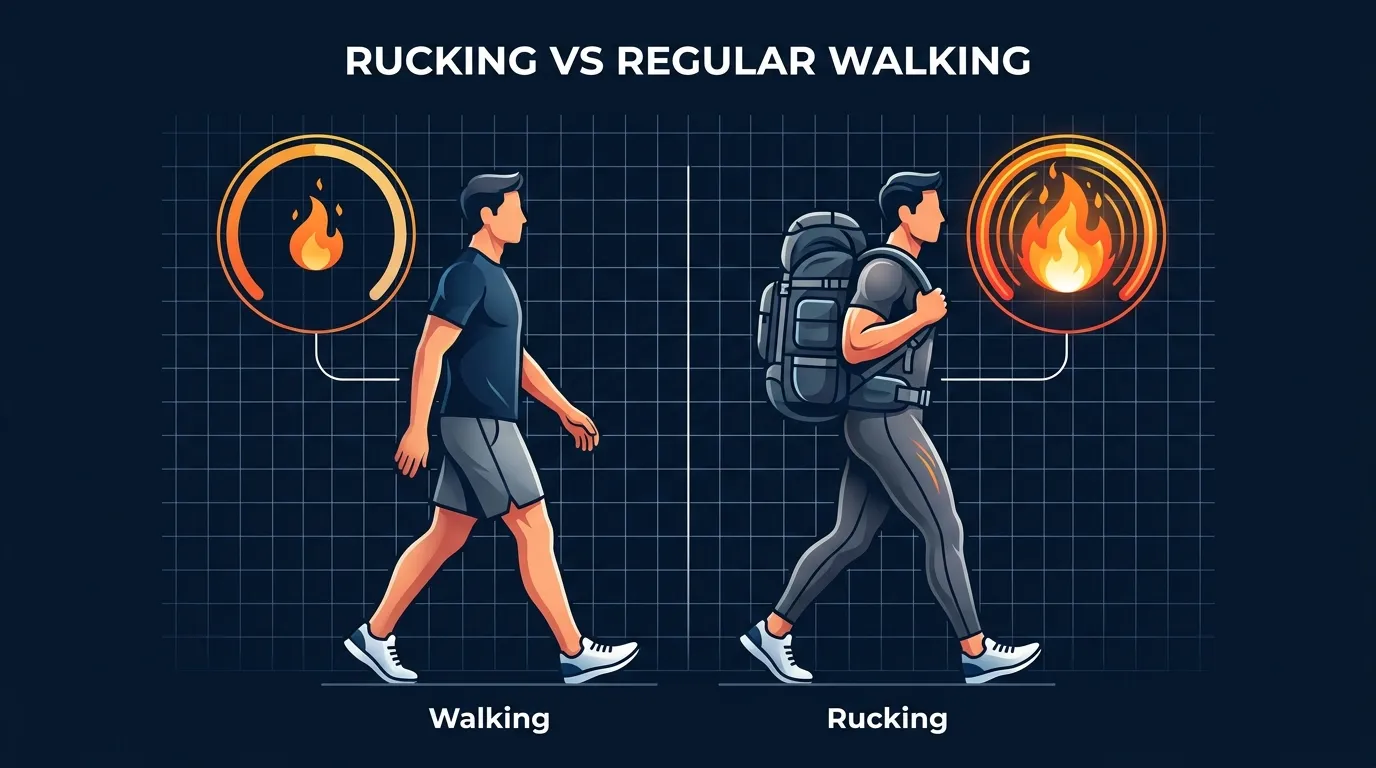
- Rucking is walking with a weighted backpack. It raises the metabolic cost of walking 30 to 100 percent depending on load size and pace.
- Start at 5 to 10 percent of body weight for 20 to 30 minutes, three times a week. Add weight in small jumps every two to three weeks.
- The joint impact is far lower than running. One foot stays on the ground the whole time, so peak ground reaction forces stay near 1 body weight.
- You do not need special gear for the first month. A school backpack, a hip belt, books wrapped in a towel, and shoes with grip will get you started.
Rucking went from a niche military drill to one of the fastest growing fitness searches of 2026. Walk with a weighted backpack. That is the whole concept. And yet most beginner content online tells you to grab a 30 pound plate and head out the door, which is the fastest way to torch your knees and quit by week two.
The actual research on load carriage is decades old. The U.S. Army has studied how weighted walking affects cardiovascular demand, bone, joint stress, and energy cost since the 1960s, and a fresh wave of studies in the last five years has clarified exactly how much load is useful and how much is just punishing. The headline is encouraging. Modest loads, walked steadily, deliver real cardiovascular and musculoskeletal benefits with a fraction of the joint impact of running.
This guide covers what rucking is, what peer-reviewed research actually shows about it, how to pick your starting weight, the gear you do and do not need, a 4-week beginner plan, and the mistakes that send most new ruckers limping home.
What Is Rucking, Exactly?
Rucking comes from the military term "ruck march," a long walk under load that has been part of basic training in most armies for over a century. In civilian fitness, the definition is looser. It just means walking with a weighted backpack, usually somewhere between 10 and 35 pounds, at a brisk pace for 20 to 60 minutes.
The appeal is that it stacks two types of training into one block of time. Your cardiovascular system gets a steady aerobic stimulus. Your legs, hips, and core get a low-grade resistance stimulus from carrying load. And because both feet never leave the ground at the same time, peak impact forces stay close to one body weight per step, instead of the 2 to 3 body weights typical of running.
Where the Idea Came From
Modern civilian rucking traces back to GORUCK, a U.S. company that started selling military-style rucksacks around 2010 and built community events around long group rucks. The format spread through veterans' fitness communities, then into the mainstream as a low-impact alternative to running. By 2024 and into 2026, weighted-vest content on TikTok and Instagram pushed it into the wider wellness space.
How It Differs from Regular Walking
The single big difference is load. Add 20 pounds to your back and the same 3 mph walk becomes a meaningfully harder cardiovascular event. The U.S. Army Research Institute has built and validated equations for predicting exactly how much harder. A 2024 study by Looney et al. in Medicine and Science in Sports and Exercise tested 20 healthy adults walking with vest loads from 0 to 66 percent of body mass at multiple speeds. Metabolic rate climbed steeply with load, and the increase was reasonably predictable from body mass and walking speed.
Practically, that means a brisk 30 minute walk with 20 pounds is closer to a slow jog in cardiovascular cost. Without the pounding.
What the Research Actually Shows
Most online claims about rucking come from product marketing or anecdote. The published research is more modest in its claims and more useful for setting expectations.
Cardiovascular Demand Goes Up Significantly
The clearest, best-replicated finding is that adding load raises oxygen consumption and heart rate during walking. Knapik and colleagues' 2004 review in Military Medicine summarized decades of load-carriage research and found that the energy cost of walking with a pack rises steadily with the weight carried, as well as with body mass, walking speed and slope. Heavier loads scale further.
That translates into a real fitness stimulus for most beginners. If your usual walk barely raises your breathing, adding a pack pushes the session into the zone where cardiovascular adaptation actually happens.
Lower-Body Strength and Bone Effects Are Smaller Than the Hype
Strength benefits exist, but they are easy to overstate. Carrying load makes the quadriceps, glutes, calves, and spinal erectors work harder per step, and across hundreds of steps that adds up. Long-term, ruckers in the military tend to develop strong calves and posterior chains. For civilians rucking 2 to 4 times a week, expect modest strength gains in the lower body and core, not the kind of hypertrophy you would get from progressive resistance training.
Bone density claims need a closer look. A 2018 pilot trial suggested weighted vests during weight loss might preserve hip bone density in older adults. But the larger 12-month INVEST in Bone Health randomized trial by Beavers et al. in JAMA Network Open (2025) found that neither weighted-vest use nor supervised resistance training mitigated weight-loss-associated bone loss at the hip. All three groups lost trabecular bone density, and the vest arm was statistically noninferior to the resistance-training arm. So the "rucking saves your bones" pitch is overstated. Weight-bearing activity in general is good for bone. Adding a pack does not appear to add a meaningful bone-density benefit on top of that.
Calorie Burn Is the Most Honest Selling Point
This is where rucking quietly wins. The energy cost of walking goes up almost linearly with load. A 2022 study from the U.S. Army Research Institute by Looney et al. validated a heavy-load metabolic equation and found that backpacks loaded up to 66 percent of body mass produced predictable, large increases in oxygen demand. For a typical recreational ruck (15 to 25 pounds for a 30 to 45 minute walk), expect to burn 1.5 to 2 times the calories of an unweighted walk at the same pace.
So if a flat 45 minute walk burns about 200 calories, the same walk with 20 pounds is closer to 300 to 350. Not magic. But meaningful, especially for people who hate running and find regular walking too easy.
How to Start Rucking This Week
Most beginner injuries come from one mistake: starting too heavy. Your cardiovascular system adapts faster than your tendons, ligaments, and feet. Start light, even if you feel like you could carry more.
Pick Your Starting Weight
Use 5 to 10 percent of your body weight for the first two weeks. Some examples:
- 140 pound adult: start with 7 to 14 pounds
- 180 pound adult: start with 9 to 18 pounds
- 220 pound adult: start with 11 to 22 pounds
If you have not been walking regularly, lean toward the lower end. If you are an experienced walker or hiker, lean toward the upper end. The Harvard Medical School physical-activity guidance on weighted vests suggests starting around 5 percent of body weight and progressing only as walking distance and time improve. That is conservative, and it is also exactly what keeps you healthy past month two.
Choose a Backpack You Already Own
Skip the gear shopping for now. Use what you have:
- Any school or hiking backpack with padded shoulder straps and ideally a hip belt
- Two or three thick books wrapped in a towel, or a sandbag, or 2 to 4 filled water bottles for weight
- Shoes with grip and arch support, the same kind you would wear for a long walk
- A timer on your phone
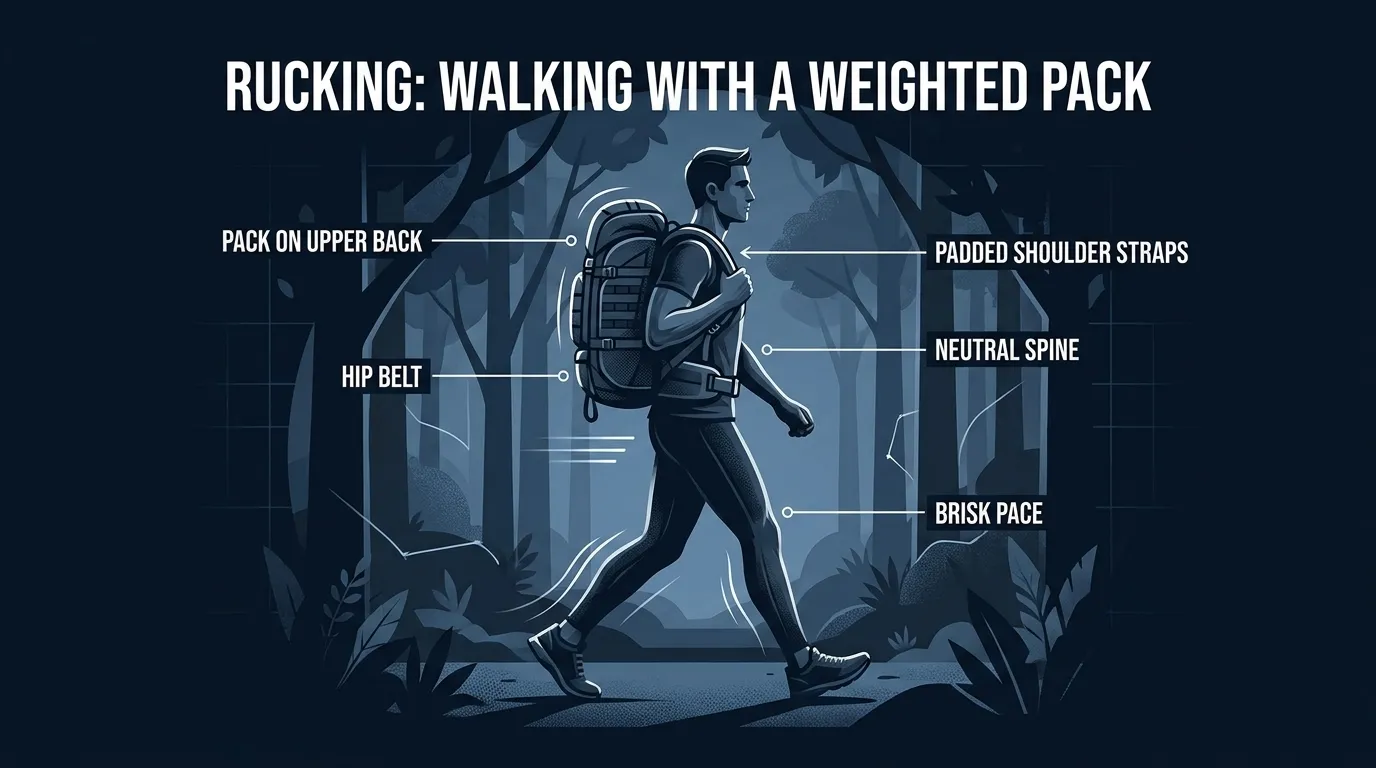
Position the load high on your back, against your spine, not sagging at your tailbone. Research on backpack biomechanics by Liew et al. (2016) shows that load carriage during walking increases trunk flexion and ground reaction forces, and that load placement closer to the body's center of mass reduces those effects. Pull the straps tight enough that the pack does not bounce on each step.
Your First Two Weeks
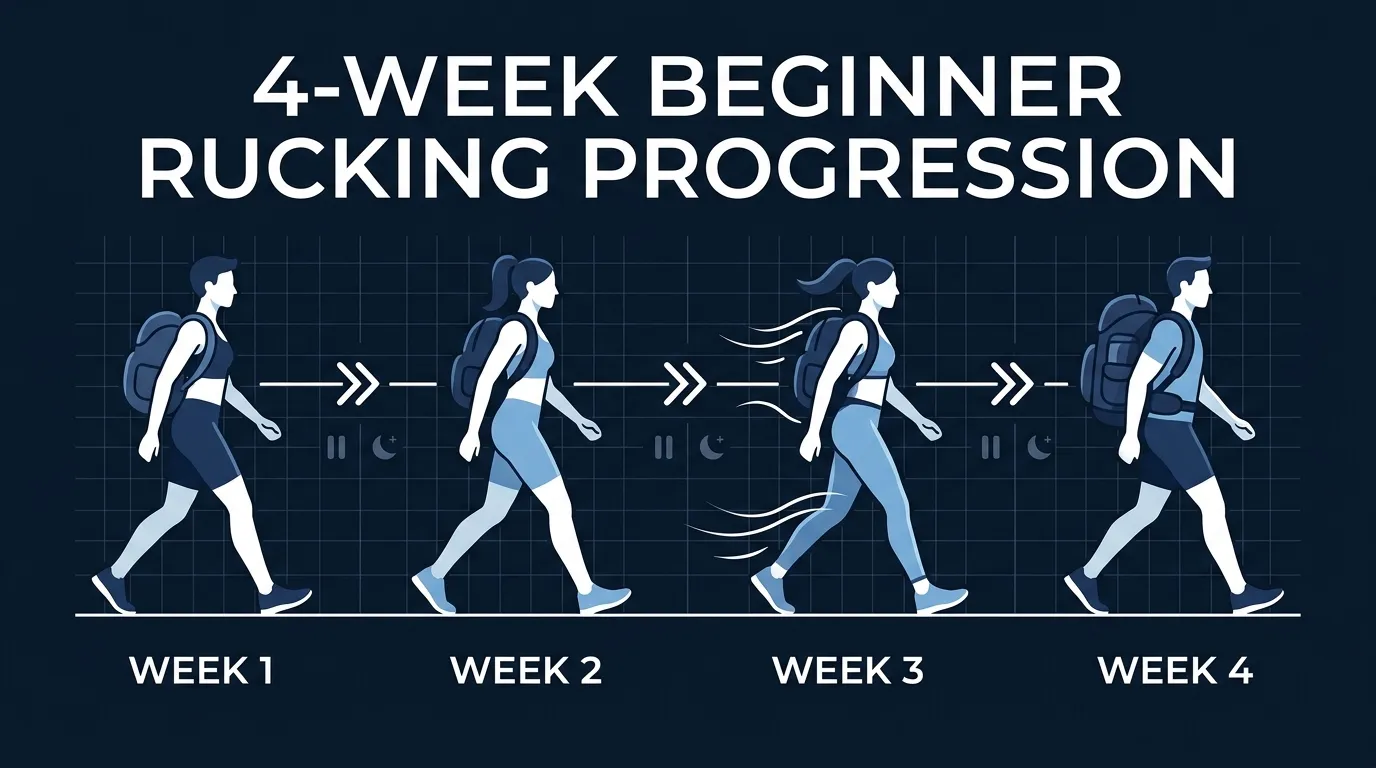
Three sessions a week, with at least one rest day between sessions. Each session looks like this:
- Walk 5 minutes unweighted as a warm-up
- Put the pack on, walk 20 minutes at a pace where you can talk in short sentences
- Take the pack off, walk 5 minutes to cool down
Total time per session: 30 minutes. Total weekly time: 90 minutes of weighted walking. That is a real training stimulus and a low enough volume that recovery is rarely the limit.
If anything hurts during or after, especially shoulders, lower back, or knees, take the load down and walk shorter for the next session. Pain is not part of the plan.
Ready to put this into practice?
Take the free FitCraft assessment and get a personalized plan built on behavioral science, not willpower.
Take the Free Assessment Free · 2 minutes · No credit cardWeeks Three and Four: Building Volume Carefully
Once two weeks of pain-free 30 minute sessions are behind you, you have two ways to progress. Either add time, or add weight. Pick one per week. Never both at once.
Week 3: Add Time
- Same load as weeks 1 and 2
- Walk 30 minutes weighted instead of 20
- Three sessions, same warm-up and cool-down
- Total weekly weighted time: 90 minutes
Week 4: Add a Little Weight
- Add 2 to 5 pounds to your starting load
- Drop weighted time back to 25 minutes per session for the first two of the three sessions
- Push the third session back up to 30 minutes weighted
That gentle two-step pattern (add time, then add weight, never both in the same week) is what keeps tendons and joints adapting in lockstep with your cardiovascular system. The military research consistently shows that overuse injuries during load carriage cluster around weeks where soldiers ramp both load and distance simultaneously. Civilians do not have to repeat that mistake.
Common Mistakes That Send Beginners to the Couch
Most rucking failures look the same. Here are the four to avoid.
Going Too Heavy in the First Month
If TikTok shows people rucking with 45 pound plates, ignore it. Those people either have years of conditioning or are already injured and have not figured it out yet. Stick to 5 to 10 percent of body weight for at least three weeks before considering a step up.
Skipping the Posture Check
Under load, posture defaults toward forward trunk lean. That shifts stress onto the lower back. Cue yourself to keep eyes on the horizon, ribs stacked over hips, and a slight forward lean only from the ankles. If you find yourself hunched and looking at the ground, the load is probably too heavy or sitting too low in the pack.
Rucking Six Days a Week
More is not better here. Three to four sessions per week is plenty for cardio and musculoskeletal adaptation. Tendons and bone need recovery time to remodel. Walking unweighted, lifting, swimming, or yoga on off days is fine. Daily rucking with the same load is the fastest way to a stress fracture or plantar fasciitis.
Treating It Like a Race
Rucking is a steady-state activity. The point is sustainable cardiovascular load over 30 to 60 minutes, not a sprint with weight. If you cannot speak in short sentences, you are walking too fast for the load. Slow down.
Rucking vs Other Walking Approaches
How does rucking compare to other walking-based fitness methods? Here is the honest version.
| Approach | Cardio Stimulus | Strength Stimulus | Joint Impact |
|---|---|---|---|
| Regular walking | Low to moderate | Minimal | Very low |
| Japanese interval walking | High | Low | Low |
| Rucking (10-15% body weight) | Moderate to high | Moderate | Low |
| Slow jogging | High | Low | High (2-3x body weight per step) |
If joint health is a priority, rucking sits in a sweet spot between regular walking and running. If you are already a fan of Japanese interval walking, rucking is a complementary tool, not a replacement. Many people alternate the two across the week.
Who Should and Should Not Ruck
Good Candidates
- Adults over 40 looking for a low-impact cardio option that also loads the legs and spine
- People returning from a long break who find unweighted walking too easy
- Hikers training for a long trip and wanting to build pack tolerance gradually
- Anyone with knees that complain when they run
Older adults in particular tend to do well with progressive load carriage. Walking with light load combines aerobic stimulus, balance work, and grip-related demand from steadying the pack, all of which matter for healthy aging. Our fitness over 60 guide covers a broader plan, and the grip-strength longevity research explains why incidental loading on walks adds up over time.
Hold Off If
- You have a recent disc herniation, spinal injury, or unmanaged hip or knee problem
- You are in the first 6 weeks postpartum and pelvic-floor symptoms have not been cleared
- You have severe osteoarthritis in the spine, hips, or knees and a clinician has flagged load carriage as a risk
- You have plantar fasciitis or another acute foot or tendon injury that is not yet resolved
When in doubt, ask your doctor or a physical therapist before adding load to walks. The injuries to avoid here are not glamorous and they take months to heal.
Why Most People Quit by Week Three
The protocol is not the hard part. The hard part is showing up three days a week for six weeks straight, especially after the novelty fades. Step-count research consistently shows that the people who get fit from walking are not the ones who walked the most in week one. They are the ones who still walked in week eight.
Rucking has the same problem. You will start motivated. The first week feels great. Then a busy work week hits, you skip two sessions, and the streak feels broken. Without a structure to pull you back, the habit dissolves.
This is exactly the consistency problem FitCraft was built for. Ty, our 3D AI coach, demonstrates each session, schedules your next one, tracks streaks, and adapts when you miss days instead of guilt-tripping you. We can plug rucking into a wider plan that combines weighted walking, mobility, and bodyweight strength so the program is varied enough that boredom does not derail you in week three.
What This Means for You
If running has always hurt your knees and walking has stopped feeling like exercise, rucking is probably the missing middle gear. Start light. Walk three days a week. Add time before you add weight. Use the gear you already own.
The research-backed promise here is honest and modest. You will burn meaningfully more calories per minute than walking unweighted. Your legs and core will get stronger. Your cardiovascular fitness will improve at a rate similar to a slow jogging program. And you will not be limping by week four if you respect the progression.
The protocol is simple. The discipline of starting light is what separates the people still rucking in month six from the ones who quit in week two.
Frequently Asked Questions
What is rucking?
Rucking is walking with a weighted backpack, originally a military training method now used as a low-impact way to combine cardiovascular work and lower-body resistance training. A typical ruck involves carrying 10 to 30 pounds at a brisk walking pace for 30 to 60 minutes, on flat ground or hills, several times per week.
How much weight should a beginner ruck with?
Start at 5 to 10 percent of body weight. For a 160 pound adult, that is 8 to 16 pounds. Walk for 20 to 30 minutes at a comfortable pace and stop early if your shoulders, hips, or knees ache. Add weight in 2 to 5 pound increments only after two to three weeks of pain-free sessions at the current load.
How many calories does rucking burn compared to walking?
Carrying a load increases the energy cost of walking roughly in proportion to the load. A 2024 study in Medicine and Science in Sports and Exercise validated metabolic models showing weighted-vest walking can raise oxygen consumption and calorie burn 30 to 100 percent above unweighted walking, depending on load and pace. A 30 minute ruck with 20 pounds typically burns 1.5 to 2 times the calories of an unweighted walk at the same speed.
Is rucking better than running for beginners?
For most beginners, yes. Rucking delivers cardiovascular and strength benefits at a fraction of the joint impact of running. Each running step transmits 2 to 3 times body weight through the knees and ankles, while rucking keeps one foot on the ground at all times. It is especially appropriate for people returning to exercise, those with joint pain, or anyone over 50 who wants steady aerobic gains without the impact load of jogging.
Do I need a special rucking backpack to start?
No. Any sturdy backpack with a hip belt and padded shoulder straps works for the first month. Use books wrapped in a towel, a sandbag, or a few water bottles for weight. Once you progress past 25 to 30 pounds or start rucking three or more days per week, a dedicated ruck plate or rucking pack distributes weight better and protects your spine, but it is not required to begin.