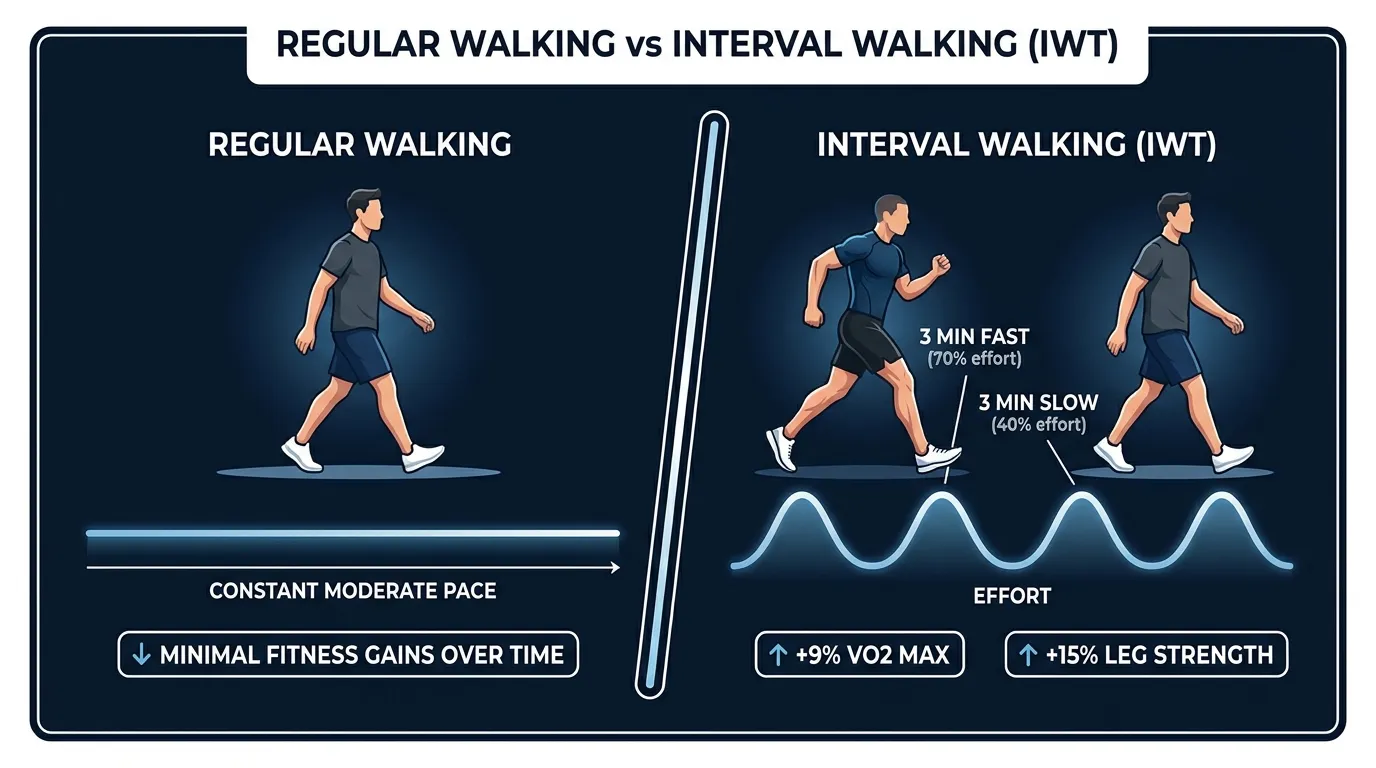
- Interval Walking Training (IWT) alternates 3 minutes of fast walking with 3 minutes of slow walking. Zero equipment required.
- A 5-month randomized controlled trial (n=246) found IWT produced 9% greater aerobic capacity gains and 13-17% leg strength improvements vs. continuous walking.
- Blood pressure dropped an average of 9 mmHg systolic and 5 mmHg diastolic in IWT participants.
- The method was designed for older adults and beginners. It's effective precisely because it's sustainable, not punishing.
You've been told walking is good for you. And it is. But if you've ever spent months trudging through a daily 30-minute walk and felt like nothing was actually changing, here's what nobody told you: the pace you're walking at might be the problem.
In Japan, researchers at Shinshu University spent years studying a deceptively simple modification to ordinary walking. Instead of walking at a steady, comfortable pace the whole time, participants alternated between bouts of fast walking and slow recovery walking. The results, published in multiple peer-reviewed journals including the British Journal of Sports Medicine, were striking enough to set off a 2,986% surge in global searches for the "Japanese Walking Method" in 2025-2026.
The method is called Interval Walking Training (IWT). This article breaks down exactly what it is, what the science shows, who benefits most, and how to do it. Starting today, with nothing but your legs and a timer.
What Is the Japanese Walking Method?
Interval Walking Training (IWT) was developed by Dr. Hiroshi Nose and colleagues at Shinshu University's Institute for Biomedical Sciences in Nagano, Japan. The concept emerged from a straightforward observation: most middle-aged and older adults who exercise "regularly" are walking at intensities too low to meaningfully improve cardiovascular fitness. But most high-intensity exercise programs are too demanding for them to stick with.
IWT threads this needle by applying the same principle that makes HIIT (High-Intensity Interval Training) effective (alternating periods of higher effort with recovery), but at walking speeds that remain low-impact and accessible.
The Protocol
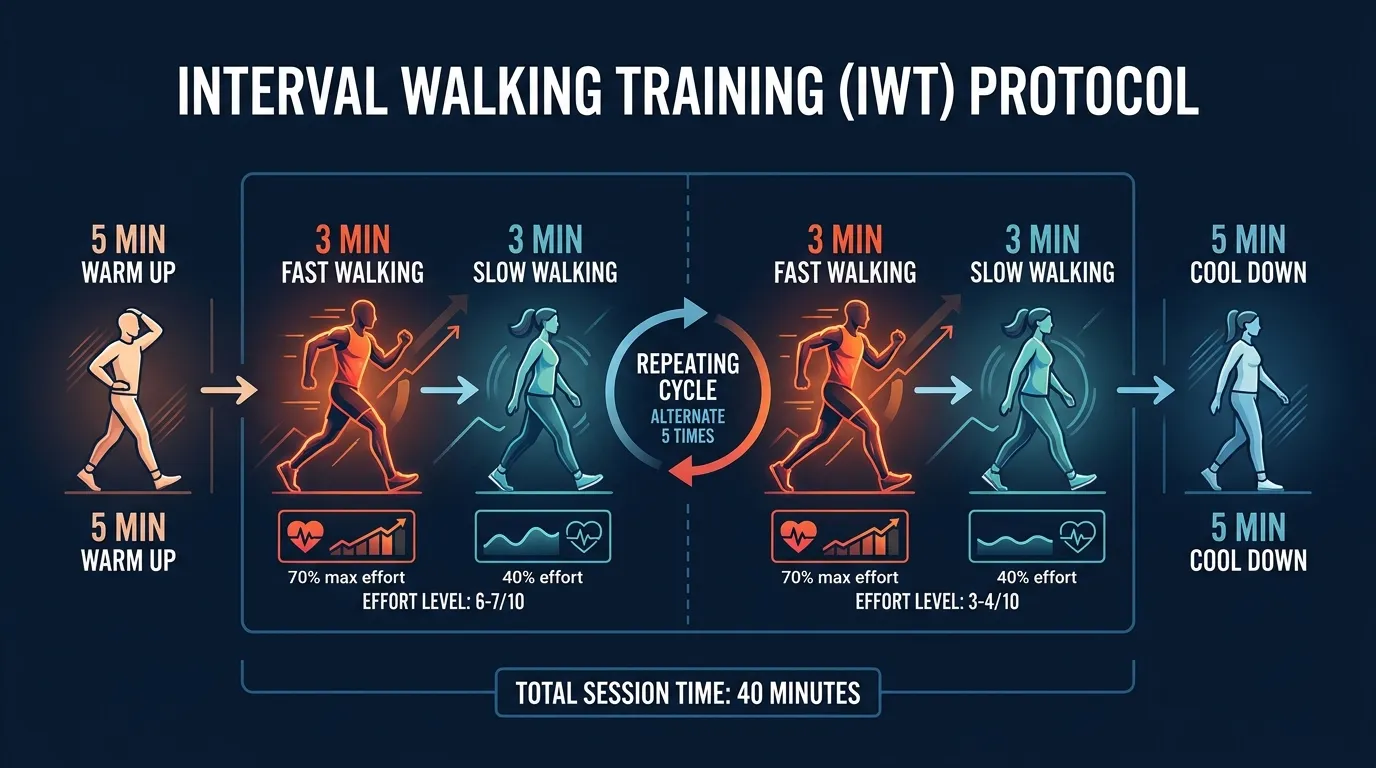
The standard IWT protocol is elegantly simple:
- Fast intervals: 3 minutes at approximately 70% of peak aerobic capacity. A brisk, purposeful pace where you're breathing harder but still able to speak in short sentences. On a 1-10 perceived effort scale, this is a 6-7.
- Slow intervals: 3 minutes at approximately 40% of peak aerobic capacity. A comfortable, easy recovery pace. Effort: 3-4 out of 10.
- Cycles: 5 or more repetitions of the fast-slow pair per session (totaling 30+ minutes of walking, excluding warm-up and cool-down).
- Frequency: 4 or more days per week.
That's it. No gym. No equipment. No special gear. Just a timer and a willingness to occasionally walk faster than feels completely comfortable.
How "Fast" Is Fast Enough?
The 70% peak aerobic capacity target sounds technical, but you don't need a lab to find it. In practice, aim for a pace where:
- You can answer a question in 3-5 words, but can't comfortably hold a full conversation
- Your breathing is noticeably elevated. You're aware of each breath
- Your arms are swinging purposefully and your stride is lengthened
- You could sustain it for 3 minutes but would welcome the rest after
The slow intervals should feel genuinely easy. A stroll, not a shuffle. The goal is real recovery, not just a slightly slower version of the fast pace. For the fast intervals, the step-rate and talk-test targets in our power walking guide show what that pace feels like, and how to use your arms to hold it.
What the Research Actually Found
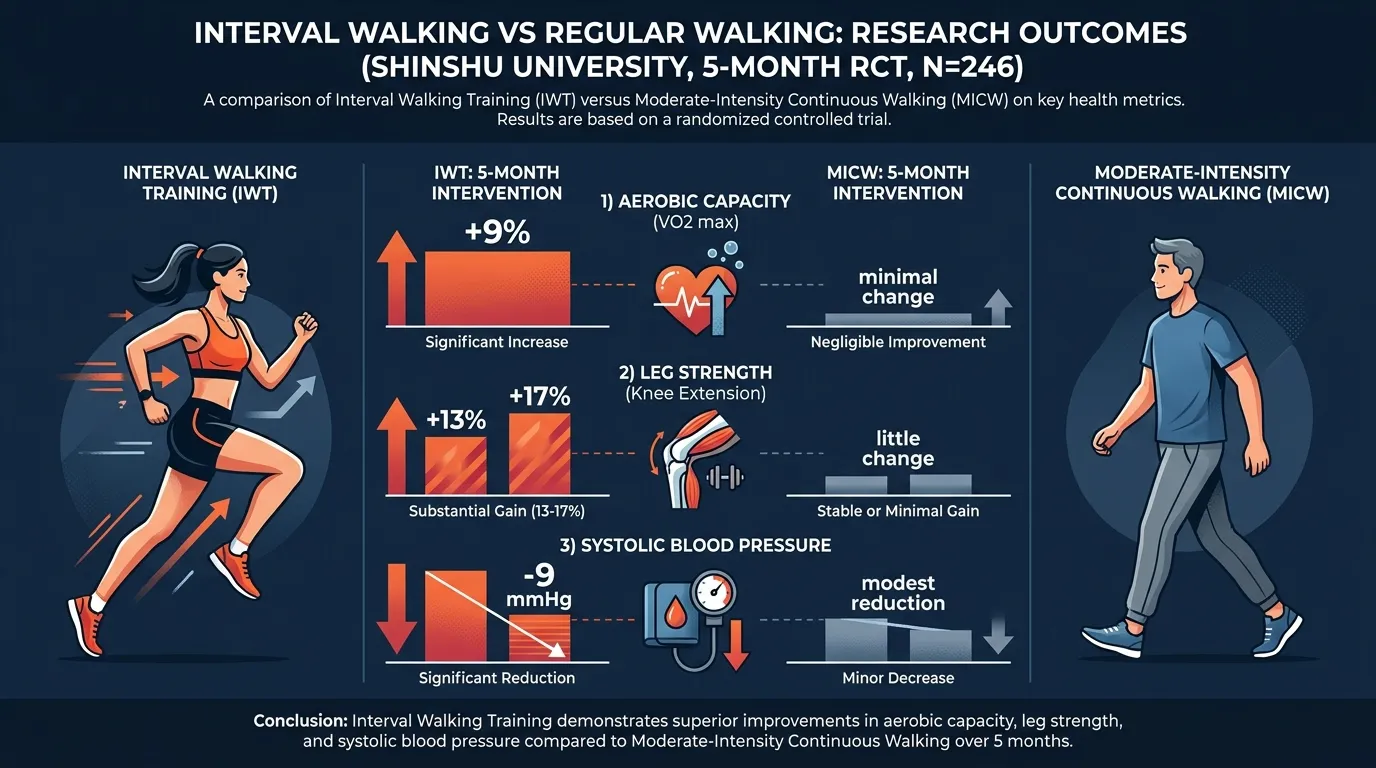
The foundational IWT study by Nose et al. followed 246 participants with a mean age of 63 over five months. Participants were randomized to either IWT or moderate-intensity continuous walking (MICW) matched for total walking time. The results, published in Mayo Clinic Proceedings, gave IWT a decisive advantage across multiple fitness markers.
Aerobic Capacity (VO₂ Max)
Peak aerobic capacity (measured as both cycling VO₂ max and walking-specific capacity) increased significantly more in the IWT group:
- Cycling VO₂ max: +8% in IWT vs. minimal change in MICW
- Walking aerobic capacity: +9% in IWT vs. MICW
A 9% improvement in aerobic capacity over five months of walking, without a single step inside a gym, is clinically meaningful. Research consistently shows that each 1-MET increase in cardiorespiratory fitness reduces cardiovascular mortality risk by approximately 13% (Myers et al., NEJM, 2002).
Leg Strength
This finding often surprises people. Walking is cardiovascular exercise. Why would it improve strength?
The fast intervals in IWT require significantly more force production from the quadriceps, hamstrings, and calves than normal-pace walking. Over hundreds of sessions, this cumulative loading produces measurable strength adaptations:
- Knee extension force (quadriceps): +13% in IWT participants
- Knee flexion force (hamstrings): +17% in IWT participants
For older adults, this is especially significant. Leg weakness is one of the primary predictors of fall risk and loss of independence. A walking protocol that simultaneously improves both cardiovascular fitness and lower-body strength is unusual. And valuable.
Blood Pressure
IWT participants in the Nose et al. research saw meaningful reductions in resting blood pressure:
- Systolic blood pressure: −9 mmHg
- Diastolic blood pressure: −5 mmHg
A 9 mmHg reduction in systolic pressure is clinically significant. The American Heart Association estimates that a 10 mmHg reduction in systolic blood pressure reduces the risk of major cardiovascular events by approximately 20%.
Metabolic and Weight Effects
A much larger follow-up by Masuki et al. (2019) put 679 middle-aged and older adults through 5 months of IWT. Peak aerobic capacity rose 14 percent and their lifestyle-related disease score, a composite of body mass index, blood pressure, and blood glucose and lipid markers, fell 17 percent. The improvement tracked fast-walking time specifically: it climbed as weekly fast walking rose toward 50 minutes and then plateaued. Slow-walking time and total walking time predicted nothing on their own.
That last detail is the practical one. The benefit is not coming from the minutes you spend walking, it is coming from the minutes you spend walking hard. Roughly 50 minutes of fast walking per week, spread across your sessions, is where the curve flattens. Adding easy walking on top of that does not appear to buy you more.
Why Interval Walking Works: The Physiology
The science behind IWT's superiority over continuous walking comes down to three interrelated mechanisms:
1. Higher Average Metabolic Stress
Even though IWT involves periods of slow walking, the fast intervals spike your metabolic demand high enough that the average intensity across the session is meaningfully higher than comfortable-pace walking. This greater metabolic challenge, experienced episodically rather than continuously, triggers stronger cardiovascular and muscular adaptations.
2. EPOC (Excess Post-Exercise Oxygen Consumption)
Higher-intensity intervals produce a larger EPOC effect: the "afterburn" where your metabolism stays elevated for hours after exercise as your body restores oxygen stores and repairs muscle tissue. Continuous walking at a comfortable pace produces minimal EPOC. IWT's fast segments are intense enough to generate meaningful EPOC without the recovery demands of traditional HIIT.
3. Neuromuscular Recruitment
The fast intervals recruit a broader spectrum of muscle fibers, including more fast-twitch fibers in the quadriceps and hamstrings, compared to slow walking. This explains the leg strength improvements. More fibers recruited per step means more total mechanical work, which is the stimulus for both cardiovascular and muscular adaptation.
Ready to put this into practice?
Take the free FitCraft assessment and get a personalized walking and workout plan built on behavioral science, not willpower.
Take the Free Assessment Free · 2 minutes · No credit cardWho Benefits Most, and Who Should Be Careful
Ideal Candidates
IWT was specifically designed for populations who can't or won't do traditional high-intensity exercise. The people who benefit most include:
- Adults 50 and older. The Shinshu University research centered on this group, and the benefits (strength, cardiovascular fitness, blood pressure) are especially impactful for aging physiology
- People returning to exercise after a long break. The slow recovery intervals make the method self-regulating and far less likely to cause injury or burnout than jumping into a running program
- People with type 2 diabetes or metabolic syndrome. Research supports IWT for improving insulin sensitivity and reducing visceral fat in this population
- Anyone who has quit gym programs before. The method requires nothing but time and a pair of shoes, removing every friction point that derails consistency
- People with joint pain or low impact tolerance. The low-impact nature of walking means joint stress is a fraction of running, while the interval structure preserves the cardiovascular stimulus
A Note on Cautions
IWT is low-risk for most healthy adults. Still, if you have diagnosed cardiovascular disease, recent joint surgery, or a condition that affects your ability to suddenly increase walking pace, consult your physician before starting any interval-based program. The fast intervals, while far milder than running intervals, do briefly elevate heart rate significantly, which warrants caution in specific medical contexts.
Interval Walking vs. Regular Walking: A Direct Comparison
So here's how IWT stacks up against common walking approaches:
| Factor | Continuous Walking | Interval Walking (IWT) |
|---|---|---|
| VO₂ max improvement | Minimal over 5 months | +9% over 5 months |
| Leg strength | Little change | +13-17% |
| Blood pressure | Modest reduction | −9 mmHg systolic |
| Visceral fat | Minimal change | Significant reduction |
| Equipment needed | None | None (timer optional) |
| Joint impact | Low | Low |
| Perceived difficulty | Easy to moderate | Moderate (manageable) |
The tradeoff is clear: interval walking demands slightly more effort than a comfortable stroll, but the fitness return per minute is dramatically higher. For people who have been walking regularly without seeing results, IWT often represents the minimum effective dose of challenge needed to actually move the needle.
How to Start: Your First IWT Session
Here's a beginner-friendly approach based on the Shinshu University protocol, structured to build gradually over your first four weeks.
Week 1-2: Build the Pattern
- Warm up with 5 minutes of easy walking
- Complete 3 cycles of: 3 minutes fast (effort 6-7/10) → 3 minutes slow (effort 3-4/10)
- Cool down with 5 minutes of easy walking
- Total time: approximately 23 minutes
- Frequency: 3-4 days per week
Focus on: Finding the right fast-pace intensity. If you can easily carry on a full conversation during the "fast" segment, speed up. If you're gasping for air, slow down. The target is "brisk and breathing hard, but under control."
Week 3-4: Increase Volume
- Warm up with 5 minutes of easy walking
- Complete 5 cycles of: 3 minutes fast → 3 minutes slow (matching the full Shinshu protocol)
- Cool down with 5 minutes of easy walking
- Total time: approximately 40 minutes
- Frequency: 4+ days per week
Month 2 and Beyond
Once 5 cycles feel manageable, you can progress by:
- Adding a 6th or 7th cycle per session
- Slightly increasing fast-interval pace (every few weeks)
- Maintaining 4+ days per week. Research found adherence at this frequency is the threshold for meaningful adaptation
The beauty of IWT is that progression is intuitive. When 5 cycles feel easy and your breathing barely gets challenged during fast segments, that's your signal to push the pace or add a cycle.
The Consistency Problem Nobody Talks About
Here's the part where most fitness content stops: they give you the protocol and assume you'll just do it. But you've tried that before. You started, you were consistent for two weeks, and then life happened.
The research on IWT adherence is actually encouraging. In the Shinshu University trials, participants maintained the protocol because the slow recovery intervals made the sessions feel manageable, not punishing. You're never in a state of suffering. Every 3 minutes, you get a break. The psychological load is completely different from programs that keep you at a high effort level continuously.
But sustainable effort level is only part of the adherence equation. The other part is structure. What happens when you miss a day? What happens in week 3 when the novelty has worn off and the sessions stop feeling exciting? This is the engagement decay problem that derails most exercise habits. And it's where the method alone isn't enough.
Research on gamification in fitness shows that adding external motivation structures (streaks, progress tracking, achievement markers) produces a small-to-medium improvement in physical activity compared with self-directed exercise alone. The physiology of IWT is sound. The habit architecture around it is what determines whether you're still doing it in month 4 or 5.
As Katie put it: "I've tried everything. This is the first time I've stuck with something past two weeks." The protocol matters. The system around it matters more.
What This Means for You
If you've been walking regularly and wondering why nothing seems to be changing, the Japanese Walking Method gives you a research-backed upgrade that costs nothing and requires zero equipment. The fast-slow alternation is the difference between maintenance and meaningful progress.
Start small. Three cycles in week one. Build to five. Stay consistent four days a week. The Shinshu University research didn't find dramatic results from a single heroic session. It found them from showing up consistently over five months and applying just enough challenge to keep your body adapting.
You don't need to suffer. You need structure and just enough discomfort to matter. That's exactly what interval walking delivers.
Frequently Asked Questions
What is the Japanese Walking Method?
The Japanese Walking Method is a form of Interval Walking Training (IWT) developed by Dr. Hiroshi Nose and colleagues at Shinshu University in Japan. It alternates 3 minutes of fast walking (about 70% of peak aerobic capacity) with 3 minutes of slow, recovery walking (about 40% of peak aerobic capacity). A standard session includes 5 or more cycles over approximately 30 minutes, performed 4 or more days per week.
Is interval walking better than regular walking?
Yes, according to a randomized controlled trial of 246 participants (mean age 63) by Nose et al. Interval walkers achieved significantly greater increases in aerobic capacity (+9%) and leg strength (13-17%) compared to participants who walked at a continuous moderate pace. Blood pressure improvements were also significantly larger in the interval group, with a 9 mmHg reduction in systolic pressure.
How fast should you walk during the fast intervals?
During the fast intervals, aim for about 70% of your peak aerobic capacity. A pace where you can still speak in short sentences but your breathing is noticeably elevated. On a 1-10 effort scale, target a 6-7. Most people describe it as a brisk, purposeful walk: faster than a stroll, slower than a jog. After 3 minutes, slow back down to a comfortable recovery pace (about 40% effort) for the next 3 minutes.
Who benefits most from interval walking?
Interval walking training was specifically designed to be effective yet sustainable for older adults and people who cannot tolerate high-intensity exercise. Research from Shinshu University found significant benefits for adults aged 50-80, including improvements in aerobic capacity, leg strength, and metabolic markers. It also benefits people returning from a long fitness break, those with type 2 diabetes, and anyone who finds continuous vigorous exercise too demanding or unsustainable.
How do I track interval walking without a coach?
The simplest approach is to use a timer set to 3-minute alerts, alternating between fast and slow segments. More advanced options include smartwatch workout modes set to interval training. FitCraft's AI coach Ty can build walking workouts with progressive interval protocols into a personalized plan, automatically adjusting intensity and duration based on your improving fitness over time.