- Somatic exercises are slow, body-aware movements designed to calm the nervous system, not just stretch muscles.
- A 2017 meta-analysis in the Journal of Psychiatric Research found that breath-linked movement practices consistently lowered cortisol and other physiological stress markers across 45 studies.
- You need zero equipment and zero fitness experience. Five minutes is enough to feel a shift in autonomic tone.
- Somatic practice works best as a bookend to harder training: nervous system primer before workouts, recovery tool after.
Here's the irony most fitness content skips. You're stressed, so you decide to exercise. You push hard, sweat through something intense, and feel briefly better. But cortisol (your body's primary stress hormone) spikes during high-intensity effort. If chronic stress is already keeping your cortisol elevated, a brutal workout can pile onto a system that's already on edge.
Somatic exercises are the answer to this problem. Not instead of hard training. Alongside it.
These are slow, breath-linked movements that ask one thing of you: pay attention to what you feel. No performance targets. No reps to hit. Just deliberate movement paired with body awareness. And the research shows that combination does something regular exercise alone can't: it directly dials down your stress response at the level of the nervous system.
This article covers what somatic exercises actually are (and aren't), the specific science behind why they reduce stress, five beginner moves you can try today, and how to weave them into an existing fitness routine without adding another hour to your day.
What Are Somatic Exercises?
The word "somatic" comes from the Greek soma, meaning body. In practice, somatic exercises are movement patterns performed with deliberate slowness and a focus on internal sensation rather than external form or outcome.
The modern framework comes from neurophysiologist Thomas Hanna, who coined the term "somatics" in the 1970s after studying the work of movement educators Moshe Feldenkrais and F.M. Alexander. Hanna's core insight was that chronic stress and trauma cause muscles to get stuck in habitual tension patterns he called "sensory-motor amnesia." The brain, overwhelmed by ongoing stress signals, loses its ability to fully relax muscles it's been holding tight for weeks or years.
Somatic exercises reverse this. By moving slowly and paying close attention to how each movement feels, you give the brain feedback that breaks the cycle. Harvard Health describes somatic workouts as practices that help "the brain relearn how to control muscles, release chronic tension, and improve the quality of movement." The key distinction: the goal is awareness, not performance.
What Somatic Exercises Are Not
It helps to clear up a few common confusions before we go further.
Somatic exercises are not just stretching. Stretching has a mechanical goal: lengthen the muscle. Somatic practice has a neurological goal: teach the nervous system to release patterns it's been holding. The physical result might look similar. The mechanism is different.
They're not the same as yoga, though there's real overlap. Yoga classes often use external cues ("reach toward the ceiling," "hold for five breaths"). Somatic practice is entirely internally referenced: "what do you feel in your lower back right now?" Some yoga traditions, particularly yin and restorative yoga, approach somatic principles. But standard flow yoga is predominantly performance-oriented.
And they're not a therapy replacement. Somatic therapy involves trained practitioners and clinical protocols for trauma processing. Somatic exercises are accessible practices anyone can do. They share a philosophical foundation but serve different purposes.
The Science: Why They Actually Work
Skepticism is fair. "Slow movements that make you feel better" sounds like wellness marketing. But the mechanisms here are grounded in well-established neuroscience.
Vagal Stimulation and the Parasympathetic Switch
Your autonomic nervous system has two branches. The sympathetic branch handles the stress response: heart rate up, cortisol released, digestion paused, muscles primed for action. The parasympathetic branch handles recovery: heart rate down, cortisol cleared, digestion resumed, muscles able to fully relax.
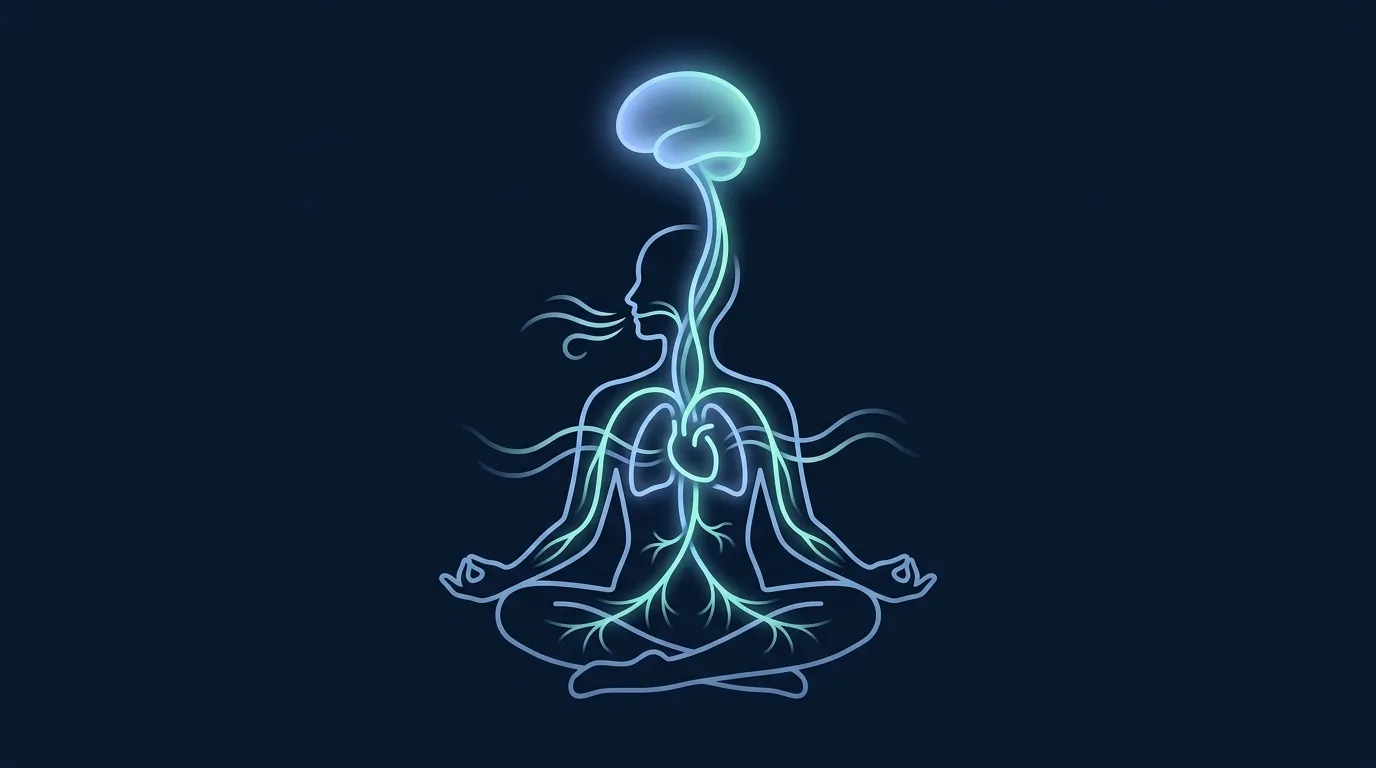
The vagus nerve is the main conduit of the parasympathetic system. It runs from your brainstem through your neck, chest, and abdomen, innervating your heart, lungs, and gut. When it's stimulated, your body gets a clear signal: the emergency is over. Relax.
Slow, diaphragmatic breathing is the foundation of almost every somatic exercise, and one of the most reliable vagal stimulators we know of. When you breathe slowly into your belly, stretch receptors in the lungs send signals via the vagus nerve that trigger the parasympathetic response. Heart rate slows. Blood pressure drops. Cortisol clearance begins.
A 2012 review by Streeter et al. in Medical Hypotheses proposed that breath-based mind-body practices work primarily through this vagal pathway, increasing GABA activity in the brain (the main inhibitory neurotransmitter, deficient in anxiety disorders) and recalibrating the stress response at a systems level.
Cortisol Reduction: What the Data Shows
The stress hormone evidence is solid. A 2017 meta-analysis by Pascoe et al., published in the Journal of Psychiatric Research, pooled results from 45 studies and found that mind-body practices involving slow, breath-linked movement consistently reduced cortisol, blood pressure, heart rate, and inflammatory markers. The effect was not trivial. Cortisol reductions were statistically significant across multiple measurement points: immediately post-session, same-day, and at longer-term follow-up in regular practitioners.
The same review found these practices reduced self-reported anxiety by a clinically meaningful margin, comparable to the effect sizes seen in some pharmacological interventions for mild-to-moderate anxiety.
Interoception: Training Your Body Awareness
Interoception is your brain's ability to perceive signals from inside your body: hunger, heart rate, muscle tension, breath. Research in the last decade has established that interoceptive ability is closely linked to emotional regulation. People who can accurately sense and interpret their internal states are better at managing stress and recovering from emotional upset faster.
A 2015 paper by Payne, Levine, and Crane-Godreau in Frontiers in Psychology argued that somatic practices work partly by training interoception: the slow, attentive movements force the brain to process body signals it normally filters out. Over time, this builds a more nuanced awareness of early stress signals, giving you the ability to respond before the stress response becomes overwhelming.
In plain terms: regular somatic practice trains you to catch tension before it accumulates. Not just to release it after it's already there.
5 Somatic Exercises to Try Right Now
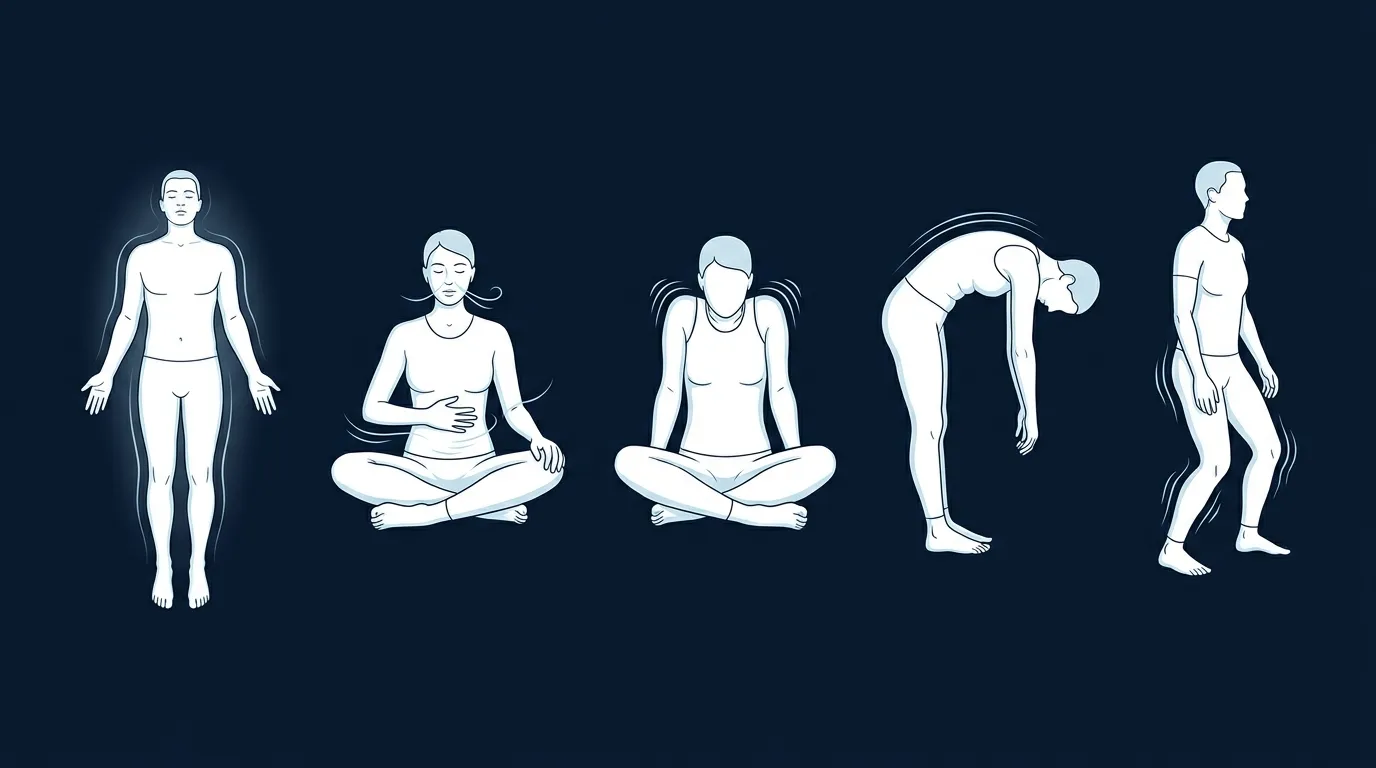
These five moves require no equipment and no fitness background. Each takes under three minutes. Do them in sequence for a complete 10-minute session, or pick one whenever you need a reset.
1. Slow Body Scan
Lie on your back or sit upright in a chair. Close your eyes. Starting at the top of your head, move your attention slowly downward through your body: scalp, jaw, neck, shoulders, chest, arms, hands, belly, lower back, hips, legs, feet.
At each region, simply notice what's there. Tight? Warm? Numb? Don't try to change anything. Just observe. This takes 3-4 minutes done slowly. Most people find at least two or three areas holding tension they weren't consciously aware of. And the act of noticing often produces a partial release on its own.
This is the entry point to somatic practice. You can't regulate what you can't perceive.
2. Diaphragmatic Breathing (4-7-8 Pattern)
Place one hand on your chest, one on your belly. Inhale for 4 counts, letting your belly rise while your chest stays relatively still. Hold for 7 counts. Exhale slowly for 8 counts through pursed lips.
Repeat 4-6 cycles. The extended exhale is the active ingredient: it lengthens the exhalation phase, which amplifies vagal stimulation and produces a faster parasympathetic shift than equal inhale-exhale ratios. You'll likely feel your heart rate slow within two or three cycles.
3. Shoulder Shrug and Release
Sit or stand. Take a slow inhale and shrug both shoulders up toward your ears as high as they'll go, hold for 3-4 seconds at the top. Then exhale and let them drop completely. Don't guide the drop. Let gravity do it.
Repeat 5 times. The deliberate contraction followed by passive release teaches your nervous system the difference between tension and relaxation in the upper trapezius, one of the most chronically overactive muscle groups in stressed adults. After 5 rounds, most people feel their shoulders sitting noticeably lower than they started.
4. Slow Spinal Roll-Down
Stand with feet hip-width apart. Drop your chin to your chest. Let your head lead a slow, vertebra-by-vertebra roll downward. No forcing, no pulling. Let gravity do the work. When you've rolled as far as comfortable, pause and breathe for 3-5 breaths. Then slowly roll back up the same way, head coming up last.
Do this 3-4 times. This move decompresses the spine, increases blood flow to the spinal cord, and uses the slow, attentive movement pattern that somatic practice is built on. It also reliably reduces the forward head posture many people accumulate through screen time and stress.
5. Neurogenic Tremor (Tension Release)
This one sounds odd. Try it anyway.
Stand with feet shoulder-width apart. Bend your knees slightly and hold the position for 1-2 minutes, until your leg muscles begin to fatigue. At that point, allow the trembling that may start to just happen. Don't suppress it. These involuntary tremors are the body's natural mechanism for discharging held muscular tension. It's the same process that animals use instinctively after a threat passes (you've seen a dog shake after a stressful event).
This is one of the core techniques in Tension and Trauma Releasing Exercises (TRE), developed by Dr. David Berceli. It feels strange for about 30 seconds, and then most people describe a wave of warmth or relaxation spreading through their lower body. Two to three minutes is enough for a meaningful effect.
How to Fit Somatic Exercises Into a Fitness Routine
The most common question: where do these fit? You're already training. You don't want to add a whole separate practice on top of everything else.
Good news. Somatic exercises work best as bookends to existing training, not standalone sessions. Here's how to use them.
Before Your Workout: Nervous System Primer
Five minutes of slow somatic work before training shifts your nervous system from reactive to ready. Not relaxed. You want arousal for performance. But regulated arousal, where you're alert without the edge of anxiety.
A body scan plus 10 rounds of diaphragmatic breathing before a workout has been shown to improve motor control and reduce injury risk by improving proprioceptive awareness. You're literally telling your brain to pay attention to your body before you ask it to perform complex movement patterns. That connection is the foundation of good form.
After Your Workout: Close the Stress Loop
Every workout raises cortisol. That's appropriate and necessary. But many people skip the recovery step, going straight from a hard session into work, screens, or other stressors. Cortisol stays elevated, and the training adaptation you just worked for is partially undermined by the inflammatory cascade that chronic stress produces.
Five to ten minutes of somatic cooldown (the slow spinal roll, the shoulder shrug and release, breath work) signals the parasympathetic system to take over. You close the stress loop that the workout opened. Recovery starts faster. Sleep quality improves. Muscle soreness, which is partly mediated by inflammation, tends to be less severe.
On Rest Days: Active Recovery Without Loading the System
A 15-20 minute somatic session on rest days provides active recovery benefits (blood flow, reduced stiffness, nervous system regulation) without the physiological cost of a workout. This is especially useful during high training volume periods when the system is running close to its recovery limit.
See also: yoga and mobility at home and the science of active recovery for complementary approaches.
What This Means for You
You've probably tried managing stress with the usual tools: working out harder, pushing through it, waiting for the weekend. Those approaches don't address what's actually happening in your nervous system. They either add more load to a system already over-budget, or they just delay the problem.
Somatic exercises are different because they work with the physiology of stress rather than against it. They're not soft or optional. They're how you keep your nervous system functional enough to actually benefit from the hard work you're already putting in.
And the research is clear: you don't need a lot of time, a lot of experience, or any equipment. Five minutes of deliberate, slow, body-aware movement produces a measurable shift in autonomic tone. Ten minutes daily for 8 weeks produces lasting changes to how your body handles stress (Khoury et al., 2015, Journal of Psychosomatic Research).
Sarah, 27, puts it this way: "First app that made exercise feel like something I chose, not forced. Adding the breathing stuff before workouts changed everything. I actually feel the difference."
The goal isn't to become someone who meditates for an hour every morning. It's to give your nervous system a daily five-minute window where it gets to fully exhale. Most people haven't done that in years. The change, when you start, is noticeable fast.
Ready to put this into practice?
Take the free FitCraft assessment and get a personalized plan based on behavioral science, not willpower.
Take the Free Assessment Free • 2 minutes • No credit card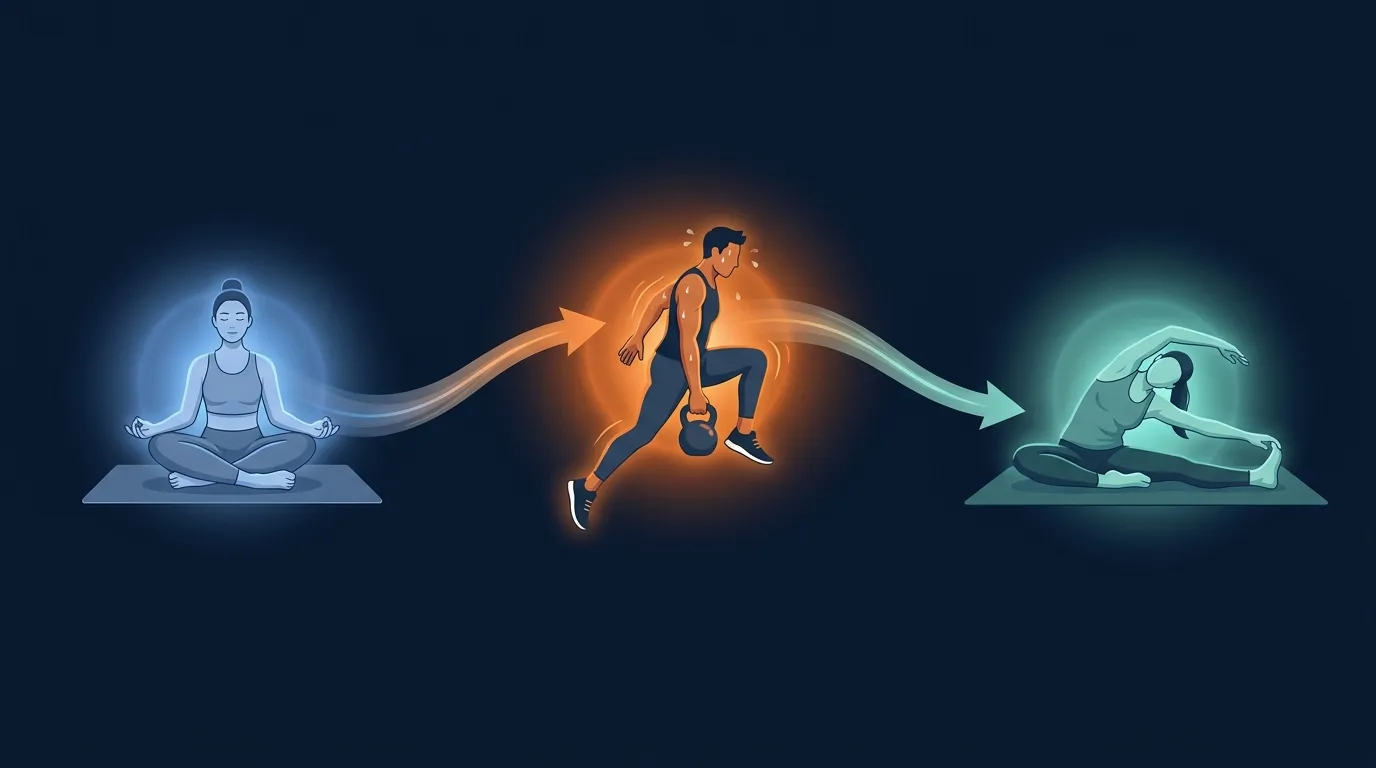
Frequently Asked Questions
What are somatic exercises?
Somatic exercises are slow, intentional movements that prioritize internal body awareness over external performance goals. Unlike regular workouts focused on reps or speed, somatic practice asks you to feel how each movement affects your muscles, breath, and nervous system. The term comes from the Greek "soma" (body), and the approach was formalized by neurophysiologist Thomas Hanna in the 1970s. Harvard Health describes them as movements designed to help the brain relearn how to control muscles and release chronic tension.
Do somatic exercises actually reduce stress?
Yes. A 2017 meta-analysis by Pascoe et al. in the Journal of Psychiatric Research analyzed 45 studies and found that mind-body practices involving slow, breath-linked movement consistently reduced physiological stress markers: cortisol, blood pressure, and inflammatory cytokines. The mechanism is vagal stimulation: slow diaphragmatic breathing activates the vagus nerve, which signals the parasympathetic nervous system to shift the body out of the stress response.
How long until I feel a difference?
Many people notice a calming effect after a single 5-10 minute session because breath-based somatic movements can shift autonomic tone relatively quickly. Lasting changes to chronic stress and muscle tension patterns typically take 4-8 weeks of consistent daily practice. A 2015 meta-analysis by Khoury et al. found that 8 weeks of regular mindfulness-based movement practice produced significant, lasting reductions in anxiety and psychological distress across 29 studies.
Can complete beginners do somatic exercises?
Absolutely. Somatic exercises are one of the most beginner-friendly movement practices available because they require zero fitness baseline, no equipment, and minimal space. The goal isn't performance: it's attention. If you can breathe and move slowly, you can do somatic exercises. Cleveland Clinic and Harvard Health both recommend them as a starting point for people who find traditional exercise intimidating or overstimulating.
Are somatic exercises the same as yoga or stretching?
They overlap but aren't identical. Yoga and stretching have external goals: reach a pose, improve flexibility. Somatic exercise focuses entirely on internal sensation. How a movement feels, where tension lives, how the nervous system responds. In practice, many somatic techniques borrow from yoga, tai chi, and feldenkrais, but the defining quality is the inward attention rather than the shape of the movement.