You've heard it a thousand times. "Don't just sit on the couch after leg day. Go for a walk. Do some light cycling. Active recovery speeds up the healing process." It sounds logical. Movement increases blood flow. Blood flow delivers nutrients. Nutrients repair muscle. Recovery complete.
There's just one problem: when researchers actually tested this idea across 99 studies, active recovery barely outperformed doing absolutely nothing. If you want the full ranking with sleep and nutrition slotted in above the hands-on tools, our guide on how to recover faster from workout to workout puts the eight techniques in order of what they actually buy you. That leaves the question most people actually want answered on a stiff morning, which is whether to train at all, and our piece on should I workout when sore gives a four-step rule for deciding.
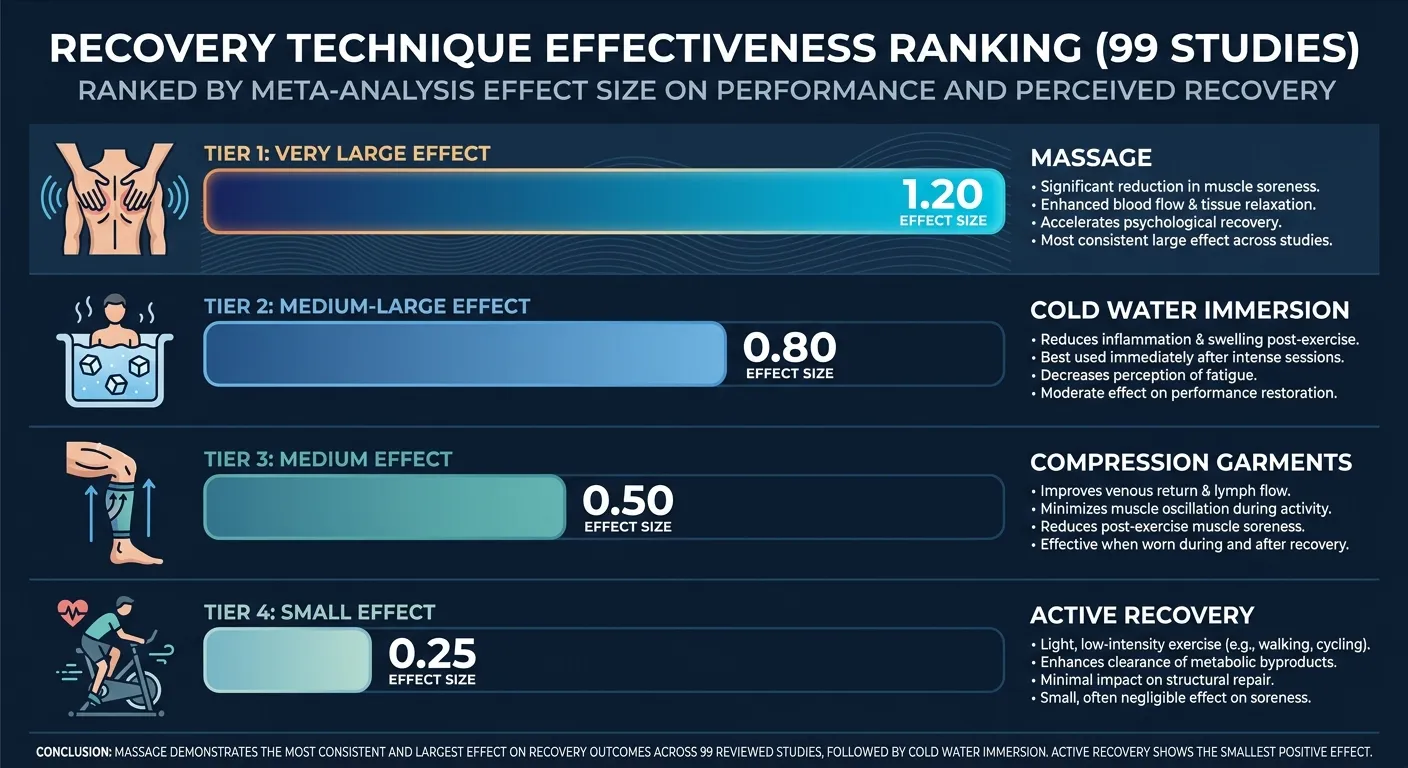
The Dupuy et al. (2018) meta-analysis, published in Frontiers in Physiology, is one of the most comprehensive reviews ever conducted on post-exercise recovery. It analyzed data from 99 studies covering eight major recovery techniques: massage, cold water immersion, compression garments, active recovery, stretching, cryotherapy, contrast water therapy, and electrostimulation. It measured their effects on four outcomes: delayed onset muscle soreness (DOMS), perceived fatigue, muscle damage (creatine kinase), and inflammation (IL-6 and CRP).
The results challenge a lot of what the fitness industry takes for granted. Here's what 99 studies actually found.
The Study: What Dupuy et al. Actually Tested
Let's start with why this meta-analysis matters more than any single recovery study you've seen on Instagram.
Scale and Scope
Dupuy and colleagues at the University of Poitiers searched three major databases (PubMed, Embase, and Web of Science) for randomized controlled trials, crossover trials, and repeated-measure studies that compared recovery techniques to passive rest. They included 99 studies, a massive evidence base that lets you see patterns no individual study can reveal.
The eight recovery techniques they analyzed: active recovery, massage, compression garments, cold water immersion, contrast water therapy, cryotherapy, stretching, and electrostimulation. Each was measured against passive recovery (doing nothing) across four time points: immediately post-exercise, 24 hours, 48 hours, and 72 hours later.
What They Measured
The study tracked four outcome markers that together give a complete picture of recovery:
- DOMS — the soreness you feel 24-72 hours after hard training
- Perceived fatigue — how tired and wrecked you feel overall
- Creatine kinase (CK): a blood marker of muscle damage; higher CK means more muscle fiber breakdown
- Inflammatory markers (IL-6, CRP): indicators of the inflammatory response to exercise
This matters because a recovery technique might reduce soreness while doing nothing for actual muscle damage. Or it might lower inflammation without affecting how tired you feel. Looking at all four outcomes together tells you which methods genuinely help and which just make you feel slightly less awful.
The Winners: What Actually Works
Six of the eight techniques produced a statistically significant reduction in DOMS, with effect sizes ranging from small to large (Hedges' g: -0.40 to -2.26). But when you look across all four recovery outcomes, clear winners emerge.
Massage: The Best Overall Recovery Technique
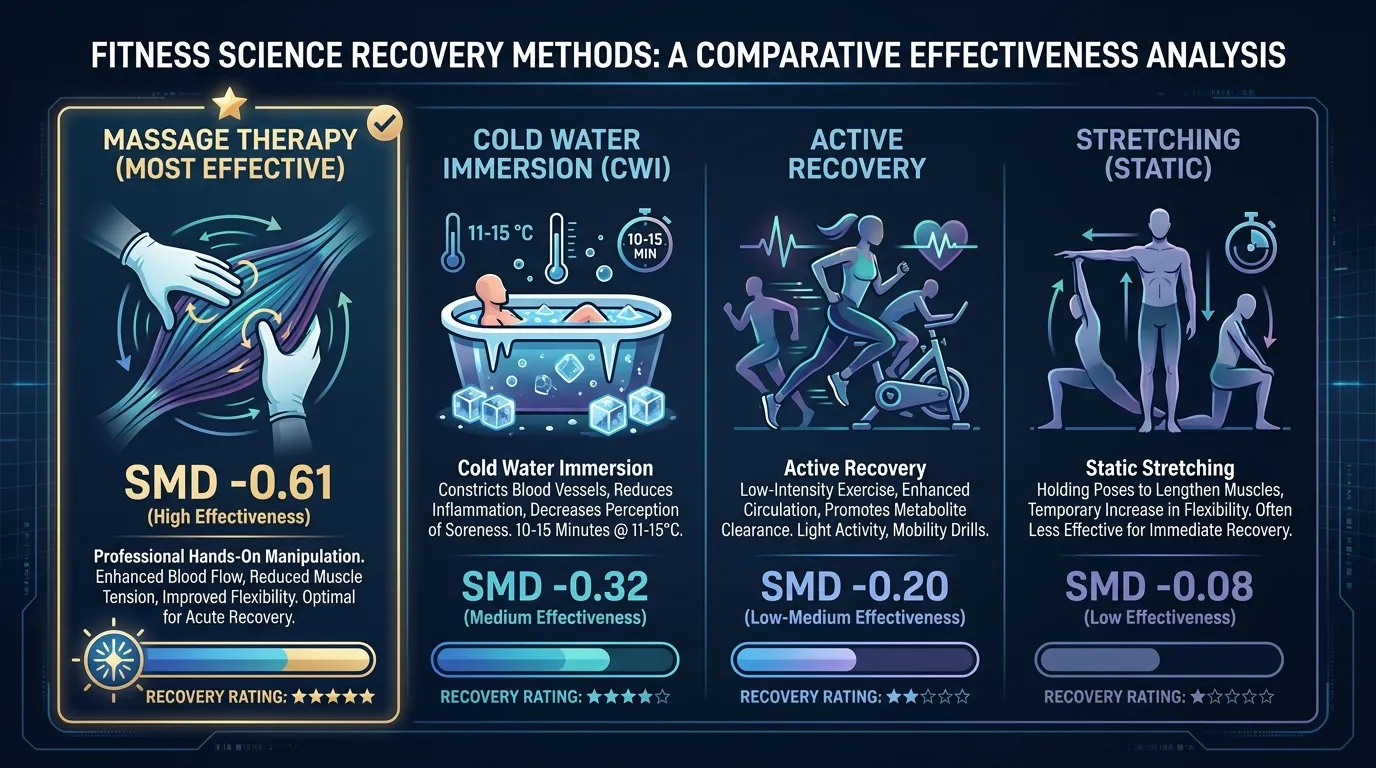
This wasn't even close. Massage was the most powerful technique for reducing both DOMS and perceived fatigue, regardless of the type of exercise that caused the damage. A separate 2017 meta-analysis by Guo et al. in Frontiers in Physiology confirmed this, finding massage reduced muscle soreness ratings significantly at 24 hours post-exercise (SMD: -0.61) with benefits lasting up to 72-96 hours.
Massage also reduced creatine kinase levels (SMD: -0.64), meaning it wasn't just masking soreness. It appeared to reduce actual muscle damage markers. And it improved maximal isometric force recovery (SMD: 0.56), suggesting it helps you get back to full strength faster.
The catch? Massage requires another person (or an expensive massage gun), it takes time, and it's not always accessible. But from a pure evidence standpoint, nothing else in the meta-analysis came close to its combined effects on soreness, fatigue, and muscle damage.
Cold Water Immersion: The Runner-Up
Cold water immersion (CWI), basically sitting in a cold bath or ice tub for 10-15 minutes at 10-15°C, ranked second. A 2023 meta-analysis by Moore et al. in Sports Medicine found CWI was more effective than other recovery methods for improving DOMS at 1 hour, 24 hours, and 48 hours post-exercise. It also accelerated the normalization of creatine kinase levels and helped restore countermovement jump performance faster.
The optimal protocol appears to be 10-15 minutes at moderate cold temperatures (11-15°C) for soreness relief, or slightly colder (5-10°C) for biochemical marker recovery. Longer isn't necessarily better. And there's one important caveat: regular CWI immediately after resistance training may modestly blunt muscle hypertrophy gains over time. If you're training primarily for muscle growth, save the cold plunge for after your hardest cardio or competition days, not after every strength session.
Compression Garments: The Convenient Option
Compression garments showed meaningful effects on perceived fatigue, not as strong as massage, but notable because they're passive. You put them on and go about your day. They didn't significantly reduce creatine kinase or inflammatory markers, but for managing how beat-up you feel after hard training, the evidence supports them as a practical, low-effort recovery tool.
The Loser: Active Recovery's Disappointing Results
Here's where it gets uncomfortable for everyone who's been religiously doing "recovery rides" and "flush runs" after hard training days.
Active recovery, defined in the studies as low-intensity exercise like walking, light cycling, or easy swimming performed after training, produced only a small effect on DOMS. It did not significantly reduce perceived fatigue. It did not meaningfully lower creatine kinase or inflammatory markers. Across the four recovery outcomes that matter, active recovery was one of the weakest performers in the entire meta-analysis.
To be clear: active recovery wasn't harmful. Light movement after exercise is fine. It does help clear blood lactate faster in the immediate post-exercise period. But the popular claim that active recovery meaningfully accelerates muscle repair, reduces next-day soreness, or speeds your return to full performance? The 99-study evidence base simply doesn't support it.
The gap between active recovery and the top-performing techniques is striking. Massage produced large, consistent effects across multiple outcomes. Active recovery produced small, inconsistent effects on just one. That's a massive difference, and it's one most fitness content completely ignores because "go for a light walk" is easier advice to give than "get a 30-minute massage."
What Else Didn't Work (Or Barely Worked)
Stretching
Static stretching as a recovery technique showed no significant effect on DOMS, fatigue, muscle damage, or inflammation across the pooled studies. This is consistent with decades of research suggesting stretching doesn't prevent or meaningfully reduce soreness. Stretch for flexibility if you want. Don't stretch expecting faster recovery.
Electrostimulation
Electrical muscle stimulation (EMS) devices, the kind marketed heavily on social media, didn't produce significant recovery benefits in the meta-analysis. Save your money.
Enjoying the article?
Start a new fitness routine today, written by me and coached by the AI I designed.
Take the Free Assessment Free • 2 minutes • No credit cardThe Recovery Factor Nobody Wants to Talk About: Sleep
Here's the part that doesn't sell recovery products or gym memberships. The single most important recovery intervention isn't a technique at all. It's sleep.
Halson (2014), writing in Sports Medicine, reviewed the evidence on sleep and athletic recovery and found that sleep deprivation impairs essentially everything your body needs for post-exercise repair: glucose metabolism, protein synthesis, growth hormone release, immune function, pain perception, and cognitive performance. Even partial sleep restriction, like getting 6 hours instead of 8, compromises the hormonal environment required for muscle repair and adaptation.
Think about that for a second. You could buy a $500 massage gun, a $200 pair of compression boots, and a chest freezer for cold plunges. Or you could go to bed an hour earlier. The research strongly suggests the extra sleep will do more for your recovery than all those gadgets combined.

This doesn't mean recovery techniques are useless. Massage and cold water immersion clearly work on top of adequate sleep. But no recovery technique can compensate for chronically insufficient sleep. Your body does the vast majority of its repair work during deep sleep stages. That's when growth hormone peaks, when muscle protein synthesis ramps up, when inflammation gets regulated. Skip that window, and all the ice baths in the world won't fully make up the difference.
Why Active Recovery Got So Popular Despite Weak Evidence
If the evidence is this clear, why does every personal trainer, fitness influencer, and gym bro still insist on active recovery? A few reasons.
It feels intuitively right. Moving after exercise feels productive. Sitting on the couch feels lazy. Our brains associate effort with results, even when the effort isn't producing measurable outcomes. This is classic effort heuristic bias: we overvalue things that require more work.
Lactate clearance got confused with recovery. Active recovery does speed up blood lactate clearance immediately after exercise. This is well-documented. The problem is that lactate clearance and actual muscle recovery are different things. Blood lactate returns to resting levels within a couple hours regardless of what you do. The soreness you feel the next day (DOMS) is caused by structural muscle damage and inflammation, processes that light cycling doesn't meaningfully affect.
It's easy to prescribe. "Go for a 20-minute walk" is simple advice. "Get a professional massage" costs money. "Sleep 8+ hours" requires lifestyle changes. Trainers default to active recovery because it's actionable and free, not because the evidence ranks it as the best option.
Movement genuinely feels good. Light exercise can improve mood, reduce perceived stiffness, and provide a psychological sense of doing something productive. These are real benefits. They're just not the physiological recovery benefits that active recovery is usually credited with.
Practical Takeaways: What to Actually Do After Hard Training
Based on the Dupuy et al. meta-analysis and supporting evidence, here's what the research actually supports, ranked by strength of evidence.
- Prioritize sleep above everything. 7-9 hours. This is non-negotiable for recovery. If you're sleeping 6 hours and doing ice baths, you're optimizing in the wrong order (Halson, 2014).
- Massage when accessible. Strongest evidence across all four recovery markers. Even 15-20 minutes of targeted massage on worked muscle groups helps. Massage guns are a reasonable substitute, though the evidence base is thinner than for hands-on massage.
- Cold water immersion after your hardest sessions. 10-15 minutes at 11-15°C. Best for acute soreness management. Skip it after hypertrophy-focused strength training if muscle growth is your primary goal.
- Compression garments for convenience. Wear them post-training or during sleep. The effects are modest but they require zero effort.
- Adequate nutrition. Protein within a few hours of training, sufficient total calories, and proper hydration. These aren't "recovery techniques" in the meta-analysis sense, but they're the substrate your body needs to actually repair tissue. If you're doing everything right recovery-wise but still plateauing, it's also worth considering whether your inter-set rest periods are long enough to let you produce full mechanical tension in each set.
- Light movement if you enjoy it. Walk, do easy yoga, swim gently. It won't hurt and it might help your mood. Just don't kid yourself that it's meaningfully speeding up muscle repair. It's fine. It's just not magical.
What This Means for Your Training Schedule
Here's the practical implication most people miss: if active recovery doesn't meaningfully speed up tissue repair, then rest days should be actual rest days. Not "light workout" days. Not "just a quick 30-minute easy run" days. Rest.
The fitness industry has created a culture where taking a day completely off feels like failure. Like you're falling behind. Like you should at least do something. The research says that's not how recovery works. Your body repairs muscle during rest and sleep, not during additional exercise, even light exercise.
This matters especially if you're following a structured program. The recovery periods programmed between hard sessions exist for a reason. Filling them with active recovery sessions because you feel guilty about sitting still may actually be counterproductive, not because light movement is harmful, but because it takes time and energy away from the recovery activities that actually work: sleep, nutrition, and genuine rest.
If you've ever felt like you're doing everything right, working out consistently, eating well, doing your recovery rides, but still feeling perpetually beat up, ask yourself: are you actually resting? Or are you filling every gap with more movement because the fitness industry convinced you that rest is laziness? Related to this, the research on deload weeks shows that planned volume reductions improve performance by 2-3% — because fatigue dissipates faster than fitness during reduced training.
How FitCraft Handles Recovery Differently
Most fitness apps don't program recovery at all. They give you a workout calendar and leave the rest to you. That's a problem, because when you're managing your own rest days, guilt wins. You train when you should rest. You skip rest when you need it most.
FitCraft's AI coach Ty takes a different approach. Ty programs your training schedule, including genuine rest days, based on your workout history, goals, and current training load. You don't have to decide whether today should be a rest day or a training day. Ty makes that call based on the same exercise science principles that inform this article — including insights from the overtraining syndrome research showing that most recreational exercisers are under-recovering, not over-training.
That means rest days are actually built into your plan, not treated as failures to train. And when Ty programs a rest day, it means real rest: not a guilt-inducing "active recovery" session that the research shows barely moves the needle.
The free version includes personalized scheduling with built-in recovery management. No guesswork. No guilt. Just a 3D personal trainer who understands that doing less is sometimes the most effective thing you can do.
Honest Limitations of This Research
We wouldn't be doing this right if we didn't flag the caveats. No meta-analysis is perfect.
- Study populations vary widely. The 99 studies included trained athletes, recreational exercisers, and sedentary individuals. Recovery needs differ between these groups, and the pooled results may not perfectly represent any single population.
- Exercise protocols differed. Some studies induced DOMS through eccentric training, others through endurance exercise, others through team sport simulations. The "best" recovery technique may depend on the type of exercise performed.
- Placebo effects are hard to control. You can't blind someone to whether they're getting a massage or sitting in a cold bath. Some of the measured benefits may reflect expectation effects rather than purely physiological mechanisms.
- Individual variation is real. What works best for you may differ from the population average. The meta-analysis tells you what works on average across 99 studies. Your personal response to cold water immersion or massage may be stronger or weaker than the pooled effect.
- Most studies measured short-term recovery. The evidence is strongest for recovery within 72 hours. Long-term effects of habitual recovery technique use are less well-studied.
None of these limitations change the core finding: active recovery is consistently one of the weakest recovery techniques in the evidence base, while massage and cold water immersion are consistently among the strongest. The ranking is robust even after accounting for these caveats.
References
- Dupuy O, Douzi W, Theurot D, Bosquet L, Dugué B. "An Evidence-Based Approach for Choosing Post-exercise Recovery Techniques to Reduce Markers of Muscle Damage, Soreness, Fatigue, and Inflammation: A Systematic Review With Meta-Analysis." Frontiers in Physiology. 2018;9:403. doi:10.3389/fphys.2018.00403
- Guo J, Li L, Gong Y, et al. "Massage Alleviates Delayed Onset Muscle Soreness after Strenuous Exercise: A Systematic Review and Meta-Analysis." Frontiers in Physiology. 2017;8:747. doi:10.3389/fphys.2017.00747
- Halson SL. "Sleep in Elite Athletes and Nutritional Interventions to Enhance Sleep." Sports Medicine. 2014;44(Suppl 1):S13-S23. doi:10.1007/s40279-014-0147-0
- Moore E, Fuller JT, Buckley JD, et al. "Effects of Cold-Water Immersion Compared with Other Recovery Modalities on Athletic Performance Following Acute Strenuous Exercise." Sports Medicine. 2023;53(3):687-705. doi:10.1007/s40279-022-01644-9
- Wiewelhove T, Döweling A, Schneider C, et al. "A Meta-Analysis of the Effects of Foam Rolling on Performance and Recovery." Frontiers in Physiology. 2019;10:376. doi:10.3389/fphys.2019.00376
Frequently Asked Questions
Does active recovery actually help with muscle soreness?
Barely. A 2018 meta-analysis of 99 studies published in Frontiers in Physiology found that active recovery (light exercise like walking or easy cycling) produced only a small reduction in delayed onset muscle soreness compared to passive rest. Massage and cold water immersion were significantly more effective. Active recovery did help with blood lactate clearance immediately post-exercise, but for reducing next-day soreness and fatigue, it ranked near the bottom of evidence-based recovery techniques.
What is the most effective post-exercise recovery technique?
According to the Dupuy et al. (2018) meta-analysis of 99 studies, massage was the most effective recovery technique for reducing both DOMS (delayed onset muscle soreness) and perceived fatigue. Cold water immersion (10-15 minutes at 10-15°C) ranked second, showing significant benefits for soreness at 24 and 48 hours post-exercise. Compression garments also showed meaningful effects on fatigue reduction.
Is it better to rest or do light exercise after a hard workout?
For most people, the difference between light exercise and complete rest after a hard workout is minimal. The 99-study meta-analysis found that active recovery produced a small effect on DOMS but did not significantly outperform passive rest for perceived fatigue or muscle damage markers. If you enjoy a light walk after training, it won't hurt. But don't force it thinking it's dramatically speeding your recovery. The research doesn't support that claim.
How important is sleep for exercise recovery?
Sleep is arguably the single most important recovery factor, yet it's often overlooked in favor of expensive recovery tools. Research by Halson (2014) in Sports Medicine found that sleep deprivation impairs glucose metabolism, protein synthesis, pain perception, and immune function, all critical for post-exercise recovery. Even partial sleep restriction compromises the hormonal environment needed for muscle repair and adaptation.
Does FitCraft include recovery guidance in its workout programs?
Yes. FitCraft's AI coach Ty programs rest days and recovery periods based on your training load, workout history, and goals. Rather than prescribing generic active recovery sessions, Ty adjusts your training schedule so you're not guessing when to push and when to rest. The free version includes personalized scheduling with built-in recovery management.