Here's something that sounds wrong but isn't: you get stronger by doing less. Not permanently less , strategically less. A planned week of reduced training volume, known as a deload, is one of the most well-supported practices in exercise science. And yet it's also one of the hardest things to actually do.
Because everything in fitness culture tells you more is better. Push harder. Never miss a day. Rest is for people who don't want it badly enough. That mindset is the villain of this story. It leads to plateaus, burnout, nagging injuries, and the slow erosion of enthusiasm that makes people quit training altogether. The research on overtraining syndrome makes this vivid: the line between productive overreaching and harmful overreaching is thin, and the only way back from true overtraining syndrome is months to years of reduced activity.
If you've ever felt guilty about taking a rest day , let alone a rest week. This article is going to make you feel a lot better about it. The research is surprisingly clear: planned recovery doesn't just prevent problems. It actively improves performance.
What a Deload Week Actually Is
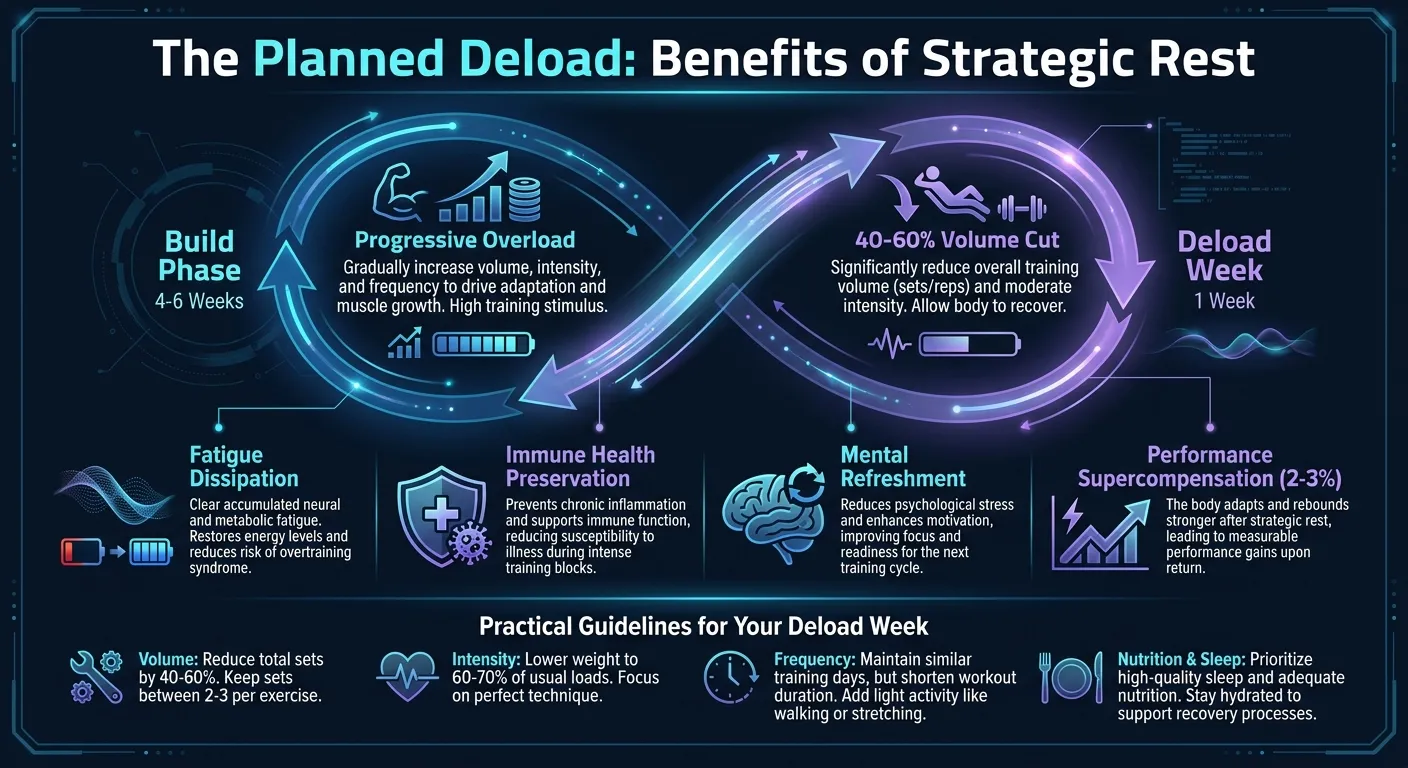
A deload is a short period , typically one week , where you deliberately reduce your training load. Not stop. Reduce. The distinction matters.
You still train. You still show up. But you pull back the volume (fewer sets, fewer reps) while keeping the intensity (the weight on the bar, or the difficulty of movements) close to where it was. Think of it as letting the engine cool down without turning it off.
Most coaches and periodization experts recommend deloading every 4 to 6 weeks. An international Delphi consensus study on deloading practices confirmed this timeline, finding that experienced coaches across strength and physique sports typically program deloads at 4-6 week intervals with volume reductions through fewer sets or reps.
The purpose isn't to get weaker. It's to let accumulated fatigue clear out so the adaptations you've been building actually show up in your performance.
The Research: What Studies Actually Show
This isn't bro-science. Multiple peer-reviewed studies have tested exactly what happens when athletes reduce training volume at the right time. The findings are consistent and pretty compelling.
Aubry et al. (2014): Overreach, Then Taper, and Watch What Happens
This study, published in Medicine & Science in Sports & Exercise, is one of the most interesting in the field. Aubry and colleagues took 33 trained male triathletes and split them into two groups: an overload training group (n=23) and a normal training group (n=10). The overload group went through a 3-week period of intensified training , deliberately pushing past their normal capacity , followed by a taper.
Here's where it gets interesting. Within the overload group, 11 athletes became "functionally overreached" (their performance actually decreased during the overload, with high perceived fatigue), while 12 were classified as "acutely fatigued" (tired but not overtrained). After the taper, the acutely fatigued group showed a peak performance supercompensation of approximately 2.6%, meaning they came back measurably better than before the overload period.
That 2.6% might sound small. In competitive athletics, it's enormous. But even for recreational exercisers, the principle is what matters: a planned period of hard training followed by strategic rest produces performance gains you can't get by just grinding at the same level week after week.
One critical finding the study also reported: 70% of the functionally overreached athletes got sick during the study, compared to only 20% of the acutely fatigued group and 10% of controls. Push too hard without a taper, and your immune system takes the hit.
Citation: Aubry A, Hausswirth C, Louis J, Coutts AJ, Le Meur Y. Functional Overreaching: The Key to Peak Performance during the Taper? Med Sci Sports Exerc. 2014;46(9):1769-1777.
Pritchard et al. (2016): How Elite Powerlifters Actually Taper
If the Aubry study covers endurance athletes, Pritchard et al. (2016) fills in the picture for strength athletes. This study surveyed New Zealand's elite raw powerlifters to document their real-world tapering practices , what they actually do before competition, not what a textbook says they should do.
The findings are remarkably specific. These athletes reduced training volume by 58.9% on average while maintaining intensity near competition levels. Training volume peaked about 5.2 weeks out from competition, while intensity peaked about 1.9 weeks out. The final weight training session was performed roughly 3.7 days before competition day.
The athletes reported that accessory work. The supplementary exercises that aren't competition lifts , got cut around 2 weeks out. Only the movements that directly contribute to competition performance stayed in the program. They also noted that deadlifts require longer recovery than squats or bench press, so deadlift volume got cut earlier.
When asked about failed tapers, the most common mistake? Taking too much time completely off , more than a week of zero training actually hurt performance. The sweet spot was reduced volume, not zero volume.
Citation: Pritchard HJ, Tod DA, Barnes MJ, Keogh JW, McGuigan MR. Tapering Practices of New Zealand's Elite Raw Powerlifters. J Strength Cond Res. 2016;30(7):1796-1804.
Bosquet et al. (2007): The Definitive Meta-Analysis on Tapering
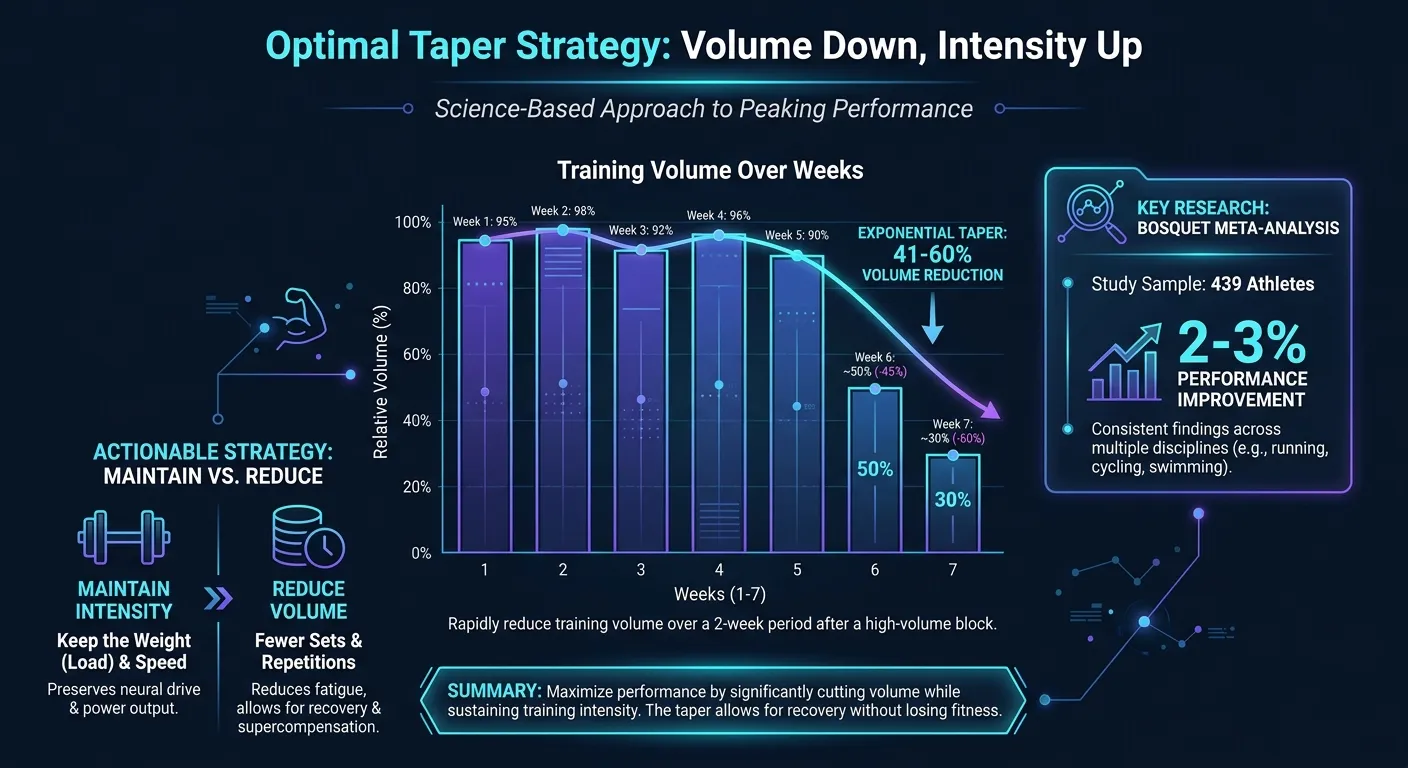
If you only read one study on tapering, make it this one. Bosquet and colleagues conducted a meta-analysis , pooling data from multiple trials , covering 249 swimmers, 80 road cyclists, and 110 track runners. They analyzed every major variable: how long the taper lasted, how much volume was cut, what happened to intensity and frequency.
Their conclusions are specific enough to use as a recipe:
- Optimal duration: 2 weeks (overall effect size = 0.59, P < 0.001)
- Volume reduction: 41-60%, reduced exponentially rather than linearly (effect size = 0.72, P < 0.001)
- Intensity: Maintain it , don't drop it (effect size = 0.33, P < 0.001)
- Frequency: Don't change it , keep showing up (effect size = 0.35, P < 0.001)
The mean performance improvement was 2-3%. And that "exponential" detail is worth noting: it means you cut volume steeply in the first few days, then level off. Not a gradual, even decline.
Citation: Bosquet L, Montpetit J, Arvisais D, Mujika I. Effects of Tapering on Performance: A Meta-Analysis. Med Sci Sports Exerc. 2007;39(8):1358-1365.
Why It Works: The Fitness-Fatigue Model
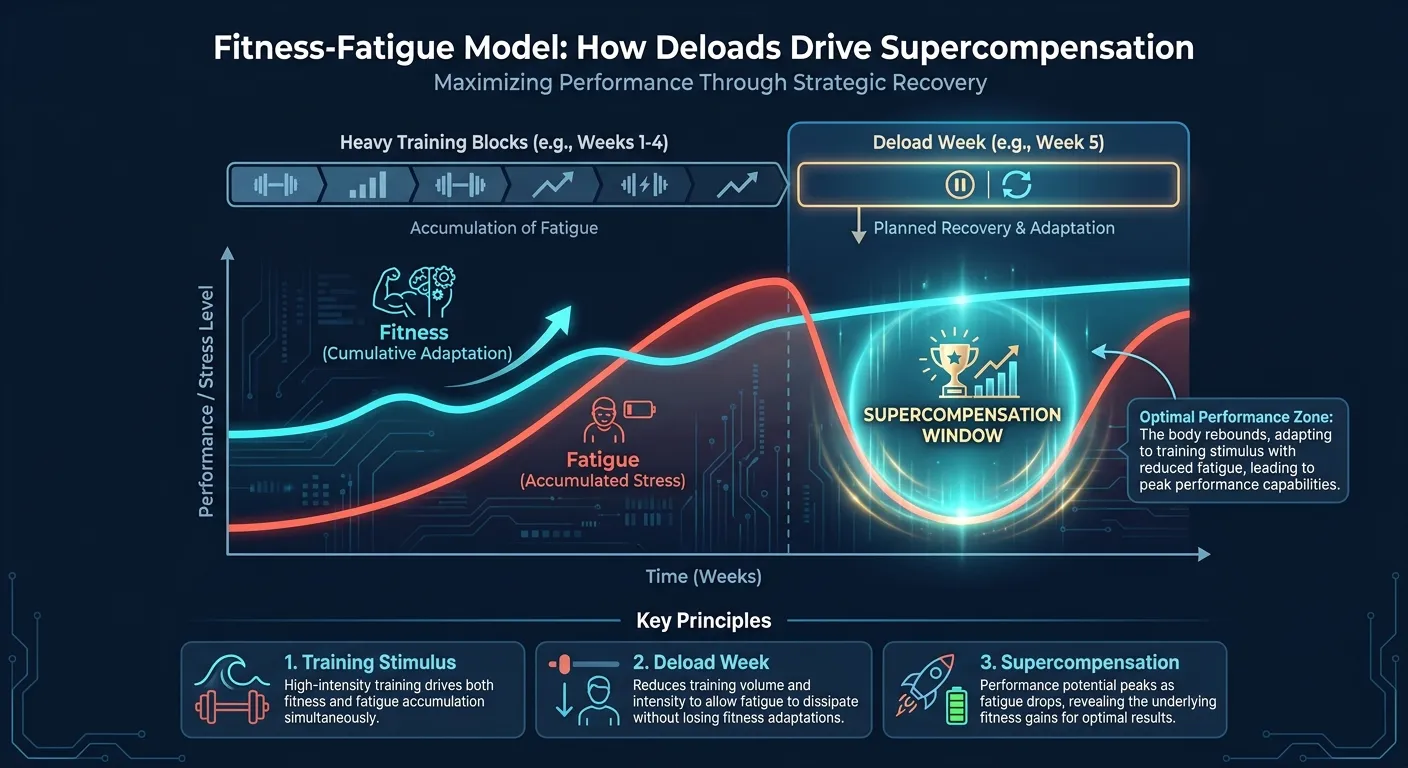
The physiological mechanism is elegantly simple. Murach and Bagley explained it well in their 2015 review, "Less Is More": every training session produces two things simultaneously , fitness (positive adaptations in muscle, cardiovascular system, neural pathways) and fatigue (accumulated stress on those same systems).
Here's the key insight: fatigue dissipates faster than fitness. When you reduce training volume, the fatigue you've been accumulating drops off within days. But the fitness adaptations you've built over weeks of training stick around much longer. The result is a window where your expressed performance , what you can actually do in a workout , jumps above where it was during heavy training.
That's supercompensation. You didn't gain new fitness during the deload. You revealed fitness that was being masked by fatigue.
It's like driving with the parking brake on for weeks, then finally releasing it. Same engine, same fuel, but suddenly you're faster.
Enjoying the article?
Start a new fitness routine today, written by me and coached by the AI I designed.
Take the Free Assessment Free · 2 minutes · No credit cardWhat About Strength Training Specifically?
Most of the classic tapering research comes from endurance sports , runners, swimmers, cyclists. But does the same logic apply if you're lifting weights? Research on inter-set rest periods suggests yes: fatigue accumulates within sessions and between sessions by the same basic mechanism — and managing it produces better results than pushing through it.
Yes. With some nuances.
A 2024 controlled trial published in PeerJ (Coleman et al.) tested what happens when you insert a one-week deload at the midpoint of a 9-week resistance training program. The results: the deload had no negative effect on hypertrophy, power, or local muscular endurance. There was a small difference in lower-body strength that the researchers themselves described as not practically significant.
Translation: you don't lose muscle during a deload week. You don't lose meaningful strength. What you do lose is accumulated fatigue, and that's exactly the point.
The Pritchard data from elite powerlifters confirms this practically. These are people whose entire competitive outcome depends on expressing maximum strength on a single day. They wouldn't reduce volume by 59% before competition if it made them weaker. They do it because it makes them stronger, or more precisely, because it allows them to finally express the strength they'd been building.
Common Misconceptions About Deloads
Misconception: "If I take a week easy, I'll lose my gains"
This is the big one. And the research flatly contradicts it. Muscle protein synthesis remains elevated for 48-72 hours after a training stimulus. One reduced-volume week doesn't undo months of adaptation. The Coleman et al. (2024) trial showed no hypertrophy difference between groups that deloaded and groups that didn't. Your muscles aren't that fragile.
What you will lose is the accumulated neural and systemic fatigue that's been quietly suppressing your performance. That's a trade you want to make.
Misconception: "Deloads are just for advanced athletes"
Actually, beginners might benefit even more. If you're new to training, your body's recovery systems aren't as developed as a seasoned athlete's. You accumulate fatigue faster and have less capacity to train through it. A proactive deload every 4-6 weeks can prevent the "hit a wall" feeling that causes many beginners to quit entirely.
If you've ever been going strong for a month, then suddenly felt exhausted, unmotivated, and like everything was harder than it should be , that's accumulated fatigue talking. A deload would have prevented it.
Misconception: "I should just take the whole week off"
This is the opposite mistake, and the Pritchard data flags it directly. Elite powerlifters reported that taking more than a week completely off training actually hurt performance. The Bosquet meta-analysis found that maintaining training frequency while reducing volume produced the best results.
A deload isn't a vacation from the gym. It's showing up and doing less. Keep the movements. Keep the intensity. Cut the volume. That's it.
The Psychology of Rest (Why This Is Actually Hard)
Let's be honest about why deloads are so difficult to actually do. It's not the physiology. It's the psychology.
Fitness culture has built an identity around effort. Grinding. Pushing through. "No days off." If your self-worth is tied to how hard you trained today, deliberately training less feels like failing. That's not a discipline problem , it's a design problem in how we think about fitness.
The athletes in the Pritchard study didn't feel guilty about their tapers. They planned them. They built them into their programming months in advance. The deload wasn't a sign of weakness. It was a sign they knew what they were doing.
If you've ever quit a fitness app because you burned out after going hard for six weeks straight, you don't need more motivation. You need a program that builds recovery into the plan. One that treats deloads not as failures, but as features.
What the Research Suggests Going Forward
The tapering literature is strong for endurance athletes and increasingly solid for strength athletes. But there are honest gaps.
Most deload research has been done with trained or competitive athletes. We have less direct evidence on recreational exercisers. The people most likely to benefit from structured recovery programming but least likely to have heard of a deload week. The 2024 Coleman et al. trial is a step in the right direction, but more work is needed.
We also don't have great data on individualization , how to know when you specifically need a deload versus following a fixed 4-week or 6-week schedule. Heart rate variability, perceived exertion trends, and performance markers all show promise as indicators, but the research on using these to time deloads in real-time is still emerging.
What we can say with confidence: the principle is well-established. Reducing volume while maintaining intensity for 1-2 weeks produces measurable performance improvements. The optimal timing and magnitude may vary by individual, but the direction of the effect is consistent across every study we reviewed.
How FitCraft Applies This Science
This is exactly the kind of research that shaped how FitCraft works. Ty, your 3D AI personal trainer, doesn't just throw random workouts at you. The programming follows periodization principles drawn directly from this literature.
- Automatic load management , Ty tracks your training volume and performance trends across sessions. When the data suggests accumulated fatigue is building, the program automatically scales back , applying the same volume reduction principles from the Bosquet meta-analysis, personalized to your pattern.
- Intensity maintenance during recovery , During lighter periods, Ty keeps movement quality and difficulty appropriate while reducing overall volume. This matches the research consensus: cut sets, not standards.
- Progressive overload with built-in recovery , The program cycles between build phases and recovery phases, so you never hit the wall of accumulated fatigue that drives most people to quit.
- No guilt for resting , FitCraft's gamification system rewards consistency, not intensity. A deload week still counts toward your streak. Still earns XP. Because the research says that's the smart play.
Programs designed by Domenic Angelino, Ivy League-trained exercise scientist (MPH, Brown University) and NSCA-certified strength coach who studied this exact literature. The free version includes adaptive programming. No paywall required to train smart.
References
- Aubry A, Hausswirth C, Louis J, Coutts AJ, Le Meur Y. "Functional Overreaching: The Key to Peak Performance during the Taper?" Medicine & Science in Sports & Exercise 46.9 (2014): 1769-1777. doi:10.1249/MSS.0000000000000301
- Pritchard HJ, Tod DA, Barnes MJ, Keogh JW, McGuigan MR. "Tapering Practices of New Zealand's Elite Raw Powerlifters." Journal of Strength and Conditioning Research 30.7 (2016): 1796-1804. doi:10.1519/JSC.0000000000001292
- Bosquet L, Montpetit J, Arvisais D, Mujika I. "Effects of Tapering on Performance: A Meta-Analysis." Medicine & Science in Sports & Exercise 39.8 (2007): 1358-1365. doi:10.1249/mss.0b013e31806010e0
- Murach KA, Bagley JR. "Less Is More: The Physiological Basis for Tapering in Endurance, Strength, and Power Athletes." Sports 3.3 (2015): 209-218. doi:10.3390/sports3030209
- Coleman M, Burke R, Augustin F, et al. "Gaining more from doing less? The effects of a one-week deload period during supervised resistance training on muscular adaptations." PeerJ 12 (2024): e16777. doi:10.7717/peerj.16777
Frequently Asked Questions
What is a deload week and why does it work?
A deload week is a planned period of reduced training volume, typically lasting about 7 days, designed to allow accumulated fatigue to dissipate while maintaining fitness. It works because the body adapts to training stress during recovery, not during the training itself. Research by Bosquet et al. (2007) found that reducing training volume by 41-60% while maintaining intensity produces an average 2-3% performance improvement.
How often should you take a deload week?
Most evidence and coaching consensus suggests deloading every 4-6 weeks, though the optimal frequency depends on training intensity, volume, and individual recovery capacity. An international Delphi consensus study found that experienced coaches typically program deloads every 4-6 weeks for a period of approximately 7 days, reducing volume through fewer sets or repetitions.
Should you reduce weight or reps during a deload?
Research consistently shows you should reduce volume (sets and reps) while maintaining intensity (weight on the bar). Pritchard et al. (2016) found elite powerlifters reduce volume by approximately 59% during tapers while keeping intensity near competition levels. Bosquet et al. (2007) confirmed that reducing intensity during a taper actually diminishes the performance benefit.
Can you lose muscle or strength during a deload week?
No. One week of reduced training does not cause meaningful muscle loss or strength loss. A 2024 controlled trial published in PeerJ found that a one-week deload at the midpoint of a 9-week program had no negative effect on hypertrophy, power, or muscular endurance. Any small differences in strength were not practically significant.
Does FitCraft program deload weeks automatically?
Yes. FitCraft's AI coach Ty monitors your training volume and performance trends, then automatically scales back intensity when the data suggests accumulated fatigue is building. This applies the same periodization principles from the tapering research, personalized to your recovery patterns and schedule. The free version includes this adaptive programming.